The Moon Society has published the Moon Miners Manifesto since 1986. Below is the cover of the latest issue. Membership is required to access recent issues. There is free access to the Moon Miners’ Manifesto Classics Volumes.
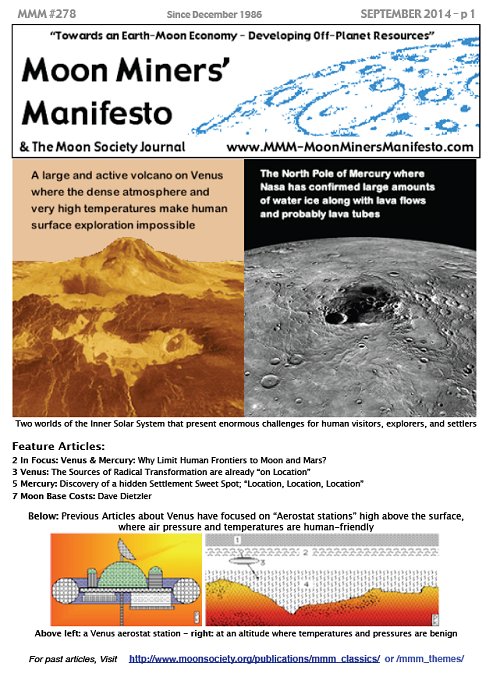
The Moon Society has published the Moon Miners Manifesto since 1986. Below is the cover of the latest issue. Membership is required to access recent issues. There is free access to the Moon Miners’ Manifesto Classics Volumes.
Submit a prediction about the future of spaceflight. along with an image, and it may be chosen to ride on the Bennu asteroid aboard the OSIRIS-REx probe in a TimeCapsule that will be opened after the spacecraft returns with samples of the asteroid in 2023: Submit Predictions to Fly in an Asteroid Time Capsule – The Planetary Society.
More in this NASA announcement:
NASA Invites Public to Submit Messages for Asteroid Mission Time Capsule
NASA is inviting the worldwide public to submit short messages and images on social media that could be placed in a time capsule aboard a spacecraft launching to an asteroid in 2016.
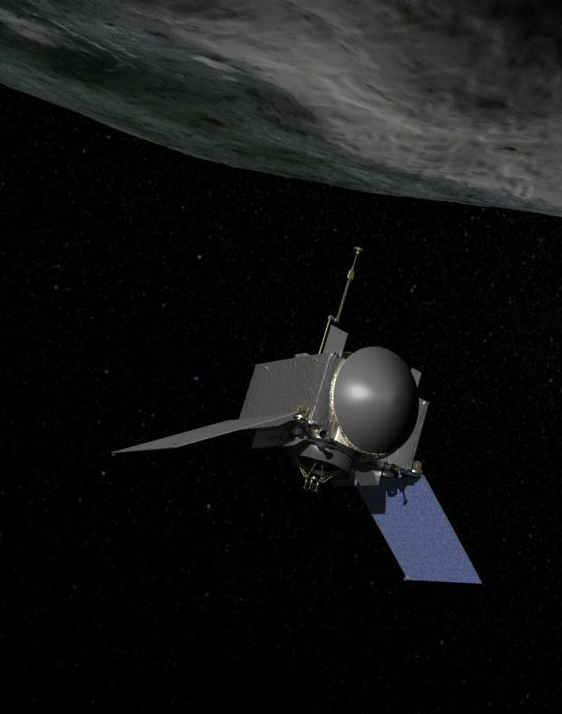
Called the Origins-Spectral Interpretation-Resource Identification-Security-Regolith Explorer (OSIRIS-REx), the spacecraft will rendezvous with the asteroid Bennu in 2019, collect a sample and return the cache in a capsule to Earth in 2023 for detailed study. The robotic mission will spend more than two years at the 1,760-foot (500-meter)-wide asteroid and return a minimum of 2 ounces (60 grams) of its surface material.
Topics for submissions by the public should be about solar system exploration in 2014 and predictions for space exploration activities in 2023. The mission team will choose 50 tweets and 50 images to be placed in the capsule. Messages can be submitted Sept. 2 – 30.
“Our progress in space exploration has been nothing short of amazing,” says Dante Lauretta, OSIRIS-REx principal investigator at the University of Arizona, Tucson. “I look forward to the public taking their best guess at what the next 10 years holds and then comparing their predictions with actual missions in development in 2023.”
This event is the second of NASA’s efforts to engage space enthusiasts around the world in the OSIRIS-REx mission, following the agency’s January invitation to participate in Messages to Bennu, which asked the public to submit their names to be etched on a microchip aboard the spacecraft.
“It is exciting to think that some people may formulate predictions then have the chance to help make their prediction a reality over the next decade,” said Jason Dworkin, OSIRIS-REx project scientist at NASA’s Goddard Space Flight Center in Greenbelt, Maryland.
When the sample return capsule returns to Earth in 2023 with the asteroid material, the mission team will open the time capsule to view the messages and images, at which time the selected submissions will be posted online at:
www.asteroidmission.org/timecapsule
“OSIRIS-REx has to take many years to perform a complex asteroid sample return,” said Bruce Betts, the director of science and technology at The Planetary Society in Pasadena, California, a public outreach partner on the asteroid mission. “A time capsule capitalizes on the long duration of the mission to engage the public in thinking about space exploration — where are we now, and where will we be.”
The OSIRIS-REx mission is focused on finding answers to basic questions about the composition of the very early solar system and the source of organic materials and water that made life possible on Earth. The mission also will contribute to NASA’s Asteroid Redirect Mission (ARM) and support the agency’s efforts to understand the population of potentially hazardous near-Earth objects and characterize those suitable for future asteroid exploration missions.
NASA’s ARM is a first-ever mission to identify, capture and redirect a near-Earth asteroid to a stable orbit around the moon, where astronauts will explore it in the 2020s, and return with samples. The mission will advance the new technologies and spaceflight experience needed for humans to explore Mars in the 2030s.
NASA’s Goddard Space Flight Center will provide overall mission management, systems engineering and safety and mission assurance. The University of Arizona, Tucson, is the principal investigator institution. Lockheed Martin Space Systems of Denver will build the spacecraft. OSIRIS-REx is the third mission in NASA’s New Frontiers Program. NASA’s Marshall Space Flight Center in Huntsville, Alabama, manages New Frontiers for NASA’s Science Mission Directorate in Washington.
For details on procedures and rules for submitting a message and image, visit: www.asteroidmission.org/timecapsule
More information is available online about Messages to Bennu, at: www.planetary.org/get-involved/messages/bennu/
For more about the OSIRIS-REx mission, visit: www.nasa.gov/osiris-rex
Mike Simmons, founder and president of Astronomers Without Borders, was interviewed on the Space Show last Friday: Mike Simmons, Friday, 8-29-14 – Thespaceshow’s Blog
During our 61 minute discussion, Mr. Simmons started out by introducing us to Astronomers Without Borders and visits to Iran and Iraq. He talked about astronomy as a cultural connection among nations and peoples, especially with young and well educated people around the world. We discussed the organization and total eclipse tours, trips, and other astro tourism projects. He mentioned the organization’s Monthly Hangout which is a Google Plus monthly meeting with guests which you can find on YouTube.
Our guest talked about the Mt. Wilson Observatory in Los Angeles and several listeners asked him about visiting the famous observatory. The same for Mt. Palomar which is still in use and also in S. California. Joe asked about the best age to introduce children to astronomy. Mike then told us about telescopes and pointed us to basic telescopes his organization sells for those interested. Seehttp://store.astronomerswithoutborders.org.
Listeners asked Mike about their participation in Uwingu programs, specifically the Beam Me to Mars program. We learned that the organization has been a beneficiary of Uwingu grants. Listeners asked about night viewing, light pollution and dark skies programs. Paul sent in a question inquiring about astronomy and the connection to space exploration & development which are major themes for The Space Show. This provoked an interesting discussion with our guest.
Near the end of our discussion, Mike talked about astronomy in the arts including astro crafts, astro poetry, space artists, and more.
—-
Here is a recent announcement about one of their projects, for which they are raising funding on Indiegogo:
The future of children’s science education in Tanzania is
looking brighter than ever.
http://vimeo.com/89799690
Telescopes to Tanzania’s campaign to bring quality science education to the children of the East African nation is off to a fantastic start by raising $11,000 and successfully completing its first phase of building The Center for Science Education and Observatory.
To build on this momentum and share our project with the world we are launching our next phase on Indiegogo – the web’s largest crowd-funding platform.
Your generous support has already been put to work by funding a pioneering Curriculum Development Workshop, just completed in June 2014 in Tanzania. Attended by all the regional stakeholders – science teachers, school administrators, scientists and government officials – the conference laid the foundation for the development of a national science curriculum integrated with astronomy concepts and applications. Those gathered at the four-day meeting in Usa River, near Arusha, were able to create the core structure of a space science model for advancing the development of inquiry-based science education in Tanzania.
Once completed, The Center for Science Education and Observatory will become a Tanzanian hub that will have a long-lasting impact nationwide by training teachers, offering hands-on laboratories (including an astronomical observatory), and providing quality educational resources.
The gateway to the development of Tanzania’s own STEM curriculum has been opened, and the groundwork has been laid to begin the next critical phase of our campaign.
We invite you to visit our official fundraising campaign website on Indiegogo. And in exchange for your support we are offering a wonderful line-up of rewards that will surely remain a lasting keepsake.
To thank all of our donors who are helping make this project possible we have created a Thank You Wall.
![20140630013044-Meru_girl_cropped[1]](http://hobbyspace.com/Blog/wp-content/uploads/2014/08/20140630013044-Meru_girl_cropped1-243x300.jpg)
A Standard 6 student looks through a telescope for the first
time during a science workshop at Kalinga Primary School
in northern Tanzania
Dennis Wingo gives an update on the ISEE-3 reboot satellite project, including what it accomplished and what they hope to do next : ISEE-3 Post Lunar Flyby Status and Modification of Mission Goals – denniswingo
Mission Status
Communication with the ISEE-3 satellite was successfully re-established with the goal of commanding the satellite to change its trajectory with the goal of putting it into a libration point orbit that would allow it to resume its original mission goals of collecting data for solar physics research. The trajectory change goal unfortunately could not be completed due to the failure of the onboard thrusters. This failure was apparently the result of the loss of nitrogen pressurant in the Hydrazine fuel system.
This inability to change the spacecraft’s orbit rules out the original reboot mission goals which would have provided long-term data collection from the satellite instrumentation package using modest antennas. After the orbit change attempt, the ISEE-3 Reboot Team powered on the instrumentation package and began data collection from the instruments to assess their current physical status and usefulness for any ongoing scientific mission.
We are now redefining our mission goals to obtain the maximum scientific usefulness of ISEE-3 in its new interplanetary orbit. Figure 1 shows the flyby orbit and the long-term sun centered (heliocentric) orbit.
He reviews the trajectory of the spacecraft in the coming years, the health of the spacecraft, and what sort of science might be done with it, particularly with public citizen science involvement.
What’s Next
So expect to see more from us in the very near future. After the rush of the flyby we took a bit of a break but we are moving forward with the new “ISEE-3 Interplanetary Citizen Science Mission”. As soon as we have the real time display systems and reliable ground station communications support we will start putting more data out to be seen. We cannot sufficiently express our appreciation to the ground stations that have helped us make this a reality. Arecibo, our national treasure, in Puerto Rico. The Bochum Radio Observatory in Germany, our reliable friends and the ground station that first got us interested in ISEE-3. Morehead state in Kentucky has provided crucial support for transmitting to the bird of late. And the SETI Institute has been listening in as well. We are working to increase this list, but without these folks and their dishes, this would not have happened…
More at
Alan Stern, principle investigator for the New Horizons mission to Pluto and head of Uwingu, spoke on The Space Show last weekend: Dr. Alan Stern, Sunday, 8-24-14 | Thespaceshow’s Blog.
Listen to the audio:
He discussed the status of the New Horizons spacecraft, which just passed by Neptune, and its fly-by of Pluto next summer. He also talked about Uwingu’s public participation programs including the new Beam Me To Mars activity.