Category Archives: Space participation

Participate in “Train Like a Martian Challenge” sponsored by Mars Generation

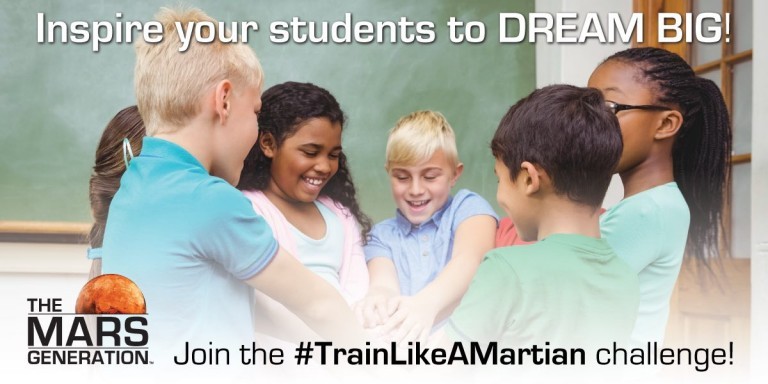
The Mars Generation is sponsoring a competition and activities event for students and educators called Train Like A Martian Challenge:

Join Us For Our 3rd Annual #TrainLikeAMartian Challenge
May 14-18, 2018

Sign up now and join us for our third annual #TrainLikeAMartian event! We expect that the event will be a blast! Anyone can join including individuals, students, teachers, schools, sports teams, community organizations and anyone who wants to get involved. For educator resources to plan for the event please click here.

What is the #TrainLikeAMartian challenge? The #TrainLikeAMartian Challenge is a week of fun activities that brings awareness to the importance of science, technology, engineering, arts, and math (STEAM) education, space exploration, and physical fitness to students and adults around the world! This is a chance to have fun, spread an important message, and have a opportunity to win some cool space and STEM prizes May 14-18, 2018!

Daily prizes include: TMG magnets, TMG logo patches, TMG stickers, Astronaut Abby patches, TMG coloring books and more! We will hold multiple random drawings of all entries each day of the event May 14-May 18, 2018.

Grand prizes include: 

Arckit A180 The Architectural Model Design Tool (4 lucky winners) $170.00 Value: The Arckit 180 provides everything you need to design and build your own impressive model structures up to 180 sq.m (1,937 sq.ft) to scale, including adhesive sheets to add realistic building finishes. There are no set instructions – just follow your imagination!

Lottie Doll Supreme Play Package (1 lucky winner): 1 Star Gazer doll,1 Muddy Puddles doll, and 1 Wildlife Photography doll, 1 Doll Treehouse, and 1 Astro Adventure Suit.

1 Lottie Doll of Winner’s Choice plus 1 Astro Adventure Suit (3 lucky winners) 

Grand prize drawing will be after the event. Winners will be chosen by random drawing of all entries throughout the event.

Constellation Community Challenge: Our event sponsors:  United Launch Services (ULA), Lottie Dolls, Arckit, Indulge Sweets, Aerojet Rocketdyne and  Classform.com have joined forces to offer a $10,000 matching challenge grant to our community. Please help us earn this $10,000 challenge grant by becoming part of our constellation community by donating today! Every donation up to $10,000 is matched 100%! Donate now here!

All donations through May 18, 2018 will be doubled up to $10,000! Click here for details.

This means we have the potential to raise $20,000 for The Mars Generation programs including sending students who lack financial resources to Space Camp! Donating is not required to participate in the challenge, but for every $25 donated you will receive on entry into the daily and grand prize drawings. Click here to donate.

Want to earn special rewards? Become a fundraiser for The Mars Generation Train Like A Martian challenge for a chance to earn exclusive rewards. Scroll to the bottom fo the page for all fundraising rewards. Fundraising is not required to participate in the challenge.

====

Continue to the Train Like A Martian Challenge website for more details about the competition including how to enter…

See also Train Like A Martian Challenge For Classrooms and Schools.
Videos: TMRO Orbit 11.15 – “Rod Pyle’s Amazing Stories of the Space Age”

The latest episode of TMRO.tv is now available in the archive: Rod Pyle’s Amazing Stories of the Space Age – Orbit 11.15 – TMRO

Author Rod Pyle joins us to talk about many topics including the Space 2.0 Revolution, International Space Development Conference and how to build a Death Star.

Launches and news topics covered:

Launches:
Long March 4C Launches Yaogan-31 Trio
PSLV-XL Launches IRNSS-1I

News:
Orion Span Announces Plan for Space Hotel
Elon Musk Posts Picture of BFR layup tool
New Lunar Tour from LRO (https://www.youtube.com/watch?v=nr5Pj…)
Tiangong 1 Burns Up on Re-entry over Pacific

TMRO is viewer supported:

TMRO shows are crowd funded. If you like this episode consider contributing to help us to continue to improve. Head over to http://www.patreon.com/tmro for per-episode contribution or http://www.makersupport.com/tmro or monthly contributions and reward information.

TMRO short reports:

====

Yuri’s Night – World Space Party : Celebrate “humanity’s past, present, and future in space”

The annual Yuri’s Night – World Space Party happens this week in honor of the first human – Yuri Gagarin – to go into space on April 12, 1961.

Yuri’s Night is the World Space Party. We hope to see you dream, explore, and celebrate with us at the hundreds of YN events held around the world each April.

“Circling the Earth in my orbital spaceship I marveled at the beauty of our planet. People of the world, let us safeguard and enhance this beauty — not destroy it!”  — Yuri Gagarin, 1st human in space.

Find a party near you at yurisnight.net/events/

Here is a message from the National Space Society about the global event:

The National Space Society has teamed with Yuri’s Night!

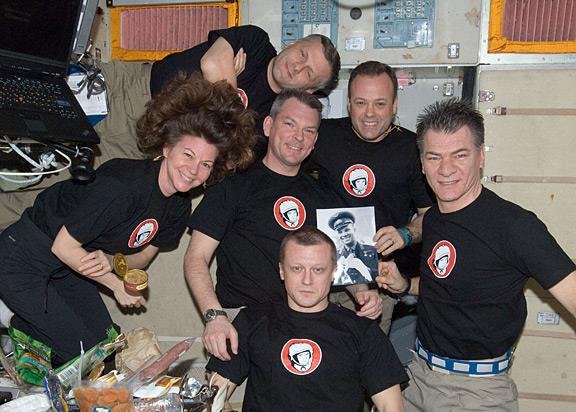
The crew of Expedition 27 celebrates Yuri’s Night aboard the International Space Station in 2011

The National Space Society invites you to celebrate Yuri’s Night in your local area. Yuri’s Night is a global celebration of humanity’s past, present, and future in space. Yuri’s Night parties and events are held around the world every April in commemoration of Yuri Gagarin becoming the first human to venture into space on April 12, 1961, and the inaugural launch of the first Space Shuttle on April 12, 1981.

Yuri’s Night events combine space-themed partying with education and outreach. These events can range from an all-night mix of techno and technology at a NASA Center, to a movie showing and stargazing at your local college, to a gathering of friends at a bar or barbecue.

In 2011, the 50th anniversary of human spaceflight, over 100,000 people attended 567 officially-recognized events in 75 countries on all 7 continents, while tens of thousands more watched the 12-hour live Yuri’s Night Global Webcast and participated online in the virtual world of Second Life.

The list of North American events this year can be accessed at https://yurisnight.net/events/#north_america

Yuri’s Night would like to thank the National Space Society for helping make Yuri’s Night in Los Angeles on April 7 the best event ever in the long history of Los Angeles Yuri’s Nights. The massive dance under the space shuttle Endeavour was truly awesome. (For details see www.la.yurisnight.net.)

This is just the beginning! On April 13 the Yuri’s Night celebration will rock the Space Coast in Florida with a dance under the Space Shuttle Atlantis. Help the National Space Society make this party one for the history books.

For more information and to get tickets see www.la.yurisnight.net/spacecoast.

Chantelle Baier
Director, National Space Society
Event Coordinator, Yuri’s Night

Send your name to the Sun on the Parker Solar Probe

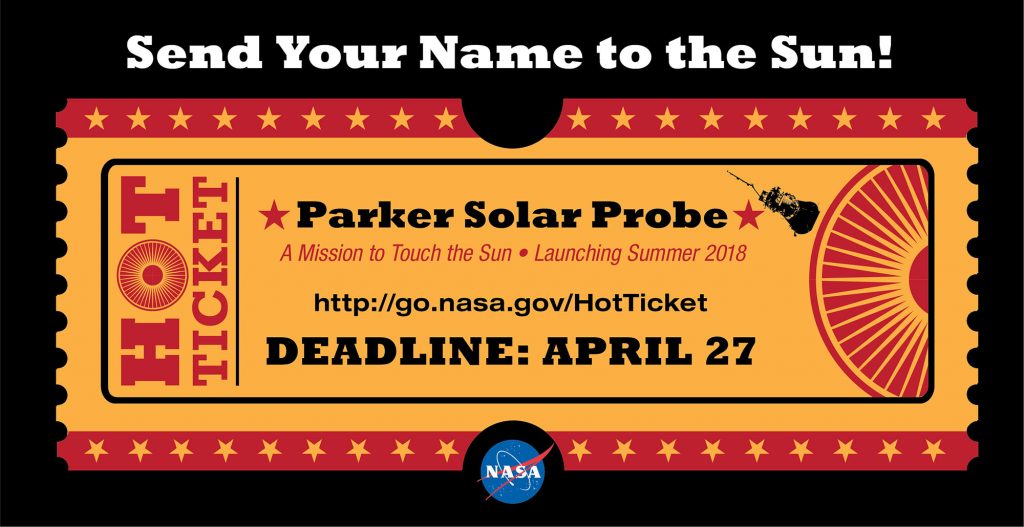
NASA’s Parker Solar Probe mission offers you the opportunity to launch your name this summer on a spaceship heading for the sun :

Public Invited to Come Aboard NASA’s First Mission to Touch the Sun

Want to get the hottest ticket this summer without standing in line?

NASA is inviting people around the world to submit their names online to be placed on a microchip aboard NASA’s historic Parker Solar Probe mission launching in summer 2018. The mission will travel through the Sun’s atmosphere, facing brutal heat and radiation conditions — and your name will go along for the ride.

“This probe will journey to a region humanity has never explored before,” said Thomas Zurbuchen, the associate administrator for the Science Mission Directorate at NASA Headquarters in Washington. “This mission will answer questions scientists have sought to uncover for more than six decades.”

Understanding the Sun has always been a top priority for space scientists. Studying how the Sun affects space and the space environment of planets is the field known as heliophysics. The field is not only vital to understanding Earth’s most important and life-sustaining star, it supports exploration in the solar system and beyond.

Submissions will be accepted until April 27, 2018. Learn more and add your name to the mission here: http://go.nasa.gov/HotTicket 

Star Trek’s William Shatner, on behalf of NASA, invites you to send your name where it’s never gone before: the Sun, by way of NASA’s Parker Solar Probe. Credits: NASA’s Goddard Space Flight Center/Rich Melnick

The spacecraft, about the size of a small car, will travel directly into the Sun’s atmosphere about 4 million miles from the star’s surface. The primary science goals for the mission are to trace how energy and heat move through the solar corona and to explore what accelerates the solar wind as well as solar energetic particles. The mission will revolutionize our understanding of the Sun, where changing conditions can spread out into the solar system, affecting Earth and other worlds.

To perform these unprecedented investigations, the spacecraft and instruments will be protected from the Sun’s heat by a 4.5-inch-thick carbon-composite shield, which will need to withstand temperatures outside the spacecraft that reach nearly 2,500 F. This state-of-the-art heat shield will keep the four instrument suites designed to study magnetic fields, plasma and energetic particles, and image the solar wind at room temperature.

The spacecraft speed is so fast, at its closest approach it will be going at approximately 430,000 mph. That’s fast enough to get from Washington, D.C., to Tokyo in under a minute.

“Parker Solar Probe is, quite literally, the fastest, hottest — and, to me, coolest — mission under the Sun,” said project scientist Nicola Fox, of the Johns Hopkins Applied Physics Laboratory. “This incredible spacecraft is going to reveal so much about our star and how it works that we’ve not been able to understand.”

Honoring a Science Legend

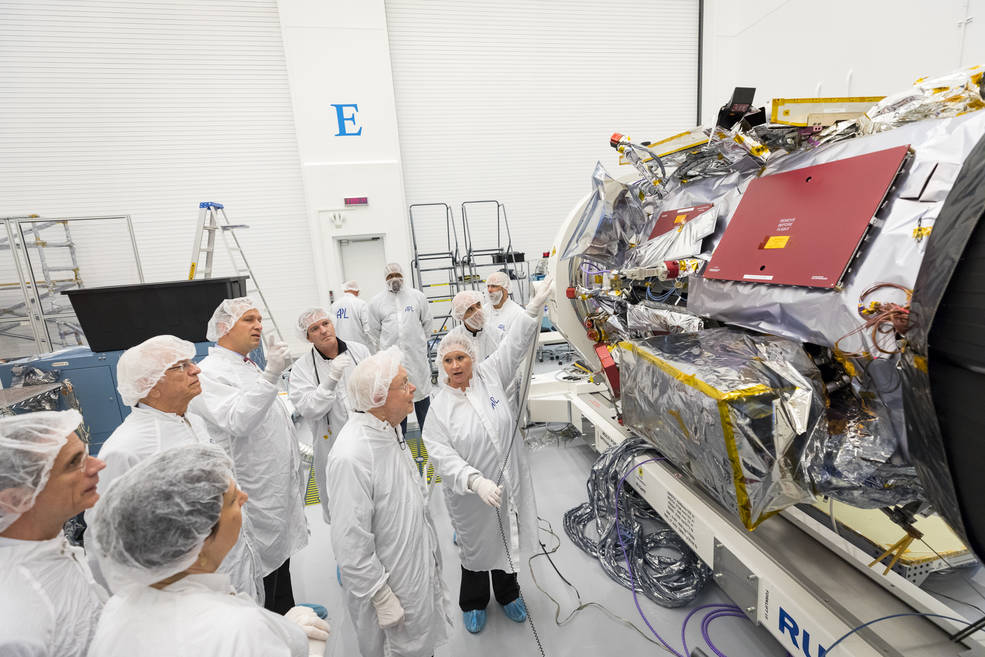
Eugene Parker, professor emeritus at the University of Chicago, visits the spacecraft that bears his name, NASA’s Parker Solar Probe, on Oct. 3, 2017. Engineers in the clean room at the Johns Hopkins Applied Physics Laboratory in Laurel, Maryland, where the probe was designed and built, point out the instruments that will collect data as the mission travels directly through the Sun’s atmosphere. Credits: NASA/Johns Hopkins University Applied Physics Laboratory

In May 2017, NASA renamed the spacecraft from the Solar Probe Plus to the Parker Solar Probe in honor of astrophysicist Eugene Parker. The announcement was made at a ceremony at the University of Chicago, where Parker serves as the S. Chandrasekhar Distinguished Service Professor Emeritus, Department of Astronomy and Astrophysics.

This was the first time NASA named a spacecraft for a living individual.

NASA missions are most often renamed after launch and certification. In this case, given Parker’s accomplishments within the field, and how closely aligned this mission is with his research, the decision was made to honor him prior to launch, in order to draw attention to his important contributions to heliophysics and space science.

In the 1950s, Parker proposed a number of concepts about how stars — including our Sun — give off energy. He called this cascade of energy the solar wind, and he described an entire complex system of plasmas, magnetic fields and energetic particles that make up this phenomenon. Parker also theorized an explanation for the superheated solar atmosphere, the corona, which is — contrary to what was expected by physics laws — hotter than the surface of the Sun itself. Many NASA missions have continued to focus on this complex space environment defined by our star.

Parker Solar Probe is part of NASA’s Living with a Star Program, or LWS, to explore aspects of the Sun-Earth system that directly affect life and society. LWS is managed by the NASA’s Goddard Space Flight Center in Greenbelt, Maryland, for NASA’s Science Mission Directorate in Washington. The Johns Hopkins Applied Physics Laboratory, in Laurel, Maryland, manages the Parker Solar Probe mission for NASA. APL is designing and building the spacecraft and will also operate it.

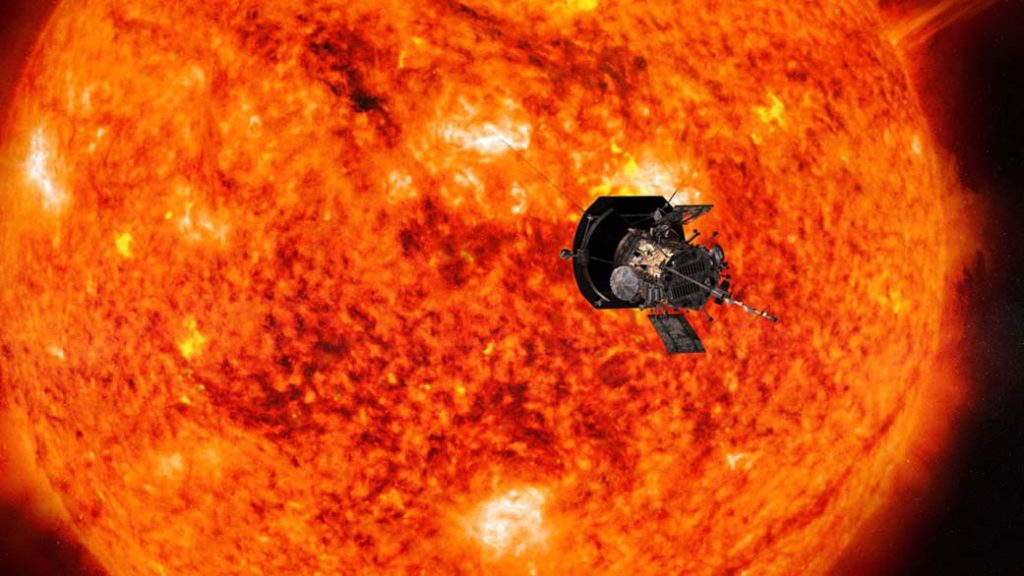
Illustration of the Parker Solar Probe spacecraft approaching the Sun.
Credits: Johns Hopkins University Applied Physics Laboratory

====

NASA’s GLOBE Clouds App: Observe clouds for fun and science

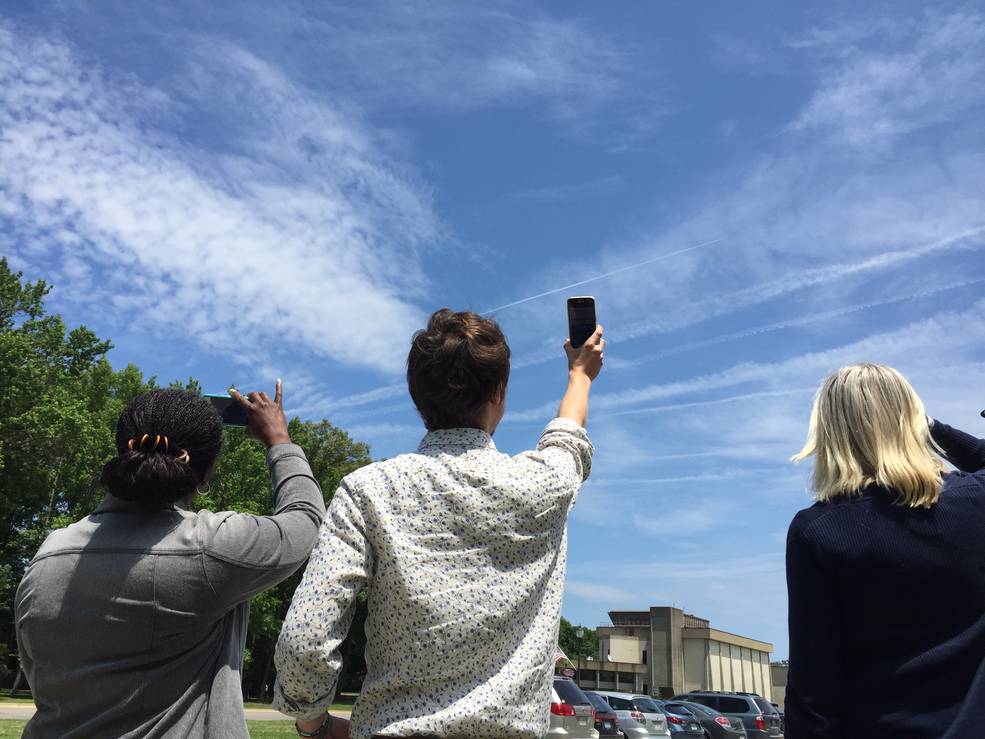
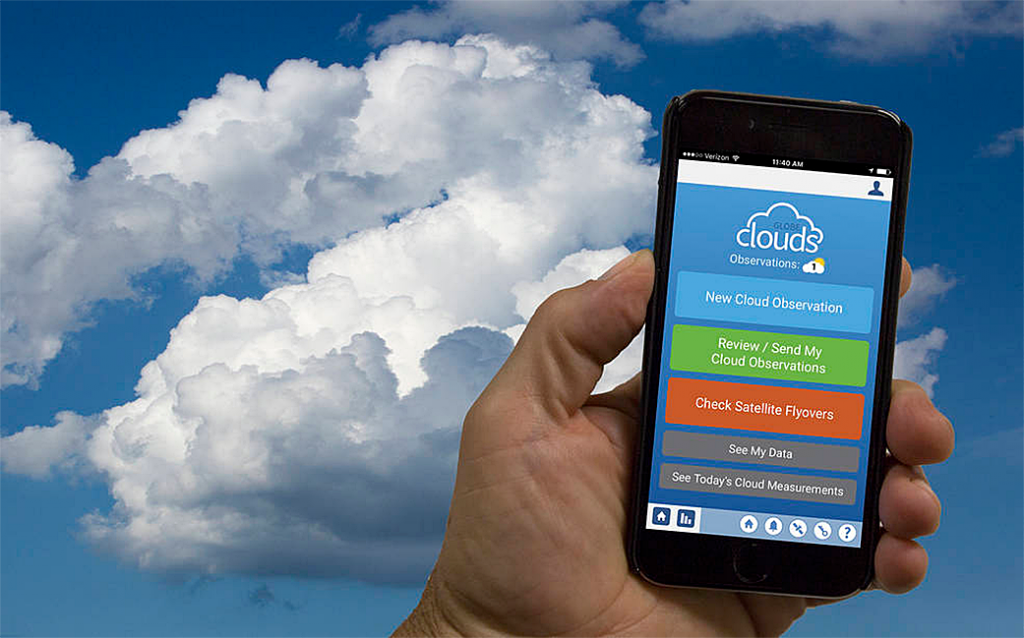
Participate in NASA’s GLOBE Clouds program and have a great excuse to go outside on spring days and gaze at the clouds. Researchers working with the Clouds and the Earth’s Radiant Energy System (CERES) recently installed on the International Space Station need to calibrate what the sensors observe with what the clouds look like from the ground. You can help out as a citizen scientist by downloading the GLOBE Clouds app for your smartphone and whenever you are outside use it to capture pictures of the clouds currently in view. The program invites participants to enter up to 10 cloud observations per day from March 15, 2018 to April 15, 2018.

More details at

And here is the announcement from NASA:

Calling All Cloud Gazers: NASA Needs Your Help!

It’s almost spring, the time of year when the looming change in seasons could lead to some pretty fascinating cloud activity in the sky. NASA and the GLOBE Program are asking for your help by taking part in a citizen science cloud observation challenge.

During the GLOBE cloud observation challenge, citizen scientists of all ages can make up to 10 cloud observations per day using the GLOBE Observer app or one of the other data entry options (for trained GLOBE members). Credits: NASA/Jessica Taylor

From March 15 through April 15, citizen scientists of all ages can make up to 10 cloud observations per day using the GLOBE Observer app or one of the other data entry options (for trained GLOBE members). Challenge participants with the most observations will be congratulated by a NASA scientist in a video posted on the GLOBE Program’s website and on social media.

“The GLOBE Program is offering this challenge to show people how important it is to NASA to have citizen scientist observations; observations from the ground up,” said Marilé Colón Robles, lead for the GLOBE Clouds team at NASA’s Langley Research Center in Hampton, Virginia. “We’re going from winter to spring, so the types of storms will change, which will also change the types of clouds.”

Researchers use, and value, this citizen science cloud data because it helps to validate data from Earth-observing instruments. Scientists at Langley work with a suite of six instruments known as the Clouds and the Earth’s Radiant Energy System (CERES).

The GLOBE Observer app.

Even though CERES’ instruments use advanced technology, it is not always easy for researchers to positively identify all types of clouds in their images. For example, it can be difficult to differentiate thin, wispy cirrus clouds from snow since both are cold and bright; even more so when cirrus clouds are above a surface with patchy snow or snow cover. One solution to this problem is to look at satellite images from a particular area and compare them to data submitted by citizen scientists on the ground.

“Looking at what an observer recorded as clouds and looking at their surface observations really helps us better understand the images that were matched from the satellite,” said Colón Robles.

Citizen science observations are especially needed now because scientists are starting to verify data from a new CERES instrument. CERES FM6 launched to orbit Nov. 18, 2017 and began taking measurements Jan. 5.

You don’t have to be a cloud-gazing pro to participate. For those who want to be part of the challenge but don’t have a lot of experience identifying clouds, Colón Robles offers the following advice: “Just go outside.” The more clouds you observe, she said, the more comfortable you’ll be collecting data.

  • Read more about the challenge here.
  • Find tips for making good cloud observations here.
 NASA sponsors the GLOBE Program. The GLOBE Program is an international science and education program that provides students and the public with the opportunity to participate in data collection and the scientific process. NASA GLOBE Observer is a free smartphone app that lets anybody make citizen science observations from the palm of their hand.