NASA JPL provides this preview of the night sky for June:
NASA JPL provides this preview of the night sky for June:
Here are four telescope tutorials from TMRO.tv Space Pod correspondent Jared Head
TMRO is a crowd funded show. If you like this episode consider contributing to help us to continue to improve. Head over tohttp://www.patreon.com/tmro for information, goals and reward levels.
* Refractor vs. Reflector: Telescopes – Space Pod 04/24/15
Are you a space geek looking to also become an astronomy geek? Space Pod correspondent Jared Head walks you through two of the most common types of telescopes and what each means. What is right for you? Keep watching Fridays for Jared’s segments to find out!
* Through the Looking Glass: Refractors – Space Pod 05/08/15
TMRO Astronomer Jared Head kicks off a 4-part SpacePod series about finding the right telescope, and takes a closer look at refracting telescopes.
* Mirror Mirror: Reflectors – Space Pod 05/15/15
Astronomer of TMRO Jared Head continues with the second part of a four-part series on telescopes. He goes into details about the lightbucket telescope design of reflectors.
* Telescope Cats!…Catadioptrics – Space Pod 05/22/15
TMRO Astronomer Jared Head continues with the third installment in a four-part series on telescopes, looking into the weird and wonderful world of catadioptric telescopes.
A new finding from the ESO (European Southern Observatory):
Astronomers using ESO’s Very Large Telescope in Chile have captured the most detailed image ever taken of the Medusa Nebula. As the star at the heart of this nebula made its transition into retirement, it shed its outer layers into space, forming this colourful cloud. The image foreshadows the final fate of the Sun, which will eventually also become an object of this kind.
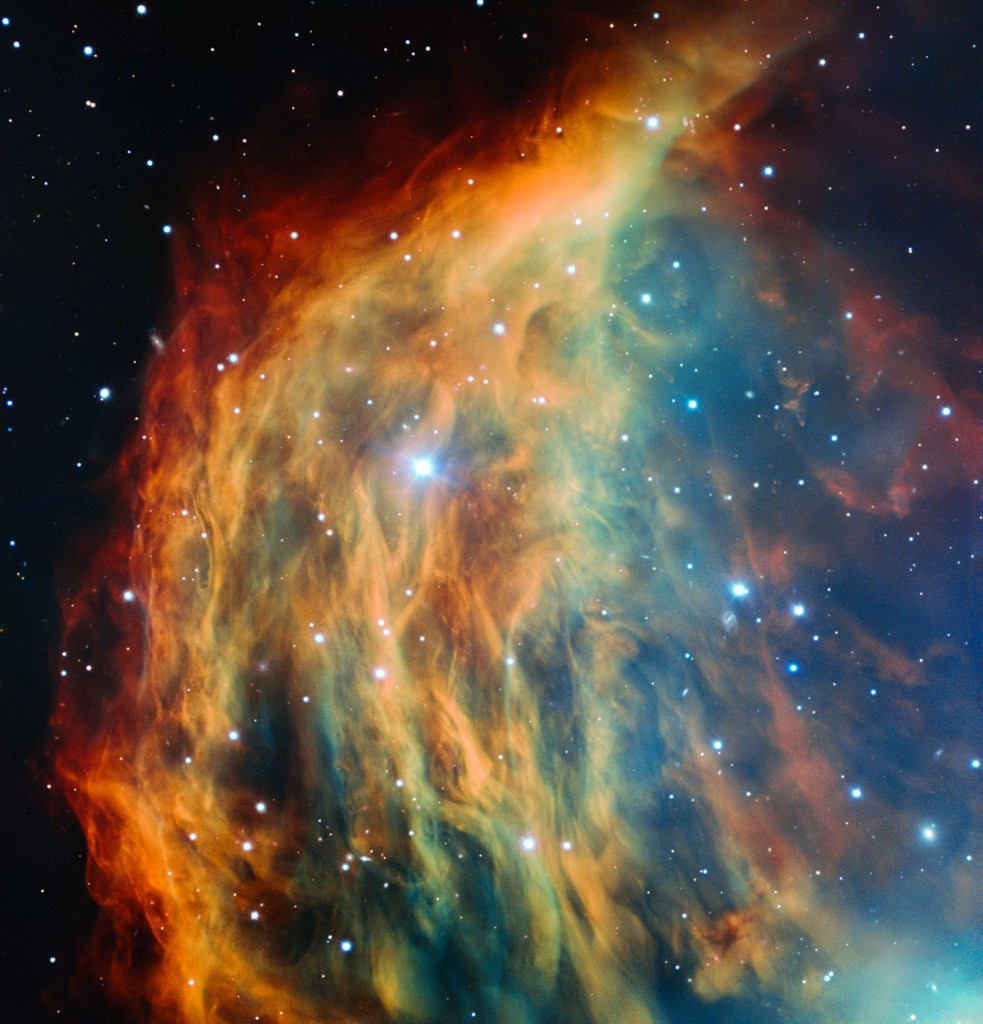
ESO’s Very Large Telescope in Chile has captured the most detailed image ever taken of the Medusa Nebula (also known Abell 21 and Sharpless 2-274). As the star at the heart of this nebula made its final transition into retirement, it shed its outer layers into space, forming this colourful cloud. The image foreshadows the final fate of the Sun, which will eventually also become an object of this kind. Credit ESO.
This beautiful planetary nebula is named after a dreadful creature from Greek mythology — the Gorgon Medusa. It is also known as Sharpless 2-274 and is located in the constellation of Gemini (The Twins). The Medusa Nebula spans approximately four light-years and lies at a distance of about 1500 light-years. Despite its size it is extremely dim and hard to observe.
Medusa was a hideous creature with snakes in place of hair. These snakes are represented by the serpentine filaments of glowing gas in this nebula. The red glow from hydrogen and the fainter green emission from oxygen gas extends well beyond this frame, forming a crescent shape in the sky. The ejection of mass from stars at this stage of their evolution is often intermittent, which can result in fascinating structures within planetary nebulae.
For tens of thousands of years the stellar cores of planetary nebulae are surrounded by these spectacularly colourful clouds of gas [1]. Over a further few thousand years the gas slowly disperses into its surroundings. This is the last phase in the transformation of stars like the Sun before ending their active lives as white dwarfs. The planetary nebula stage in the life of a star is a tiny fraction of its total life span — just as the time a child takes to blow a soap bubble and see it drift away is a brief instant compared to a full human life span.
Harsh ultraviolet radiation from the very hot star at the core of the nebula causes atoms in the outward-moving gas to lose their electrons, leaving behind ionised gas. The characteristic colours of this glowing gas can be used to identify objects. In particular, the presence of the green glow from doubly ionised oxygen ([O III]) is used as a tool for spotting planetary nebulae. By applying appropriate filters, astronomers can isolate the radiation from the glowing gas and make the dim nebulae appear more pronounced against a darker background.
When the green [O III] emission from nebulae was first observed, astronomers thought they had discovered a new element that they dubbed nebulium. They later realised that it was simply a rare wavelength of radiation [2] from an ionised form of the familiar element oxygen.
The nebula is also referred to as Abell 21 (more formally PN A66 21), after the American astronomer George O. Abell, who discovered this object in 1955. For some time scientists debated whether the cloud could be the remnant of a supernova explosion. In the 1970s, however, researchers were able to measure the movement and other properties of the material in the cloud and clearly identify it as a planetary nebula [3].
This image uses data from the FOcal Reducer and low dispersion Spectrograph (FORS) instrument attached to the VLT, which were acquired as part of the ESO Cosmic Gems programme [4].

Here is a collection of recent TMRO.tv Space Pod video reports. Note that
TMRO Space Pods are crowd funded shows. If you like [these episodes] consider contributing to help us to continue to improve. Head over to http://www.patreon.com/spacepod for information, goals and reward levels. Don’t forget to check out our weekly live show campaign as well over at http://www.patreon.com/tmro
* Why is there no cold beer in space!? – Space Pod 05/06/15
From wet burps to breaking the rules, Lisa Stojanovski talks about the different fridges on the International Space Station and why none of them are stocked with beer.
* NASA is STILL Doing Amazing Things – Space Pod 05/05/15
NASA is still doing some amazing things, both in space and on Earth, and in this episode, Space Mike discusses some awesome stuff that just happened in the last week.
* A Symphony of Satellites – Space Pod 05/03/15
What if you could hear the satellites that are over your head? This week, Ariel Waldman showcases a really cool space hack that translates Earth-orbiting robots into rhythm.
* The Cosmic Yardstick: Light Years – Space Pod 05/01/15
TMRO Astronomer Jared Head goes over what a light year is, and why astronomers use them.
* EMERGENCY Russia’s Progress Cargo Vessel Fails! – Space Pod 04/30/15
Russia’s Progress 27M Cargo Vessel failed to deploy it’s antenna’s so that ground controllers could successfully dock the spacecraft to the International Space Station. In this video Space Mike discusses why it failed and what we are going to do about it.
* Allergies, synthetic muscle and Robonaut on the International Space Station – TMRO
Last week on the International Space Station, astronauts swabbed their noses in search of allergy-causing microorganisms and played with synthetic muscle that could make robots perform more like humans. Lisa Stojanovski also talks about her favourite International Space Station crew member – Robonaut-2.
Spacevidcast Robonaut-2 Coverage
Myco Experiment
Synthetic Muscle
Robonaut-2
NASA JPL describes the night sky for this month: