Category Archives: Astronomy

A sampling of citizen science at Zooniverse

I scanned blogs of some of the space related citizen science projects at Zooniverse and turned up this items:

Fans in the Manhattan region of the south pole of Mars


====

This is an old blog post from 2012 but the video looks cool:  See your data analysis like never before! – Solar Stormwatch Blog

An animation of data scaled from images of the NASA STEREO Heliospheric Imagers by members of the Citizen Science project Solar Stormwatch. For more information, or to participate in the project, visit www.solarstormwatch.com

ESO spots planet orbiting star similar to the sun in star cluster

Here’s an announcement from  ESO (European Southern Observatory):

First Planet Found Around Solar Twin in Star Cluster
Six-year search with HARPS finds three new planets in Messier 67

Astronomers have used ESO’s HARPS planet hunter in Chile, along with other telescopes around the world, to discover three planets orbiting stars in the cluster Messier 67. Although more than one thousand planets outside the Solar System are now confirmed, only a handful have been found in star clusters. Remarkably one of these new exoplanets is orbiting a star that is a rare solar twin — a star that is almost identical to the Sun in all respects.

Planets orbiting stars outside the Solar System are now known to be very common. These exoplanets have been found orbiting stars of widely varied ages and chemical compositions and are scattered across the sky. But, up to now, very few planets have been found inside star clusters [1]. This is particularly odd as it is known that most stars are born in such clusters. Astronomers have wondered if there might be something different about planet formation in star clusters to explain this strange paucity.

Loading player…

Anna Brucalassi (Max Planck Institute for Extraterrestrial Physics, Garching, Germany),
lead author of the new study, and her team wanted to find out more. “In the Messier 67
star cluster the stars are all about the same age and composition as the Sun. This
makes it a perfect laboratory to study how many planets form in such a crowded
environment, and whether they form mostly around more massive or less massive stars.”

The team used the HARPS planet-finding instrument on ESO’s 3.6-metre telescope at the La Silla Observatory. These results were supplemented with observations from several other observatories around the world [2]. They carefully monitored 88 selected stars in Messier 67 [3] over a period of six years to look for the tiny telltale motions of the stars towards and away from Earth that reveal the presence of orbiting planets.

Loading player…


This zoom sequence takes the viewer from a broad view of the entire night sky
into a close up view of the old star cluster Messier 67 in the constellation of Cancer
(The Crab). Observations using ESO’s HARPS instrument on the 3.6-metre telescope
at La Silla in Chile, along with other telescopes, have found three planets orbiting
stars in this cluster.

This cluster lies about 2500 light-years away in the constellation of Cancer (The Crab) and contains about 500 stars. Many of the cluster stars are fainter than those normally targeted for exoplanet searches and trying to detect the weak signal from possible planets pushed HARPS to the limit.

Three planets were discovered, two orbiting stars similar to the Sun and one orbiting a more massive and evolved red giant star. The first two planets both have about one third the mass of Jupiter and orbit their host stars in seven and five days respectively. The third planet takes 122 days to orbit its host and is more massive than Jupiter [4].

The first of these planets proved to be orbiting a remarkable star — it is one of the most similar solar twins identified so far and is almost identical to the Sun (eso1337) [5]. It is the first solar twin in a cluster that has been found to have a planet.

Two of the three planets are “hot Jupiters” — planets comparable to Jupiter in size, but much closer to their parent stars and hence much hotter. All three are closer to their host stars than the habitable zone where liquid water could exist.

“These new results show that planets in open star clusters are about as common as they are around isolated stars — but they are not easy to detect,” adds Luca Pasquini (ESO, Garching, Germany), co-author of the new paper [6]. “The new results are in contrast to earlier work that failed to find cluster planets, but agrees with some other more recent observations. We are continuing to observe this cluster to find how stars with and without planets differ in mass and chemical makeup.”

===

Find more videos and images here.  This is an artist impression of the

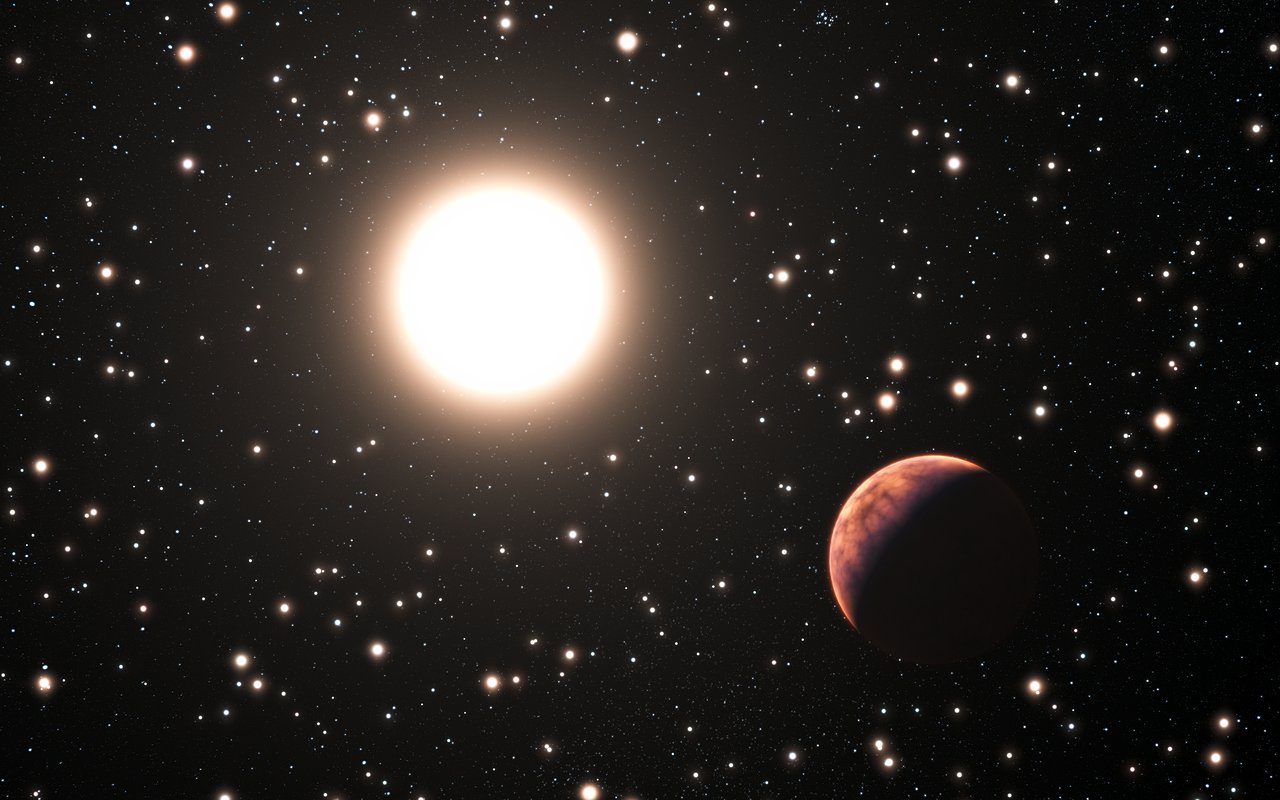
This artist’s impression shows one of the three newly discovered planets in the
star cluster Messier 67. In this cluster the stars are all about the same age and
composition as the Sun. This makes it a perfect laboratory to study how many
planets form in such a crowded environment. Very few planets in clusters are
known and this one has the additional distinction of orbiting a solar twin — a star
that is almost identical to the Sun in all respects.

Video: Focusing on exoplanets with the Giant Magellan Telescope

Here’s a Planetary Society report on the making of one of the seven mirrors for the Giant Magellan Telescope, which should become operational in 2020.

From the caption:

After spending three months cooling, the GMT’s third mirror was removed from its rotating furnace on Dec. 6, 2013 and unveiled at the University of Arizona Steward Observatory Mirror Lab. It will take another three years for the mirror to be polished to extremely high precision. If the finished mirror were enlarged to cover the continental U.S., the peak-to-valley variance in smoothness would only be a half-inch.

The GMT’s seven 8.4 meter mirrors and adaptive optics system will give it ten times the resolution and sensitivity of the Hubble Space Telescope. It will be able to measure the mass of exoplanets and determine the composition of their atmospheres.

If life exists on one of the 1,000 currently known exoplanets, the GMT may be able to see indicators of life like ozone and chlorophyll in the exoplanet’s atmosphere. Such a game-changing discovery could tell us Earth is not the only planet in the Universe with life.

SpaceWarps citizen science boosted by BBC Two program

The BBC Two Stargazing LIVE program has been urging its viewers to participate in the project SpaceWarps, which is one of several citizen science projects sponsored by the Zooniverse organization. In SpaceWarps participants examine celestial images in search of the very rare cases where the gravitational effects of a distant galaxy can magnify the image of an even more distant galaxy directly behind it. This lensing effect was predicted by Einstein’s general theory of relativity.

The big increase in the number of participants has been a boon to the project and several candidate gravitational lenses have been found: Stargazing Live: The Results Are In –  Zooniverse

BBC Stargazing Live 2014 has been asking people to visit the Zooniverse’s Space Warps site to identify gravitational lenses: extremely rare events caused by one galaxy passing in front of another (very distant) galaxy. Tens of thousands of you have taken part and classified more than 6.5 million images.

Your classifications have already led to the discovery of more than 50 potential gravitational lenses! Amongst them are several beautiful and interesting discoveries. You can see a few of our favourite candidates above. For Stargazing Live’s third and final show we have focussed on the spectacular red arc/ring shown below, it has been nicknamed 9io9 by the team right now, because of it’s Zooniverse ID. You can see more of what our volunteers are saying about it here on Talk.

Credit: Jim Geach / VICS82

Credit: Jim Geach / VICS82

More info on SpaceWarps can be found at:

American Astronomical Society conf + New Kepler results + Reviving Kepler + Starshades

The  223rd Meeting  of the American Astronomical Society is taking place in Washington this week. Exoplanets and the Kepler observatory have been a topic of discussion today. Jeff Foust is posting notes from some of the presentations: Jeff Foust (jeff_foust) on Twitter.

===

The Kepler space observatory group released this today: NASA Kepler Provides Insight About Enigmatic But Ubiquitous Planets, Five New Rocky Planets – NASA

The Kepler team today reports on four years of ground-based follow-up observations targeting Kepler’s exoplanet systems at the American Astronomical Society meeting in Washington. These observations confirm the numerous Kepler discoveries are indeed planets and yield mass measurements of these enigmatic worlds that vary between Earth and Neptune in size.

Included in the findings are five new rocky planets ranging in size from ten to eighty percent larger than Earth. Two of the new rocky worlds, dubbed Kepler-99b and Kepler-406b, are both forty percent larger in size than Earth and have a density similar to lead. The planets orbit their host stars in less than five and three days respectively, making these worlds too hot for life as we know it.

===

The Kepler spacecraft was crippled last year when one of its reaction wheels failed and prevented the telescope from pointing precisely enough to observe exoplanets transiting across the face of their stars. Since then they have proposed to NASA a way to regain some of their exoplanet observation capabilities. The new project would be called K2 if funded by NASA: K2 – Kepler Science Center

===

To see a small earth-like planet, the light from its star must be blocked by a specially shaped mask or ‘star shade” set at a good distance from the telescope. Jeff points to this interesting article and video from 2012 : The Search for Another Earth – PlanetQuest