Category Archives: Astronomy

Terrific ‘Aurora over a Glacier Lagoon’ image wins 2014 Astronomy Photographer of the Year

An amazingly beautiful aurora image by James Woodend wins the Royal Museum Greenwich‘s contest for the 2014 Astronomy Photographer of the Year. See the top images at Earth & Space : 2014 winners : Exhibitions : What’s on : RMG

[]

Aurora over a Glacier Lagoon by James Woodend, UK

9 January 2014

Canon 5D Mk III camera; 33mm f/3.2 lens; ISO 1000; 10-second exposure

What the photographer says…

Although this is not a strong aurora, they sometimes make the best reflection shots. The water was very still – you can see the icebergs floating in the lagoon and their reflections. In the background is the Vatnajökull Glacier.

What it shows…

The pale-green glow of the aurora comes from oxygen atoms high in the atmosphere, energized by subatomic particles blasted out by the Sun. The particles are funnelled down towards the north and south poles by the Earth’s magnetic field, which is why these spectacular light shows are so often juxtaposed with the frozen scenery of the Arctic and Antarctic regions. Here the photographer has skilfully captured the delicate, icy colouration of land, water and sky.

Here’s a series of videos about the contest leading up to the winners:

The Black Rock Observatory at Burning Man

For the recent Burning Man event, the “Desert Wizards of Mars” brought their Black Rock Observatory. Funded via a Kickstarter, the project include two domed-covered 21 inch telescopes and the Mars Rover Art Car.

dust[1]

Here’s an article about the project : Bringing Space Science Education to Burning Man–and Beyond – Co.Create.

And their Kickstarter video:

Part 2: Photometry tutorial for amateur and pro astronomers

Rick Boozer posts the second installment of his tutorial on photometry with the AIP4WIN software package:

From Part 1:

The science of photometry can be used by both amateur astronomers and professionals for some very advanced scientific work.  You can detect the light changes caused by eclipsing binary stars, plot the changes in luminosity of a variable star and even detect an exoplanet orbiting another star.  This tutorial will be your step-by-step guide on how to employ the powerful Magnitude Measurement Tool that comes with the renowned astronomical imaging software known as AIP4WIN by Richard Berry and Robert Burnell.  Special thanks to Mr. Berry for giving me permission to include screen images and extensive operating details from AIP4WIN.

ESO: Possible explanation for why Milky Way-like galaxies are so common

A report from the European Southern Observatory (ESO):

Violent Origins of Disc Galaxies Probed by ALMA

New observations explain why Milky Way-like galaxies are
so common in the Universe

For decades scientists have believed that galaxy mergers usually result in the formation of elliptical galaxies. Now, for the the first time, researchers using ALMA and a host of other radio telescopes have found direct evidence that merging galaxies can instead form disc galaxies, and that this outcome is in fact quite common. This surprising result could explain why there are so many spiral galaxies like the Milky Way in the Universe.
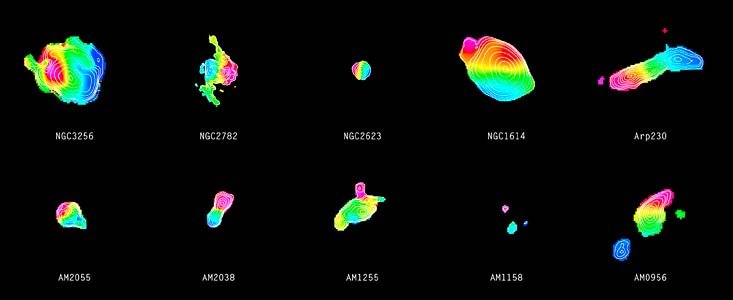
eso1429a

An international research group led by Junko Ueda, a Japan Society for the Promotion of Science postdoctoral fellow, has made surprising observations that most galaxy collisions in the nearby Universe — within 40–600 million light-years from Earth — result in so-called disc galaxies. Disc galaxies — including spiral galaxies like the Milky Way and lenticular galaxies — are defined by pancake-shaped regions of dust and gas, and are distinct from the category of elliptical galaxies.

It has, for some time, been widely accepted that merging disc galaxies would eventually form an elliptically shaped galaxy. During these violent interactions the galaxies do not only gain mass as they merge or cannibalise each-other, but they are also changing their shape throughout cosmic time, and therefore changing type along the way.

Computer simulations from the 1970s predicted that mergers between two comparable disc galaxies would result in an elliptical galaxy. The simulations predict that most galaxies today are elliptical, clashing with observations that over 70% of galaxies are in fact disc galaxies. However, more recent simulations have suggested that collisions could also form disc galaxies.

Loading player…

Merger between two galaxies (artist’s impression)

To identify the final shapes of galaxies after mergers observationally, the group studied the distribution of gas in 37 galaxies that are in their final stages of merging. The Atacama Large Millimeter/sub-millimeter Array (ALMA) and several other radio telescopes [1] were used to observe emission from carbon monoxide (CO), an indicator of molecular gas.

The team’s research is the largest study of molecular gas in galaxies to date and provides unique insight into how the Milky Way might have formed. Their study revealed that almost all of the mergers show pancake-shaped areas of molecular gas, and hence are disc galaxies in the making. Ueda explains:

“For the first time there is observational evidence for merging galaxies that could result in disc galaxies. This is a large and unexpected step towards understanding the mystery of the birth of disc galaxies.”

Nonetheless, there is a lot more to discover. Ueda added:

“We have to start focusing on the formation of stars in these gas discs. Furthermore, we need to look farther out in the more distant Universe. We know that the majority of galaxies in the more distant Universe also have discs. We however do not yet know whether galaxy mergers are also responsible for these, or whether they are formed by cold gas gradually falling into the galaxy. Maybe we have found a general mechanism that applies throughout the history of the Universe.”

On line tutorial on advanced stellar photometry

Rick Boozer has opened a series of posts that will provide a tutorial on advanced stellar photometry :  Photometry with AIP4WIN: A Tutorial – Part 1 – Astron Maven –

The science of photometry can be used by both amateur astronomers and professionals for some very advanced scientific work.  You can detect the light changes caused by eclipsing binary stars, plot the changes in luminosity of a variable star and even detect an exoplanet orbiting another star.  This tutorial will be your step-by-step guide on how to employ the powerful Magnitude Measurement Tool that comes with the renowned astronomical imaging software known as AIP4WIN by Richard Berry and Robert Burnell.  Special thanks to Mr. Berry for giving me permission to include screen images and extensive operating details from AIP4WIN.

The proper equipment for this endeavor is as follows:  a telescope with an accurate tracking drive, a sufficiently sensitive CCD or CMOS camera, and a computer with AIP4WIN installed.  AIP4WIN comes on a DVD accompanying the book The Handbook of Astronomical Image Processing by the aforementioned Messrs. Berry and Burnell.