The latest episode of the weekly TMRO web program includes an interview with “Jared Head, astronomy geek, rocket scientist and STEM educator [who spoke] about why astronomy is as cool as a rocket launch”.
The latest episode of the weekly TMRO web program includes an interview with “Jared Head, astronomy geek, rocket scientist and STEM educator [who spoke] about why astronomy is as cool as a rocket launch”.
Luke Skywalker could see two suns in the sky over his home planet. There are planets, however, with three and four ‘suns’ in view:
Planet ‘Reared’ by Four Parent Stars
Astronomers have discovered the second known case of a planet residing in a quadruple star system.
— The planet was known before, but was thought to have only three stars, not four.
— The findings help researchers understand how multiple star systems can influence the development and fate of planets.
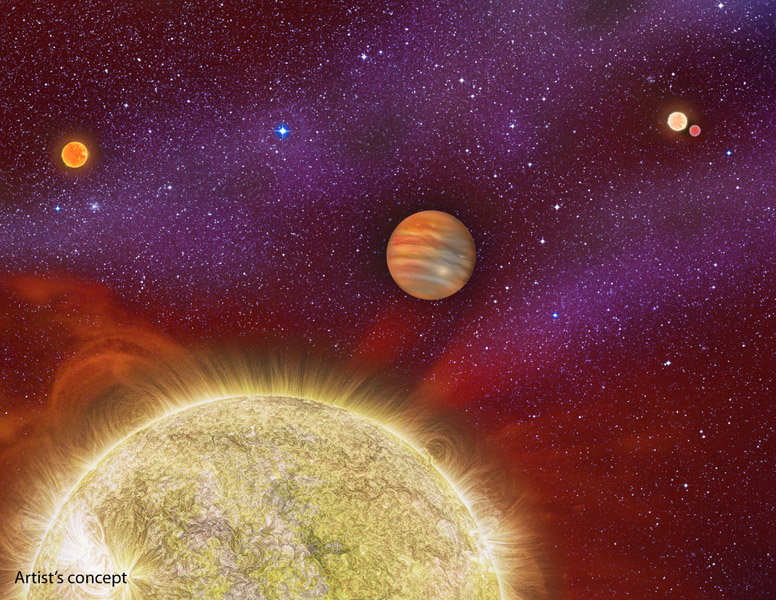
This artist’s conception shows the 30 Ari system, which includes four stars and a planet. The planet, a gas giant, orbits its primary star (yellow) in about a year’s time. The primary star, called 30 Ari B, has a companion — the small “red dwarf” star shown at upper left. This pair of stars is itself locked in a long-distance orbit with another pair of stars (upper right), known as 30 Ari A. Researchers using instruments at the Palomar Observatory near San Diego, Calif., recently discovered the red star at upper left, bringing the total number of known stars in the system from three to four.
Growing up as a planet with more than one parent star has its challenges. Though the planets in our solar system circle just one star — our sun — other more distant planets, called exoplanets, can be reared in families with two or more stars. Researchers wanting to know more about the complex influences of multiple stars on planets have come up with two new case studies: a planet found to have three parents, and another with four.
The discoveries were made using instruments fitted to telescopes at the Palomar Observatory in San Diego: the Robo-AO adaptive optics system, developed by the Inter-University Center for Astronomy and Astrophysics in India and the California Institute of Technology in Pasadena, and the PALM-3000 adaptive optics system, developed by NASA’s Jet Propulsion Laboratory in Pasadena, California, and Caltech.
This is only the second time a planet has been identified in a quadruple star system. While the planet was known before, it was thought to have only three stars, not four. The first four-star planet, KIC 4862625, was discovered in 2013 by citizen scientists using public data from NASA’s Kepler mission.
The latest discovery suggests that planets in quadruple star systems might be less rare than once thought. In fact, recent research has shown that this type of star system, which usually consists of two pairs of twin stars slowly circling each other at great distances, is itself more common than previously believed.

“About four percent of solar-type stars are in quadruple systems, which is up from previous estimates because observational techniques are steadily improving,” said co-author Andrei Tokovinin of the Cerro Tololo Inter-American Observatory in Chile.
The newfound four-star planetary system, called 30 Ari, is located 136 light-years away in the constellation Aries. The system’s gaseous planet is enormous, with 10 times the mass of Jupiter, and it orbits its primary star every 335 days. The primary star has a relatively close partner star, which the planet does not orbit. This pair, in turn, is locked in a long-distance orbit with another pair of stars about 1,670 astronomical units away (an astronomical unit is the distance between Earth and the sun). Astronomers think it’s highly unlikely that this planet, or any moons that might circle it, could sustain life.
Were it possible to see the skies from this world, the four parent stars would look like one small sun and two very bright stars that would be visible in daylight. One of those stars, if viewed with a large enough telescope, would be revealed to be a binary system, or two stars orbiting each other.
In recent years, dozens of planets with two or three parent stars have been found, including those with “Tatooine” sunsets reminiscent of the Star Wars movies. Finding planets with multiple parents isn’t too much of a surprise, considering that binary stars are more common in our galaxy than single stars.
“Star systems come in myriad forms. There can be single stars, binary stars, triple stars, even quintuple star systems,” said Lewis Roberts of JPL, lead author of the new findings appearing in the journal Astronomical Journal. “It’s amazing the way nature puts these things together.”
Roberts and his colleagues want to understand the effects that multiple parent stars can have on their developing youthful planets. Evidence suggests that stellar companions can influence the fate of planets by changing the planets’ orbits and even triggering some to grow more massive. For example, the “hot Jupiters” — planets around the mass of Jupiter that whip closely around their stars in just days — might be gently nudged closer to their primary parent star by the gravitational hand of a stellar companion.
In the new study, the researchers describe using the automated Robo-AO system on Palomar Observatory to scan the night skies, searching hundreds of stars each night for signs of stellar companions. They found two candidates hosting exoplanets: the four-star system 30 Ari, and a triple-star planetary system called HD 2638. The findings were confirmed using the higher-resolution PALM-3000 instrument, also at Palomar Observatory.
The new planet with a trio of stars is a hot Jupiter that circles its primary star tightly, completing one lap every three days. Scientists already knew this primary star was locked in a gravitational tango with another star, about 0.7 light-years away, or 44,000 astronomical units. That’s relatively far apart for a pair of stellar companions. The latest discovery is of a third star in the system, which orbits the primary star from a distance of 28 astronomical units — close enough to have influenced the hot Jupiter’s development and final orbit.
“This result strengthens the connection between multiple star systems and massive planets,” said Roberts.
In the case of Ari 30, the discovery brought the number of known stars in the system from three to four. The fourth star lies at a distance of 23 astronomical units from the planet. While this stellar companion and its planet are closer to each other than those in the HD 2638 system, the newfound star does not appear to have impacted the orbit of the planet. The exact reason for this is uncertain, so the team is planning further observations to better understand the orbit of the star and its complicated family dynamics.
JPL is managed for NASA by the California Institute of Technology in Pasadena.
A paper reporting on research carried out with the help of more than 4900 participants in the citizen science project Radio Galaxy Zoo, a member of the Zooniverse array of citizen science projects, has been submitted to a scientific journal: First Radio Galaxy Zoo paper has been submitted! – Galaxy Zoo.
The goal of the project is to take advantage of the image recognition capabilities of the volunteers to classify radio and infrared images of galaxies where supermassive black holes are believed to be hiding behind clouds of gas and dust. Such images are messy and not easily defined in a way that a computer algorithm can properly characterize them.


We find that the RGZ citizen scientists are as effective as the science experts at identifying the radio sources and their host galaxies.
The program recently passed a million classifications by the volunteers: 1 million classifications and beyond! – Galaxy Zoo
The Stanford Arts Institute is sponsoring a year long program organized around the theme of cosmology and the arts: Stanford Arts Institute launches Imagining the Universe program – Stanford Daily .
Imagining the Universe will combine
the arts, humanities and sciences to explore our understanding of the universe. Program events include a speaker series, musical performances, art exhibits and even a freshman course on cosmology.
The goals
are to find and develop points of contact and connection among these different approaches, to deepen our understanding and appreciation for the richness of the universe, and to appreciate what we can learn about ourselves from the way we depict our cosmos. Through a related set of events and programs, the project will aim to engage multiple audiences: Stanford undergraduates and graduate students, specialists in relevant fields, and the broader community.
All public conversations are free and open to all.
Mars presents a new mystery:
Mystery Mars plume baffles scientists

Observations of a mysterious plume-like feature (marked with yellow arrow) at the limb of the Red Planet on 20 March 2012. The observation was made by astronomer W. Jaeschke. The image is shown with the north pole towards the bottom and the south pole to the top.
16 February 2015: Plumes seen reaching high above the surface of Mars are causing a stir among scientists studying the atmosphere on the Red Planet.
On two separate occasions in March and April 2012, amateur astronomers reported definite plume-like features developing on the planet.
The plumes were seen rising to altitudes of over 250 km above the same region of Mars on both occasions. By comparison, similar features seen in the past have not exceeded 100 km.
“At about 250 km, the division between the atmosphere and outer space is very thin, so the reported plumes are extremely unexpected,” says Agustin Sanchez-Lavega of the Universidad del País Vasco in Spain, lead author of the paper reporting the results in the journal Nature.

The top image shows the location of the mysterious plume on Mars, identified within the yellow circle (top image, south is up), along with different views of the changing plume morphology taken by W. Jaeschke and D. Parker on 21 March 21 2012.
The features developed in less than 10 hours, covering an area of up to 1000 x 500 km, and remained visible for around 10 days, changing their structure from day to day.
None of the spacecraft orbiting Mars saw the features because of their viewing geometries and illumination conditions at the time.
However, checking archived Hubble Space Telescope images taken between 1995 and 1999 and of databases of amateur images spanning 2001 to 2014 revealed occasional clouds at the limb of Mars, albeit usually only up to 100 km in altitude.
But one set of Hubble images from 17 May 1997 revealed an abnormally high plume, similar to that spotted by the amateur astronomers in 2012.
Scientists are now working on determining the nature and cause of the plumes by using the Hubble data in combination with the images taken by amateurs.

A curious plume-like feature was observed on Mars on 17 May 1997 by the Hubble Space Telescope. It is similar to the features detected by amateur astronomers in 2012, although appeared in a different location.
The Hubble image is extracted from this publicly available image.
“One idea we’ve discussed is that the features are caused by a reflective cloud of water-ice, carbon dioxide-ice or dust particles, but this would require exceptional deviations from standard atmospheric circulation models to explain cloud formations at such high altitudes,” says Agustin.
“Another idea is that they are related to an auroral emission, and indeed auroras have been previously observed at these locations, linked to a known region on the surface where there is a large anomaly in the crustal magnetic field,” adds Antonio Garcia Munoz, a research fellow at ESA’s ESTEC and co-author of the study.
The jury is still out on the nature and genesis of these curious high-altitude martian plumes. Further insights should be possible following the arrival of ESA’s ExoMars Trace Gas Orbiter at the Red Planet, scheduled for launch in 2016.
===
Other articles: