Category Archives: Astronomy

ESO: A grand extravaganza of new stars in The Altar

The latest cool astronomical report from the European Southern Observatory (ESO):

A Grand Extravaganza of New Stars
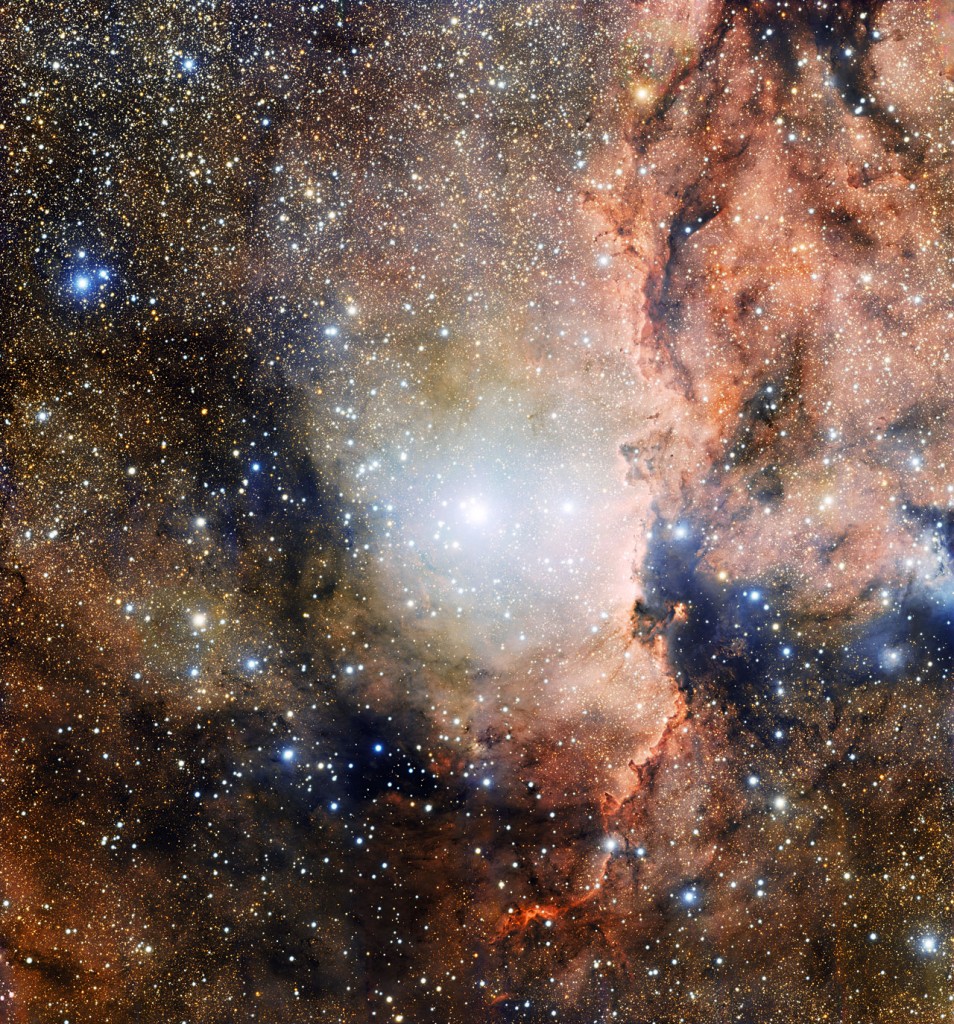
Star cluster NGC 6193 and nebula NGC 6188

This dramatic landscape in the southern constellation of Ara (The Altar) is a treasure trove of celestial objects. Star clusters, emission nebulae and active star-forming regions are just some of the riches observed in this region lying some 4000 light-years from Earth. This beautiful new image is the most detailed view of this part of the sky so far, and was taken using the VLT Survey Telescope at ESO’s Paranal Observatory in Chile.

At the centre of the image is the open star cluster NGC 6193, containing around thirty bright stars and forming the heart of the Ara OB1 association. The two brightest stars are very hot giant stars. Together, they provide the main source of illumination for the nearby emission nebula, the Rim Nebula, or NGC 6188, which is visible to the right of the cluster.

A stellar association is a large grouping of loosely bound stars that have not yet completely drifted away from their initial formation site. OB associations consist largely of very young blue–white stars, which are about 100 000 times brighter than the Sun and between 10 and 50 times more massive.

The Rim Nebula is the prominent wall of dark and bright clouds marking the boundary between an active star-forming region within the molecular cloud, known as RCW 108, and the rest of the association [1]. The area around RCW 108 is made up of mostly hydrogen — the primary ingredient in star formation. Such areas are also known as H II regions.

The ultraviolet radiation and intense stellar wind from the stars of NGC 6193 seem to be driving the next generation of star formation in the surrounding clouds of gas and dust. As cloud fragments collapse they heat up and eventually form new stars.

As the cloud creates new stars, it is simultaneously being eroded by the winds and radiation emitted by previous stars, and by violent supernova explosions. In this way, such star-forming H II regions tend to have a lifespan of just a few million years. Star formation is a very inefficient process, with only around 10% of the available material contributing to the process — the rest is blown off into space.

The Rim Nebula also shows signs of being in the early phase of “pillar formation”, meaning that in the future it could end up looking similar to other well-known star-forming regions, such as the Eagle Nebula (Messier 16, containing the famous Pillars of Creation) and the Cone Nebula (part of NGC 2264).

This single spectacular image was actually created from more than 500 individual pictures taken through four different colour filters with the VLT Survey Telescope. The total exposure time was more than 56 hours. It is the most detailed view of this region yet achieved.

Where are the stars in in-space made images?

Here’s an excellent mini-tutorial by Bill Dunford on why one seldom sees stars in the dark sky background of images of planets, moons, asteroids, etc. made by scientific probes: A Sky Full of Stars -The Planetary Society

He includes lots of examples such as this counter one:

20130826_PIA10526_f840[1]

 Enceladus among stars
“Extremely unusual circumstances were required to get this shot of Enceladus floating in front of a field of stars. The Cassini spacecraft is flying in space, of course, and regularly captures images of star fields. It also regularly captures images of Enceladus. But Enceladus is so brightly reflective that, under normal circumstances, it is impossible to see both features on Enceladus’ surface and a dense field of stars in the same image. To see Enceladus’ surface, the camera team would select a short exposure setting; to see the stars, they would select a long exposure setting. This photo is possible because Enceladus was actually in Saturn’s shadow when it was taken; the only light reaching its surface (and reflecting from there to Cassini’s camera) is sunlight that has first been reflected off of Saturn or its rings. A long exposure revealed both Enceladus’ surface and the background field of stars.”

Help capture a 360 deg view of solar eclipse from stratosphere above the North Pole

The high-altitude balloon near-space adventure company zero2infinity has opened a crowd-funding campaign to sponsor a balloon project to film the upcoming total solar eclipse that will be visible above the arctic circle: bloon: 360 view of a Total Solar Eclipse from Space – Indiegogo

Help us record the first ever spherical video of an
eclipse from the Stratosphere!

This is our last chance to capture the shadow of the Moon
over the northern ice cap before it melts

On the 20th of March 2015, at the North Pole, there will be a total solar eclipse. This is an extraordinary and very rare event, that has never been thoroughly documented and will take thousands of years to happen again. After 6 months of polar night, the Moon will pass between the Earth and the Sun and will darken this infinitely white snow-covered region. Add to that, the very high probability of Northern lights lighting up the sky, and you can imagine what a magical moment this will be.

SolarEclipseImaging

Unfortunately there is a very high probability of cloud cover at those latitudes, which means the event will not be as impressive seen from the ground. What we are proposing is to fly higher, much higher, with a stratospheric helium balloon, from Svalbard in Norway, the only populated area from which the eclipse will be fully visible. The balloon won’t only fly above the clouds, it will come close to space, and the view will be incredible.

On the day of the eclipse, when the Moon will obscure the Sun, the stars and the planets will become visible and the shadow of the Moon will be seen going over the Earth. We will record this with a spherical camera that will cover a 360º angle. We are the only company in the world ever having flown such a camera in Space. The results are spectacular: www.abaco-digital.es/360plus/zero2infinity.html

Check out what you will enable us to do:

We need your help! Recovery and distribution are crucial aspects, and time is of the essence! Help us here, choose one of our exciting perks and let’s make it happen! 

Video: Bruce Betts on detecting potentially dangerous asteroids and comets

Bruce Betts of the Planetary Society talks about the potential danger of near earth objects and about donations to the Society’s Shoemaker Near-Earth Object Grant Program, which supports astronomers who search for such objects.

Help crowd-fund research to answer “How old is the Milky way Galaxy?”

Aaron Webster, Ted von Hippel, and Elliot Robinson at Embry Riddle Aeronautical University have opened a crowd-funding campaign to raise $3500 to support their research into the question of How Old is the Milky Way Galaxy? – Experiment –

We derive the ages and other properties of stars by combining theoretical astrophysics, data from the best telescopes, Bayesian statistical analyses, and advanced computational techniques. We have developed an algorithm that allows us to combine the age information from multiple white dwarf stars to derive the age of our Galaxy.

We request funds to support converting our algorithm to high-performance software code. From this we will both derive the age of the Galaxy as well as make our code publicly available for other research groups.

This video provides more details on their project:

https://vimeo.com/118054821

===

Note that this campaign is based at experiment.com, which hosts many such crowd-funding efforts in many scientific fields. See their FAQ for details.