Category Archives: Astronomy

ESO: Complex organic molecules discovered in infant star system

The latest news from the European Southern Observatory (ESO):

Complex Organic Molecules Discovered in Infant Star System
Hints that the building blocks of the chemistry of life are universal

For the first time, astronomers have detected the presence of complex organic molecules, the building blocks of life, in a protoplanetary disc surrounding a young star. The discovery, made with the Atacama Large Millimeter/submillimeter Array (ALMA), reaffirms that the conditions that spawned the Earth and Sun are not unique in the Universe. The results are published in the 9 April 2015 issue of the journal Nature.
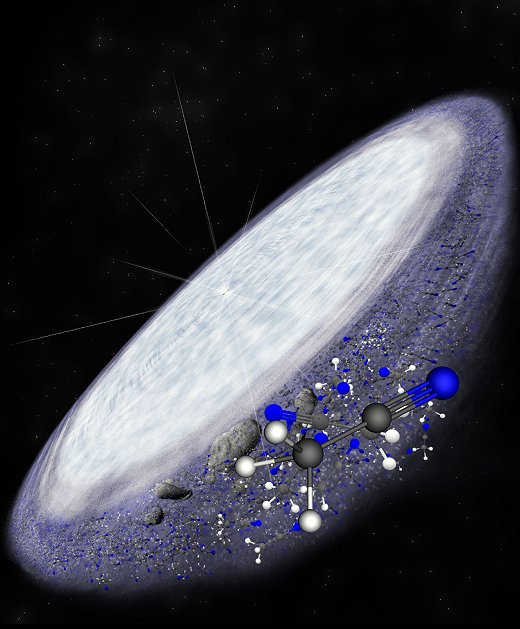
eso1513a_520x629Artist’s illustration of of the protoplanetary disc surrounding the young star
MWC 480. ALMA has detected the complex organic molecule methyl
cyanide in the outer reaches of the disc in the region where comets
are believed to form. This is another indication that complex organic
chemistry, and potentially the conditions necessary for life, is universal.
 Credit: B. Saxton (NRAO/AUI/NSF)

The new ALMA observations reveal that the protoplanetary disc surrounding the young star MWC 480 [1] contains large amounts of methyl cyanide (CH3CN), a complex carbon-based molecule. There is enough methyl cyanide around MWC 480 to fill all of Earth’s oceans.

Both this molecule and its simpler cousin hydrogen cyanide (HCN) were found in the cold outer reaches of the star’s newly formed disc, in a region that astronomers believe is analogous to the Kuiper Belt — the realm of icy planetesimals and comets in our own Solar System beyond Neptune.

Comets retain a pristine record of the early chemistry of the Solar System, from the period of planet formation. Comets and asteroids from the outer Solar System are thought to have seeded the young Earth with water and organic molecules, helping set the stage for the development of primordial life.

“Studies of comets and asteroids show that the solar nebula that spawned the Sun and planets was rich in water and complex organic compounds,” noted Karin Öberg, an astronomer with the Harvard-Smithsonian Center for Astrophysics in Cambridge, Massachusetts, USA, and lead author of the new paper.

“We now have even better evidence that this same chemistry exists elsewhere in the Universe, in regions that could form solar systems not unlike our own.” This is particularly intriguing, Öberg notes, since the molecules found in MWC 480 are also found in similar concentrations in the Solar System’s comets.

The star MWC 480, which is about twice the mass of the Sun, is located 455 light-years away in the Taurus star-forming region. Its surrounding disc is in the very early stages of development — having recently coalesced out of a cold, dark nebula of dust and gas. Studies with ALMA and other telescopes have yet to detect any obvious signs of planet formation in it, although higher resolution observations may reveal structures similar to HL Tauri, which is of a similar age.

Astronomers have known for some time that cold, dark interstellar clouds are very efficient factories for complex organic molecules — including a group of molecules known as cyanides. Cyanides, and most especially methyl cyanide, are important because they contain carbon–nitrogen bonds, which are essential for the formation of amino acids, the foundation of proteins and the building blocks of life.

Until now, it has remained unclear, however, if these same complex organic molecules commonly form and survive in the energetic environment of a newly forming solar system, where shocks and radiation can easily break chemical bonds.

By exploiting ALMA’s remarkable sensitivity [2] astronomers can see from the latest observations that these molecules not only survive, but flourish.

Importantly, the molecules ALMA detected are much more abundant than would be found in interstellar clouds. This tells astronomers that protoplanetary discs are very efficient at forming complex organic molecules and that they are able to form them on relatively short timescales [3].

As this system continues to evolve, astronomers speculate that it’s likely that the organic molecules safely locked away in comets and other icy bodies will be ferried to environments more nurturing to life.

“From the study of exoplanets, we know the Solar System isn’t unique in its number of planets or abundance of water,” concluded Öberg. “Now we know we’re not unique in organic chemistry. Once more, we have learnt that we’re not special. From a life in the Universe point of view, this is great news.”
Videos: TMRO 8.11 – The SpaceUP Foundation + Spacepod – Hacking space with 3DSlicer

The latest episode of TMRO is now available on line: The SpaceUP Foundation – TMRO

This week we are joined by Chris Radcliff, creator and head monkey of SpaceUP. For more information on the new SpaceUP Foundation head over to http://www.spaceup.org

Here’s the latest TMRO Spacepod news report: Hacking Space with 3DSlicer – Space Pod 03/30/15

Hubble sees galaxies displaying after-glow of quasar blasts

The latest finding from the Hubble Space Telescope:

Hubble finds ghosts of quasars past

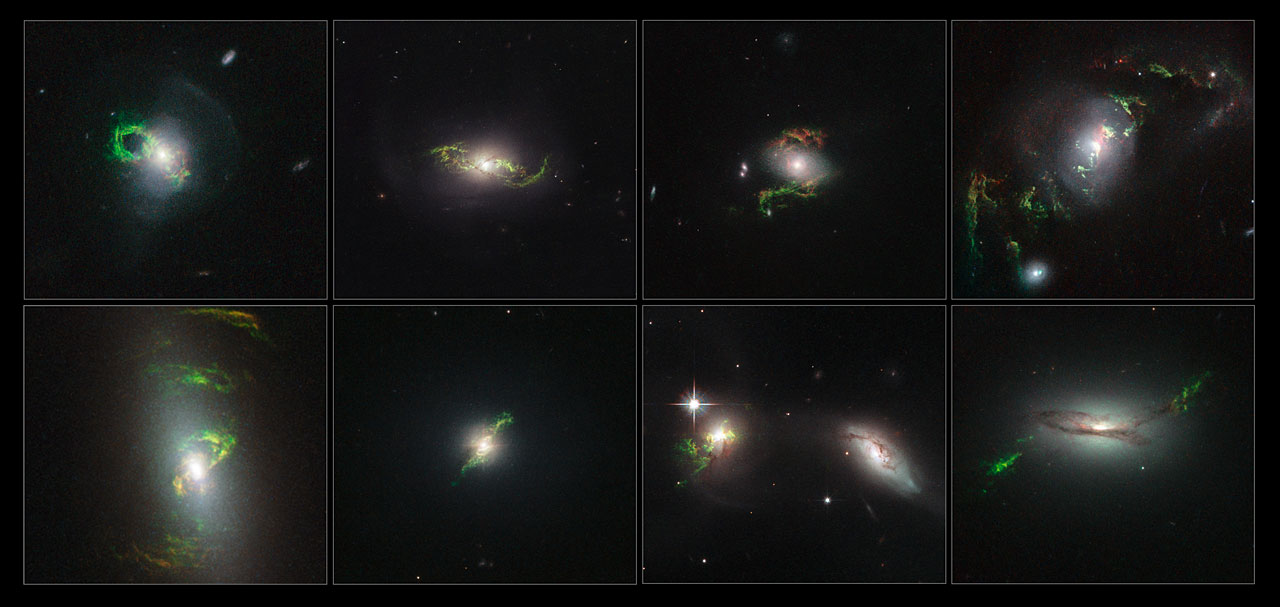
The NASA/ESA Hubble Space Telescope has imaged a set of enigmatic quasar ghosts — ethereal green objects which mark the graves of these objects that flickered to life and then faded. The eight unusual looped structures orbit their host galaxies and glow in a bright and eerie goblin-green hue. They offer new insights into the turbulent pasts of these galaxies.

Hubble spies eight green filaments lit up by past quasar blasts

The ethereal wisps in these images were illuminated, perhaps briefly, by a blast of radiation from a quasar — a very luminous and compact region that surrounds asupermassive black hole at the centre of a galaxy. Galactic material falls inwards towards the central black hole, growing hotter and hotter, forming a bright and brilliant quasar with powerful jets of particles and energy beaming above and below the disc of infalling matter.

In each of these eight images a quasar beam has caused once-invisible filaments in deep space to glow through a process called photoionisation. Oxygen, helium, nitrogen, sulphur and neon in the filaments absorb light from the quasar and slowly re-emit it over many thousands of years. Their unmistakable emerald hue is caused by ionised oxygen, which glows green.

These ghostly structures are so far from the galaxy’s heart that it would have taken light from the quasar tens of thousands of years to reach them and light them up. So, although the quasars themselves have turned off, the green clouds will continue to glow for much longer before they too fade.

Not only are the green filaments far from the centres of their host galaxies, they are also immense in size, spanning tens of thousands of light-years. They are thought to be long tails of gas formed during a violent past merger between galaxies — this event would have caused strong gravitational forces that would rip apart the galactic participants.

Despite their turbulent past, these ghostly filaments are now leisurely orbiting within or around their new host galaxies. These Hubble images show bright, braided and knotted streams of gas, in some cases connected to twisted lanes of dark dust.

Galactic mergers do not just alter the forms of the previously serene galaxies involved; they also trigger extreme cosmic phenomena. Such a merger could also have caused the birth of a quasar, by pouring material into the galaxies’supermassive black holes.

The first object of this type was found in 2007 by Dutch schoolteacher Hanny van Arkel (heic1102). She discovered the ghostly structure in the online Galaxy Zooproject, a project enlisting the help of the public to classify more than a million galaxies catalogued in the Sloan Digital Sky Survey (SDSS). The bizarre feature was dubbed Hanny’s Voorwerp (Dutch for Hanny’s object).

These objects were found in a spin-off of the Galaxy Zoo project, in which about 200 volunteers examined over 16 000 galaxy images in the SDSS to identify the best candidates for clouds similar to Hanny’s Voorwerp. A team of researchers analysed these and found a total of twenty galaxies that had gas ionised by quasars. Their results appear in a paper in the Astronomical Journal.

Those featured here [see above matrix of images] are (from left to right on top row) the Teacup (more formally known as 2MASX J14302986+1339117), NGC 5972, 2MASX J15100402+0740370 and UGC 7342, and (from left to right on bottom row) NGC 5252, Mrk 1498, UGC 11185 and 2MASX J22014163+115123

Unusual pattern found in fast radio bursts

When radio astronomers first detected the regular beat of a pulsar in 1967, there was some initial excitement that it might be a signal from a distant civilization. However, it was soon realized that pulsars were spinning neutron stars, which are the dense remains of supernovae. At the poles of the neutron star’s intense magnetic fields, which don’t have to line up with the rotation axis, particles are accelerated, causing beams of radiation to be emitted. Like a rotating light house beam aimed in our direction, we see a regular pulse of energy from the very dense star.

This is something to keep in mind when hearing about patterns seen in fast radio bursts, which, as the name implies, are short pulses of high frequency radio waves that last for about a millisecond. They were first detected in 2001 and seen infrequently since. A recent study found an unusual pattern in a group of such pulses: Is this ET? Mystery of strange radio bursts from space – New Scientist

We have detected 10 fast bursts of radio waves (FRBs) coming from space in the past 15 year. The delay between the arrival of the first and last waves of each burst is always close to a multiple of 187.5. No known natural process can explain this.

FRBplot

As with radio pulses, a natural phenomenon of some sort, or just noise from some man-made source,  will very likely be found to explain these bursts.

More at:

Update Apr.4.15: Another item at NS about the signals: Alien FAQ: 6 questions about strange cosmic radio bursts – New Scientist.

Video: “What’s Up for April 2015” – NASA JPL night sky preview

The NASA JPL “What’s Up for April 2015” reports on an upcoming total lunar eclipse and the Lyrid meteor shower: