Category Archives: Space transport roundup

Latest on all means of traveling to, from and in space.

Space transport roundup – June.10.2020

A sampling of recent articles, videos, and images dealing with space transport (find previous roundups here):

** SpaceX to launch another batch of Starlink satellites on a Falcon 9 rocket this week, the second such launch in June. Liftoff at Cape Canaveral is set for 5:42 am EDT (0942 GMT). Here is a video from SpaceX showing the fairings separating from the Falcon 9 on the recent Starlink launch:

Find more about other SpaceX activities below

** Rocket Lab Electron set to launch on Thursday June 11:. The liftoff is set for a window between 12:43-2:32 a.m. EDT ( 0443-0632 GMT)

See also:

** Update on development of ULA Vulcan launch system: Vulcan on track as ULA eyes early-2021 test flight to the Moon – NASASpaceFlight.com

United Launch Alliance has announced their Vulcan rocket is progressing towards its maiden launch as soon as early-2021. While an exact launch target isn’t known yet, the mission will use a newly-built Launch Umbilical Tower while sharing Atlas V’s Vertical Integration Facility and SLC-41 launch pad in Florida.

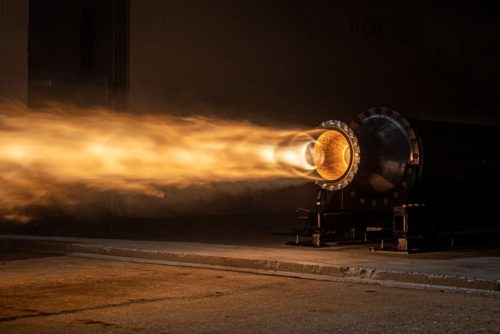
** Update on ESA’s reusable Prometheus engine: ESA moves ahead on low-cost reusable rocket engine – ESA

ESA’s Prometheus is the precursor of ultra-low-cost rocket propulsion that is flexible enough to fit a fleet of new launch vehicles for any mission and will be potentially reusable.

At the Space19+ Council meeting in Seville, Spain last November, ESA received full funding to bring the current Prometheus engine design to a technical maturity suitable for industry. Developed by ArianeGroup, Prometheus is now seen as key in the effort to prepare competitive future European access to space.

By applying a design-to-cost approach to manufacturing Prometheus, ESA aims to lower the cost of production by a factor of ten of the current main stage Ariane 5 Vulcain 2 engine.
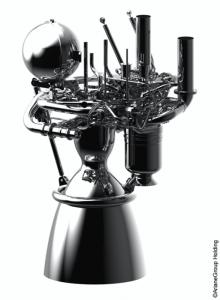
Rendering of the reusable methane fueled Promethus engine.

** Sierra Nevada posts snapshots from Dream Chaser assembly:

** Briefs:

==================

Check out the
The Lurio Report
for news and analysis of key developments in NewSpace

The latest issue:
Masten Goes Lunar, Rocket Lab, New Space and a Virus
Vol. 15, No. 3, May 2, 2020

Space Frontier Foundation Award for NewSpace Journalism

==================

** SpaceX:

**** SpaceX aiming for four launches in June:

  • June 3:  Successful launch of Starlink 7
  • June 12 – Starlink 8 + Planet Labs SkySats 16-18
  • June 24 – Starlink 9 + Two Blacksky/LeoStella satellites
  • June 30 – USAF GPS-III-SV03

Acceleration of the Starlink deployments is very important for the company and two or more Starlink flights per month are likely to become the norm: Evaluating SpaceX’s Starlink Push – NASASpaceFlight.com.

**** A Falcon 9 booster landed after a 5th flight following the Spacelink 8 launch on June 3rd. A previous booster flew five times but its 5th landing failed due to a mistake during refurbishment. The boosters for the Falcon 9 Block 5 vehicles, considered the final major variant of the F9 system, were designed to fly 10 times before undergoing either major refurbishment or retirement. So this booster will no doubt be used for a 6th flight. Turn around times were predicted by Elon Musk to go as low as 24 hours but so far have not been less than a couple of months. With the pressure on to launch Spacelink satellites as quickly as possible, it will be interesting to see if the turnaround times decrease substantially.

**** Booster from June 3rd Starlink launch has already gone horizontal at Port Canaveral. Leg retractions now happen quite soon after the boosters are lifted from the landing platforms onto the dock.

A video of the booster returning to Port Canaveral on June 7th:

**** Starlink and Dragon spacecraft share some hardware and software technology: SpaceX engineers flash some facts about Starlink satellites – Geekwire

    • The technology used for the display screens on the Crew Dragon also provided the basis for the user interface on the first two prototype Starlink satellites, launched in 2018. “It’s grown a ton since then, but it was awesome to see Bob and Doug using something that somehow felt familiar to us too,” Monson wrote.
    • SpaceX relies on the Linux operating system in its satellites as well as its rockets. “Each launch of 60 satellites contains more than 4,000 Linux computers,” Monson said. “The constellation has more than 30,000 Linux nodes (and more than 6,000 microcontrollers) in space right now. And because we share a lot of our Linux platform infrastructure with Falcon and Dragon, they get the benefit of our more than 180 vehicle-years of on-orbit test time.”

**** NASA agrees to allow crew missions to fly with previously flown Dragon spacecraft and first stage boosters. This is similar to what happened with cargo missions. After initial flights with all new systems are performed successfully, NASA will allow to the utilization of previously flown Dragon 2 vehicles and F9 boosters. There will be certification procedures to insure the systems are as ready for flights as  new unused systems would be.

**** Astronauts launched on first crewed Dragon mission will stay at the ISS till August. : NASA anticipates August return for Hurley and Behnken – Spaceflight Now

SpaceX’s Crew Dragon spacecraft will likely return to Earth in August to wrap up a test flight to the International Space Station with NASA astronauts Doug Hurley and Bob Behnken, a senior space agency official said Tuesday.

The exact schedule for Hurley and Behnken’s return to Earth will hinge on several factors, such as the performance of their Crew Dragon spaceship, the progress of their work on the space station, and weather conditions in the capsule’s landing zones in the Atlantic Ocean and the Gulf of Mexico, according to Ken Bowersox, the acting associate administrator for NASA’s human exploration and operations mission directorate.

Bowersox said Tuesday that the Crew Dragon’s Demo-2 mission — the first SpaceX mission to carry astronauts — is proceeding as planned, and the crew capsule is performing well since its launch on a Falcon 9 rocket May 30 from the Kennedy Space Center and docking with the space station one day later.

The first operational crew mission with four astronauts aboard a Dragon is expected to lift off in late August or early September:

NASA astronauts Mike Hopkins, Victor Glover, Shannon Walker, and Japanese astronaut Soichi Noguchi are training for the Crew-1 mission. The Crew-1 flight will only launch after the return of the Demo-2 mission, and a subsequent review of data from the Crew Dragon test flight.

While the spacecraft for the Demo-2 mission came with a four-month certified mission lifetime, the Dragon for the Crew-1 flight will be certified for a full-duration 210-day mission, according to NASA.

Stich said there are several modifications to the capsule SpaceX is building for the Crew-1 mission, although major components such as the capsule’s life support system and guidance, navigation and control systems are largely unchanged.

“The Crew-1 vehicle can land in a little bit higher wind state,” Stich said. SpaceX has changed some of the outer composite panels to make that a little stronger.”

“It also has the capability not only dock to the forward port of the space station, but it can go to the zenith (space-facing) port as well, so it has that capability, and it has a couple other features,” Stich said.

**** 10 years since the launch of the first Falcon 9. Here’s an article about the history of the F9 highlighted by a couple of interesting stories about improvisations that got the early F9s into orbit on time: Forget Dragon, the Falcon 9 rocket is the secret sauce of SpaceX’s success | Ars Technica

Musk hated to substantially delay the mission. With this first launch of the Cargo Dragon spacecraft, he knew full well SpaceX stood to make history. No private company had ever launched a spacecraft into orbit before and then safely retrieved it. So he took out his phone and rang up Marty Anderson, one of the company’s ace technicians.

“Hey Marty, do you think you can just go and climb in the interstage and cut the bottom six inches off the skirt?” Musk asked.

No joke—Musk wanted Anderson to go into the rocket with a pair of metal shears and trim the bottom of the skirt. This was the solution to a tear in an engine nozzle.

Anderson was game. Hours later, he flew on Musk’s private jet from the company’s factory in California to Florida, got into a lift, and rode a crane up to the interstage. This happened with the rocket standing upright, out on the launch pad. Soon, Anderson had snipped away the skirt at the bottom of the engine.

**** Starship

****** The cleanup following the SN4 explosion proceeded rapidly and another launch platform will be ready soon. According to road closure schedules and FAA notices, the SN5 prototype is expected to roll out to the launch site this week and engine tests restarted soon thereafter.

More at SpaceX set for a swift return to testing following Starship SN4 anomaly – NASASpaceFlight.com.

** Elon makes Starship the primary focus for SpaceX. With the successful launch of the Crew Dragon spacecraft to the ISS with two astronauts on board, the development of the Falcon vehicle Crew systems is essentially complete. The company will need to insure that Crew and Cargo operations are carried out efficiently and safely, but the hardware development segments of the company can now move on to other projects. These will now be centered on development of the Starship and its Super Heavy Booster systems: Elon Musk email to SpaceX employees: Starship is the top priority – CNBC

SpaceX launched astronauts for the first time barely a week ago but CEO Elon Musk does not want the company resting on its laurels.

Instead, Musk urged SpaceX employees to accelerate progress on its next-generation Starship rocket “dramatically and immediately,” writing Saturday in a company-wide email seen by CNBC.

“Please consider the top SpaceX priority (apart from anything that could reduce Dragon return risk) to be Starship,” Musk wrote in the email.

See also

****** SpaceX drops plans to restart Starship activities at a facility at Port of L.A. While some design and component manufacture will be carried out at the Hawthorne, California headquarters, it appears that Texas will be the primary site for most all Starship  development, assembly, and testing activities.

****** View of the Boca Chica facilities:

The next major structure for Boca Chica is a building to assemble the huge Super Heavy booster: SpaceX’s Starship Super Heavy booster needs a custom assembly tower – Teslarati

**** Selections of videos showing activity at Boca Chica during the past week:

****** June 5: SpaceX Boca Chica – Starship SN7 taking shape as launch site is prepared for SN5 – NASASpaceflight – YouTube

With Starship SN5 days from rolling to the launch site Starship SN7 sections (inc. “mystery dome”) are being prepared for stacking next to Starship SN6 in the High Bay! Video and Photos from Mary (@bocachicagal). Edited by Jack Beyer (@thejackbeyer)

****** June 6:  SpaceX Boca Chica – New Starship Nosecone Peeking – NASASpaceflight – YouTube

While preparations continue at the launch site for the arrival of Starship SN5, future Starships are lining up for their turn. Another new nosecone was spotted peeking out of one of the big tents. Video and Photos from Mary (@bocachicagal). Edited by Jack Beyer (@thejackbeyer)

****** June 8:  SpaceX Boca Chica – Launch Pad prepares to receive Starship SN5 – NASASpaceflight – YouTube

Lots of work on the newly installed launch mount at the Boca Chica launch site was ongoing on Sunday as Starship SN5 prepares for this coming week’s rollout for testing. Video and Photos from Mary (@bocachicagal). Edited by Jack Beyer (@thejackbeyer)

****** June 8:  SpaceX Boca Chica – SN6 prepares as launch site work continues – NASASpaceflight – YouTube

While work continues at the SpaceX Boca Chica launch site ahead of Starship SN5’s arrival later this week, Starship SN6 is almost ready to become a complete stack via work on the thrust section. Video and Pictures from Mary (@bocachicagal)

****** June 9: SpaceX Boca Chica – SN7 dome goes for a flip – NASASpaceflight – YouTube

Three Starships in work at SpaceX Boca Chica, highlighted by a flip of a SN7 dome, that is either a common or top dome, but is certainly looks different to previous domes. Video and Photos from Mary (@bocachicagal). Edited by Jack Beyer (@thejackbeyer).

** Webcast rocket reports:

**** SpaceX Starship News with SN5, SN6 and SN7, Crew Dragon to be reused for Crew flights, StarlinkMarcus House

**** Scott Manley reviews rocket designs that SpaceX proposed but later dropped:

==
=====

=== Space Art from C. Sergent Lindsey ===

Sweatshirt imprinted with Space Art from C. Sergent Lindsey.

Space transport roundup – June.2.2020

A sampling of recent articles, videos, and images dealing with space transport (find previous roundups here):

** A SpaceX Falcon 9 successfully placed a Dragon into orbit on Saturday with astronauts Doug Hurley and Robert Behnken on board.  About 19 hours later, the spacecraft successfully docked to the Int. Space Station. This was the first time that a commercial, privately developed launch system put humans into orbit.

As on the first launch attempt last Wednesday,  weather had been poor on Saturday but cleared up in the last hour before the scheduled liftoff time and the launch went very smoothly. The first stage booster landed safely as well on a platform at sea. During a live broadcast from the Dragon (see video below), the astronauts announced that the Dragon had been christened Endeavor.

On Sunday morning the Dragon reached the Station and docked with it about 20 minutes earlier than expected. An hour or so later, the crew opened the hatch and entered the station to hugs from the three station occupants – NASA astronaut Chris Cassidy and Russian cosmonauts Anatoly Ivanishin and Ivan Vagner.

See also:

More about DM-2 and other SpaceX activities below.

** Virgin Orbit‘s first launch attempt of the LauncherOne rocket failed when the engine cut off shortly after firing. Virgin Orbit Ignites LauncherOne Rocket During First Launch Demo, Mission Safely Terminated – Virgin Orbit

Virgin Orbit, the California-based satellite launch company, conducted a launch demonstration of its innovative air-launched rocket today in the skies over the Pacific Ocean just off the California coast. The company successfully completed all of its pre-launch procedures, the captive carry flight out to the drop site, clean telemetry lock from multiple dishes, a smooth pass through the racetrack, terminal count, and a clean release. After being released from the carrier aircraft, the LauncherOne rocket successfully lighted its booster engine on cue — the first time the company had attempted an in-air ignition. An anomaly then occurred early in first stage flight, and the mission safely terminated. The carrier aircraft Cosmic Girl and all of its crew landed safely at Mojave Air and Space Port, concluding the mission.

“Our team performed their prelaunch and flight operations with incredible skill today. Test flights are instrumented to yield data and we now have a treasure trove of that. We accomplished many of the goals we set for ourselves, though not as many as we would have liked,” said Virgin Orbit CEO Dan Hart. “Nevertheless, we took a big step forward today.  Our engineers are already poring through the data. Our next rocket is waiting. We will learn, adjust, and begin preparing for our next test, which is coming up soon.”

The company’s next rocket is in final stages of integration at its Long Beach manufacturing facility, with a half-dozen other rockets for subsequent missions not far behind. Virgin Orbit’s decision to begin production of multiple rockets well in advance of this test flight will enable the team to progress to the next attempt at a significantly faster pace, shortly after making any necessary modifications to the launch system.

More about the launch attempt: Mission Recap: Our First Launch Demo | Virgin Orbit

About 9 seconds after drop, something malfunctioned, causing the booster stage engine to extinguish, which in turn ended the mission. We cannot yet say conclusively what the malfunction was or what caused it, but we feel confident we have sufficient data to determine that as we continue through the rigorous investigation we’ve already begun. With the engine extinguished, the vehicle was no longer able to maintain controlled flight — but the rocket did not explode. It stayed within the predicted downrange corridors of our projections and our Federal Aviation Administration (FAA) launch license as the vehicle fell to the ocean, posing no risk to public safety, no danger our aircrew or aircraft, and no significant environmental impact.

See also:

** The Japanese HTV-9 cargo vessel berthed to the ISS on May 25th following its launch on a H-IIB rocket on May 20th.: Japan’s Resupply Ship Installed on Station’s Harmony Module – Space Station/NASA

** China launched Long March 2D rocket with two satellites on Sunday, May 31st from the Jiuquan Satellite Launch Center in China’s northwest Gansu Province: China sends two satellites into planned orbit – Xinhua

As an optical remote sensing satellite, Gaofen-9 is capable of providing photographs with a resolution of about one meter.

It will be used in land surveys, urban planning, road network design and crop yield estimates, as well as disaster relief. It can also serve projects along the Belt and Road.

The other satellite, HEAD-4, was developed by Beijing-based HEAD Aerospace Technology Co. Ltd. It can carry out on-orbit information collection, including that on ships and aircraft, and the Internet of Things.

See also Long March 2D lofts Gaofen-9 – NASASpaceFlight.com.

** China launched two technology demo satellites on a Long March-11 launch vehicle on Friday, May 29th from the Xichang Satellite Launch Center, Sichuan Province in southwest China.

An enhanced LM-11 is in development: Designers working on new, more powerful Long March 11 rocket – Chinadaily.com.cn.

** Rocket Lab returning to launchpad following stand-down due to the corona virus. The Don’t Stop Me Now mission (pdf) aims to send an Electron into orbit during a window that between June 11 – 24. The Electron

will launch several small satellites, including the ANDESITE (Ad-Hoc Network Demonstration for Extended Satellite-Based Inquiry and Other Team Endeavors) satellite created by electrical and mechanical engineering students and professors at Boston University. The satellite will launch as part of NASA’s CubeSat Launch Initiative (CSLI) and will conduct groundbreaking scientific study into Earth’s magnetic field. Once in space, the ANDESITE satellite will initiate measurements of the magnetosphere with onboard sensors, later releasing eight pico satellites carrying small magnetometer sensors to track electric currents flowing in and out of the atmosphere, a phenomenon also known as space weather. These variations in the electrical activity racing through space can have a big impact on our lives here on Earth, causing interruptions to things like radio communications and electrical systems. The ANDESITE satellite follows on from Rocket Lab’s first ELaNa (Educational Launch of Nanosatellites) launch for NASA, the ELaNa-19 mission, which launched a host of educational satellites to orbit on Electron in December 2018.

The mission also carries three payloads designed, built and operated by the NRO. The mission was procured under the agency’s Rapid Acquisition of a Small Rocket (RASR) contract vehicle. RASR allows the NRO to explore new launch opportunities that provide a streamlined, commercial approach for getting small satellites into space, as well as provide those working in the small satellite community with timely and cost-effective access to space. This mission follows Rocket Lab’s first dedicated mission for the NRO, Birds of a Feather, which was launched on 31 January 2020 NZT from Rocket Lab Launch Complex 1.

The ANDESITE and NRO payloads will be joined on the mission by the M2 Pathfinder satellite, a collaboration between the University of New South Wales (UNSW) Canberra Space and the Australian Government. The M2 Pathfinder will test communications architecture and other technologies that will assist in informing the future space capabilities of Australia. The satellite will demonstrate the ability of an onboard software-based radio to operate and reconfigure while in orbit.

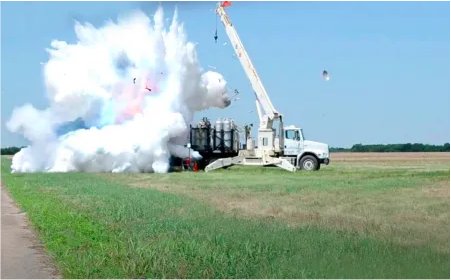
** EXOS Aerospace engine test a success but ends with test stand tank failure: Dramatic Engine Test Dubbed Success Amidst Explosion | EXOS Aerospace

Set upon the Caddo Mills (Texas) Airport Testpad, Exos Aerospace’s new SARGE R2 rocket engine was ready for testing. The efficient eight-man Operations Team of Exos prepared to conduct a 55- second engine run test.

In the briefest moment, as the valves opened and the liquid oxygen mixed with the Ethanol fuel the ambient noise was sucked into a vapor of silence, then blasted by the roar of a clean-burning engine. For 15 seconds, the perfect fiery exhaust gave a glimpse into the thrust that will fly the Exos’ SARGE R2 rocket.

But the impressive display of power was cut short by the failure of the LOX tank on the test stand, resulting in the near-instantaneous release of the liquid oxygen and ignition of the residual Ethanol in the supply lines between the tanks and the engine. This created all the pomp & circumstance expected of such an energetic event. After the level-two Safety event was under control, the Exos team was in good spirits, as they seemed more focused on the new data and slight performance boost of the SARGE engine than with the theatrics that accompanied the test.

A liquid oxygen tank on the mobile test stand failed during an engine test on Mar.27, 2020. Credits: EXOS Aerospace

** Interview with Masten Space CEO: Evadot Podcast #116 – Sean Mahoney CEO of Masten Space Systems – Evadot

We talk about a huge range of subjects, from how he got there, to entrepreneurial strategies and how the current Space industry is preparing us for a future worth looking forward to.

Sean has over 15 years of corporate and technology industry experience, having founded and led a number of technology start-up ventures, and raised multiple rounds of private funding. Sean received his MBA from Emory University’s Goizueta Business School and serves in a leadership capacity for a number of entrepreneurship and environmental non-profit organizations, including serving as Chairman of the Board of the Space Frontier Foundation.

** Briefs:

==================

Check out the
The Lurio Report
for news and analysis of key developments in NewSpace

The latest issue:
Masten Goes Lunar, Rocket Lab, New Space and a Virus
Vol. 15, No. 3, May 2, 2020

Space Frontier Foundation Award for NewSpace Journalism

==================

** SpaceX:

**** SpaceX achieves human orbital spaceflight after a hectic 18 year trek. In an interview with Irene Klotz  recorded before the launch, Elon Musk describes some of the trials and tribulations that he and SpaceX endured during the long struggle to reach the point where a SpaceX rocket will send people to orbit for the first time: Podcast: Interview with SpaceX’s Elon Musk – Aviation Week Network (subscription not required). He also briefly recounted the SpaceX story during the post-launch briefing on Saturday:

**** Misc. DM-2 resources:

**** SpaceX Falcon 9 launch of 60 Starlink satellites set for Wednesday, June 3rd. They aim to

They aim to capture the nosecone fairings as well:

See also SpaceX to ring in Crew Dragon’s success with a Starlink launch and landing – Teslararti

**** Starship

The Starship program, currently centered at Boca Chica Beach in South Texas, continues to exhibit an amazing mixture of assembly-line vehicle construction running at a furious pace with prototype tests that fluctuate between incremental successes and hugely energetic failures.

On May 19th, the third test firing of the SN4 prototype seemed to go well but as the plume dissipated,  small fires could be seen around the base of the vehicle and the launch mount.  Remote controlled water sprays eventually got the flames under control but it was more than a day before anyone approached the vehicle.

Another test fire happened on Thursday May 28th without any subsequent extraneous fires breaking out:

Before that test, there was an announcement from the FAA that SpaceX had been awarded a license to carry out suborbital test launches for the Starship:

While it appeared from this successful test that the SN4 was poised to do a brief hop, Elon Musk had said in the Aviation Week interview (see above) that they would wait to do a flight after the Crew Dragon launch.  This was presumably to prevent any distraction from the most important SpaceX mission since the founding of the company and to avoid any negative vibes that could result from a mishap.  The road closure schedule and FAA NOTAMs hinted, however, that a test flight might be attempted during the week after the Dragon launch.  SpaceX’s first Starship hop on hold for historic Crew Dragon astronaut launch – Teslarati

Pushing its luck, SpaceX tried another engine tests on Friday, May 29th. The Raptor firing  appeared to go well but a minute or so after the engine shut off, methane began pouring out at a point on the interface between the support stand and the vehicle. A few seconds later, a huge fiery explosion enveloped the vehicle when the methane ignited. After the flames and smoke died down, it appeared that the vehicle had vanished but in fact its mangled remains lay on the ground be the test stand. SpaceX Starship SN4 prototype explodes in dramatic fireball – Teslarati.

Elon said in comments following the post-DM2 briefing that the methane leak was due to a problem with a test of the quick disconnect mechanism that allows the fuel line to separate from the vehicle as it lifts off the pad:

Elon Musk, leaving the KSC press site just now, said of yesterday’s Starship test in Boca Chica Texas: “Unfortunately what we thought was going to be a minor test of a quick disconnect ended up being a big problem,” referring to the explosion.

With two out of three engine tests marred by serious problems at the interface between the vehicle and the ground support equipment, it might seem that SpaceX needs to take a pause to do some redesign and component testing. Note that using liquid methane in a large rocket and feeding propellants from the base rather than from umbilical towers are both new technological challenges. It will take SpaceX some time to get them right.

Scott Manley  discusses “What Can We Learn From The Explosion Of The Latest SpaceX Prototype?”:

After several weeks of testing Starship prototype SN4 something went wrong minutes after a successful engine test. A massive fuel leak caused an explosion which wrecked the vehicle and cause significant damage to the test stand. As far as we know nobody was injured and there are prototypes already waiting in the wings to continue tests. …

… I believe that unlike the first few failures due to welding quality this is not related to the manufacture of the rocket, but in the way it’s connected to the ground service equipment that resulted in the propellent loading lines coming loose and spraying liquid methane everywhere.

****** Elon Musk said at the post-launch briefing for DM-2 that he hopes Starship to be operational within 2-4 years, though he admits scheduling is not his strong point. Gwynne Shotwell is on the same page:

****** SpaceX has raised additional funding for development of Starships as well as for the Starlink broadband Internet constellation : SpaceX raises more than half a billion dollars for Starship, Starlink programs – Teslarati

****** Aerial views of the Boca Chica construction and pad sites – Starship SN4 Ultimate Fly Over! – May 25 – LabPadre – YouTube

Feast your eyes on this exquisite aerial footage of SpaceX’s Starship SN4. These images will knock your socks off! SpaceX Boca Chica, Texas is more like a new city now. All images are explicitly owned by LabPadre Media and may not be used without written permission.

****** May.26: SpaceX Ultimate Rocket Shipyard Fly Over! LabPadre – YouTube

Feast your eyes on this exquisite aerial footage of SpaceX’s Starship Shipyard facility. These images will knock your socks off! SpaceX Boca Chica, Texas is more like a new city now. All images are explicitly owned by LabPadre Media and may not be used without written permission.

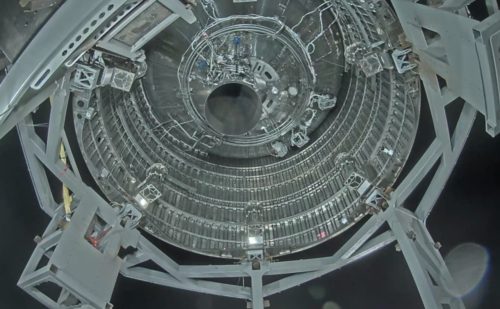
**** Construction of Prototypes SN5, SN6, and SN7 continues. The videos below show that SN5  is stacked except for a nosecone. SN6 is nearly fully stacked as well. Parts for SN7 have been seen. Here is a diagram showing the state of SN6 assembly:

****** May 23:  SpaceX Boca Chica – Starship SN6 Section in the High Bay – NASASpaceflight – YouTube

While SN4 undergoes work at the launch site, SN5 is waiting in the VAB/High Bay, with a SN6 section paying a visit. Video also includes new – and very cool – SpaceX Food Truck! Video and Photos from Mary (@bocachicagal).

****** May 30:  SpaceX Boca Chica – Starship SN4 Aftermath – Successors Line Up – NASASpaceflight – YouTube

****** May 31: SpaceX Boca Chica – New Starships Prepare during Launch Site clearing – NASASpaceflight – YouTube

Several Starships are waiting for their turn at testing on the Boca Chica launch mount(s) as the clearing of SN4’s remains continues – notably under a Sunday Rainbow. Video and Photos from Mary (@bocachicagal). Edited by Jack Beyer (@thejackbeyer).

****** June 1: SpaceX Boca Chica – Starships SN5 and SN6 in the High Bay – SN7 Sleeved – NASASpaceflight – YouTube

****** June 2: SpaceX Boca Chica – SPadre – YouTube

** Webcast rocket reports:

**** Starship SN4 Explodes, Crew Dragon Demo 2, Rocket Lab’s 3 years and Virgin Orbit LauncherOne testMarcus House

**** SpaceX Starship Updates – Crew Dragon Demo 2 Launch Attempt SummaryWhat about it!?

=== Amazon Ad ===

2008-2018: A NewSpace Primer

Space transport roundup – May.23.2020

A sampling of recent articles, videos, and images dealing with space transport (find previous roundups here):

** Final reviews and preparations underway for first crewed Dragon mission to the ISS. On Friday, the joint NASA/SpaceX Flight Readiness Review (FRR)  gave the  Demonstration Mission-2 (DM-2) a Go for liftoff next Wednesday.  And a couple of hours later, SpaceX carried out a successful static test firing at Pad 39A of the Falcon 9’s booster engines. A “dry dress rehearsal” today will have the crew in full flight suits board the capsule and go through all activities short of firing the engines.

The liftoff is set for 4:33 pm EDT on May 27th. This is an instantaneous window so any problems during the countdown will lead to a delay of the launch. The next available launch opportunities are on Saturday, May 30 at 3:22 p.m. EDT (19:22 UTC) and on Sunday, May 31 at 3:00 p.m. EDT (19:00 UTC).

Weather looks to be a major factor since not only does the weather at the Cape need to be acceptable, but it must also be acceptable at 50 points along the ground track from the Cape to West Europe where the Dragon could land if there is an in-flight abort. The current weather forecast (pdf) from the USAF Weather Squadron at Patrick AFB gives only a 40% chance of acceptable conditions at the Cape for liftoff on Wednesday.

Here is a video of the post-FRR press conference:

https://youtu.be/YWT68ASS5uw

And here is a view of the test firing from the team at www.USLaunchReport.com.

Find more about DM-2 and other SpaceX activities below

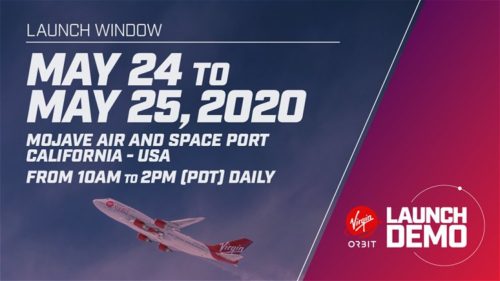
** Virgin Orbit will attempt the first air launch of the LauncherOne rocket this weekend: Announcing the Window for Our Launch Demo | Virgin Orbit

We are extremely excited to announce that the window for our Launch Demo mission starts on Sunday, May 24th, and extends through Monday, May 25th, with an opportunity to launch from 10 A.M. – 2 P.M. Pacific (17:00 – 21:00 GMT) each day.

That means that this weekend, our 747 carrier aircraft Cosmic Girl will prepare to take off from Mojave Air and Space Port, fly out over the Pacific ocean, and release our two-stage, orbital rocket, LauncherOne — which will then proceed to ignite its engine in mid-air for the first time.

This Launch Demo marks the apex of a five-year-long development program. On our journey to open up space for everyone we’ve conducted hundreds of hotfires of our engines and our rocket stages, performed two dozen test flights with our carrier aircraft, and conducted countless other tests of every bit of the system we could test on the ground.

Launching from the Earth to space is mind-bogglingly difficult. Thousands of components all need to function as planned while controlling high energy and flying at incredibly fast speeds. The vehicle’s structures must be robust enough to tolerate traveling at up to 18,000 mph without disintegrating; the temperatures and pressures of its propellants can’t be too high or too low; every internal valve must click open and closed in perfect synchronicity… There’s a long list of factors that need to line up in order to make it all the way. We’re mindful of the fact that for the governments and companies who have preceded us in developing spaceflight systems, maiden flights have statistically ended in failure about half of the time.

In the future, the goal of our launches will be to deploy satellites for a new generation of space-based services. For this Launch Demo, though, our goal is to safely learn as much as possible and prove out the LauncherOne system we’ve worked so hard to design, build, test and operate.

The instant our Newton Three engine ignites, we will have done something no one has ever done before — lighting an orbital-class, liquid-fueled, horizontally-launched vehicle in flight. Once we reach an altitude of 50 miles it will be the first time this kind of launch system will have ever done so.

We’ll continue the mission for as long as we can. The longer LauncherOne flies, the more data we’ll be able to collect. Should we defy the historical odds and become one of those exceedingly rare teams to complete a mission on first attempt, we will deploy a test payload into an orbit, take our data, and then quickly de-orbit so as not to clutter the heavens.

Scott Manley gives his preview of the test:

Virgin Orbit have announced their first test launch is targeted for Sunday May 24th, they’ll attempt to launch their Launcher One rocket into orbit from the Cosmic Girl carrier aircraft. The launch will occur over the Pacific ocean west of Southern California. It’s the first time a cryogenically fueled air launched orbital rocket has been attempted, so it’ll be fascinating to see whether all the engineering, planning, testing and rehearsals will reward the company with a successful launch on their first attempt. Most rockets fail on their first attempt, and since this is doing a number of new things the team are prepared to accept even a partial success as a win. The Kerbal 747 Craft File was built by Sea2007 https://kerbalx.com/SEA2007/Boeing-74...

** Japan launched a HTV cargo module to the ISS on H-2B rocket.  Final H-2B rocket launch sends Japanese supply ship toward space station – Spaceflight Now

The ninth and final flight of Japan’s H-2B rocket — the country’s most powerful launcher — drove an automated cargo freighter into orbit Wednesday on a five-day pursuit of the International Space Station.

The 186-foot-tall (56.6-meter) launcher lifted off from the Tanegashima Space Center in southern Japan at 1731 GMT (1:31 p.m. EDT) Wednesday, sending an HTV supply ship into space with 2.5 million pounds of thrust from four solid rocket boosters and two hydrogen-fueled core engines.

Wednesday’s launch was the last in a series of nine H-2B rockets, and also marked the ninth and final flight of Japan’s current-generation barrel-shaped HTV cargo carriers. Japan is developing a more capable supply freighter named the HTV-X, which will deliver heavier payloads to the space station.

The HTV-X is scheduled for its first flight to the space station in 2022, and it’s designed to eventually fly supplies to the planned Gateway mini-space station in orbit around the moon.

The H-2B and the less powerful H-2A rocket will be replaced by a new, less expensive Japanese launcher named the H3, which will launch the HTV-X missions. MHI and the Japan Aerospace Exploration Agency, or JAXA, are jointly developing the H3 rocket, which could be ready for an inaugural test flight before the end of 2020.

See also:

** ULA Atlas V rocket successfully placed a X-37B spaceplane into orbit. The 6th X-37B mission includes both classified and unclassified payloads:

On its USSF-7 flight, the X-37B is expected to demonstrate new capabilities – including flying with the service module for the first time. This module, which is attached to the aft end of the spacecraft, hosting additional equipment and experiments for the mission. Ahead of launch Barbara Barrett, the Secretary of the Air Force, stated that this mission would carry out more experiments than any previous OTV flight. The X-37B spacecraft incorporates a payload bay that can be opened in orbit to expose experiments to space. A solar panel, deployed from the bay, provides power to the spacecraft and its experiments.

During the course of its mission, X-37B will deploy the small FalconSAT-8 satellite for the US Air Force Academy. The latest in a series of experimental satellites built by the Academy for technology demonstration and to give cadets experience constructing and operating spacecraft. FalconSAT-8 carries eight experiments. Two of these are being carried on behalf of NASA, investigating the effects of the space environment and radiation on material samples in one experiment, and on seeds in the other. FalconSAT will also conduct an experiment for the Naval Research Laboratory to investigate wireless power transfer, generating electrical power through the satellite’s solar panels and transmitting it to the ground as microwave radiation.

—- Atlas V USSF-7 Launch Highlights – United Launch Alliance (ULA)

A United Launch Alliance (ULA) Atlas V rocket carrying the USSF-7 mission for the U.S. Space Force lifted off from Space Launch Complex-41 on May 17 at 9:14 a.m. EDT. This marks the 84th successful launch of an Atlas V rocket, 139th launch for ULA, the second launch for the U.S. Space Force and the sixth flight of the X-37B Orbital Test Vehicle (OTV-6).

—- AtlasV – USSF-7 – X37B Space Drone Launch 05-17-2020USLaunchReport

** Russia launched a missile warning satellite today from the Plesetsk Cosmodrome in northern Russia.

** UK-based Skyrora launch provider test fired a Skylark L rocket on a mobile launch system: First time that a team has built a mobile launch complex and successfully live tested a complete rocket vehicle within five days – Skyrora

Edinburgh, Scotland, 20 May 2020 – The UK’s Space race heats up as Skyrora effectively made the UK ready for launching rockets into space after a team successfully built a mobile launch complex and completed a full static fire test with the Skylark L rocket on it – in only five days. Skyrora’s combined achievement also signifies the first vertical static fire test of this magnitude in the UK since the Black Arrow Programme, 50 years ago. The Skylark L rocket could be ready to launch from a British spaceport as early as spring 2021 and the inaugural launch of the low Earth orbital (LEO) Skyrora XL rocket by 2023.

The ground test at the mobile launch complex at Kildemorie Estate in North Scotland earlier this month, saw Skyrora’s launch vehicle, Skylark L perform all actions of a launch while restrained to the ground and prevented from taking off.

Skylark L is a bi-liquid propellent launch vehicle. It is Skyrora’s first sub-orbital flight vehicle, ready to reach a height of approximately 100km, just on the Karman line, and carry a payload of up to 60kg. Skylark L uses a propellent combination of Hydrogen Peroxide and Kerosene which are pressure fed into a Skyrora 30kN engine. Building up to the static fire test, the rocket engine itself has gone through three hot fire tests before integration into the vehicle. When commercial, the company plans to use their own Ecosene, an equivalent Kerosene fuel made from un-recyclable plastic waste. In Skyrora’s rocket suite, its aim is to start with launching sub-orbital rockets and move to orbital by 2023.

The full static firing test, fully checked out the design and in-house manufacture, making sure the vehicle itself is ready for launch. It was also successful in the feed system validation tests leading up to the full static fire test. During the test, Skylark L was supported by Skyrora’s transporter-erector that was fixed to the trailer.

In order to complete this test, the Skyrora team accomplished the build of a mobile launch complex in record time right in the heart of the Scottish Highlands.

The mobile complex was made up of several modules including, a command centre, oxidiser and fuel handing containers and a compressed gas container. During the test, the Bells and Two Tones Fire and Rescue team were onsite ready to perform any necessary procedures if anything was to go wrong.

Leading the operations of Skylark L’s static fire testing, Dr Jack-James Marlow said: “It is very hard to oversell what we have achieved here with this test; the whole team has pulled through again to deliver another UK first. We have successfully static tested a fully integrated, sub-orbital Skylark L launch vehicle in flight configuration. This means we performed all actions of a launch but did not release the vehicle. The rocket engine successfully burned, with all vehicle systems showing nominal operation.

** A Relativity Space 3D-printed propellant tank passed pressure tests: Relativity Space verifies 3D printing works to build its rocket – CNBC

The burst pressurization tests helped the company verify its ambitious 3D-printing approach to building rockets, as well as the materials it’s using. Ellis said the tank burst at about “10% more than the requirements with the safety factor” needed for a launch.

“It’s definitely sufficient for the whole launch vehicle,” Ellis said, adding that “we’ve got two years to keep making it better.”

Relativity also nabbed a top SpaceX manager:

** Rocket Lab gearing up for 12th Electron launch following the lifting of the lockdown in New Zealand:

Here is a Bloomberg interview with Rocket Lab CEO Peter Beck:

*** Skyroot Aerospace is an Indian startup launch services company. The Vikram Launch Vehicles will provide increasing orbital payload capabilities. The Vikram I rocket will use solid fueled motors to put 225 kg into 500 km orbits.

A statement from Pawan Kumar Chandana, the co-founder & CEO of the company:  The Greater Indian Space Ecosystem – The super power of the future

In my view, space is a sector with clear achievable objectives for the decades to come like more launches, rapid re-usability to enable satellite constellations and human space travel. To me the biggest barrier to all space activities is ‘speed’ or rapid developmental cycles. At Skyroot, that is exactly what we are building a culture around –rapid development of complex aerospace systems with lean use of resources. We are building the first private Indian launch vehicle to put a satellite in orbit and marching ahead to compete for a reasonable share in the international small satellite launch market which is estimated to be $16Bn in the next decade. hiCompleting seven months of advanced development, we are building an ecosystem of quick development of aerospace systems in speeds never imagined before. The idea of Skyroot was born from the need of having an internationally competent company with the capability of complementing ISRO’s capacity to meet our nations Space aspirations. hiIn this process, we are taking baby steps into our eventual goal of pushing the boundaries of spaceflight to uplift our civilization out into the cosmos.

** Rocket Crafters completes test program for prototype hybrid rocket engine: Rocket Crafters Concludes Comet Testing | Rocket Crafters

Rocket Crafters, the first space launch company to use additive manufacturing to 3D print rocket fuel, announces the conclusion of testing for the Comet engine, a large-scale proof of concept test model of its STAR-3DTM hybrid rocket engine. The tests were designed to show that the patent-pending hybrid rocket engines could scale from the laboratory to a size more commercially relevant. With 49 successful laboratory tests under their belt ranging from 250 to 500 pounds of thrust, Rocket Crafters initiated testing of the Comet 5000-pound thrust engine in February of this year.

Comet was tested three times. The first two tests were successful, closely matching the performance models that Rocket Crafters created. While still considered successful in terms of research and development, the third test experienced an overpressure anomaly, resulting in damage to the test stand and test engine. After the anomaly, the Rocket Crafters engineering team dug deep into the hardware and recorded data to determine what had occurred and how to prevent it in future tests. After extensive analysis, it was concluded that there was an initial failure in an ancillary part of the engine. This led to a larger over-pressurization inside the combustion chamber. The team found no problems within the core STAR-3DTM engine design.

“This is why we test,” said Rocket Crafters President, Robert Fabian, a twenty-five-year veteran of military space and missile operations and maintenance. “We find and fix problems in testing, so we don’t have them on the launch pad. We’re moving forward from here.”

With the completion of the large-scale proof of concept testing, Rocket Crafters is taking their lessons learned and applying them to their next big project- a test flight powered by a smaller version of the STAR-3DTM hybrid rocket engine. This will be Rocket Crafters’ inaugural launch of a flight engine and the first opportunity to see the performance in motion rather than bolted to a test stand. Rocket Crafters has planned two more consecutively larger test flights into space and back to Earth, and then into orbit. Not long after that, commercial service to Low Earth Orbit with the Intrepid small satellite launch vehicle will begin.

** Neutron Star Systems UG is developing electric propulsion (EP) systems using superconductor technology. The company is a spinoff from research at the Institute for Space Systems (IRS) at the University of Stuttgart.

—-  Plasma Engine for Space Cargo Trucks – The SX3 AF-MPD Thruster:

The future of space is here, and it’s electric! Watch the SX3 in action – an Applied-field Magentoplasmadynamic thruster (or AF-MPD for short) that’s unlocking the future of spaceflight. This type of plasma propulsion uses strong magnetic and electric fields to produce thrust, which is why it’s best suited for high-power applications (think space exploration, or even cargo transfer to the Moon and Mars!).

Developed at the Institute for Space Systems (IRS) at the University of Stuttgart, it’s the most advanced AF-MPD prototype in the world. Here, it’s running on Argon (that’s why it’s blue), but it can also work on many other propellants like Krypton, Ammonia and Hydrogen. This versatility is what gives it huge economic and technological advantages compared to competing technologies.

So far, the SX3 has achieved ground-breaking thrust efficiencies (as high as 63%) and steady-state operation of several hours. This is thanks to the world class professors, researchers, testing facilities, and simulation capabilities at the university.

—- Interview with Marcus Collier-Wright, co-founder of Neutron Star Systems:

** Launcher update:

**  An update on Canadian rocket startup Reaction Dynamics – SpaceQ – Interview with Bachar Elzein, CEO and CTO, and Neil Woodcock, COO, of Reaction Dynamics.


** Watch propellant usage in four famous rockets – If Rockets were Transparent – Hazegrayart – YouTube

Launch to orbit in real time Fuel Burn and Staging of the Saturn V, Space Shuttle,Falcon Heavy and the Space Launch System (SLS) rockets Launching from Kennedy Space Center Launch Complex 39

Red = Kerosene RP-1
Orange = Liquid Hydrogen LH2
Blue = Liquid Oxygen LOX

** Briefs:

==================

Check out the
The Lurio Report
for news and analysis of key developments in NewSpace

The latest issue:
Masten Goes Lunar, Rocket Lab, New Space and a Virus
Vol. 15, No. 3, May 2, 2020

Space Frontier Foundation Award for NewSpace Journalism

==================

** SpaceX:

** Web resources for the DM-2 crew mission to the ISS:

Some perspectives on the mission:

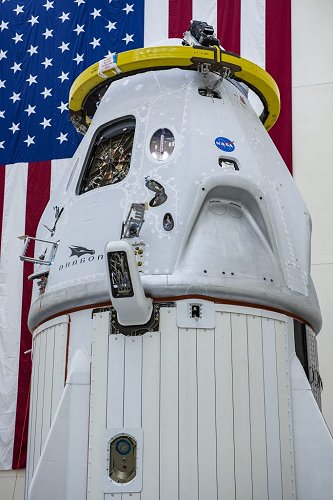
** Crew Dragon and Falcon 9 rocket in the hangar by Pad 39A:

**** SpaceX releases highlights video of Crew Dragon parachute testing in the past year:

****

**** Next Starlink mission delayed till after the DM-2 crew launch. The one day slip of the Atlas V launch of the X-37B last weekend bumped the Falcon 9 launch of 60 more Starlink satellites by a day but then stormy seas made a landing of the booster impossible. So the launch was postponed till after the crew mission.

**** Smallsats sharing of Spacelink rides to space is driving down prices for getting small spacecraft to orbit: SpaceX rideshare program putting downward pressure on prices – SpaceNews.com

“SpaceX is offering pricing that previously wasn’t really seen,” said Mike Safyan, vice president of launch at Planet, an Earth imaging company with more than 150 small satellites in orbit.

Planet announced last week that it will launch six SkySat satellites as rideshare payloads on SpaceX rockets scheduled to launch Starlink broadband satellites. Two sets of three SkySats will ride in separate Starlink missions to low Earth orbit

SpaceX advertises a base price of $1 million for launching up to 200 kilograms and $5,000 extra per kilogram.

The rideshare program is “incredibly competitive,” Safyan told SpaceNews. He called it “one of the more significant programs for the smallsat industry especially because of the pricing, the reliability and the number of orbits.”

**** Starship

****** Fire broke out on the SN4 prototype Starship following a Raptor engine test last week at the Boca Chica Beach facility on May 19th. The engine firing itself seemed to go well but the plume set off a couple of small fires along the base of the vehicle. One of the fires appeared to be fed by insulation wrapping on the launch stand’s metal structure and was put out fairly quickly. Another fire flared near a small pipe that connected into the base of the vehicle. Don’t know if this line contained methane fuel or hydraulic fluid to control the engine. Whatever was flowing in it, the crew appeared to have little or no control over a valve to shut it off. It took probably 15-20 minutes to put out the fire completely with a remotely controlled water hose. Several times it seemed to be snuffed out, only to flare up again. The flames appeared to damage cables going up the side of the vehicle.

Usually after a test, the road by the launch pad area is reopened and a group of techs and engineers soon arrive in a fleet of vehicles to resume work on the vehicle. This time, however, the road remained closed for over a day and no one other than a drone approached the vehicle. Though there had been forceful venting from the liquid methane and oxygen tanks following the engine firing, some hazardous fluids and/or gases must have remained in the vehicle. Perhaps damage from the fire had severed the control room’s connections to the valves and sensors needed to fully safe the vehicle after the test. There was no statement released by the SpaceX team at Boca Chica or by Elon Musk explaining what was going on with the vehicle.

There were times during the continuous live video of the vehicle through the rest of the day and night when one could see some vapor emitted near the base of the vehicle. It was perhaps this additional venting that eventually made the vehicle safe enough to approach. By the afternoon of the 20th, the road was finally opened and techs arrived to begin working on the vehicle,. It seems the damages were not too serious since SpaceX has scheduled further testing at the site. This presumably includes another static firing and then a short hop flight.

More about last week’s test at SpaceX Starship prototype charred but intact after catching fire – Teslarati

Here is a video of the engine test and the resulting fires: 4K Starship SN4 Slow Mo Static FireLabPadre – YouTube

****** SpaceX’s Starship Test HistoryNickHenning3D – YouTube

With the impending hop of SpaceX’s Starship SN4 and its continuing successful tests, I wanted to show how they got to where they are in just over 1 year. After the successful 150 meter flight of Starhoper in August of 2019 SpaceX went all in on development of the Starship spacecraft and us rocket fans couldn’t be happier. These are very simplified animations of what basically occurred with each test article.

****** Speculative First Flight of SpaceX’s Starship SN-4NickHenning3D – YouTube

Speculation time! This is my simplified animation on how SN4 might look on its first flight, landing legs and all. With the single Raptor engine mounted in its place off center, it will need to balance its center of gravity with a bit of tilt. In reality it will land on an adjacent cement landing pad, but for animation reasons I had it land next to the test stand. Enjoy!

**** While SN4 was struggling to get off the Boca Chica launch pad, assembly of more Starship prototypes continued in the manufacturing area. Here are some videos over the past several days showing the work on SN5 and SN6.

****** May 19: SpaceX Boca Chica – Starship SN4 fires up as SN6 makes an appearance – NASASpaceflight – YouTube

Three Starships in various stages of flows, with Starship SN4 undergoing her third – and slightly eventful – Static Fire test (first with Raptor SN20), SN5 in the High Bay and SN6 turning up outdoors. Video and Photos from Mary (@BocaChicaGal). Edited by Jack Beyer (@thejackbeyer).

****** May 20: SpaceX Boca Chica – Starship Nosecones learn their fate – NASASpaceflight – YouTube

While Starship SN4 continues safing operations, SN5 is gaining its nosecone section at the same time as another nosecone was moved for dismantling. All the pieces for a full stack Starship SN5 are now in play. Video and Photos from Mary (@BocaChicaGal). Edited by Jack Beyer (@thejackbeyer).

****** May 21: SpaceX Boca Chica – Checking in on Starship SN4 – NASASpaceflight – YouTube

With the roadblocks removed, Mary checked in to see how Starship SN4 is doing after her (toasty) Static Fire test with Raptor SN20. A little scorched, one of the TPS tiles has fallen off, otherwise… she’s good! VIdeo and Pics by Mary (@bocachicagal)

****** May 21: SpaceX Boca Chica – So Many Starship Nosecones – NASASpaceflight – YouTube

At the Boca Chica Production Facility, the Nosecones are either being prepared for mating with future Starships or finding their fate is the sharp end of a cutting tool. Video and Photos from Mary (@BocaChicaGal). Edited by Jack Beyer (@thejackbeyer).

****** May 22: SpaceX Boca Chica – Re-tuning Starship SN4 – NASASpaceflight – YouTube

Engineers have been repairing minor post-Static Fire damage to Starship SN4 ahead of the next test cycle, while the nosecone merry-go-round continues at SpaceX Boca Chica. VIdeo and Pics by Mary (@bocachicagal). Edited by Jack Beyer (@thejackbeyer)

**** Updates on SN5 and SN6 assembly:

** Webcast rocket reports:

**** SpaceX Crew Dragon Demo 2 Launch this Week, SpaceX Starship News, X-37B military space plane 2020Marcus House

The SpaceX Crew Dragon Demo 2 Launch this Week, SpaceX Starship News and the X-37B military space plane 2020 launched. There is certainly no shortage of news and updates in the space industry since the last video. It’s been another interesting week with SpaceX’s Starship prototype developments with the SN4 breathing fire again with both a pre-burner test and a static fire leading up shortly to that 150-meter flight. The SN5 and SN6 are both being stacked together in the high bay which is a first to see so we’ll dive into all that. We had the amazing X-37B launch on the Atlas V with a bunch of new experiments. The incredible upcoming Crew Dragon mission which will fly Astronauts Bob and Doug is now potentially only days away assuming no delays. This is, of course, the first flight with Crew from the United States for almost a decade. This is going to be a huge week.

**** SpaceX Starship Updates – NASA Artemis UpdateWhat about it!?

In this Episode, we will take a look at the recent Static Fire and analyze, what happened. We will also take a look at a Starship Taco Dome, Serial Number 5s Nose Cone, Starship heat tiles and last but not least, we will take a look at the Artemis progress. How far are NASAs SLS, Orion and the Lunar Gateway?

=== Amazon Ad ===

Frozen Orbit

Space transport roundup – May.14.2020

A sampling of recent articles, videos, and images dealing with space transport (find previous roundups here):

** Two launches from Cape Canaveral this weekendBack-to-back launches scheduled from Cape Canaveral this weekend – Spaceflight Now

**** Saturday, May 16th, a ULA Atlas V rocket will take a X-37B spaceplane into orbit for the 6th mission of the program. (See previous ST Roundup for info on the X-37B mission.) The window for the launch is between 8:24-10:53 am EDT (1224-1453 GMT).

****  Sunday, May 17th, a SpaceX Falcon 9 will put 60 more Starlink satellites into orbit. Over 400 Starlink satellite are already in space. Liftoff is set for 0753 GMT (3:53 a.m. EDT). A storm brewing in the Atlantic, however, may cause a postponement since it could prevent the recovery of the booster, which will be on its 5th flight. To maintain the desired high flight rate for the Starlink program, the boosters need to be reused multiple times. A test firing of the booster engines was successfully carried out yesterday.

Find more SpaceX items below

** China launches Kuaizhou-1A solid fueled rocket with two smallsats (93 kg each )for the Xingyun communications and data relay constellation. The constellation will eventually reach 80 satellites.

** China’s new crew capsule lands successfully a few days after launch on the new Long March 5B:

The core stage made an uncontrolled reentry a week after the launch:

**** Recovery operations for China’s new crewed spacecraft – SciNews/CCTV/CNSA

China’s new-generation crewed spacecraft successfully landed at the Dongfeng landing site, Inner Mongolia Autonomous Region, China, on 8 May 2020, at 05:49 UTC (13:49 local time). During the two days and 19 hours in orbit, the uncrewed spacecraft carried out a series of space science and technology experiments. The spacecraft was transported to the Jiuquan Satellite Launch Center for inspection and verification work. Credit:China Central Television (CCTV)/China National Space Administration (CNSA)

**** Spacecraft Return Capsule Structure Intact as Designed after Return to Earth: Designer – CCTV

The structure of the return capsule of the trial version of China’s new-generation manned spaceship was intact as designed after it landed on the Earth on Friday, a designer of the spaceship said on Saturday.

** History of Chinese spaceplane designs and projects:

** Rocket Lab updates:

** Firefly updates:

** Briefs:

** SpaceX:

** Counting down to launch of astronauts to the ISS on SpaceX Crew Dragon.  Preparations are speeding up for the Commercial Crew Program (CCP) demonstration launch for crew transport to the Station. Liftoff is set for May 27th at

**** Try docking the Crew Dragon to the ISS with the SPACEX – ISS Docking Simulator. Scott Manley gives a tutorial on the simulator:

How To Dock With ISS in SpaceX’s Free Dragon Docking Simulator

In advance of the DM-2 Flight carrying crew to the ISS using the first privately designed and built spacecraft SpaceX have released a cut down version of the Dragon simulator which allows you to fly the docking sequence with the ISS. While this is only a cut down version of a full Dragon 2 simulation, it does give you a chance to see how the user interface design is radically different from existing space vehicles. It also gives you a chance to fly recklessly around a simulated ISS, since they won’t let you do that in real life.

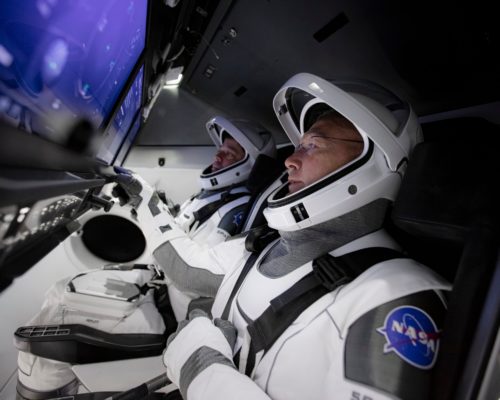
The astronauts in flight-suits practice docking in the full scale hardware simulator: Crew Dragon Displays and Crew Spacesuits Ready for Mission to Space Station – Commercial Crew Program

Astronauts practice docking the Dragon. Credits: SpaceX/NASA.

**** Promotional video from NASA on the upcoming commercial crew mission: NASA and SpaceX prepare to #LaunchAmerica – NASA

Together with SpaceX, NASA will return human spaceflight to American soil after nearly a decade. SpaceX will launch people into space for the first time ever with astronauts Bob Behnken and Doug Hurley on board Crew Dragon, which will dock to the International Space Station.
Prepare to
#LaunchAmerica on May 27: www.nasa.gov/launchamerica

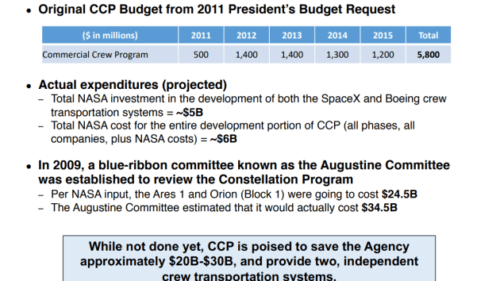
**** Commercial Crew was a huge bargain and Orion/SLS a boondoggle of historic proportions: NASA: SpaceX, Boeing building spacecraft for astronauts saved up to $30 billion – CNBC

**** Planet Labs takes advantage of Rideshare  on Starlink launches: SkySats 16-21 to Launch on SpaceX Falcon 9 Rideshare Missions – Planet Lab

Planet is set to launch six more SkySat satellites (SkySats 16-21) into Low Earth Orbit this summer, rounding out the fleet of 15 SkySats already in operation.

SkySats 1-15 operate in Sun Synchronous Orbits, a specific type of Low Earth Orbit that results in the Earth’s surface always being illuminated by the Sun at the same angle when the satellite is capturing imagery. About half of the SkySats currently pass overhead in a morning crossing plane, while the other half moves in an afternoon crossing plane, so together they provide twice-daily coverage of select areas on a global scale. SkySats 16-21 will operate at a “mid-inclination” orbit of 53 degrees, complimenting the Sun Synchronous fleet, and will offer more targeted coverage and raw image capacity in key geographic regions.

The six SkySats will be evenly split across two launches on SpaceX’s Falcon 9, a two-stage reusable rocket that has successfully flown satellites and cargo over 80 times to orbit. They will do so as rideshare payloads on launches of SpaceX’s Starlink satellites.

SkySats 16-18 will launch on SpaceX’s ninth Starlink mission, targeted for launch in the next month, and SkySats 19-21 will launch later this summer. Both missions will launch from Cape Canaveral Air Force Base in Florida.

The launch of SkySats 16-21, as well as the development of our enhanced 50 cm imagery (to be made available to customers this year)—are just some examples of Planet’s continuously evolving industry-leading geospatial offerings. Stay tuned to the Pulse blog for more launch and product updates in the coming months.

See also:

**** Each generation of SpaceX rockets pushes the technology to the next level: Technology Progress = Iterations Times Progress Between Iterations – NextBigFuture.com

Elon Musk has noted that progress in any given technology is simply # of iterations * progress between iterations. SpaceX has successfully completed six major iterations and is on its seventh rocket version iteration. SpaceX has existed for eighteen years and has shortened its development time from six years to about two years.

This is why SpaceX is crushing all of its competitors like United Launch Alliance, China, Russia, Ariane and Blue Origin.

**** Starship

****** SpaceX continues to maintain a very high level of activity at Boca Chica Beach. The Raptor engine used during test firings last week was removed from the SN4 Starship prototype. A subsequent pressure test on the SN4 using cryogenic propellants successfully reached 7.5 atmospheres, which should provide sufficient margin for uncrewed test flights. (8.5 atm will need to be reached to provide the safety margin desired for crew flights.) A different Raptor engine was then installed on SN4. Test firings are expected to start within a day or two. If these go well, there could be a 150 meter hop a few days after that.

This diagram for the cryogenic tank tests shows the liquid methane fuel in green and the liquid oxygen in blue:

Meanwhile, the SN5 is nearly fully stacked. It’s expected that it will get a nosecone on top and the reentry fins on the side. Assuming it passes tank pressure and engine test firing tests with three engines installed, the SN5 might launch to as high as 20 km. SpaceX’s first high-flying, triple-Raptor Starship is almost finished – Teslarati.


Components for SN6 are also in production. Each prototype is expected to have improvements and enhancements over the previous one. Eventually, a SN# will go to orbit and then attempt a reentry and landing.

Here are Elon’s goals for transport costs once operational Starships are flying:

***** Views of Boca Chica activities:

****** May 7: Starship SN-4 Slow Motion 4K Static Fire [May 7, 2020] – Everyday Astronaut on Youtube

SpaceX successfully static fired their Starship SN-4 prototype using fuel from the header tank (secondary smaller tank inside the main tank). Everything looked good and SpaceX will continue to push to prepare for the 150m hop of this vehicle. Thanks to Rachel and Gene from @SPadre [@ spacepadreisle on twitter] for shooting this for us!

****** May 8: SpaceX Releases Massive LN2 Possible Cryo Test Abort – LabPadre – YouTube

05.09.2020 After an initial possible ambient test. SpaceX unexpectedly released a massive amount of LN2 from the tank farm. Some are speculating that a valve may have ruptured. Waiting on Elon’s response. All images are explicitly owned by LabPadre Media.

****** May 9: SpaceX Boca Chica – Full Drive-Past Entire Facility – NASASpaceflight – YouTube

Mary takes you on an updated drive past the growing facility at SpaceX Boca Chica, from the launch site to the production facility. Very useful to get one’s bearings. No fancy editing or timelapse, just a fateful of Boca Chica, which most of you will appreciate! Video from Mary (@BocaChicaGal)

****** May 10: 4K SpaceX Starship SN4 Passes Cryo Test! – LabPadre – YouTube

05.09.2020 A 4K segment of SpaceX Boca Chica crossing another milestone with Starship SN4 passing a cryogenic pressure test at 7.5 Bar according to Elon Musk on Twitter. At this point in the test the top starts to frost rather quickly. All images are explicitly owned by LabPadre Media.

****** May 11: SpaceX Boca Chica – Raptor delivery for Starship SN4 ahead of 150 meter hop – NASASpaceflight – YouTube

A new Raptor engine for Starship SN4 has arrived at SpaceX’s Boca Chica launch site ahead of the final static fire test, set for no earlier than Tuesday. If all goes well with the static fire, SN4 is expected to hop to 150 meters. Video and Photos from Mary (@BocaChicaGal). Edited by Jack Beyer (@thejackbeyer).

****** May 11:  SpaceX Boca Chica – Starship SN4, 5, 6 and Nosecones Everywhere – NASASpaceflight – YouTube

As Starship SN4 prepares for another Static Fire test, SN5 is in the VAB and SN6 sections wait their turn at SpaceX Boca Chica. Meanwhile, yet another new nosecone has been spotted. Video and Photos from Mary (@BocaChicaGal).

****** May 12: SpaceX Boca Chica – Starship SN5 Stacked – NASASpaceflight – YouTube

Another Starship is born at SpaceX Boca Chica as SN5 is stacked inside the High Bay. Meanwhile, SN4 is in final preparations for a Static Fire test with the SN20 Raptor on Wednesday. Video and Photos from Mary (@BocaChicaGal). Edited by Jack Beyer (@thejackbeyer).

** May 14: SpaceX Boca Chica – Final preps underway ahead of Starship SN4’s third static fire – NASASpaceflight – YouTube

Final preparations were underway at SpaceX’s Boca Chica launch site on Wednesday ahead of the third Raptor static fire on Starship SN4. The static fire is slated to occur on Thursday afternoon. Video and Photos from Mary (@BocaChicaGal). Edited by Jack Beyer (@thejackbeyer).

** Webcast rocket reports:

**** SpaceX Starship SN4 Prepares for flight, Crew Dragon Demo 2 & Crew-1 updates, Chinese Long March 5BMarcus House

Starship completed its static fires with the SN4 Starship and we are looking onwards now to the potential 150 metre flight test. The SN5 and SN6 Starship continues construction as well so loads going on again in BocaChica Texas. More news, talks, and footage related to the first crewed flight for SpaceX coming up in a few weeks with the Crew Dragon Demo 2 mission including a great talk from Gwynne Shotwell. This week also saw the first successful flight of the Chinese Long March 5B heavy-lift rocket. Then a few other great little snippets of news as well.

**** SpaceX Starship Updates – A History Of Starship EvolutionWhat about it!?

**** SpaceX Starship Updates – NASA Perseverance Rover Getting Ready For MarsWhat about it!?

== Amazon Ad ==

Safe Is Not an Option

Space transport roundup – May.7.2020

A sampling of recent articles, videos, and images dealing with space transport (find previous roundups here):

** SpaceX test fired the Raptor engine on the SN4 Starship prototype on two consecutive days. On Tuesday evening, a Raptor engine fired for the first time while mounted on a full scale Starship. Previous Starship prototypes did not survive propellant tank pressure testing. On Wednesday, another brief firing took place. No word from SpaceX or Elon Musk yet on whether more engine tests are planned or if they will proceed towards a 150 meter hop. Higher altitude flights will wait for the SN5 or later model prototypes. SpaceX test-fires Raptor engine on Starship test rocket – Spaceflight Now.

May5: Starship SN4 Static Fire Test – NASASpaceflight – YouTube

SpaceX successfully conducted a Static Fire test on Starship SN4 on Tuesday night, marking the first time Starship had fired a Raptor engine, paving the way for the upcoming hop test. Photos and Video by Mary (@BocaChicaGal) for NASASpaceflight.com. Edited by Jack Beyer (@thejackbeyer).

May 6: Starship SN4 Static Fire May 5 2020 – SPadre – YouTube

An image posted by Elon of the Raptor installed on the SN4. The engine is off-center but this can be compensated with with gimbling. There should otherwise be three engines symmetric about the center.

Raptor engine installed on StarshipSN4. Credits: SpaceX

Find more SpaceX items below

** China’s new Long March 5B heavy lift rocket successfully launched on its first attempt. The vehicle, powered by a liquid-fuel core first stage and four liquid-fueled side boosters, lifted off from the Wenchang Spaceflight Launch Center on the southern island of Hainan. The primary payload was a prototype of a new crew vehicle design that will replace the Shenzhou spacecraft that were used for several crew missions. A reentry operation from a high orbit is expected on Friday, which will send the reusable capsule to a remote northern desert area for a landing by parachute. The fast reentry will put the heat shield under stresses and temperatures similar to that of a return from the Moon. The LM-5B will be the primary launch system for China’s crew program, which include the launch of a space station in the coming years. The country’s first Mars rover will also be launched this July on a LM-5B.

Scott Manley examines the LM-5B:

** A secondary payload on the LM-5B mission was a module with an inflatable heat shield that was to demonstrate a low cost way to return cargo from orbit. There was a problem during its reentry: China’s space test hits snag with capsule ‘anomaly’ – AFP/Phys.org

… “an anomaly occurred today during the return” of the cargo capsule, the China Manned Space Agency said in a statement.

“Experts are currently analysing the data,” it said without offering details.

The cargo capsule was not designed to transport astronauts, only equipment. The device, developed by China Aerospace Science and Industry Corporation, is an experimental prototype.

See also: Experimental Chinese cargo return capsule malfunctions during re-entry – Spaceflight Now

** The first flight of the Virgin Orbit LauncherOne rocket is expected soon: Virgin Orbit’s first launch could happen later this month – Spaceflight Now

Virgin Orbit could attempt its first orbital test launch later this month over the Pacific Ocean southwest of Los Angeles, capping a development program for an air-launched small satellite carrier that began in earnest eight years ago.

The small satellite launch company, part of Richard Branson’s Virgin Group, entered the final phase of pre-flight testing last week with a ground fueling test of its first flight-worthy LauncherOne rocket.

Dan Hart, Virgin Orbit’s CEO, said the company is on track for the rocket’s first demonstration launch in May.

The LauncherOne rocket is designed to compete with other commercial smallsat launchers, such as Rocket Lab’s Electron booster, for contracts to deliver CubeSats and microsatellites to orbit for commercial customers, the U.S. military and NASA. Virgin Orbit says it can haul up to 660 pounds (300 kilograms) of cargo into a 310-mile-high (500-kilometer) polar sun-synchronous orbit, a standard operating orbit for Earth-imaging satellites.

Vox Space, the subsidiary of Virgin Orbit that launches military payloads, now has a Guam option for its operations: VOX Space Readies to Launch from Andersen Air Force Base in Guam — VOX Space

** Rocket-powered long distance point-to-point transportation has been a long term goal of Richard Branson and Virgin Galactic management. They now have a partnership arrangement with NASA to work on the design of such a system: Point-To-Point transportation gains boost via NASA/Virgin Galactic SAA – NASASpaceFlight.com

A Space Act Agreement (SAA) between NASA, Virgin Galactic and The Spaceship Company (TSC) has been announced, raising the hope that spacecraft could one day become a future high-speed civilian transportation system. Utilizing the “Point-To-Point” method, Virgin Galactic – and as previously envisioned by SpaceX – is aiming for a transportation option that would vastly reduce transit times.

The SAA is aimed at “advancing the United States’ efforts to produce technically feasible, high Mach vehicles for potential civil applications,” noted the text of the agreement.

** A USAF X-37B reusable spaceplane is set to liftoff on an ULA Atlas V rocket on May 16th from Cape Canaveral. This will be the 6th X-37B mission. Previous missions have lasted as long as 779 days : Next X-37B Orbital Test Vehicle Scheduled to Launch – United States Space Force

This will be the first X-37B mission to use a service module to host experiments. The service module is an attachment to the aft of the vehicle that allows additional experimental payload capability to be carried to orbit.

“This sixth mission is a big step for the X-37B program,” said Mr. Randy Walden, Director and Program Executive Officer for the Department of the Air Force Rapid Capabilities Office. “This will be the first X-37B mission to use a service module to host experiments. The incorporation of a service module on this mission enables us to continue to expand the capabilities of the spacecraft and host more experiments than any of the previous missions.”

The mission will deploy the FalconSat-8, a small satellite developed by the U.S. Air Force Academy and sponsored by the Air Force Research Laboratory to conduct several experiments on orbit. The FalconSat-8 is an educational platform that will carry five experimental payloads for USAFA to operate. In addition, two National Aeronautics and Space Administration experiments will be included to study the results of radiation and other space effects on a materials sample plate and seeds used to grow food. Finally, the U.S. Naval Research Laboratory, will transform solar power into radio frequency microwave energy which could then be transmitted to the ground.

“We are excited to return the X-37B to space and conduct numerous on-orbit experiments for both the Air Force and its mission partners,” said Lt. Col. Jonathan Keen, the X-37B program manager.

The X-37B program completed its fifth mission in October 2019, landing after 780 days on orbit, extending the total number of days spent on orbit for the spacecraft to 2,865 – or seven years and 10 months.

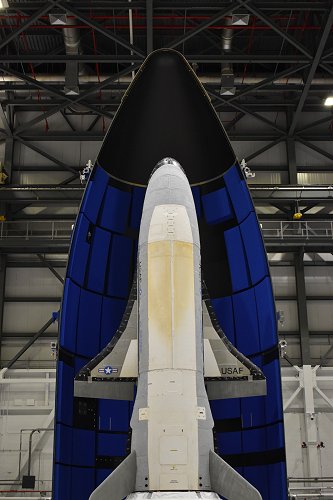
X-37B inside fairing of Atlas V in preparation for Misison 6. Credits: USAF

More at:

** Northrop Grumman Cygnus cargo vehicle to depart from ISS on Monday:

Nearly three months after delivering several tons of supplies and scientific experiments to the International Space Station, Northrup Grumman’s unpiloted Cygnus cargo craft is scheduled to depart the International Space Station on Monday, May 11.

Live coverage of the spacecraft’s release will air on NASA Television and the agency’s website beginning at 11:45 a.m. EDT, with release scheduled for noon.

Dubbed the “SS Robert H. Lawrence,” Cygnus arrived at the station Feb. 18 with supplies and science experiments following its launch on Northrup Grumman’s Antares rocket from NASA’s Wallops Flight Facility on Wallops Island, Virginia.

Flight controllers on the ground will send commands to robotically detach Cygnus from the Earth-facing port of the Unity module, maneuver it into place, and release it from the Canadarm2 robotic arm. Station commander Christopher Cassidy of NASA will monitor Cygnus’ systems as it moves away from the orbiting laboratory.

Within 24 hours of its release, Cygnus will begin its secondary mission, hosting the Spacecraft Fire Safety Experiment – IV (Saffire-IV), which provides an environment to safely study fire in microgravity. It also will deploy a series of payloads. Northrop Grumman flight controllers in Dulles, Virginia, will initiate Cygnus’ deorbit to burn up in Earth’s atmosphere Monday, May 25.

** An update on Blue Origin development of the New Glenn rocket, BE-4 engine and other systems: Blue Origin preparing to enter the orbital arena – NASASpaceFlight.com

Blue Origin has been making significant progress on the structures, systems, propulsion, and infrastructure supporting their New Glenn heavy lift rocket. Though the company is traditionally quite secretive about most of their operations, they have recently been revealing more and more information as they work towards a first flight date of no earlier than 2021. They also won through as part of the Human Landing System (HLS) award winners as its goals move from the suborbital, through to Low Earth Orbit and beyond.

At their facility in West Texas, Blue Origin has been conducting test fires of both its BE-4 first stage engine and BE-3U upper stage engine. BE-3U is a variant of the BE-3PM engine that has powered the suborbital, reusable New Shepard vehicle on 12 flights. Unlike the tap-off cycle PM variant, BE-3U operates on an open expander cycle, which in turn with a vacuum optimized nozzle creates higher thrust, efficiency, and provides for multiple restarts in space.

The company expects to deliver two “flight readiness” BE-4 engines to ULA this summer. These two engines will be attached to a Vulcan rocket for a hot-fire at SLC-41.

And here is a bit of info on the status of the suborbital New Shepard:

** Dave Masten interviewed about Masten Space Systems and the recent “lunar lander award from NASA, XL-1 lander development program, human lunar landers, company information, and much more”: The Space Show – Sun, 05/03/2020

… Dave was asked a few questions about the corporation Masten Space Systems. Dave talked about employees, hiring new employees from engineering disciplines but not specifically aerospace engineers, plus he talked about their expected growth over the next 5-10 years. I asked Dave how he got his interest in lunar landers \. He said it started early on, around 2004. Don’t miss Dave’s story. Ft. Worth John then called to ask questions about the green fuel plus he wanted specific impulse information for their rocket engines. After this call, Dr. Lurio called to ask Dave about the additional mass for the XL-1 lander over and above the NASA payload requirement of 80kg. Dave was also asked about having made structural changes to the XL-1 to add the additional payload mass. Don’t miss this discussion. …

** Rocket Lab resumes operations after New Zealand loosens virus lock-down restrictions:

** Briefs:

==================

Check out the
The Lurio Report
for news and analysis of key developments in NewSpace

The latest issue:
Masten Goes Lunar, Rocket Lab, New Space and a Virus
Vol. 15, No. 3, May 2, 2020

Space Frontier Foundation Award for NewSpace Journalism

==================

** SpaceX:

**** SpaceX prepares for launch of Crew Dragon with 2 astronauts on May 27th.

The Crew Dragon for the Demo-2 mission shown with the trunk attached. Credits: NASA/SpaceX

**** The next launch of a batch of Starlink satellites now set for May 18th: SpaceX’s next Starlink satellite launch slips closer to Crew Dragon astronaut debut – Teslarati

SpaceX’s next Starlink satellite launch has slipped about a week and a half into mid-May, placing it just nine days (or less) prior to the company’s inaugural NASA astronaut mission.

Known as Crew Dragon’s second Demonstration Mission (Demo-2), SpaceX’s first astronaut launch is officially scheduled no earlier than May 27th and is with little doubt the most important mission in the company’s history. Simultaneously, however, SpaceX is working to rapidly launch thousands of Starlink satellites in a bid to deliver high-quality internet service to tens – or even hundreds – of millions of people. The company has already launched an incredibly 420 operational Starlink satellites but that’s just a drop in the bucket compared to the ~4400, ~12,000, or even ~40,000+ the company will ultimately need to match its ambitions.

**** Starship

****** In addition to the firing of the Raptor engine on the SN4 prototype mentioned at top, there is a great deal of production activity underway at Boca Chica Beach. The SN5 prototype is nearly completed and construction of SN6 has begun. Unlike SN4, these will have conical nosecones stacked on top since they will need aerodynamic shapes to carry out high-altitude flights. Here is a diagram showing the estimated assembly status of SN5 and SN6:

**** Below are videos showing scenes from the day-to-day activities at the ever expanding Boca Chica facility:

****** May.3.2020:  SpaceX Boca Chica – SN4 begins testing. SN5 Preps. Hopper speaks – NASASpaceflight – YouTube

At SpaceX Boca Chica, Starship SN4 began testing at the launch site, while SN5 continues preps for stacking. Hopper was also heard “speaking” (PA system in use). Photos and Video by Mary (@BocaChicaGal) for NASASpaceflight.com.

****** May.5.2020: SpaceX Boca Chica – Starship SN4 Preburner Test. SN5 Stacking. SN6 Bulkhead – NASASpaceflight – YouTube

Triple Starship flows now! SN4 was out at the pad for a Static Fire attempt last night, got as far as preburner test, but no Static Fire. Attempting again tonight – see our livestream that has already been spooled up at the time this video went on. SN5 is being stacked in the VAB, but a SN6 bulkhead has also been spotted in one of the tents! Photos and Video by Mary (@BocaChicaGal) for NASASpaceflight.com. Edited by Jack Beyer (@thejackbeyer).

****** May.6.2020:  SpaceX Boca Chica – Starship SN6 build-up begins amid SN4 testing and SN5 stacking – NASASpaceflight – YouTube

Ahead of another test of Starship SN4 tonight, SN5 stacking ops continue around the VAB and sections of SN6 have been spotted out in the wild near the big tents! Video and Photos from Mary (@bocachicagal). Edited by Jack Beyer (@thejackbeyer).

** Webcast rocket reports:

**** SpaceX Starship Updates – Static Fire! – Crew Dragon Demo Mission 2 UpdateWhat about it!?

In this Episode, we will take a look at the intense testing operations at the SpaceX Launch Site in Boca Chica Texas. Static fires, methane flares and Starship SN5 & 6 construction. We will also take a look at the recent NASA press conference regarding the SpaceX Demo Mission 2. We will take a look at trainings, Bob Behnken and Doug Hurley had to go through, last minute Crew Dragon preparations and the latest news on parachute tests.

****  Let’s watch SpaceX Static Fire Starship SN-4! – Tim Dodd, the Everyday Astronaut

=== Amazon Ad ===

Frozen Orbit