Category Archives: Space transport roundup

Latest on all means of traveling to, from and in space.

Space transport roundup – Sept.30.2020

A sampling of recent articles, videos, and images dealing with space transport (find previous roundups here):

** Scrubs and delays continue to plague ULA and SpaceX launch plans. The ULA Delta IV Heavy launch of the NROL-44 spysat has been trying to lift off since August but various ground system and weather problems have kept it grounded.  Weather has been the primary factor in keeping three SpaceX Falcon 9 rockets from flying two StarLink missions and one USAF GPS

[ Update: The Delta IV Heavy launch of the NROL-44 classified payload was aborted again late Wednesday. In this case, the abort happened at 7 seconds before liftoff. (An abort on August 29th happened 3 seconds before scheduled liftoff.) Commentators on the NSF webcast said there will be a delay of at least a week to prepare for the next attempt: ULA suffers another abort during Delta IV Heavy’s attempt to launch NROL-44 – NASASpaceFlight.com ]

As of Wednesday, Sept.30th, the current Florida launch planning shows:

  • NROL-44 Delta IV Heavy – 11:54 pm EDT – Sept. 30th (354 GMT on 1st)
  • Starlink-12 Falcon 9, Pad 39A KSC -9:17 am EDT (1317 GMT) – Oct. 1st
  • GPS 3 SV04 Falcon 9, SLC-40 Cape Canaveral   9:43-9:58 p.m. EDT on 2nd ( 0143-0158 GMT on 3rd) – Oct. 2nd
  • Starlink-13 Falcon 9, SLC-40 Cape Canaveral – In October but no date announced yet.

More at SpaceX rockets await launch opportunities later this week – Spaceflight Now.

** Northrop Grumman Antares rocket set to launch Cynus cargo vehicle to the ISS Thursday evening at 9:38 pm EDT ( 0138 GMT, Oct. 2) from Wallops Island”s commercial spaceport: Prelaunch Briefing for Northrup Grumman’s 14th Cargo Resupply Mission to Space Station

During a Sept. 28 news briefing at NASA’s Wallops Flight Facility, in Virginia, the agency’s commercial partner, Northrop Grumman and others discussed the prelaunch status of the company’s 14th commercial resupply mission to the International Space Station. On Oct. 1, Northrop Grumman’s Cygnus cargo spacecraft is targeted to launch aboard an Antares rocket from Wallops. The Cygnus will carry nearly 8,000 pounds of research, crew supplies and hardware to the station.

** A Russian Soyuz 2.1b sent 3 comm-sats and 18 smallsats into orbit:

** China launches two environmental monitoring/disaster management satellites on a Long March-4B from the Taiyuan Satellite Launch Center on Sunday. There was no prior public announcement of the launch.

From CGTN:

The new HJ-2A and HJ-2B satellites will replace the previous generation of environmental monitoring satellites HJ-1A and HJ-1B, to provide services concerning environmental protection, natural resources, water conservancy, agriculture and forestry, according to the satellite developer China Academy of Space Technology (CAST).

The HJ-2A and HJ-2B are 16-meter optical satellites with high mobility, precision control and stability, as well as strong load adaptability and long lifespans.

The satellites can provide 16-meter multispectral, 48-meter hyperspectral and infrared image data.

They will support the monitoring of natural disasters and land utilization, regulation and protection of water resources, dynamic monitoring of crop areas and assessment of yield, as well as quake emergency rescue.

** Germany’s HyImpulse launch company tests hybrid motor: First hot fire testing of the 75kN HyImpulse hybrid rocket motor –

At midday of Tuesday 15 September, the first firing of the HyImpulse 75kN hybrid rocket motor was a full success! It was performed at the world class DLR Lampoldshausen testing facility. This is the biggest hybrid rocket motor ever built and tested in Europe. This marks an important milestone in accomplishing our plan for a suborbital flight in early 2021 and the first flight of the three stage HyImpulse launcher SL1 by the end of 2022. HyImpulse is the first German Mini -Launcher startup to have its full-size flight weight motor developed, built and hot fire tested on a test bench. With the NewSpace Launch sector heating up, this important milestone immensely advances our international position in this area. The test confirms that the rocket propellants based on our proprietary Paraffin /LOX formulation achieve the same high performance as liquid hydrocarbon-based fuels with a much-simplified propulsion system and at a fraction of the cost.

See also: HyImpulse hybrid rocket motor roars to life for the first time – SpaceNews.

** Rocket Factory Augsburg plans for their RFA One Launcher to lift off from Norway in 2022: Rocket Factory Augsburg Signs Agreement with Andøya Space for maiden launch – Andøya Space Center

Andøya Space is developing the new launch complex on Andøya island, 35 km south of their existing sub-orbital launch site. This new site will provide operators of vehicles in the 1.5t payload class with independent integration facilities and access to two launch pads with necessary support infrastructure.

Rocket Factory, a start-up backed by the German satellite manufacturer OHB as a strategic investor and Munich-based venture capital firm Apollo Capital Partners, currently is developing a launcher system called RFA ONE for small satellites with a payload performance of up to 1.500kg to low earth orbit (LEO). The first launch is scheduled for 2022. The company recently qualified the upper stage tank system during cryogenic tests and is currently preparing hot-fire tests of the main engine in Esrange, Sweden.

“We are convinced that Rocket Factory is one of the most progressive SSLV companies in Europe. Having them commit to Andøya Space as a partner is of great significance to us. We are developing an efficient multi-user launch site in Norway, and Rocket Factory has the technical capabilities, the same innovative culture, and the enthusiastic team we need in a partner to help us take the spaceport initiative forward. We look forward to supporting them in their missions to polar- and sun synchronous orbits.”, said Odd Roger Enoksen, CEO and President of Andøya Space.

RFA is at the forefront of the global new-space launch vehicle development, with its state-of-the-art staged-combustion engine technology. This high-performance engine design, coupled to lowest-possible-cost production techniques, is essentially new to Europe, and through the support of OHB, RFA has managed to acquire key technologies and key talent that will propel the business case of the RFA One launch vehicle to dominate the market on a global scale. Recent firing tests have demonstrated that RFA is on a winning path to establish Europe’s most efficient and powerful rocket engine technology. Recently, RFA won the first round of the micro-launcher competition of the German Space Agency DLR, which granted RFA a letter of support to submit a proposal to ESA’s Boost! programme.

** Masten Terrestrial Rocket Testbed Introduction: Masten Space Systems highlights their vertical takeoff and landing rocket flight services.

** India’s Skyroot Aerospace shows off new cryogenic methane-fueled engine:

The company is aiming to launch the first Vikram-1 rocket, which will use solid fueled motors in all stages, in December 2021. The cryogenic engine will be used for the upper stage of the Vikram-2 rocket.

More about Skyroot at:

While the company has successfully tested the upper-most stage engine of its first rocket Vikram-I, the initial stage engines of Vikram-I are being manufactured. If all goes well, the company is looking forward to a maiden launch of Vikram-I by December 2021, with the support and guidance of the Indian Space Research Organization(ISRO). The cryogenic engine won’t see action in Vikram-I and is meant for their bigger rocket Vikram-II. 

In terms of payload capacity, Vikram I is meant to lift 225 kg to 500 km Sun Synchronous Polar Orbit(SSPO) and 315 kg to 45º inclination 500 km Low Earth Orbit (LEO). Vikram II is designed for 410 kg to 500 km SSPO and 520 kg to 45º inclination 500km LEO. In the case of Vikram III, we are looking at 580 kg to 500 km SSPO and 720 kg to 45º inclination 500 km LEO. 

** bluShift Aerospace will test bio-fuel in low altitude rocket flight at a site in Maine:  Brunswick aerospace company sets date for rocket launch – Portland Press Herald

Years of planning will be on the line Oct. 21 with the launch of bluShift’s 20-foot test rocket, the Stardust 1.0. The company hopes to launch the 540-pound Stardust 4,500 feet into the air, about twice as high as the world’s tallest skyscraper, before landing safely back onto the ground at the Loring Commerce Centre, formerly known as the Loring Air Force Base. The trip will use 10 pounds of bluShift’s trademark fuel.

The rocket will be airborne for roughly 58 seconds, a tiny span of time compared with the years of work it took for engineers to get to this point. But Deri and his team understand the gravity of this moment.

“This launch is the culmination of six years of research and development by bluShift to develop a type of chemical rocket engine that is perhaps less understood than more common technologies” he says, hoping to demonstrate the functionality of a “bio-derived, carbon-neutral, high-performing and even less expensive than its liquid petroleum counterpart.”

** Scott Manley describes the design and operation of the Space Shuttle solid rocket boosters: The Amazing Engineering Behind Solid Rocket Boosters

The solid rocket motors on the space shuttle accounted for the majority of the launch mass and launch thrust. They’re the most powerful rocket thrusters ever flown, at least until the 5 segment versions take flight with SLS in the next year or so. I’ve often described solid rocket motors as being relatively simple compared to the complex plumbing, pumps and turbines of liquid rocket motors. However there’s still a huge amount of critical engineering and science that goes into these boosters. The design of the boosters were also partly responsible for the accident that destroyed Challenger during launch.

** And Manley highlights the spaceship capabilities of the ISS: How the Space Station Moves In Orbit Like A Spaceship

Many people don’t realise that the International Space Station is also a space ship, able to maneuver in space as required by mission operations. It has thrusters and control moment gyros to control its orientation and adjust its orbit.

I could have explaind this with CGI, I could have used KSP Instead I decided to use my LEGO model of the ISS as a prop: The LEGO ISS is available on Amazon and other online retailers. https://amzn.to/3kV4aqC

** Briefs:

==================

Check out the
The Lurio Report
for news and analysis of key developments in NewSpace

The latest issue:
Strides and Views, Rocket Lab, Bernard Kutter, RIP
Vol. 15, No. 6, September 18, 2020

Space Frontier Foundation Award for NewSpace Journalism

==================

** SpaceX:

** Launch of first operational SpaceX Commercial Crew mission now set for October 31st:

Some of the delay from the original late August target date was due to an issue with the Crew Dragon heat shield showing more erosion than expected around the areas where the service stage bolts to the capsule. The problem had to be diagnosed, and then a fix designed, implemented and tested. There will also be an adjustment to the timing of the drogue chute deployment, which happened a bit later than desired.

Final certification of the Crew Dragon/Falcon 9 for operational crew missions will be presented about a week before the launch.

Between now and the end of 2021, SpaceX and NASA expect to launch seven Dragon missions – three crew and four cargo. The Cargo Dragon vehicles will now be reconfigured versions of the Crew vehicles. There will be times when both types of Dragon vehicles (Crew and Cargo) are docked to the station at the same time.  SpaceX has busy manifest of Dragon missions – SpaceNews

The CRS-21 mission will also mark the first time two Dragon spacecraft are in space at the same time. That mission will remain docked to the station for 35 days before returning to Earth. After that, the Crew-2 astronauts will board the Crew Dragon and relocate it from its original docking port, called Node 2 Forward, to the neighboring Node 2 Zenith port. That would free up the Node 2 Forward port, which offers a more straightforward approach to the station, for an uncrewed Boeing CST-100 Starliner test flight tentatively scheduled for late this year.

Flying seven Dragon missions in 14 months will require some degree of spacecraft reuse, Reed said. “A number of them are reused flights, and a handful of them are new,” he said, but didn’t immediately know how many of the missions will use previously flown spacecraft. NASA and SpaceX previously said they would refurbish the Dragon flown on the Demo-2 test flight this summer for the Crew-2 mission. Both Crew-1 and possibly Crew-3 will use new spacecraft, he said.

Continue reading Space transport roundup – Sept.30.2020

Space transport roundup – Sept.23.2020

A sampling of recent articles, videos, and images dealing with space transport (find previous roundups here):

** Blue Origin plans a New Shepard flight on Sept. 24th:

NS-13 Update: September 22
Next New Shepard Launch Will Test Key Technologies
with NASA for Returning to the Moon

Blue Origin’s next New Shepard mission (NS-13) is currently targeting liftoff for Thursday, September 24, at 10:00 am CDT / 15:00 UTC. Current weather conditions are favorable. This will be the 13th New Shepard mission and the 7th consecutive flight for this particular vehicle (a record), demonstrating its operational reusability.

New Shepard will fly 12 commercial payloads to space and back on this mission, including the Deorbit, Descent, and Landing Sensor Demonstration with NASA’s Space Technology Mission Directorate under a Tipping Point partnership. This is the first payload to fly mounted on the exterior of a New Shepard booster rather than inside the capsule, opening the door to a wide range of future high-altitude sensing, sampling, and exposure payloads.

The lunar landing sensor demo will test precision landing technologies for future missions to the Moon in support of the Artemis program. The experiment will verify how these technologies (sensors, computers, and algorithms) work together to determine a spacecraft’s location and speed as it approaches the Moon, enabling a vehicle to land autonomously on the lunar surface within 100 meters of a designated point. The technologies could allow future missions—both crewed and robotic—to target landing sites that weren’t possible during the Apollo missions, such as regions with varied terrain near craters. Achieving high accuracy landing will enable long-term lunar exploration and future Mars missions.

This is the first of two flights to test these lunar landing technologies, increasing confidence for successful missions in the Artemis program. NS-13 is part of the risk reduction process to test these types of sensors for future missions.

As a part of NASA’s Artemis Human Landing System program, Blue Origin is also leading the National Team, comprised of Lockheed Martin, Northrop Grumman, and Draper, to develop a Human Landing System to return Americans to the lunar surface. The technology for the Blue Origin Descent Element that takes astronauts to the lunar surface is derived from the autonomous landing capabilities developed for the New Shepard program.

New Shepard has flown more than 100 payloads to space across 10 sequential flights. Payloads on board NS-13 include experiments from Johns Hopkins University Applied Physics LaboratorySouthwest Research InstituteNASA Flight OpportunitiesSpace Lab TechnologiesUniversity of FloridaSpace Environment Technologies, and mu Space Corp. A selection of the manifested payloads can be found below.

Also on board will be tens of thousands of postcards from Blue Origin’s nonprofit, Club for the Future, some of which will include a special NASA Artemis stamp.

All mission crew supporting this launch are exercising strict social distancing and safety measures to mitigate COVID-19 risks to personnel, customers, and surrounding communities.

You can watch the launch live at BlueOrigin.com. The pre-show begins at T-30 minutes and will provide mission details, including a special update from NASA Administrator Jim Bridenstine.

** Blue Origin facilities at Cape Canaveral continue to expand:

** Blue Origin planning development of near earth orbit destinations for the company’s future crew vehicles:

The job description begins with:

To develop Blue Origin’s vision of millions of people living and working in space, humanity will require places for them to live and work: space destination systems in which value-creating economic activity can occur. LEO (low Earth orbit) habitable stations, learning from but going beyond the ISS (International Space Station), are a first step. Such stations, supporting a robust LEO economy, will be fundamentally different from “exploration” habitats designed for small, professionally trained crews in deep space.

More at Blue Origin considers entering commercial space station business – SpaceNews

** ULA sets launch of Delta IV Heavy for Sept. 26th at 12:14am EDT ( 0414 GMT) from Cape Canaveral. The NROL-44 mission will launch at a classified spy satellite for the  National Reconnaissance Office (NRO). A launch on August 29th was abort just 3 seconds before liftoff due a ground systems failure.

** Northrop Grumman is set to launch a Cygnus vessel on an Antares rocket on Sept 29th. The Cygnus will deliver cargo to the ISS. Liftoff from Wallops Island, Virginia is targeted for 10:26 am EDT (0226 GMT on 30th)

** China launches Long March 4B rocket with Haiyang-2C ocean observation satellite from the Jiuquan Satellite Launch Center on Monday:

** Nuclear-powered space tug in advanced development by Russia’s KB Arsenal Design Bureau .

Anatoly Zak reports on the project: Russia reveals a formidable nuclear-powered space tug – RussianSpaceWeb.com

After years of near silence, a prominent developer of Russian military spacecraft suddenly publicly floated the first pictures of a massive nuclear-powered space transport undergoing assembly at the company’s facility in St. Petersburg. The KB Arsenal design bureau, which serves as the prime contractor in the project, is known for its Soviet-era nuclear-powered satellites, one of which infamously crashed in the Arctic region of Canada in 1977.

A series of photos and computer-generated imagery, which surfaced on the Internet in 2020 and originated from KB Arsenal clearly revealed the latest version and the planned operation of a very large space tug propelled by electric engines and powered by a nuclear source.

The project officially known as the Transport and Energy Module, TEM, has been well known to the watchers of the Russian space program for more than a decade.

Tracing its roots to the dawn of the Space Age, the TEM concept is attempting to marry a nuclear reactor with an electric rocket engine. The electric propulsion systems heat up and accelerate ionized gas to create a thrust-generating jet and, therefore, are alternatively known as ion or plasma engines. When measured per unit of spent propellant mass, electric engines are more efficient than traditional liquid or solid-propellant rockets, but their thrust is relatively low at any given time and they require a great deal of electric power to operate. Because of this, until recently, the practical use of electric propulsion in space flight was mostly limited to orbit adjustment systems aboard satellites or to deep-space missions, in which spacecraft could take advantage of low thrust over very long periods of time.

The nuclear reactor would not be activated until the tug was in a high orbit. It would use solar panels for power during the preparatory period. The fuel would not become highly radioactive until after the reactor was turned on.

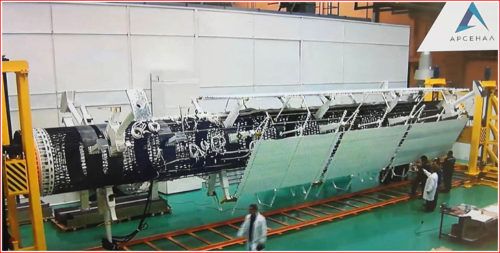
The TEM space tug truss section with radiator panels in assembly at KB Arsenal. Credits: KB Arsenal & RussianSpaceWeb.com

The photos of a vehicle in construction are new but the existence of TEM and other nuclear powered spacecraft projects had been generally known for awhil: Ekipazh: Russia’s top-secret nuclear-powered satellite – The Space Review – Oct.7.2019.

On February 2, 1998, the Russian government adopted a decree aimed at reviving the dormant Russian space nuclear program. It called for resuming research and development in the field with the goal of producing nuclear reactors with a capacity of up to 100 kilowatts and an operational lifetime of five to seven years after 2010. A key short-term goal was to use nuclear reactors as part of so-called “transport and energy modules” (TEM), a Russian term for electric space tugs. The nuclear reactor would power an electric propulsion system to boost spacecraft to their operational orbits (“transport”) and subsequently provide power to their on-board systems (“energy”). This would make it possible to increase the mass of payloads delivered to high orbits by two to three times and supply them with 10 to 20 times more power than before.[4]

A video of a video shown at an exhibition shows a possible crewed system powered by a TEM:

As with many such Russian projects, the design and ambition are admirable but the execution will be slow (due to low funding, bureaucratic management, etc) and take many years before reaching space. Find occasional updates posted at Russian nuclear propulsion – NASASpaceflight Forum.

** Rocket Lab announces target date for next Electron mission, which will deliver a total of 10 satellites to orbit: Rocket Lab To Launch Commercial Earth-Imaging Rideshare Mission For Planet, Canon Electronics – Rocket Lab

This rideshare mission will be Electron’s 15th launch overall and fifth in 2020, making Electron the second most-frequently launched U.S. rocket this year.

Long Beach, California. 21 September, 2020 – Leading space systems company, Rocket Lab, has today announced its next Electron launch will be a rideshare mission to low Earth orbit for Planet and Spaceflight Inc.’s customer Canon Electronics.

The mission – named ‘In Focus’ in a nod to the Earth-imaging satellites onboard – will lift-off in October from Rocket Lab’s private orbital launch site, Launch Complex 1, in New Zealand. The mission will deploy a total of 10 satellites to precise and individual orbits. The mission will be Rocket Lab’s 15th launch overall and fifth mission of 2020, making Electron the second most-frequently launched United States orbital rocket this year.

Earth-imaging company Planet has nine of their latest generation SuperDove satellites booked on the mission for deployment to a 500km morning-crossing Sun Synchronous Orbit (SSO). Each of the nine SuperDoves will be integrated with and deployed from Rocket Lab’s Maxwell dispensers, the industry’s lightest CubeSat dispenser in its class. Planet’s Flock 4e’ of SuperDoves will join the company’s constellation of Earth-observation satellites already on orbit providing medium-resolution global coverage and near-daily revisit.

The 10th and final payload aboard this mission, Canon Electronics Inc.’s CE-SAT-IIB, was arranged by satellite rideshare and mission management provider Spaceflight Inc. CE-SAT-IIB is a technical demonstration microsatellite developed by Canon Electronics Inc. It has a middle-size telescope equipped with an ultra-high sensitivity camera to take night images of the Earth and small size telescopes which are suitable for CubeSat use.

In a mission later this year, the company will attempt to recover the first stage of the Electron for the first time:

Rocket Lab has multiple missions scheduled for the remainder of 2020, including an upcoming launch in Q4 earmarked for the company’s first Electron first stage recovery attempt. The Electron’s first stage will be equipped with new hardware, including a reaction control system and an in-house designed parachute system, to orient the booster during its re-entry descent and slow down the first stage before a soft landing in the ocean where it will be collected by a ship.

** Firefly test fires Alpha rocket in preparation for first flight:

Here is an extended profile of Max Polyakov, the Ukrainian mogul who rescued Firefly from oblivion: Firefly Aerospace and Max Polyakov Want to Build Smaller Rockets Than SpaceX – Bloomberg

This fish-out-of-water routine is fun, but Polyakov is someone the emerging commercial spaceflight industry needs to take seriously. To date, he’s put $150 million of his own money into rocketry, more than anyone besides Elon Musk, with SpaceX, and Jeff Bezos, with Blue Origin. Polyakov’s company, Firefly Aerospace Inc., runs a vast engine test site about a half-mile from the beer barn. From offices in nearby Cedar Park, Firefly executives have put the company in the mix for a series of contracts to launch satellites into orbit for NASA, the U.S. Department of Defense, and a string of commercial satellite companies.

** Southern Launch in Australia tests sounding rocket:

** HyImpulse Technologies in Germany tests hybrid rocket motor:

** PLD Space of Spain shows off an 180 sec test of the b-prop (Kerosene/LOX) TEPREL-B engine, which  will power the reusable MIURA-1 suborbital rocket:

MIURA 1 Qualification Campaign of the flight engine version (TEPREL-B). PLD Space successfully achieved a 180 seconds test of the MIURA 1 liquid rocket engine. This test is an increased duration test (x1.5 MIURA 1 powered flight time) of the TEPREL-B engine, developed by the company, focused on demonstrating the engine´s endurance and reliability. This test is a key milestone for the engine qualification process. About the company: PLD Space, founded in 2011, and based in Elche, is a Spanish company developing reusable rockets. Currently, PLD Space is working on two launchers, the suborbital MIURA 1 and the orbital MIURA 5.

** Launch system startup Isar Aerospace of Germany aims for the European smallsat constellation market: A German rocket startup seeks to disrupt the European launch industry | Ars Technica

Founded in 2018 by a group of recent engineering graduates who had participated in a rocket research group, plus a few students still in school, Isar chose to focus first on developing an engine. Named Aquila, the engine is fueled by propane and liquid oxygen, and nine of these engines will power the first stage of the company’s “Spectrum” rocket.

With this booster, Isar intends to launch up to 1,000kg to low-Earth orbit. It has not set a price per launch, but it is targeting a competitive price point of 10,000 Euros ($11,700) per kg.

The company concluded a round of seed funding in August 2018—raising in the low millions of Euros, Metzler said—that allowed Isar to build its first test site near Munich, finalize the design of the vehicle, and begin to work on its propulsion system. Isar ramped up its fundraising in December 2019, bringing in 17 million Euros in series A funding. This allowed the company to grow from 25 to 100 employees and build out a 4,500 sq. meter production facility. There, it seeks to build Aquila engines in weeks, rather than months, at the lowest possible cost.

First launch is targeted for 2022. A launch site has not yet been chosen.

** SNC update focuses on the Dream Chaser wings via a profile of a engineer working on them: Employee Spotlight: Meet Dream Chaser Structural Engineer, Gracie P – Sierra Nevada

Dream Chaser is a lifting body which means that the actual body of the vehicle provides much of the required lift, whereas on a standard aircraft, you would expect the wings to do the lifting.  That does not, however, mean that you can count the Dream Chaser wings out.  The design and analysis of the wings proved to be a decisively complex technical problem. Developing the loading criteria for the wings resulted in many iterations in the analysis to prove the wings could withstand the extreme conditions from orbital re-entry. As a result, the wings have some of the thickest composite on Dream Chaser. The wing skins are optimized for weight and each section was sized based off of analysis that I performed, with the thickest sections being at the root of the wing, while the tip is relatively thin. All of the analysis that I completed culminated in the completion of the composite co-bonded wings being delivered to our production facilities in Louisville, CO.

** Briefs:

==================

Check out the
The Lurio Report
for news and analysis of key developments in NewSpace

The latest issue:
Strides and Views, Rocket Lab, Bernard Kutter, RIP
Vol. 15, No. 6, September 18, 2020

Space Frontier Foundation Award for NewSpace Journalism

==================

** SpaceX:

Continue reading Space transport roundup – Sept.23.2020

Space transport roundup – Sept.15.2020

A sampling of recent articles, videos, and images dealing with space transport (find previous roundups here):

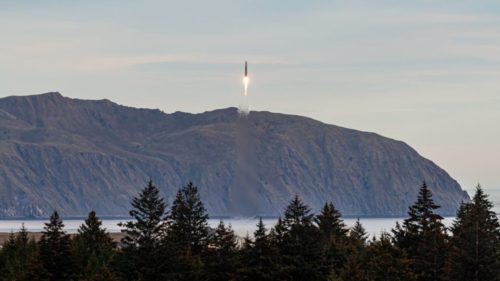
** Astra Space attempts orbital launch but fails during first stage boost phase. Following several scrubbed attempts over the past few months to launch Rocket 3.1, the vehicle lifted off from the pad at the Alaska Aerospace on Kodiak Island on Friday Sept. 11th. After about 30 seconds into the flight, the engine cutoff and the rocket fell onto the ground, producing an explosion visible to observers on the island.

A posting from the company: We Have Liftoff! | Astra

As we’ve always said, we expect it to take three flights to make it to orbit. Tonight, we saw a beautiful launch! Preliminary data review indicates the rocket performed very well. Early in the flight, our guidance system appears to have introduced some slight oscillation into the flight, causing the vehicle to drift from its planned trajectory leading to a commanded shutdown of the engines by the flight safety system. We didn’t meet all of our objectives, but we did gain valuable experience, plus even more valuable flight data. This launch sets us well on our way to reaching orbit within two additional flights, so we’re happy with the result.

We are incredibly proud of what the team accomplished today. This was our first orbital launch attempt, and the first flight of a rocket designed from the ground-up for low cost mass production and highly-automated launch operations. The entire launch system was deployed by six people in less than a week – completely unprecedented.

Astra’s strategy is to learn fast through iterative development. Although we’re pleased with today’s outcome, we still have more work to do to reach orbit. Once we reach orbit, we will relentlessly continue to improve the economics of the system as we deliver our customers’ payloads.

Over the next several weeks, we’ll be taking a close look at the flight data to determine how to make the next flight more successful. Rocket 3.2 is already built and ready for another big step towards orbit. Thank you to our incredible team and their families, all of our supporters, and stay tuned for updates over the next few weeks. We’ll be back to the pad before you know it!

Astra rocket lifts off from Kodiak Island, Alaska. Credits: Astra Space/John Kraus

Other reports

** A  Chinese Long March-11H rocket launched nine remote sensing satellites on Tuesday, Sept.15th from a platform at sea: China bounces back with Long March 11 launch of nine satellites – NASASpaceFlight.com

Three days after losing a high-resolution remote sensing satellite due to an apparent problem with its upper stage, China launched nine new satellites for the Jilin-1 remote sensing constellation from a barge out at sea.

Launch of the nine Jilin-1 Gaofen-03 satellites took place at 01:23 UTC on Tuesday using the Long March-11H (Y2) rocket.

Launched from the De Bo 3 launch platform, all mission preparations and countdown operations were conducted from the command and control ship Bei Hai Jiu 101. This ship left port on September 13 to travel to the launch zone in the Yellow Sea.

** Chinese Kuaizhou-1A rocket fails during launch of remote sensing satellite. The solid-fueled vehicle lifted off on Sept. 12th  from the Jiuquan Satellite Launch Center. The failure of the Jilin-1 Gaofen satellite to reach orbit was reported several hours later. The small launch system can put 200kg into a sun synchronous low earth orbit.

** China successfully launched a Gaofen remote sensing satellite on a Long March 4B rocket from Taiyuan Satellite Launch Center on Sept. 7th.

The LM-4B booster with toxic fuel still on board falls into a civilian area: Another Chinese rocket falls near a school, creating toxic orange cloud | Ars Technica

** Chinese launched a small space plane on Long March-2F rocket on September 4th from the Jiuquan Satellite Launch Center in northwest China. It landed after two days in orbit at an undisclosed location.  Little information about the vehicle has been given out by the Chinese government,. No images of the vehicle have been released. Most reports assume that it is similar to the X-37B uncrewed spaceplane.

** ULA sets new target date for Delta IV Heavy launch with the NROL-44 reconnaissance satellite. The company has diagnosed the fault that caused the scrub of a launch attempt on Aug. 29th. The abort happened 3 seconds before liftoff and after the liquid hydrogen/oxygen engine on the core booster had ignited.

** Dynetics led team rolls out engineering mockup of human lunar lander system: Dynetics Marks Progress With Artemis Human Landing System Test Article Development – Dynetics

Dynetics, a wholly owned subsidiary of Leidos, has completed building a full-scale human landing system (HLS) test article that will be used for initial evaluations for NASA’s Artemis program.

The Dynetics HLS (DHLS) test article, located in Huntsville, Ala., is built to-scale and allows for test and evaluation across the engineering lifecycle. The DHLS team will use the test article for human-in-the-loop (HITL) task identification and analysis, assessing net habitable volume, crew module accommodations, placement and orientation of various components and overall habitability.

The test article includes the crew module, autonomous logistics platform for all-moon cargo access (ALPACA), ascent and descent propellant tanks and deployable solar arrays. This low-slung design could allow for easier and safer access to the lunar surface.

** A note from the LAUNCHER team:

** A fun view from EXOS Aerospace of the leak check of a new engine: Pressure Test Video – EXOS Aerospace  Blog

** Every Spacecraft Which Has Visited The Space StationScott Manley

Over the last 2 decades there have been over 200 spacecraft which have visited the space station, built by many nations and organizations, with different designs. So I thought it might be nice to make a summary of every spacecraft for comparison since we’re getting close to the 20th anniversary and 100th crew to visit the ISS.

** Links:

==================

Check out the
The Lurio Report
for news and analysis of key developments in NewSpace

The latest issue:
Changes Here, Starliner Analysis, OneWeb-A UK View
Vol. 15, No. 5, July 24, 2020

Space Frontier Foundation Award for NewSpace Journalism

==================

** SpaceX:

Falcon 9 launches of the Starlink 12 and Starlink 13 missions, each with up to 60 Starlinks depending on the number and masses of any rideshare customer payloads, are scheduled for this month.

Starlink 12 is currently set for no earlier than  Thursday, September 17 at 2:17 pm EDT (10:17 am UTC).  The landing platform droneship “Just Read the Instructionsleft Port Canaveral on Sunday. The booster for the launch is the same one used for the Crew Dragon mission on May 30th that sent astronauts Bob Behnken and Doug Hurley to the ISS.  It also launched the South Korean ANASIS II comm-sat on July 20th.

The launch of a USAF GPS satellite is currently set for the end of the month.

** A continuous video from Falcon 9 booster during the SAOCOM 1B launch and landing back at the Cape:

Sped up footage from an onboard camera during Falcon 9’s launch of the SAOCOM 1B mission – SpaceX’s first launch to a polar orbit from the East Coast. After launching from Space Launch Complex 40 at Cape Canaveral Air Force Station, Falcon 9’s first stage returned to land at Landing Zone 1.

** A high resolution time lapse of the return and port handling of the booster that flew the recent Starlink 10 mission: 8K: SpaceX Falcon 9 B1060 2 Return to Port Canaveral & Leg Folding On Board OCISLY – Trevor Mahlmann

Compiled all my coverage from the recent Falcon 9 B1060.2 return to Cape Canaveral into one video. Some really fascinating time lapses I waited around all day for (Octagrabber releasing Falcon 9’s thrust structure and collapsing)

**** Starship

The current activities at Boca Chica include:

  • SN-5, SN-6 – Appear to have been refurbished after their short test hops. Not clear if they will fly again.
  • SN-7.1 – engineering model expected to be pressure tested to failure this week. It underwent an initial test last week and subsequently was moved to another test stand that has rams to push on the lower tank to simulate the extra weight during flight due to acceleration.
  • SN-8 – From Elon’s tweet shown below, this vehicle will soon be assembled and, unlike SN-5 and SN-6, it will have flaps and nosecone . After pressure tests and static firings, a high altitude 20 km flight will be attempted: Starship test program advances towards ambitious SN8 test flight – NASASpaceFlight.com.

  • SN-9 – Stacking has begun in the mid-bay hangar.
  • SN-10 – Assembly of some sections.
  • SN-11 – Some parts observed on site.

The construction of the High-Bay hangar continues. It will probably be finished within a week or so. Presumably, assembly of the first Super-Heavy prototype can then proceed. Construction is also progressing on the orbital launch mount for the Super Heavy booster. Regarding orbital tests:

The landing will look something like this:

Elon responded to this in a tweet:

Pretty accurate simulation, although SN8 will use 3 Raptors. If SN8 craters, SN9 & SN10 are close behind. High production rate allows for fast iteration

****** Testing of Raptor with high vacuum nozzle is ready to start:

******  Sept.8 – SpaceX Boca Chica – SN10 Forward Dome Sleeved – SN7.1 Test Preps – NASASpaceflight – YouTube

Starship Serial Number 10’s forward dome was sleeved with a 4 ring stack, large pieces of the High Bay’s roof were lifted into place, SN7.1 was readied for its test campaign and work continued around the entire facility. Video and Pictures from Mary (@BocaChicaGal). Edited by Jack Beyer (@TheJackBeyer)

******  Sept.8 – SpaceX Boca Chica – SN11 Parts Spotted – NASASpaceflight – YouTube

Starship SN11’s Aft Dome Section, the three ring stack that will eventually go over the Aft Dome was spotted by Mary today, that makes at least SN8, SN9, SN10, and SN11 all in production simultaneously. Work on the Orbital Pad, Starship Pads, High Bay and SN7.1 continued. Video and Pictures from Mary (@BocaChicaGal). Edited by Jack Beyer (@TheJackBeyer)

****** Sept.12: SpaceX Boca Chica Launch Site Flyover 09/12! – RGV Aerial Photography

***** Sept.12: SpaceX Boca Chica Build Site Flyover 09/12/2020 – RGV Aerial Photography

****** Sept 12: SpaceX Boca Chica – Starship Test Tank SN7.1 readied for Burst Test – NASASpaceflight – YouTube

The Starships SN7.1 Test Tank has been moved on to the test mount with the hydraulic rams ahead of an expected burst test as a pathfinder for upcoming Starships. Video and Pictures from Mary (@BocaChicaGal). Edited by Brady Kenniston (@TheFavoritist).

****** Sept.12: SpaceX Boca Chica – Starship SN6 Moved Out Of Mid Bay – High Bay Roof Work Continues – NASASpaceflight – YouTube

Starship SN6’s post flight inspections appear to be complete with it being moved out of the Mid Bay, next to its twin SN5. Work on the roof of the High Bay continued, some new unknown parts were delivered, and SN7.1 had been mounted on Starship Pad B. Video and Pictures from Mary (@BocaChicaGal). Edited by Nic Gautschi (@NGautschi)

***** Sept.15:  SpaceX Boca Chica – New Legs and Thrust Puck Delivered – NASASpaceflight – YouTube

New legs were delivered along with a fresh Thrust Puck. The SN7.1 Test Tank is hooked up for testing, SN9’s Thrust Section was flipped ahead of stacking, and work around the entire site continued. Video and Pictures from Mary (@BocaChicaGal). Edited by Nicholas Gautschi (@NGautschi).

**** Other Starship and space transport reports:

**** Sept.12: SpaceX Starship updates, Starlink Space Lasers, Rocket Lab Photon, SLS news & Astra launch failure – Marcus House

Today we are going to give you a rundown of SpaceX Starship updates, Starlink Space Lasers, Rocket Lab Photon, SLS news & Astra launch failure. So many updates Starship updates from BocaChica. SN7.1, SN8, SN9, SN10 and now SN11! Some interesting new information about Starlink and its newly tested communication via space lasers. We are going to talk a little about Rocket Labs’ awesome new Photon spacecraft and a few interesting updates on NASA’s Space Launch System. Sadly Astra’s 1st orbital test launch failed during first-stage engine burn. That news was breaking as this video was rendering. Tough luck. Better luck next time.

**** Sept.11: SpaceX Starship Mass Production Starting . – What about it!?

Today amongst other things I’ll explain to you, how SpaceX will be able to build their offshore launch platforms for Starship and Super Heavy!

**** Sept. 7: SpaceX Starship – Around the honeymoon – DeepSpaceCourier – “Video follows newlyweds on their lunar honeymoon.”

https://youtu.be/TUWMgshx-Hw

=== Amazon Ad ===

Space Is Open for Business:
The Industry That Can Transform Humanity

Space transport roundup – Sept.3.2020

A sampling of recent articles, videos, and images dealing with space transport (find previous roundups here):

** SpaceX flies the prototype Starship SN6 on a low altitude hop: The SN6 flew today following a postponement on Sunday believed due to high winds, which continued until today. In what looked like a duplicate of the hop by SN5 on August 4th, the vehicle flew up and over and down to a pad while leaning from vertical due to the offset position of the  single Raptor engine from the center of the base.  It may have gone a bit higher than the SN5’s 150 meters. Elon Musk has spoken of eventually seeing test flights of Starship prototypes happening multiple times a week.

[ Update: More views of the hop:

]

More at:

** SpaceX launches  two Falcon 9 rockets within four days. On Sunday, August 30th, a F9 put the Argentine SAOCOM-1B radar satellite and two American smallsats into orbit. The unusual southern trajectory took the rocket along the Florida coast and the upper stage over Cuba. The first stage booster returned for a landing on a pad back at Cape Canaveral. The fairing halves were recovered from the sea.

Here is a view of the F9 continuously from liftoff to the booster landing: From Launch To Landing – SpaceX Falcon 9 w/ SAOCOM 1B – YouTube

On Thursday morning, September 3rd, another batch of 60 Starlink satellites were launched from Pad 39B. The booster landed safely on a platform at sea and the satellites were deployed successfully.

Find more about other SpaceX activities below

** An Arianespace Vega rocket put over 50 smallsats into orbit Thursday morning as well. This was the first flight of the Vega since a launch failure on July 10, 2019. The flight also marked the start of a smallsat rideshare program in which satellites from different organizations split the cost of flying to space. The four-stage Vega is all solid-fueled except for the small fourth stage, which uses UDMH and nitrogen tetroxide.

** Rocket Lab sends Capella radar sat to orbit on August 31st in the first mission since a launch failure on July 4th.

** Rocket Lab included the first Photon satellite on the same flight with the Capella radar satellite: Rocket Lab Launches First In-house Designed & Built Photon Satellite | Rocket Lab

The satellite, named ‘First Light’, is the first spacecraft from Rocket Lab’s family of configurable Photon satellites to be deployed to orbit. Launched as a technology demonstration, ‘First Light’ builds upon the existing capabilities of the Electron launch vehicle’s Kick Stage with additional subsystems to enable long duration satellite operations. This pathfinding mission is an initial demonstration of the new power management, thermal control and attitude control subsystem capabilities. By testing these systems for an extended period on orbit, Rocket Lab is building up flight heritage for future Photon satellite missions planned to low Earth orbit, the Moon, and Venus.

‘First Light’ was deployed to orbit on Rocket Lab’s 14th Electron mission, ‘I Can’t Believe It’s Not Optical’, which lifted-off from Rocket Lab Launch Complex 1 in New Zealand on August 31, 2020. Approximately 60 minutes after lift-off, Electron deployed a 100 kg microsatellite for Capella Space, an action that would typically signal the successful completion of a standard Rocket Lab mission. However, shortly after deploying the customer payload, Rocket Lab conducted an entirely new operation for the first time: Rocket Lab engineers sent a command to transition the Kick Stage into Photon satellite mode. This action marked the first on-orbit demonstration of Rocket Lab’s Photon satellite as a two-in-one spacecraft, first using it to complete its conventional launch vehicle function to deploy customer satellites, then transitioning into a satellite to continue a standalone mission

Rocket Lab will offer the Photon to users who want to send a payload to space but don’t want to build a whole satellite. By taking advantage of the Photon’s built-in capabilities, a payload owner can focus just on the payload’s operations and not those of the carrier spacecraft.

** Rocket Lab obtains a FCC license to launch from the commercial spaceport on Wallops Island: FAA Approves Rocket Lab’s Operator License for Wallops Launch Complex – SpacePolicyOnline.com

The license allowsallows for multiple launches from LC-2 for the next 5 years without needing a new launch-specific license for every mission“.

** A ULA Delta IV Heavy aborted after ignition of one of its engines and just 3 seconds before the planned liftoff on August 29th. According to ULA, there will be a postponement of at least seven days before the next launch attempt.  The launch had been postponed several times, most recently due to a ground equipment problem. No new launch date has been announced yet. The NROL-44 mission involves a classified spysat of some sort.

Note that the flames are standard for DIV launches due to the deliberate ignition of hydrogen gas that can build up around the base of the rocket.

More at:

** OHB’s Rocket Factory aims to launch first smallsat rocket in 2022. OHB of Germany, which has sold a wide range of rocket and satellite components and systems for many years, recently began development of its own rocket for launching smallsats. The venture recently got a contract with Exolaunch, “to provide end-to-end launch services for small satellites”: OHB start-up Rocket Factory signs agreement with Exolaunch to supply commercial launch services – OHB.

Rocket Factory currently is developing a launcher system called RFA One for small satellites with a payload performance of up to 300kg to low earth orbit (LEO). The first launch is scheduled for 2022.

Two other German smallsat launcher companies are Isar Aerospace and HyImpulse.

** Interesting account of the history of RLV development in the US: Jess Sponable – Reusable Launch, Pete Conrad, and DARPA – Cold Star Project S02E58

2X past DARPA Program Manager Jess Sponable is on the Cold Star Project to share his experiences and aspirations in the space industry. With host Jason Kanigan, our topics cover the development of reusable launch technology, a colorful character (#3 to walk on the Moon) named Pete Conrad and Jess’ interactions with him, and DARPA. Our conversation was submitted to and approved for public release by the USAF.

Relevant resources:

** How many small launcher companies can survive out of the 100 or so globally that are seeking to make a sustainable business from smallsat orbital delivery services? This question is discussed by Patrick Host in a recent article in Jane’s International Defense Review titled, Tough crowd: Small launch vehicles seek niche in ultra-competitive market (pdf). David Livingston talked with Host about the article on The Space Show – Tues. Aug.25.2020.

The general consensus is that only 2 to 3 companies can survive the coming shakeout. However, I will note that many countries will support at least one or two national smallsat launch service ventures. For example, Spain is likely to steer government funded smallsats to a company like PLD Space, UK will send government payloads to companies like Skyrora and Orbex, Germany will back ventures such as HyImpulse and OHB’s Rocket Factory (see above), China and India are each going to support their multiple launcher companies, etc.

So while 2 or 3 small launch system companies will get the bulk of competitively selected payloads, globally there could easily be a dozen or more small companies around the world that survive indefinitely on government smallsats and subsidies. They may not generate high profits but they can remain in business with a modest number of launches per year.

** Briefs:

==================

Check out the
The Lurio Report
for news and analysis of key developments in NewSpace

The latest issue:
Changes Here, Starliner Analysis, OneWeb-A UK View
Vol. 15, No. 5, July 24, 2020

Space Frontier Foundation Award for NewSpace Journalism

==================

** SpaceX:

As noted at the top of this posting, SpaceX has launched Falcon 9 rockets twice since the previous roundup. According to this schedule, there could be up to three more flights in September, including two Starlink missions

**** Starship

See the SN6 flight video at top. A pressure test to destruction of the SN7.1 propellant tank prototype is said by many to be the next major action at Boca Chica. The goal is to confirm the improvements in welding techniques and the performance of a new steel alloy.

Meanwhile, construction of the High Bay building for stacking of the Super Heavy has reached its full height greater than 81 meters. It just needs a roof and side panels to complete the external structure.  Elon has said that construction of the first Super Heavy prototype should start this week.

Work continues also on the launch platform for the Super Heavy. This involves the building of massive tilted pillars to hold up the base where the SH will stand.

See the videos below for visuals of these activities and projects.

****** Elon Musk talked about Starship, Raptor engines, and building a colony on Mars in a phone interview for the Humans to Mars conference.

Some highlights of his remarks:

  • Making good progress on the production line for Starship.
  • Need eventually to make a thousand or more Starships to make it feasible and affordable to put a city on Mars.
  • Assembly of the first prototype Super Heavy booster to start this week at Boca Chica.
  • The target number of Raptor engines on the SH has decreased from 31 to 28.
  • Raptor thrust to weight ratio could reach 200.
  • First orbital mission could take place next year.
  • Initial missions could be failures due to the difficult challenges of developing a fully reusable system.
  • Will do hundreds of satellite launch missions before taking people to orbit on a Starship.

See also:

****** Aug.28: SpaceX Starship Facility Update  Alex Rex – YouTube

This short video shows a virtual flight over the Starship Facility in Boca Chica, TX on August 28th, 2020. It is kept as simple as possible with major focus on BUILDINGS, JIGS and STARSHIP-Parts. For other design projects, please visit my webpage: http://www.alexrex.de/


****** Aug.31: SpaceX Boca Chica – SN7.1 Assembly amid SN6’s aborted hop attempts – NASASpaceflight – YouTube

While Starship SN6 aborted it hop attempts on Sunday due to very windy conditions in Boca Chica, Test Tank SN7.1 continued assembly ahead of its expected test to failure after SN6’s completed hop. Video and Pictures from Mary (@BocaChicaGal). Edited by Nicholas Gautschi (@NGautschi).

****** Sept.1:

A sign of future intent as a huge amount of steel that will make up future Starships – and possibly allocated to the prototype Super Heavy – was on show at Boca Chica. Includes checking in with SN7.1 and the soon-to-hop SN6, the latter view a drive past. Video and Pictures from Mary (@BocaChicaGal). Edited by Nicholas Gautschi (@NGautschi).

****** Sept.2 – RGV Aerial Report #1 – SN6 Ready For The Hop! – What about it!? + RGV Aerial Photography

****** Sept.3: SpaceX Boca Chica – Starship SN10 parts arriving as SN6 looks forward to hop – NASASpaceflight – YouTube

Multiple current/future Boca Chica efforts in work as Starship SN6 prepare to hop. SN10 parts have now started to arrive, while work on the Super Heavy mount continues. Video and Pictures from Mary (@BocaChicaGal). Edited by Theo Ripper (@TheoRipper).

**** Other Starship and space transport reports:

**** Aug.29: SpaceX Starship Super Heavy Booster to start soon, SN6 flight shortly and Delta IV Heavy Abort – Marcus House

Around a few frustrating delays, we have a lot to talk about. Starship Super Heavy Booster build to start soon according to Elon’s recent tweets. We had the Delta IV Heavy Abort just hours ago and hopefully an SN6 flight shortly This week we have lots to share yet again on SpaceX’s starship development from Boca Chica Texas. Much more information on the super-heavy launch pad and we are of course gearing up for the launch of Starship serial number 6. We had an interesting abort just hours ago with the attempted flight of the Delta IV Heavy from Cape Canaveral Air Force Station. Some updates on the James Webb Space Telescope. And SpaceX may very well be flying back to back Falcon 9’s on the next Starlink mission and SAOCOM1B mission on Sunday depending on range approval (although Delta IV heavy may cause issues with this plan).

**** Aug.28: How to finance a fleet of SpaceX Starships? – What about it!?

Today amongst other thing’s I’ll explain to you, what SpaceX’s Starship has to do with the number 553 and how it will be financed.

=====

=== The Art of C. Sergent Lindsey ===

SpaceX Delivers the Goods” by C. Sergent Lindsey printed on phone cover. Available at Fine Art America.

Space transport roundup – Aug.28.2020

A sampling of recent articles, videos, and images dealing with space transport (find previous roundups here):

** ULA, SpaceX, and Rocket Lab are all planning launches over the next few days. In fact, SpaceX is targeting two Falcon 9 launches [and one Starship prototype hop]. A Vega rocket is set to launch next week from French Guiana as well.

** ULA set to launch Delta IV Heavy from Cape Canveral with classified military payload. Liftoff is currently set for Saturday morning following a scrub on Thursday morning due to a ground equipment problem.

** ULA aims for first Vulcan rocket launch in  2021: ULA updates Vulcan status, readiness for certification missions – NASASpaceFlight.com

Development and flight qualification for United Launch Alliance’s new rocket, Vulcan, remains on track and on schedule (with margin) to make its debut flights next year, as do all ground support facilities and flight software elements for the heavy-lift vehicle.

Vulcan’s first two flights, certification missions to clear the rocket to fly category A/B national security payloads for the U.S. Space Force, will loft Astrobotic’s Peregrine Lander outward to the Moon and then Sierra Nevada’s Dream Chaser spacecraft on its demonstration mission for NASA to become the third U.S. cargo vehicle for Station operations.

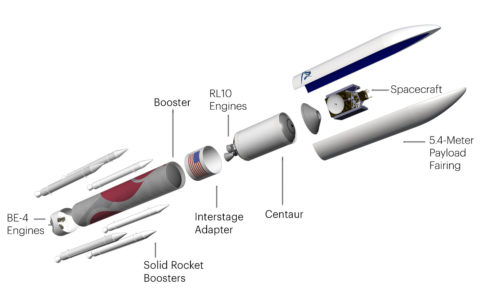
The major elements of the ULA Vulcan Centaur rocket. Credits: ULA

Blue Origin is dealing with turbine pump issues that arose with the BE-4 engines that will be used for the Vulcan first stages: ULA CEO Tory Bruno: Here’s how we beat SpaceX for Space Force’s big contract – Denver Business Journal

By [early 2021], 90% of the Vulcan rocket’s systems and its upgraded Centaur upper stage will have already been flown.

The biggest elements not previously flown will be the booster structure itself and the BE-4 engines.

Blue Origin is still troubleshooting the 75,000-horsepower pumps that bring fuel to the BE-4’s main combustion chamber, Bruno said, adding that’s he confident the issues will soon be solved.

“There’s very little technical risk,” he said. “It isn’t easy, but we know we can do it.”

** China launched a Gaofen-9 optical remote imaging satellite on a Long March 2D rocket on Saturday from the Jiuquan Satellite Launch Center. Additional payload riders included theTiantuo-5 smallsat to test Internet of Things (IoT) communications and the Duo Gongneng Shiyan Weixing, which is also a technology test satellite.

** Rocket Lab to launch Capella radar satellite on the first mission since a launch failure on July 4th. By the end of July the company had traced the failure to an electrical connection problem and taken corrective actions for a return to flight status by the end of August.

— Rocket Lab (@RocketLab) August 25, 2020

Capella is developing a constellation of radar satellites for commercial remote sensing:

Sequoia is a 100 kg class microsatellite and will be positioned in a 45-degree inclination. This mid-inclination allows us to give our customers immediate access to rapid coverage of important regions, including the Middle East, Korea, Japan, Europe, South East Asia, Africa, and the U.S. Like all of our Capella satellites, Sequoia will be able to see through clouds and in the dark and detect sub-0.5 meter changes on Earth’s surface. When fully deployed, our satellite constellation will offer hourly coverage of every point on Earth.

We were fortunate to work with Rocket Lab to name this mission “I Can’t Believe It’s Not Optical,” a reference to our innovative SAR satellite technology, which overcomes the limits of the optical imagery used in other commercial satellites. Unlike optical, SAR can see through clouds, in all weather conditions and even at night. Our team voted on the mission name in June, ultimately choosing it as a nod to our unique satellite technology and the infamous advertisement campaign for “I Can’t Believe It’s Not Butter.” We take our work seriously, but we don’t take ourselves that seriously.

** Astra Space has a new window for their next attempt to launch from the Alaska spaceport:

** PLD Space in Spain report on engine qualification:

** Briefs:

==================

Check out the
The Lurio Report
for news and analysis of key developments in NewSpace

The latest issue:
Changes Here, Starliner Analysis, OneWeb-A UK View
Vol. 15, No. 5, July 24, 2020

Space Frontier Foundation Award for NewSpace Journalism

==================

** SpaceX:

** Two Falcon 9 launches from Cape Canaveral planned during the next few days. Weather and the delays in the launch of the ULA Delta IV Heavy launch mentioned above have affected the schedule so the exact launch times are uncertain at the moment.

  • Starlink 11 – Falcon 9 will take 60 more satellites to low earth orbit for SpaceX’s Starlink broadband Internet constellation
  • SAOCOM 1B – Earth observation satellite for CONAE, Argentina’s space agency.

Currently, the launch schedule shows both launches set for August 30 (Sunday) with Starlink 11 at 1408 GMT (10:08 a.m. EDT) from Pad 39A at KSC and SAOCOM 1B at  2319 GMT (7:19 p.m. EDT) from SLC-40.  However, it’s unlikely they will actually launch the same day.

** SpaceX wins another lunar mission launch contract:

Masten Space Systems announced today that it has selected SpaceX to launch Masten Mission One (MM1). As part of MM1, Masten’s lunar lander will deliver nine NASA-sponsored science and technology demonstration experiments and several commercial payloads to the lunar south pole.

“Having SpaceX’s proven launch success behind us is not only great for us, but it’s great for our customers,” said Masten chief executive officer, Sean Mahoney. “We share a common vision with SpaceX and that makes this more than a partnership. It’s more like a dream team.”

Masten’s first mission to the Moon, MM1 is a collaboration with NASA’s Commercial Lunar Payload Services (CLPS) Project Office. The Masten XL-1 lunar lander is scheduled to touch down on the lunar south pole in 2022, carrying a suite of NASA-sponsored scientific instruments and various payloads from commercial space customers.

SpaceX also has contracts for launching payloads to the Moon from iSpace of Japan and Intuitive Machines. In 2019, SpaceX launched Israel’s Beresheet commercial lunar mission, which went successfully into orbit around the Moon but unfortunately fail at its landing attempt.

** Here are some notes on Falcon 9 reusability here from a presentation by a SpaceX manager earlier this year. At the time, the inspection/refurbishment took about 30 days.  Not clear if the $30M mentioned is the cost to SpaceX to prepare a F9 or if it is the price to customers.

**** Starship

SpaceX continues to manage a frenetic pace of activity at Boca Chica. The Raptor engine on the Starship SN6 prototype was test fired last weekend and a low altitude test hop is expected in next few days. Starship SN6 fires up Raptor SN29 – NASASpaceFlight.com.

The SN5 prototype was moved back to the assembly site and appears to have been refurbished from the hop it took on August 4th.

It’s been a year since the Hopper took its jump up to 150 meters and back down for a soft landing: Boca work continues as SpaceX marks anniversary of Starhopper’s final flight – NASASpaceFlight.com.

Good progress has been made in assembling two prototypes – SN8 and SN9 – that will be fully fitted out with body flaps and nosecones.

Here are renderings of SN8 and SN9 as imagined by Neopork (@Neopork85) / Twitter:

A partial propellant tank module titled SN7.1 is also under construction. It will be used to pressure test improved welding techniques and iron alloy.

** Super Heavy booster launch plans. Some of the videos below show construction underway for a structure at Boca Chica for launching Super Heavy Boosters. This will be for occasional test flights. For operational launches, SpaceX plans on using offshore platform:

The first Super Heavy prototype test  hop could happen as early as October according to Elon.

***** Aug.23: SN6 Static Fire with Thermal Time lapse – LabPadre – YouTube

SpaceX Boca Chica has completed a static fire with SN6. No issues seemed to have occurred but it did take three tries. Thermal time lapse shows thermal exchanges on the vehicle. Thermal imagery provided by CrowBit.

***** Aug. 24: SpaceX Boca Chica – Starship SN6 Static Fire – NASASpaceflight – YouTube

Starship SN6 fires up its single Raptor engine (Raptor SN29) for the first time on the third attempt of the day, in magnificent golden hour lighting. Close up, wide angle, full speed and slo mo – all with glorious ambient audio. Video and Pictures from Mary (@BocaChicaGal). Edited by Jack Beyer (@TheJackBeyer)

****** Aug. 26: SpaceX Boca Chica – From SN5 re-hop preps to SN9 sleeving – A busy Spaceport – NASASpaceflight – YouTube

From Starship SN5 being prepared for a re-hop, SN6’s preps for a maiden hop, through to SN9 taking shape, it’s all go at SpaceX Boca Chica! All while the orbital launch mount build continues and the High Bay grows. (Lengthy) Video and Photos from Mary (@BocaChicaGal). Edited by Nicholas Gautschi (@NGautschi)

****** Aug. 26: Starship Views – StarshipBocaChica/Maria Pointer – YouTube

Join me for a visit to the Starship Production Complex showing tanks and newly groomed areas. They developed roadside access and drainage, stowed much of the yard stockpiles and made the area much safer for the worrisome flying debris during hurricane season. These images were taken before the static fire on Sunday, but you will find something to study. Fin Park is included, showing continued landscaping progress. I call the gathering area Fin park for 2 reasons, the upcycled MK1 Fins, and to honor an executive that works close with Elon that has Fin in his name. So I’ve been lobbying hard for Fin Park as the official name. I think it is smackdown time with other’s promoting names as we wait to see Elon’s reveal. Can’t wait to see your comments. Many names are popping up making the parks naming entertaining. (Fin Park is perfect name right?)

***** Aug. 27: SpaceX Boca Chica – SN6 Mass Simulator Installed – Other Starships Prepare – NASASpaceflight – YouTube

Starship SN6 has had its Mass Simulator installed at the launch site while SN8 waits to become a completed stack under the watchful eye of SN5. Video and Photos from Mary (@BocaChicaGal). Edited by Nicholas Gautschi (@NGautschi).

***** Aug 28: SpaceX Boca Chica – SN8 Stacked, Orbital Pad Progress, and High Bay Construction Continues – NASASpaceflight – YouTube

Starship SN8 was stacked in the Mid Bay and progress on the construction of the Orbital Launch Pad continues with another rebar cage getting its steel cladding. A lift of a section of the High Bay was briefly aborted due to wind before being successfully completed, and activity at the launch site, including SN6 hop preparations, continued. Video and Pictures from Mary (@BocaChicaGal). Edited by Nicholas Gautschi (@NGautschi).

**** Other Starship and space transport reports:

*****Aug 22: SpaceX Starship SN6 to fly in less than a week!?, Starlink Speed Results, Saocom 1B, Ariane 5/MEV-2 – Marcus House

So much news today with a possibility of SpaceX Starship SN6 to fly in less than a week. We get some Starlink Speed Results along with an update on the record-breaking booster landing, Saocom 1B is coming up, Ariane 5/MEV-2 mission successful and Blue Origin Human Landing System update. Starship Serial number 6 having had its pressure test and raptor installation will have a static fire test coming potentially over the next few days. And the breaking news is that we could be seeing Starship SN6 fly within a week (see road closures notices). Another beautiful launch Starlink launch during the week with some newly broken records for SpaceX on that mission. Arianespace recently completed another successful launch of the Ariane 5 Heavy Lift vehicle. Really cool detail about that MEV-2 payload that we’ll talk about as well. Updates by Blue Origin on the Human Landing System being constructed by the National Team. And on top of all that, we have another Falcon 9 launch potentially next week with the Saocom 1B mission.

***** Aug. 25: How To Construct A SpaceX Starship Launch Mount? – What about it!?

Today I’ll explain to you, what points towards SpaceX building a Starship Launchpad in Boca Chica and why!

***** Aug. 21: How Will SpaceX’s Starship SN8 Fly & Land? – What about it!?

Today I’ll explain to you, how long we’ll have to wait for the next Starship hop and what the rest of the world is doing to keep up with SpaceX.

=====

=== Space Art from C. Sergent Lindsey ===

Sweatshirt imprinted with “SpaceX Delivers the Goods” by C Sergent Lindsey. Available at Fine Art America.