Sci-Tech: UrbanAero’s fancraft AirMule making test flights

Urban Aeronautics in Israel has begun untethered unmanned flight tests of their vertical takeoff and landing (VTOL) prototype AirMule vehicle:

“AirMule Achieves Major Milestone on the Path to
Full Mission Demonstrations”

The AirMule, an unmanned VTOL (Vertical Takeoff and Landing) aircraft developed by Tactical Robotics Ltd., a subsidiary of Urban Aeronautics, Ltd., has successfully completed a major milestone in preparation for full mission demonstrations scheduled for next year. The aircraft has completed several fully automatic test flights in which it carried out take-offs, flights to and from a specified location and landing back at its point of origination.

The 1-ton vehicle is unique from all existing vertical take-off and landing aircraft in that it has no exposed rotors. This allows the aircraft to fly in air space that is off limits for any other aircraft.

During these tests height above ground is maintained by two laser altimeters (to be augmented soon by a radar altimeter for dusty conditions). Accurate position is maintained through data fusion of GPS signals, INS data and optical reference to markers on the ground.

Acoustic signature (Sound Pressure Level in dBA) has been recorded as a function of distance from the aircraft to a calibrated microphone and has been found to be significantly lower than an equivalent helicopter.

Additional flight testing is planned for next year with a second prototype, now in construction, planned to join the flight test program in the second half of 2014.

About Urban Aeronautics and Tactical Robotics

Urban Aeronautics Ltd, is the world leader in developing Fancraft technologies. These technologies are the foundation for a family of internal rotor (modified ducted-fan) aircraft with both manned and unmanned, civil and military applications. Due to their internal rotors, compact design and revolutionary ‘six-degrees-of-freedom’ mobility, these aircraft are uniquely suited to flight inside of cities and other obstructed environments where both fixed wing aircraft and traditional rotorcraft are unable to operate. Urban’s subsidiary, Tactical Robotics Ltd. develops these technologies for the military and unmanned market including the company’s flagship model, AirMule.

A video showing extracts from AirMule’s recent test flights:
Yutu begins its roving of the Moon

Emily Lakdawalla at the Planetary Society has posted some reports and lots of pictures on the status and plans for the Chinese Chang’e 3 lander and Yutu rover on the Moon:

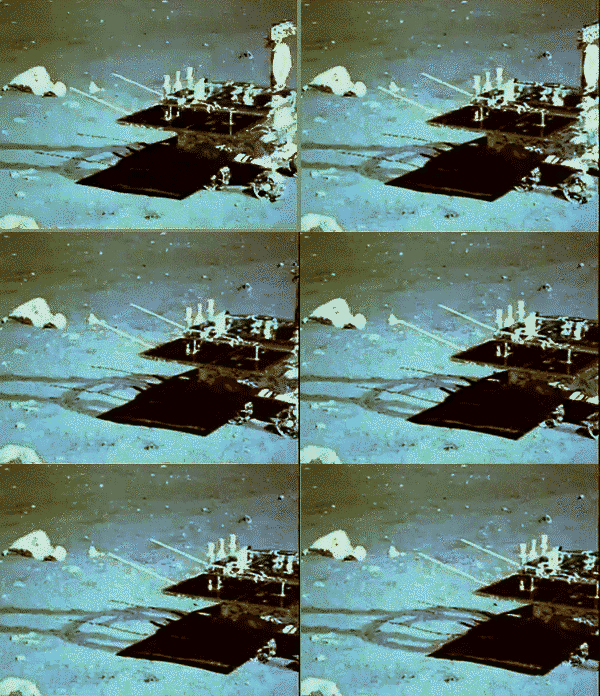
Yutu rolling on the Moon
CNSA / ifeng.com / Emily Lakdawalla
Yutu rolling on the Moon
China’s Yutu rover makes tracks on the surface of the Moon,
taken on December 21, 2003. This sequence was taken from a
television broadcast, aligned to correct for the motion of the camera,
and its color adjusted.

Mars misc: Crowd-funded mock Mars mission + Extracting Mars water + Curiosity update

Some misc. Mars items:

—

A reader points me to this successful crowd-funding campaign to back artist Ian Etters stay at the Mars Desert Research Station (MDRS) and his plan to create a

Manned Mock Mars Mission (M.M.M.M.) that incorporates performance, sculpture, painting, drawing, printmaking, photography and a simulation of living on Mars.

– Manned Mock Mars Mission by Ian Etter — Kickstarter

===

Here’s an article about how water might be extracted from the Martian ground: Incredible Technology: How to Mine Water on Mars – Space.com.

===

Here’s a recent update on the Curiosity rover on Mars: Curiosity Team Upgrades Software, Checks Wheel Wear – NASA Jet Propulsion Laboratory

Rocky Mars Ground Where Curiosity Has Been DrivingNASA’s Mars rover Curiosity captured this 360-degree view using its
Navigation Camera (Navcam) after a 17-foot (5.3 meter) drive on
477th Martian day, or sol, of the rover’s work on Mars (Dec. 8, 2013).
Credit: NASA/JPL-Caltech/MSSS. 
Full image and caption

ISS astronauts on EVA to install new cooling system pump

Astronauts  Rick Mastracchio and  Mike Hopkins are now outside the ISS installing the spare pump in the cooling system. It is the second of perhaps three spacewalks needed to fix the system. (See earlier post on the first EVA last Saturday.) So far they have mechanically installed the pump and are now reconnecting the ammonia lines to the pump.

They had difficulty disconnected one line from a temporary jumper box. After they finally disconnected it, there was venting of ammonia as small snowflakes, some of which got on their suits. They will have to go through a decontamination procedure before they reenter the airlock. This could mean shortening the spacewalk.

See updates and pictures at ISS Updates (ISS101) on Twitter.

[ Update: The astronauts finished their EVA and they also completed the repairs to the cooling system. So a third EVA will not be needed:

]

Other updates and info at:

Some images of the astronauts moving the spare pump into place:

[]


[]
[]

Everyone can participate in space