ISS astronaut Mike Hopkins space work out demo

Speaking of exercise and diet to prevent bone loss in space, here is a video showing how astronaut Mike Hopkins goes about exercising during his stay on the International Space Station:

Caption:

Astronaut Mike Hopkins, a lifelong athlete, worked closely with his strength and conditioning coach Mark Guilliams to develop these specially-designed workouts in orbit. Shown here, Hopkins is using the Advanced Resistive Exercise Device to perform this challenging workout. (100 Pull Ups, Push Ups, Sit Ups and Air Squats each.)

As part of his mission, Hopkins is a participant in a number of going medical studies and research experiments.

Pro K is one area of research Mike is helping with. For this study, the astronauts eat a low protein diet in an effort to minimize bone mineral loss. This will not only help future astronauts on long duration missions, but given the dietary trends in the U.S., this research will have direct public health significance helping us better understand protein-rich diets. Learn more about Pro K: http://www.nasa.gov/mission_pages/sta…

Numerous benefits are already being realized from space station science such as vaccine development research, imagery that aids disaster relief and farming, and education programs that inspire future scientists, and engineers are just some examples. To learn more about benefits from ISS, visit: http://www.nasa.gov/iss-science

Staying healthy is important for all astronauts going to space, but lifelong fitness is particularly important to Mike. To follow along with his workouts and other Astronaut workouts and activities, check out: http://www.facebook.com/TrainAstronaut

You can follow Astronaut Mike Hopkins on Twitter at: @AstroIllini

Sci-Tech: Totipotent stem cells derived from adult cells in new simple technique

I don’t post many items about biology but this developments sounds quite significant if it holds up:

The research will now be subject to yet more scrutiny as other teams try to replicate it. Cracks may yet appear. But right now it looks like that rarity: an actual breakthrough.

If so, the implications are huge. First and foremost, it promises an almost ridiculously simple route to regenerative medicine. There is a lot of work still to do, and many potential pitfalls before it could be applied to human patients, but in principle almost any illness caused by damaged or ageing tissue – heart disease, diabetes, Alzheimer’s and dozens of others – could be fixed this way.

That’s an exciting prospect, but as so often with stem cells, ethical concerns are lurking.

Student Spaceflight Experiments Program (SSEP) activity underway on the ISS

The Student Spaceflight Experiments Program (SSEP) is described as follows:

The Student Spaceflight Experiments Program (SSEP) was launched in June 2010 by the National Center for Earth and Space Science Education (NCESSE) in strategic partnership with NanoRacks, LLC. Designed as a model U.S. national Science, Technology, Engineering, and Mathematics (STEM) education initiative, the program gives typically 300+ students across a participating community the ability to design and propose real microgravity experiments to fly in low Earth orbit, first aboard the final flights of the Space Shuttle, and then on the International Space Station (ISS) – America’s newest National Laboratory. SSEP is suitable for students in pre-college grades 5-12, 2-year community colleges, and 4-year colleges and universities. SSEP also affords a participating community a high level of media exposure at a time when STEM education is of national strategic importance.

In 2012, SSEP was extended to international communities through the Arthur C. Clarke Institute for Space Education, NCESSE’s new international arm.

SSEP is about immersing and engaging students and their teachers in every facet of real science—on the high frontier—so that students are given the chance to be scientists—and experience science firsthand.

This report includes videos  showing ISS astronaut  Koichi Wakata starting and stopping SSEP experiments  recently delivered to the station : VIDEOS: Astronaut Koichi Wakata Activating SSEP Mission 3b/4 Experiments on ISS – SSEP

These are video records of on-orbit activations, de-activations and other interactions associated with the SSEP Mission 3b and Mission 4 experiments by assigned astronaut Koichi Wakata (Japan). The videos were taken on the two (of six) scheduled SSEP Crew Interaction Days that have thus far taken place since the Cygnus spacecraft berthed at ISS on January 12, 2014, with the SSEP Mission 3b Falcon II and Mission 4 Orion experiment payloads.

Koichi’s activities are reported to all student flight teams via the SSEP Mission 4 and 3b to ISS: Experiments Log page, so that flight teams can mirror all activities in their vital ground truth experiments.

The next scheduled crew interaction with the experiment payloads is to take place on the third scheduled Crew Interaction Day, January 30, 2014 (Crew Interaction Day A+17). You can see the list of all expected January 30 crew interactions on the Experiment Log page.

Beings are making space liviable

This title is quite misleading: Beings Not Made for Space – NYTimes.com.

Human beings are also not made for living on the sea but we’ve learned how to do it for indefinite periods. We are learning how to live in space as well. For example, the degradation of bone density has long been a serious problem but has indicated in the article is now largely preventable with improved exercise and nutrition regimes.

The eye issue mentioned in the article has only recently started to receive serious research attention and already there are signs that it might be solvable with simple nutritional anti-oxidants: Orbital Samples With Sight-Saving Potential – NASA.

Note that living in space and living in microgravity are not synonymous.  I don’t know of any space settlement advocate who has promoted long term residency in microgravity.  As the article hints at, habitats in space can rotate to provide spin gravity, which can reduce or eliminate the effects of microgravity. The large wheel-shaped space station  seen in the movie 2001: A Space Odyssey is the iconic  approach to this.

2001: A Space Odyssey Poster
2001: A Space Odyssey film poster

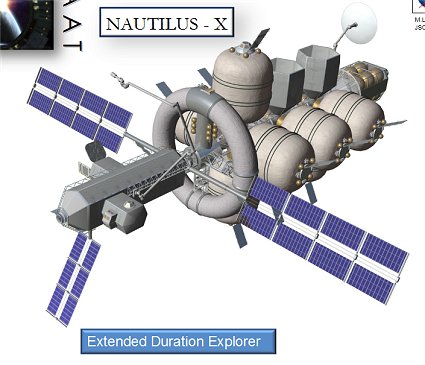
For long distance transports, a centrifuge could be added to provide some fraction of a G, which should be sufficient to prevent or ameliorate microgravity problems. A recent version of such a vehicle is the Nautilus-X concept, which was designed by Mark Holderman and Edward Henderson of NASA Johnson Space Center. If NASA was not wasting vast amounts of money on SLS/Orion,  in-space infrastructure systems like this could be under development today.

NautilusX_ExtendedDuration_425x365Nautilus-X concept for in-space transport.

Radiation protection requires shielding, not magic. Habitats on the Moon or Mars are easily shielded with regolith. In-space transports may not get radiation levels down to that of the earth at sea level but a lot can be done by surrounding living areas with all the water, foodstuffs, equipment, propellants, waste, etc that are coming along on the trip as well. Space transports should be designed from the start with radiation exposure reduction has a key goal. Eventually, material shielding may  be supplemented with magnetic shielding as well.

People are almost certainly going to live in space permanently at some point. The human spaceflight programs of today are learning how to make that happen.

===

See the HobbySpace Living in Space section for lots of resources on the microgravity health effects, radiation shielding, etc.

Update Jan.31.14: Some comments about this post: Beings Making Space Livable – Transterrestrial Musings

European Southern Observatory VLT maps surface of nearest brown dwarf

Though not actually imaging its surface, I still find it amazing that the surface of an object the size and distance of a brown dwarf can now be studied:

First Weather Map of Brown Dwarf
ESO’s VLT charts surface of nearest brown dwarf

ESO’s Very Large Telescope has been used to create the first ever map of the weather on the surface of the nearest brown dwarf to Earth. An international team has made a chart of the dark and light features on WISE J104915.57-531906.1B, which is informally known as Luhman 16B and is one of two recently discovered brown dwarfs forming a pair only six light-years from the Sun. The new results are being published in the 30 January 2014 issue of the journal Nature.

Brown dwarfs fill the gap between giant gas planets, such as Jupiter and Saturn, and faint cool stars. They do not contain enough mass to initiate nuclear fusion in their cores and can only glow feebly at infrared wavelengths of light. The first confirmed brown dwarf was only found twenty years ago and only a few hundred of these elusive objects are known.

The closest brown dwarfs to the Solar System form a pair called Luhman 16AB [1] that lies just six light-years from Earth in the southern constellation of Vela (The Sail). This pair is the third closest system to the Earth, after Alpha Centauri and Barnard’s Star, but it was only discovered in early 2013. The fainter component, Luhman 16B, had already been found to be changing slightly in brightness every few hours as it rotated — a clue that it might have marked surface features.

Now astronomers have used the power of ESO’s Very Large Telescope (VLT) not just to image these brown dwarfs, but to map out dark and light features on the surface of Luhman 16B.

Ian Crossfield (Max Planck Institute for Astronomy, Heidelberg, Germany), the lead author of the new paper, sums up the results:

“Previous observations suggested that brown dwarfs might have mottled surfaces, but now we can actually map them. Soon, we will be able to watch cloud patterns form, evolve, and dissipate on this brown dwarf — eventually, exometeorologists may be able to predict whether a visitor to Luhman 16B could expect clear or cloudy skies.”

To map the surface the astronomers used a clever technique. They observed the brown dwarfs using the CRIRES instrument on the VLT. This allowed them not just to see the changing brightness as Luhman 16B rotated, but also to see whether dark and light features were moving away from, or towards the observer. By combining all this information they could recreate a map of the dark and light patches of the surface.

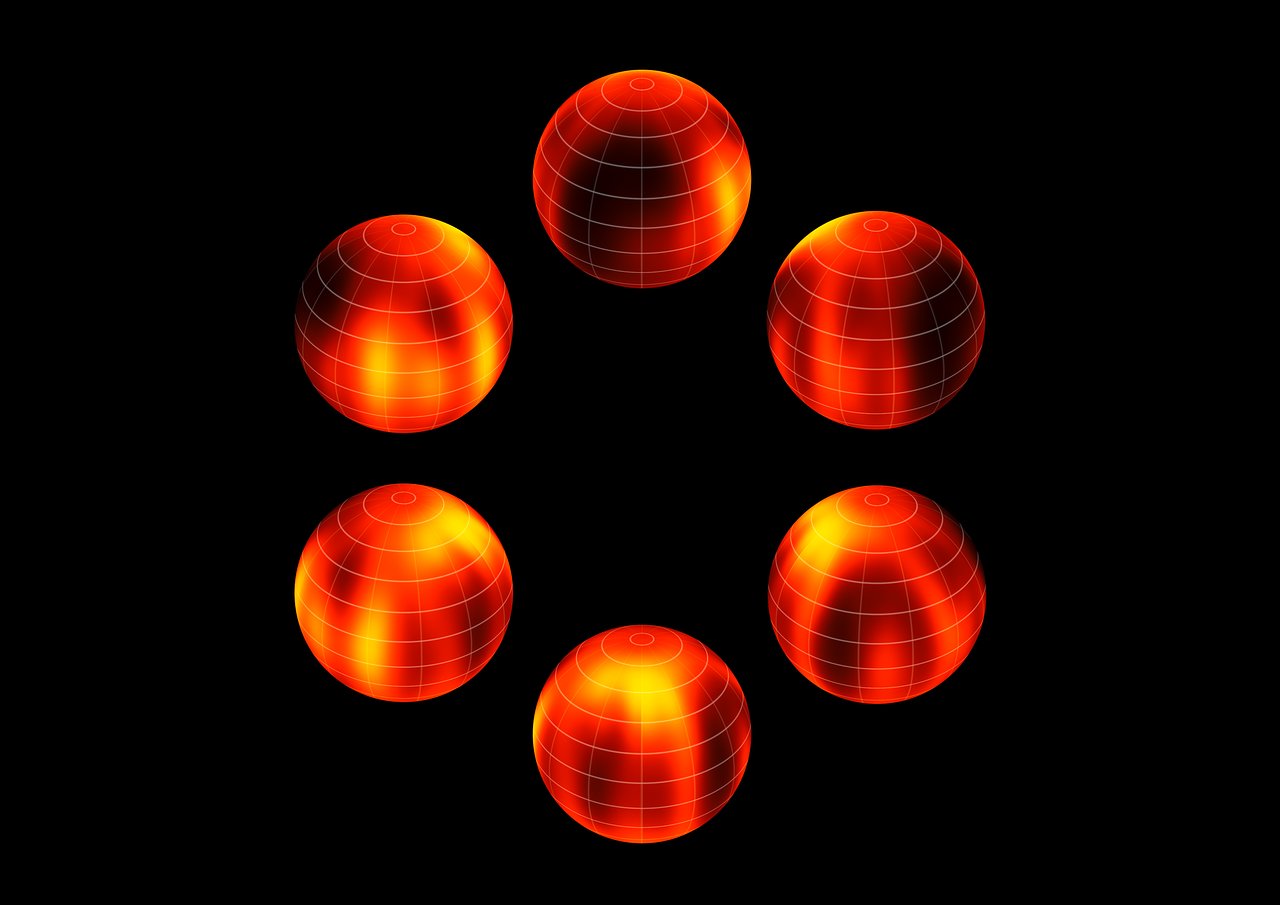
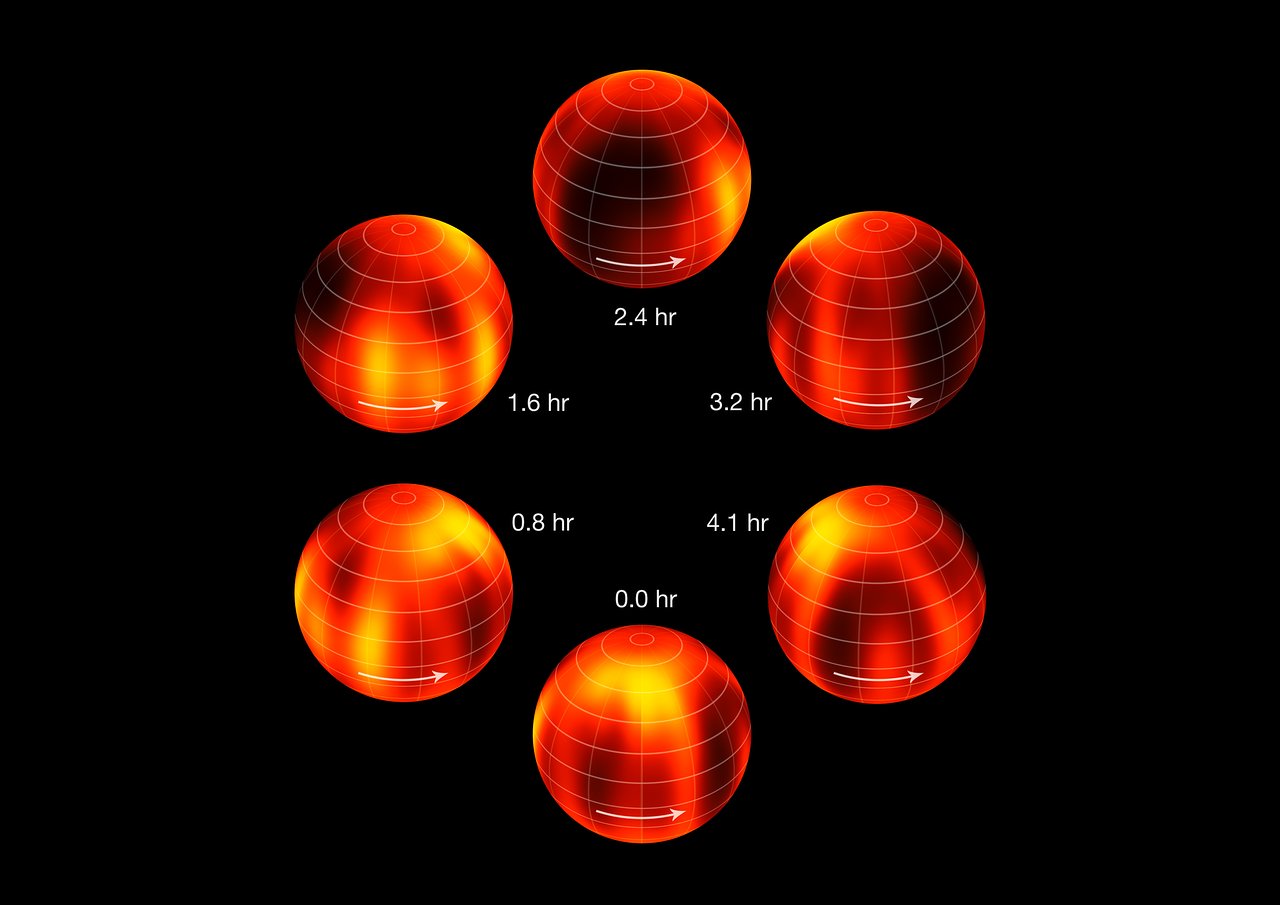
Surface map of Luhman 16B recreated from VLT observations (annotated) Click to Enlarge
ESO’s Very Large Telescope has been used to create the first ever map of the
weather on the surface of the nearest brown dwarf to Earth. An international team
has made a chart of the dark and light features on WISE J104915.57-531906.1B,
which is informally known as Luhman 16B and is one of two recently discovered
brown dwarfs forming a pair only six light-years from the Sun.

The figure shows the object at six equally spaced times as it rotates
once on its axis. Credit: ESO/I. Crossfield

The atmospheres of brown dwarfs are very similar to those of hot gas giant exoplanets, so by studying comparatively easy-to-observe brown dwarfs [2] astronomers can also learn more about the atmospheres of young, giant planets — many of which will be found in the near future with the new SPHERE instrument that will be installed on the VLT in 2014.

Crossfield ends on a personal note: “Our brown dwarf map helps bring us one step closer to the goal of understanding weather patterns in other solar systems. From an early age I was brought up to appreciate the beauty and utility of maps. It’s exciting that we’re starting to map objects out beyond the Solar System!”

—-

Find more images here.

Everyone can participate in space