JP Aerospace sale on flights of MiniCubes to NearSpace

John Powell of JP Aerospace sends me a notice of their sale on flights of the Minicubes to high altitudes on their balloon and airship missions :  MiniCube Flights on Sale! – JP Aerospace Blog –
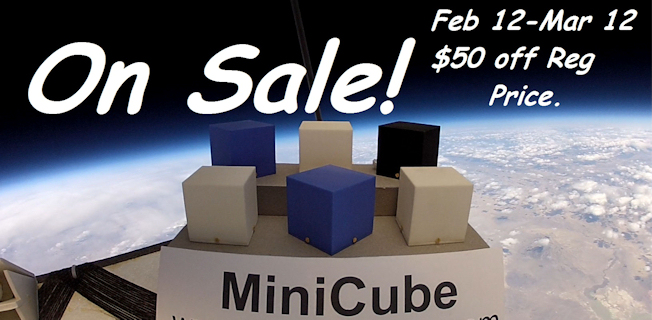
minicube_sale2mPhoto of MiniCubes in flight at 100,000 feet.

A MiniCube is a payload container for people to fly their projects on our high altitude balloons and airship missions.

MiniCubes can be used for research, commercial applications, art, inspiration or anything you can imagine.

Run your own space program!

The MiniCube is small plastic box five cm on a side. On the base is a standard camera tripod mount. You put your project inside the cube and mail it to JP Aerospace. We carry it to the edge of space on a high altitude balloon then send it back to you.

MiniCube and flight all included price: regularly $320 now on sale for $270

Flights available April 26th and September 27, 2014

Sale ends March 12th 2014.
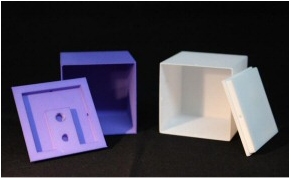
minicubes

When you purchase a MiniCube you will get a MiniCube and a flight. After the flight your MiniCube will be returned to you along with a data sheet about the mission and a CD with images and video from the flight.

  • MiniCube Home Page
  • MiniCube Store
  • JP Aerospace Home Page
  • MiniCube on facebook

The next MiniCube mission: High altitude balloon flight to 100,000 feet, April 26, 2014

Thank you,

John Powell
President
JP Aerospace, America’s OTHER Space Program
Space policy roundup – Feb.13.14

Allen Taylor writes about Rick Boozer’s book : Book Review: The Plundering of NASA – The Zetetic Forum.

More space policy/politics links:

Update:


**************************

Chinese media say lunar rover shows signs of life

Chinese sources now say that Yutu was not dead but just sleeping or pining for the lunar fjords :

China’s moon rover Yutu is awake after its troubled dormancy but experts are still trying to find out the cause of its abnormality, a spokesman with the country’s lunar probe program said on Thursday.

“Yutu has come back to life,” said Pei Zhaoyu, the spokesman.

Video: Philip Lubin (UCSB) on planetary defense with beamed power

Speaking of lasers,  Philip Lubin, a professor of experimental cosmology at UC Santa Barbara, gives a SETI Institute lecture on the DE-STAR project to design a system to protect earth from comet and asteroid collisions : Is Planetary Defense Feasible – DE-STAR: A Planetary Defense and Exploration System –

Dr. Lubin will discuss how his team has proposed an orbital planetary defense system that is capable of beamed power allowing a number of directed energy (DE) possibilities including planetary defense, propulsion allowing relativistic probes and interstellar communications using existing technologies. Recent developments in photonics allow such a system whereas even a decade ago it would have been simply science fiction.


Sci-Tech: Milestone achieved in laser fusion

The National Ignition Facility at Lawrence Livermore National Laboratory has achieved scientific break-even in laser fusion tests for the first time. This is comparing the amount of laser energy impinging upon a tiny drop of tritium-deuterium to the fusion energy that takes place in the droplet due to the compression and high temperatures resulting from the blast of laser light:

The amount of fusion energy, however, is still only about 1% of the total energy needed to create those laser pulses. However, as they understand better how to shape and time the pulses and how to design the fuel droplet and the “hohlraum” capsule that holds it, the fusion output could rise very rapidly. This ignition condition occurs when the heat of the fusions starts to drive other tritium-deuterium fusions, which in turn creates more heat, etc.

To build a reactor from such a process will require an efficient way to turn the emitted energy (high energy helium nuclei and neutrons) into heat to drive electrical generators. And the rate of laser pulsing needs to be increased substantially. All tough technology challenges.

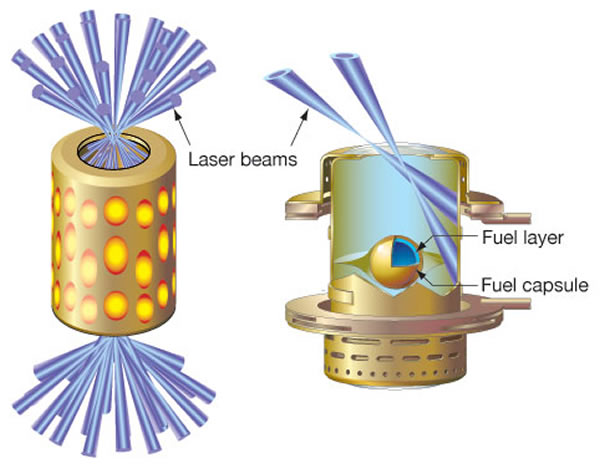
Drawings of a NIF Hohlraum

All of the energy of NIF’s 192 beams is directed inside a gold cylinder called a
hohlraum,  which is about the size of a dime. A tiny capsule inside the hohlraum
contains atoms of deuterium (hydrogen with one neutron) and tritium (hydrogen with
two neutrons) that fuel the ignition process. Credit: LLNL

Everyone can participate in space