AMSAT, Student satellites, & ISS amateur radio news – Feb.16.14

Go to AMSAT News for the latest headlines about developments in amateur and student satellites and for updates about amateur radio on the ISS.

ANS 047 Weekly AMSAT Bulletin – February 15, 2014:
* University of Louisiana CAPE II Cubesat Designated LO-75
* CubeSats deployed from International Space Station
* Brazilian students talk to Space Station using Amateur Radio
* New launch dates for SpaceX and Soyuz-2.1b Fregat-M
* FUNcube Data Warehouse Min-Max Values
* Brown University LED CubeSat
* Santa Catalina Island Activation on SO-50
* $50SAT PocketQube Update
* Upcoming AMSAT Events
* ARISS News
* Satellite Shorts from All Over

Ikarie XB-1: An influential space SF film from 1963

Author Steven Donoso wrote me today about the 1963 Czechoslovakian space science-fiction film Ikarie XB-1, which I was unaware of and did not have on my space sci-fi film list. In the US the film was shortened and released as Voyage to the End of the Universe. A newly restored version is available from Second Run DVD. They describe the movie as follows:

Jindřich Polák’s pioneering and much-imitated feature Ikarie XB 1 is one of the cornerstones of contemporary sci-fi cinema. It predates Star Trek and Kubrick’s 2001: A Space Odyssey and was clearly an influence on both, as well as on almost every other science-fiction work that followed.

Adapted from Stanisław Lem’s 1955 novel The Magellanic Cloud, the film is set in 2163 and follows a mission deep into space in search of alien life. During their perilous journey the crew confront the effects of a malignant dark star, the destructive legacy of the 20th century and, ultimately, the limits of their own sanity. With outstanding design and cinematography, Ikarie XB 1 is imbued with a seriousness, intelligence and attention to detail rarely seen in science-fiction cinema of the period.

Here’s a teaser:

And here is a longer clip:

—————————————

FanWing wins EU award to design cargo-lifting vehicle

The FanWing project announced at the end of 2013

that, following an unexpected approach early this year from Germany, it has become joint recipient for a European Union Award. The new two-year research and development SOAR project aims to optimise the originally patented FanWing rotor and wingshape and explore feasibility of a full-size cargo-lifting FanWing (see image below).  

DLR, the German Aerospace and Space Research Centre, led the original award application. They will administer the project and provide final data documentation for the EU. Test models and oversight throughout the project will be provided by the FanWing Company in consultation with George Seyfang. The University of Saarland will provide motors and the actuation process for the rotors. The Von Karman Institute, Belgium will provide wind-tunnel tests and CFD analysis.
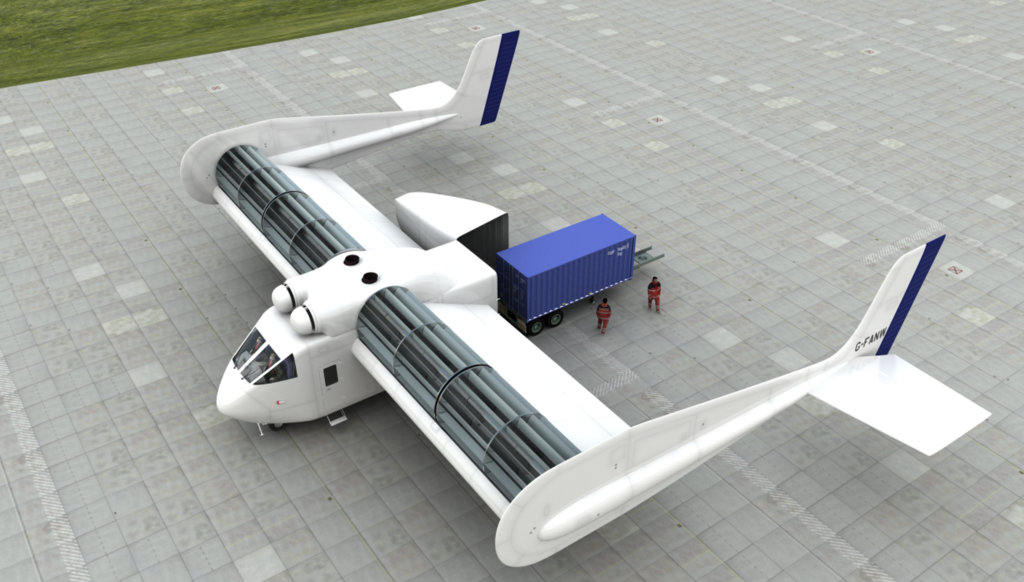
Ground 2 HR-004Simulated view of Fanwing cargo carrier.

From the entry at European Commission : CORDIS : Projects : SOAR

Objective

The SOAR open-fan wing technology at the focus of this project is a new concept that distributes the thrust and powered-lift over the entire span of the wing resulting in a model-proven lift efficiency three times that of helicopters as well as truly quiet U-STOL performance and safe autorotation landing.

Wind tunnel testing augmented by CFD simulations during the SOAR programme are expected to bring improvements in lift efficiency, flight speed and cruise economy on the order of 10% to 20% relative to those seen on small-scale wind tunnel and flight models.

The experimental data collected in this programme will be incorporated in a common aircraft design study targeting a certain mission range. The aircraft is developed in two versions – one passenger and one freight aircraft. The passenger version carries about 60-70 passenger. The freighter version is able to carry up to eight tons of freight. These two aircraft projections, based on the same wing and propulsion system, will subsequently be evaluated in terms of their direct operating cost in comparison with competing types such as conventional STOL aircraft, helicopters and Tilt-rotor aircraft.

It is believed that the SOAR open-fan wing technology, to be developed during this programme, will provide significant technical data at a much larger scale than previously; and this will eventually lead to a new class of aircraft with attractive operational and economic features.

Video: Adam Savage’s Mercury spacesuit

Adam Savage of MythBusters fame has created a highly detailed reproduction of the spacesuits used for the Mercury missions:

In this video Adam discusses the spacesuit and also an Apollo era Flight Jacket :

Photographer capturing photos of European space

Photographer Edgar Martins is working with the European Space Agency

to produce the most comprehensive survey ever assembled about a leading scientific and space exploration organization. It is the first time in their history that they have granted an artist exclusive access to all of their facilities, staff, programs, technology, partners, etc. The access I have been granted is unparalleled, even within the framework of the residency programs specified above.

This project had an 18-month gestation period and will be launched in early 2014.

It documents over 15 separate facilities, located across the world, namely in the UK, Holland, France, Germany, Italy, Spain, Russia, Kazakhstan, French Guiana, etc. These locations range from test centers, robotics departments, jet propulsion laboratories, space simulators, launch sites and launch platforms, astronaut training centers and training modules, satellites and technological components, payload/launcher assembly and integration rooms, etc.

A sampling of his work can be found at:

[]
[]
[]

Everyone can participate in space