In a TEDx talk, Shaun Moss lays out his vision of settling Mars in an affordable way. See the site International Mars Research Station for details.
From the caption:
Shaun Moss is a computer scientist with a 15-year passion for Mars. While reading Red Mars by Kim Stanley Robinson in 1999 Shaun realised that people would go to Mars in his lifetime, and he decided he wanted to be part of that. Since then he has been an active member of a variety of space enthusiast groups, mainly the Mars Society and Mars Society Australia (for which he acts as secretary and director) but also the Moon Society, the Mars Foundation and many others. Shaun’s research has included how to make air and steel on Mars, Martian timekeeping systems, terraforming and more, and he has given numerous presentations at conferences in Australia and the United States. For the past year he has been developing a robust and affordable humans-to- Mars mission architecture with the intention of establishing the International Mars Research Station. He publishes regular writing on Mars at his blog and is working on a book; he has already published a book on one of his other passions, Practical Metaphysics.
Unfortunately, they more or less follow a 1960s Apollo model for lunar missions, which results in a hugely expensive multi-hundred billion dollar program. And that’s despite using NASA’s fictitious $500M cost for each SLS flight.
The International Space Station is home to Russian and American astronauts. Author and space analyst Rand Simberg breaks down the situation on the ISS. Could the conflict in Ukraine spread to space? The U.S. cannot get to the ISS without hitching a ride from the Russia. Does this mean that Russia could block U.S. access to space, or worse, annex the ISS? Find out.
Local botanical groups were only able to successfully breed descendants from the tree through grafting, as none of the seeds taken from it have sprouted after being sewn. Well, all except one, a seed from the Chujohime Seiganzakura that made the trip to space and back. Not only has the space sakura grown to four meters (13 feet, 1 inch) in height, flowers recently bloomed on the tree.
Generally, sakura blooming in the spring don’t shock anyone, given that all of Japan anxiously waits for the arrival of the cherry blossoms every year. The four-year-old Gifu space sakura managed to catch scientists and caretakers off guard, though, as ordinarily cherry trees of this type don’t produce blossoms until they reach a decade or so in age.
And
Scientists aren’t exactly sure why the trees in question are exhibiting such extraordinarily quick development. One researcher was quoted as saying that while it’s yet to be confirmed, they have to at least acknowledge the possibility that the environmental influences of space have somehow altered the plants’ DNA or stimulated their cells in as yet undetected ways, giving them capabilities beyond that of their earthbound brethren.
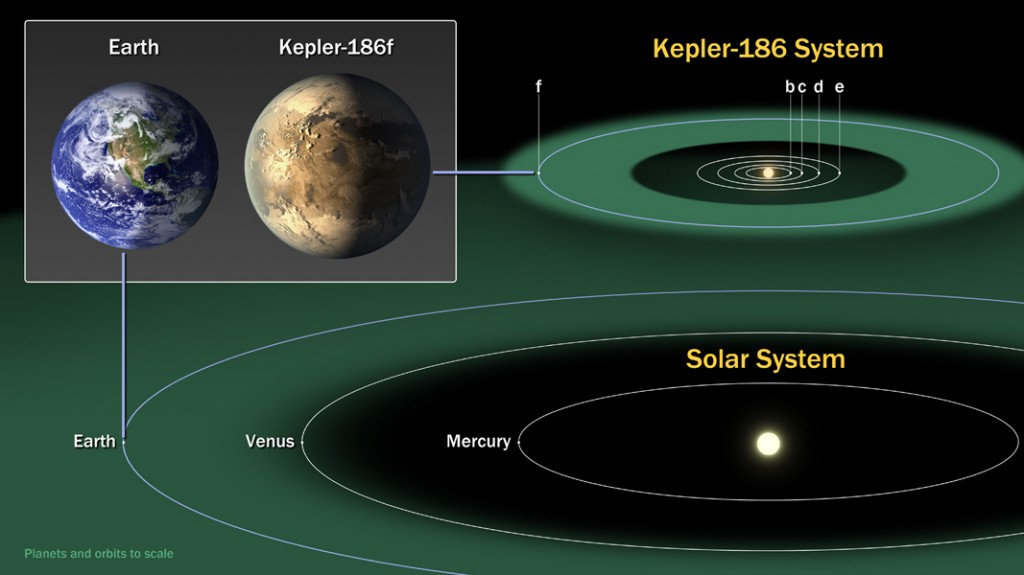
Using NASA’s Kepler Space Telescope, astronomers have discovered the first Earth-size planet orbiting a star in the “habitable zone” — the range of distance from a star where liquid water might pool on the surface of an orbiting planet. The discovery of Kepler-186f confirms that planets the size of Earth exist in the habitable zone of stars other than our sun.
The diagram compares the planets of our inner solar system to Kepler-186,
a five-planet star system about 500 light-years from Earth in the constellation
Cygnus. Image credit: NASA Ames/SETI Institute/JPL-Caltech › Full image and caption
While planets have previously been found in the habitable zone, they are all at least 40 percent larger in size than Earth, and understanding their makeup is challenging. Kepler-186f is more reminiscent of Earth.
“The discovery of Kepler-186f is a significant step toward finding worlds like our planet Earth,” said Paul Hertz, NASA’s Astrophysics Division director at the agency’s headquarters in Washington. “Future NASA missions, like the Transiting Exoplanet Survey Satellite and the James Webb Space Telescope, will discover the nearest rocky exoplanets and determine their composition and atmospheric conditions, continuing humankind’s quest to find truly Earth-like worlds.”
The artistic concept of Kepler-186f is the result of scientists and artists collaborating to imagine the appearance of these distant worlds. › Full image and caption Image credit: NASA Ames/SETI Institute/JPL-Caltech
Although the size of Kepler-186f is known, its mass and composition are not. Previous research, however, suggests that a planet the size of Kepler-186f is likely to be rocky.
“We know of just one planet where life exists — Earth. When we search for life outside our solar system, we focus on finding planets with characteristics that mimic that of Earth,” said Elisa Quintana, research scientist at the SETI Institute at NASA’s Ames Research Center in Moffett Field, Calif., and lead author of the paper published today in the journal Science. “Finding a habitable zone planet comparable to Earth in size is a major step forward.”
Kepler-186f resides in the Kepler-186 system, about 500 light-years from Earth in the constellation Cygnus. The system is also home to four companion planets, which orbit a star half the size and mass of our sun. The star is classified as an M dwarf, or red dwarf, a class of stars that makes up 70 percent of the stars in the Milky Way galaxy.
“M dwarfs are the most numerous stars,” said Quintana. “The first signs of other life in the galaxy may well come from planets orbiting an M dwarf.”
Kepler-186f orbits its star once every 130 days and receives one-third the energy from its star that Earth gets from the sun, placing it nearer the outer edge of the habitable zone. On the surface of Kepler-186f, the brightness of its star at high noon is only as bright as our sun appears to us about an hour before sunset.
“Being in the habitable zone does not mean we know this planet is habitable. The temperature on the planet is strongly dependent on what kind of atmosphere the planet has,” said Thomas Barclay, research scientist at the Bay Area Environmental Research Institute at Ames, and co-author of the paper. “Kepler-186f can be thought of as an Earth-cousin rather than an Earth-twin. It has many properties that resemble Earth.”
The four companion planets, Kepler-186b, Kepler-186c, Kepler-186d and Kepler-186e, whiz around their sun every four, seven, 13 and 22 days, respectively, making them too hot for life as we know it. These four inner planets all measure less than 1.5 times the size of Earth.
The next steps in the search for distant life include looking for true Earth-twins — Earth-size planets orbiting within the habitable zone of a sun-like star — and measuring their chemical compositions. The Kepler Space Telescope, which simultaneously and continuously measured the brightness of more than 150,000 stars, is NASA’s first mission capable of detecting Earth-size planets around stars like our sun.
Ames is responsible for Kepler’s ground system development, mission operations, and science data analysis. NASA’s Jet Propulsion Laboratory in Pasadena, Calif., managed Kepler mission development. Ball Aerospace & Technologies Corp. in Boulder, Colo., developed the Kepler flight system and supports mission operations with the Laboratory for Atmospheric and Space Physics at the University of Colorado in Boulder. The Space Telescope Science Institute in Baltimore archives, hosts and distributes Kepler science data. Kepler is NASA’s 10th Discovery Mission and was funded by the agency’s Science Mission Directorate.
The SETI Institute is a private, nonprofit organization dedicated to scientific research, education and public outreach. The mission of the SETI Institute is to explore, understand and explain the origin, nature and prevalence of life in the universe.