Apollo 15 artifacts set record prices at space collectibles auction

An auction of space collectibles at RR Auction did well especially for Apollo 15 astronaut David Scott : Joystick sets record price for space collectibles – AFP/Phys.Org

The price of space junk inched closer to the moon on Friday after a hand controller from the Apollo 15 mission sold at auction for $610,063—an apparent new record.

The joystick assembly from the fourth US manned lunar landing was snapped up by an online bidder whose identity was not disclosed by RR Auction, a Massachusetts auction house specializing in rare collectibles. 

Robert Pearlman at collectSpace writes about the auction: Astronaut’s joystick used for Apollo moon landing tops half a million at auction – collectSPACE.

The Apollo 15 joystick controller and the crewman optical alignment sight (COAS) from the same spacecraft topped the sale’s results. The COAS, which was used by Scott to make star sightings and to align the lunar module with the moon’s horizon, sold for $126,180.

Both artifacts were removed from the lunar module Falcon at end of the lander’s use, prior to its intentional crash into the lunar surface. Scott and his crewmates, Jim Irwin and Al Worden, returned to Earth aboard the command module Endeavour.
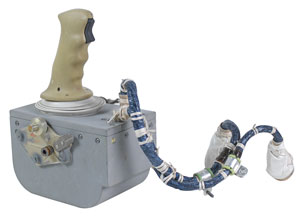
3321443_2Flown lunar module rotational hand controller, used
by Dave Scott and flown to the lunar surface on board
Apollo 15’s Lunar Module Falcon. 

Video: Space to Ground report on ISS

Here is NASA’s latest Space to Ground weekly video update on what’s been happening aboard the International Space Station:

Space policy roundup – May.23.14

Space policy/politics related links:

—-

Webcasts:

* Thurs 5/22/14 Hr 4 | John Batchelor Show – Bob Zimmerman (2nd guest) reports on latest space news and policy issues

* Living and Working on Mars—A Conversation at the International Space Development Conference – The Planetary Society – Weekly Planetary Radio report includes an update from Bill Nye on NASA budget

Citizen science and “the makers, the scientists, the hobbyists”

This article gives an overview of the range and scope of activities that fall under the Citizen Science rubric: The Weird, Wild World of Citizen Science Is Already Here – Opinion/WIRED

Citizen Science is a somewhat vague term. It can mean hands-on research by amateur investigators or it can mean helping professional scientists sift through large data sets for rare items of interest.

There’s power in this diffuse definition, though, as long as new interpretations are welcomed and encouraged. By inviting and inspiring people to ask their own questions, citizen science can become much more than a way of measuring bird populations. From the drone-wielding conservationists in South Africa to the makeshift biolabs in Brooklyn, a widening circle of participants are wearing the amateur badge with honor. And all of these groups–the makers, the scientists, the hobbyists–are converging to create a new model for discovery. In other words, the maker movement and the traditional science world are on a collision course.

Meteor shower expected to light up the sky tonight over North America

There’s a good chance, but no guarantee, of a strong meteor shower tonight over North America. The May Camelopardalids come from the dust debris trail of the periodic comet 209P/LINEAR, a little known and not very bright comet discovered in 2004 that orbits the sun every 5.1 years. According to Sky & Telescope:

What’s got dynamicists excited, however, is that Earth might might plow right through relatively dense strands of debris shed by the comet long ago. This should create a strong burst of “shooting stars” on May 24th.

Several predictions suggest you might see anywhere from 100 to 200 meteors per hour from a dark location free of light pollution. That means you could perhaps see one or two meteors per minute. Some (but not all) dynamicists think there’s even an outside chance that the celestial spectacle could briefly become a meteor “storm,” with more than 1,000 arriving per hour! (But it’s also possible that the display might be weak, with just a few dozen meteors visible per hour even in a dark sky.)

The meteor shower should peak around 3 am EDT. If you don’t have a clear sky, you can watch online at Slooh.

More at:

Map showing where the expected May Camelopardalid meteor shower will be visible during the peak time on May 24, 2014, 6:00-8:00 UTC.
Map showing where the expected May Camelopardalid
meteor shower will be visible during the peak time
on May 24, 6:00-8:00 UTC.
Image Credit: NASA’s Marshall Space Flight Center

Everyone can participate in space