Rick Boozer, the Astro Maven, tells me that on Thursday, Oct. 16th at 7:30 pm he will give a presentation at Roper Mountain Science Center in Greenville, South Carolina. The title of his talk is Hunting for an Exoplanet Using Stellar Photometry.
Rick has been posting a series of tutorials on his blog explaining the science of photometry and how the astronomical imaging software known as AIP4WIN can be used “by both amateur astronomers and professionals for some very advanced scientific work”.
While I’m quite optimistic about progress with LENR energy production, it’s great to see progress being made on more conventional fusion approaches as well. There has been a flurry of reports recently on different approaches to fusion that are far simpler and lower in cost than the ITER Tokamak-based system that is soaking up most all government fusion funding globally. At best ITER won’t reach break-even for decades and is unlikely ever to lead to a practical power generation system.
Here are updates and links on five fusion power projects:
===
Univ. Washington Dynomak:
Derived from the spheromak concept, a group at the University of Washington has
designed a concept for a fusion reactor that, when scaled up to the size of a large electrical power plant, would rival costs for a new coal-fired plant with similar electrical output.
The team published its reactor design and cost-analysis findings last spring and will present results Oct. 17 at the International Atomic Energy Agency’s Fusion Energy Conference in St. Petersburg, Russia.
“Right now, this design has the greatest potential of producing economical fusion power of any current concept,” said Thomas Jarboe, a UW professor of aeronautics and astronautics and an adjunct professor in physics.
The UW’s reactor, called the dynomak, started as a class project taught by Jarboe two years ago. After the class ended, Jarboe and doctoral student Derek Sutherland – who previously worked on a reactor design at the Massachusetts Institute of Technology – continued to develop and refine the concept.
The design builds on existing technology and creates a magnetic field within a closed space to hold plasma in place long enough for fusion to occur, allowing the hot plasma to react and burn. The reactor itself would be largely self-sustaining, meaning it would continuously heat the plasma to maintain thermonuclear conditions. Heat generated from the reactor would heat up a coolant that is used to spin a turbine and generate electricity, similar to how a typical power reactor works.
Helion Energy is a spinoff from another group at Univ. of Washington and they have gotten some private funding recently to pursue their colliding plasmoids approach. Their design would work with neutron-free deuterium/helium-3 fusion, so no radioactive materials would be created.
I’ve posted many times (e.g. see here and here) about the Polywell fusion system invented by the late Robert Bussard. The research team at EMC2 has made solid progress but the Navy is out of money for such research so the company is looking for private investment.
EMC2 reports experimental results validating the concept that plasma confinement is enhanced in a magnetic cusp configuration when beta (plasma pressure/magnetic field pressure) is order of unity. This enhancement is required for a fusion power reactor based on cusp confinement to be feasible. The magnetic cusp configuration possesses a critical advantage: the plasma is stable to large scale perturbations. However, early work indicated that plasma loss rates in a reactor based on a cusp configuration were too large for net power production. Grad and others theorized that at high beta a sharp boundary would form between the plasma and the magnetic field, leading to substantially smaller loss rates. The current experiment validates this theoretical conjecture for the first time and represents critical progress toward the Polywell fusion concept which combines a high beta cusp configuration with an electrostatic fusion for a compact, economical, power-producing nuclear fusion reactor.
Sandia uses its Z Machine, which can produce millions of amps of current in short bursts, to create fusion in small canisters holding deuterium:
Sandia’s technique is one of several that fall into the middle ground between the extremes of laser fusion and the magnetically confined fusion of tokamaks. It crushes fuel in a fast pulse, as in laser fusion, but not as fast and not to such high density. Known as magnetized liner inertial fusion (MagLIF), the approach involves putting some fusion fuel (a gas of the hydrogen isotope deuterium) inside a tiny metal can 5 millimeters across and 7.5 mm tall. Researchers then use the Z machine to pass a huge current pulse of 19 million amps, lasting just 100 nanoseconds, through the can from top to bottom. This creates a powerful magnetic field that crushes the can inward at a speed of 70 km/s.
While this is happening, the researchers do two other things: They preheat the fuel with a short laser pulse, and they apply a steady magnetic field, which acts as a straitjacket to hold the fusion fuel in place. Crushing the plasma also boosts the constraining magnetic field, from about 10 tesla to 10,000 tesla. This constraining field is key, because without it there is nothing to hold the superheated plasma in place other than its own inward inertia. Once the compression stops, it would fly apart before it has time to react.
Astronomers have used the APEX telescope to probe a huge galaxy cluster that is forming in the early Universe and revealed that much of the star formation taking place is not only hidden by dust, but also occurring in unexpected places. This is the first time that a full census of the star formation in such an object has been possible.
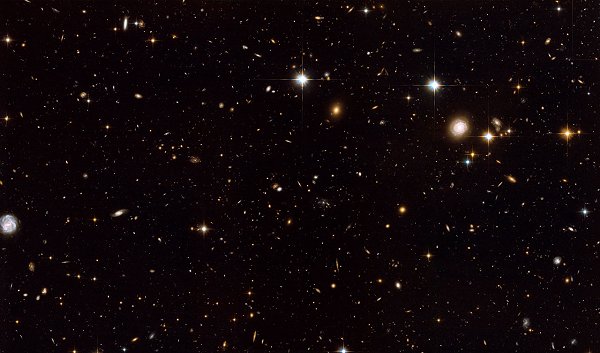
This image, taken by the NASA/ESA Hubble Space Telescope, shows the full ACS overview of the region around the Spiderweb Galaxy (just to the right of the center). The galaxy is sitting at the centre of an emergent galaxy cluster, surrounded by hundreds of other galaxies from the cluster.
Galaxy clusters are the largest objects in the Universe held together by gravity but their formation is not well understood. The Spiderweb Galaxy (formally known as MRC 1138-262 [1]) and its surroundings have been studied for twenty years, using ESO and other telescopes [2], and is thought to be one of the best examples of a protocluster in the process of assembly, more than ten billion years ago.
But Helmut Dannerbauer (University of Vienna, Austria) and his team strongly suspected that the story was far from complete. They wanted to probe the dark side of star formation and find out how much of the star formation taking place in the Spiderweb Galaxy cluster was hidden from view behind dust.
The team used the LABOCA camera on the APEX telescope in Chile to make 40 hours of observations of the Spiderweb Cluster at millimetre wavelengths — wavelengths of light that are long enough to peer right through most of the thick dust clouds. LABOCA has a wide field and is the perfect instrument for this survey.
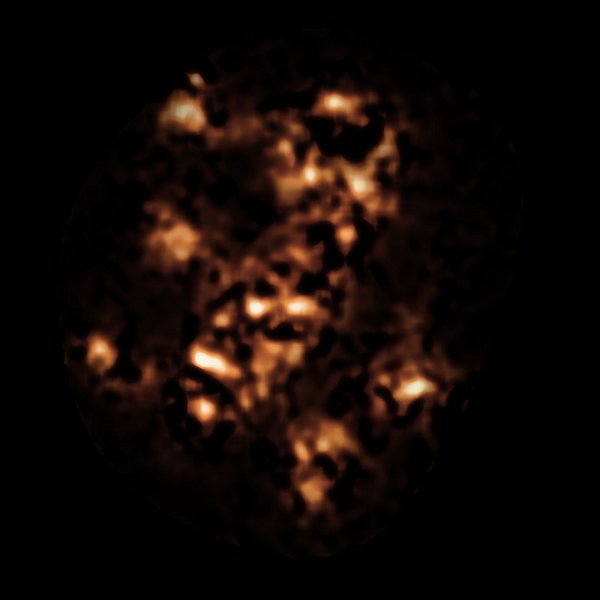
The APEX view in sub-millimetre light of the region around the Spiderweb Galaxy a protocluster of galaxies in the early Universe surrounding a radio galaxy containing a supermassive black hole. Some of the blobs in this image correspond to dusty star-forming galaxies in the protocluster that cannot be seen in visible light due to absorption by dust. The fainter features here are artifacts of the difficult APEX image processing.
Carlos De Breuck (APEX project scientist at ESO, and a co-author of the new study) emphasises: “This is one of the deepest observations ever made with APEX and pushes the technology to its limits — as well as the endurance of the staff working at the high-altitude APEX site, 5050 metres above sea level.”
The APEX observations revealed that there were about four times as many sources detected in the area of the Spiderweb compared to the surrounding sky. And by carefully comparing the new data with complementary observations made at different wavelengths they were able to confirm that many of these sources were at the same distance as the galaxy cluster itself and must be parts of the forming cluster.
Helmut Dannerbauer explains: “The new APEX observations add the final piece needed to create a complete census of all inhabitants of this mega star city. These galaxies are in the process of formation so, rather like a construction site on Earth, they are very dusty.”
But a surprise awaited the team when they looked at where the newly detected star formation was taking place. They were expecting to find this star formation region on the large filaments connecting galaxies. Instead, they found it concentrated mostly in a single region, and that region is not even centred on the central Spiderweb Galaxy in the protocluster [3].
Helmut Dannerbauer concludes: “We aimed to find the hidden star formation in the Spiderweb cluster — and succeeded — but we unearthed a new mystery in the process; it was not where we expected! The mega city is developing asymmetrically.”
To continue the story further observations are needed — and ALMA will be the perfect instrument to take the next steps and study these dusty regions in far greater detail.
—
Loading player…
This video shows an artist’s impression of the formation of a galaxy cluster in the early Universe. The galaxies are vigorously forming new stars and interacting with each other. Such a scene closely resembles the Spiderweb Galaxy (formally known as MRC 1138-262) and its surroundings, which is one of the best-studied protoclusters. Credit: ESO/M. Kornmesser
It took the team four years, thousands of volunteer hours, and $60,000 from crowdfunding, to complete the “Lohan.” The nickname is short for “Low Orbit Helium Assisted Navigator” and, its inventors say, a reference to the Hollywood star Lindsey Lohan.