Hubble: Revisiting the Pillars of Creation

Another spectacular image from the Hubble space telescope:

Revisiting an icon
Hubble captures the Pillars of Creation twenty years on

The NASA/ESA Hubble Space Telescope has captured many breathtaking images of the Universe, but one snapshot stands out from the rest: the Eagle Nebula’s Pillars of Creation. In 1995 Hubble’s iconic image revealed never-before-seen details in the giant columns and now the telescope is kickstarting its 25th year in orbit with an even clearer, and more stunning, image of these beautiful structures.
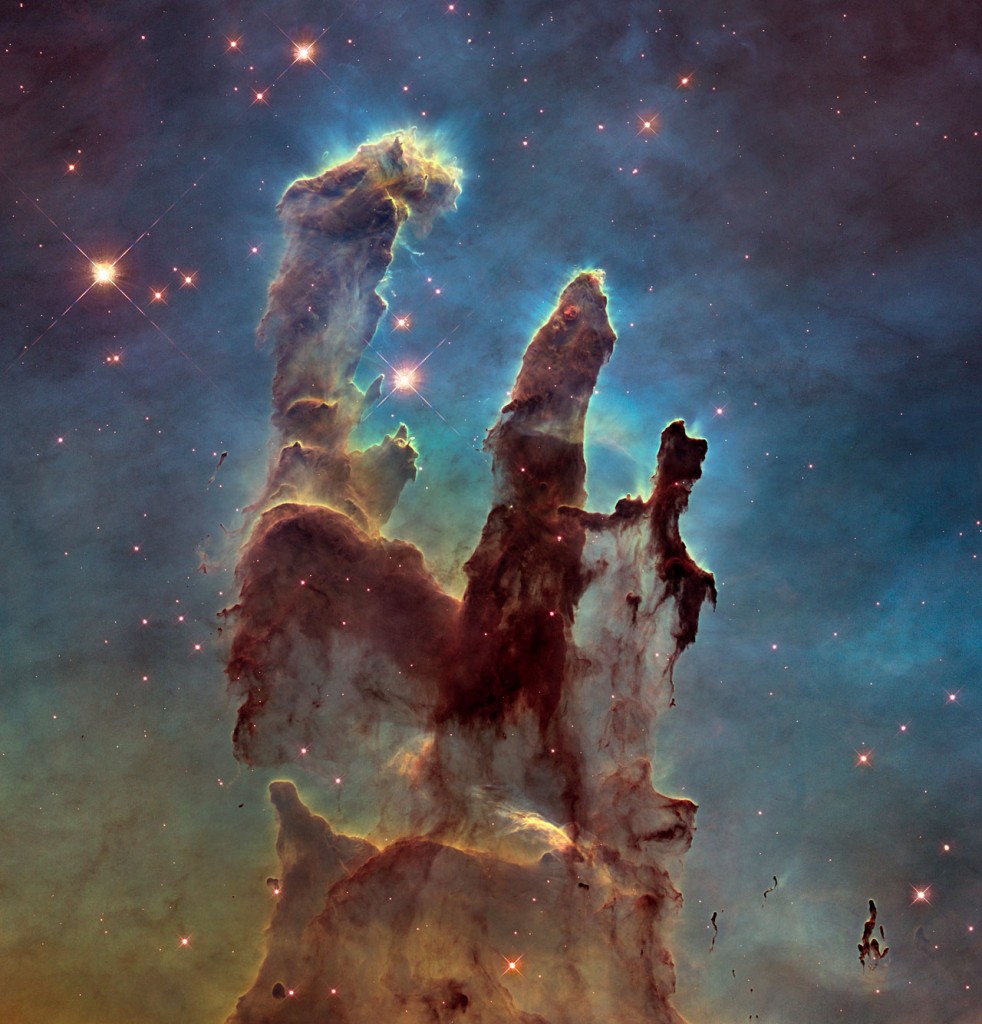
New view of the Pillars of Creation — visible


The three impressive towers of gas and dust captured in this image are part of the Eagle Nebula, otherwise known as Messier 16. Although such features are not uncommon in star-forming regions, the Messier 16 structures are by far the most photogenic and evocative ever captured. The Hubble image of the pillars taken in 1995 is so popular that it has appeared in film and television, on tee-shirts and pillows, and even on postage stamps.

Now Hubble has revisited the famous pillars, capturing the multi-coloured glow of gas clouds, wispy tendrils of dark cosmic dust, and the rust-coloured elephants’ trunks with the newer Wide Field Camera 3, installed in 2009. The visible-light image builds on one of the most iconic astronomy images ever taken and provides astronomers with an even sharper and wider view.

In addition to this new visible-light image, Hubble has also produced a bonus image. This image is taken in infrared light, which penetrates much of the obscuring dust and gas and unveils a more unfamiliar view of the pillars, transforming them into wispy silhouettes set against a background peppered with stars. Here newborn stars, hidden in the visible-light view, can be seen forming within the pillars themselves [1].

Although the original image was dubbed the “Pillars of Creation”, this new image hints that they are also pillars of destruction. The dust and gas in these pillars is seared by intense radiation from the young stars forming within them, and eroded by strong winds from massive nearby stars. The ghostly bluish haze around the dense edges of the pillars in the visible-light view is material that is being heated by bright young stars and evaporating away.

With these new images come better contrast and clearer views of the region. Astronomers can use these new images to study how the physical structure of the pillars is changing over time. The infrared image shows that the reason the pillars exist is because the very ends of them are dense, and they shadow the gas below them, creating the long, pillar-like structures. The gas in between the pillars has long since been blown away by the winds from a nearby star cluster.

At the top edge of the left-hand pillar, a gaseous fragment has been heated up and is flying away from the structure, highlighting the violent nature of star-forming regions.

These massive stars may be slowly destroying the pillars but they are also the reason Hubble sees the structures at all. They radiate enough ultraviolet light to illuminate the area and make the clouds of oxygen, hydrogen and sulphur glow.

Although structures like these exist throughout the Universe, the Pillars of Creation — at a distance of 6500 light-years away — provide the best, and most dramatic, example. Now, these images have allowed us to see them more clearly than ever, proving that at 25 years of age, Hubble is still going strong.

This image and the associated results were presented today at the 225th meeting of the American Astronomical Society in Seattle, Washington, USA.


The Space Show this week – Jan.5.15

Guests and topics on The Space Show this week:

1. Monday, Jan. 5, 2015: 2:00-3:30PM PST (5:00-& 6:30 PM EST, 4:00-5:30 PM CST): We welcome back DR. JOHN BRANDENBURG re his new book, Death On Mars: The Discovery of a Planetary Nuclear Massacre.

2. Tuesday, Jan. 6, 2015:,7-8:30 PM PST (10-11:30 PM EST, 9-10:30 PM CST): We welcome back PAUL TURNER to complete his discussion regarding his book The Space Trade. Find out more about his book and ideas at www.thespacetrade.com.

3. Friday, Jan. 9 2015; , 9:30 -11 AM PST (12:30-2 PM EST; 11:30-1 PM CST): Dr. HAYM BENAROYA is back to do a reality check with us regarding lunar habs, settlements & more. This will be a most exciting & informative program.. .

4. Sunday, January 11, 2015: 12-1:30 PM PST (3-4:30 PM EST, 12-1:30 PM CST): We welcome KELVIN LONG from the UK to discuss interplanetary spaceflight and his new book, Beyond The Boundary.

See also:
/– The Space Show on Vimeo – webinar videos
/– The Space Show’s Blog – summaries of interviews.
/– The Space Show Classroom Blog – tutorial programs

The Space Show is a project of the One Giant Leap Foundation.

Winner of Mars One University Competition announced

The Mars One organization has been running a contest to select one of ten university team finalists for an experiment payload on an unmanned lander mission. Today they announced the winning team:

The winner of the Mars One University Competition
will bring life to Mars in 2018

Amersfoort, 5th January 2015 – Mars One is proud to present the winner of the Mars One University Competition: Seed. The Seed team is an important step closer to sending their payload to Mars. The winning payload will fly to the surface of Mars on Mars One’s 2018 unmanned lander mission. Seed was selected by popular vote from an initial 35 university proposals and this is the first time the public has decided which payload receives the extraordinary opportunity to land on Mars.

“We were generally very pleased with the high quality of the university proposals and the amount of effort associated with preparing them,” said Arno Wielders, co-founder and Chief Technical Officer of Mars One. “Seed itself is uniquely inspiring since this would be the first time a plant will be grown on Mars.”

The Winning Team – Seed aims to germinate the first seed on Mars in order to contribute to the development of life support systems and provide a deeper understanding of plant growth on Mars. The payload will consist of an external container, which provides protection from the harsh environment, and interior container, which will hold several seed cassettes. The seeds will stem from the plant Arabidopsis thaliana, which is commonly used in space plant studies. After landing, the seeds inside the cassette will be provided with conditions for germination and seedling growth. The growth will then be recorded using images transmitted back to Earth.

“We are really pleased to be the selected project among so many excellent ideas. We are thrilled to be the first to send life to Mars! This will be a great journey that we hope to share with you all!” said Teresa Araújo, Seed team member.

Seed consists of four bioengineering students from the University of Porto and two PhD students from MIT Portugal and the University of Madrid. The team is supported by Dr. Maria Helena Carvalho, plant researcher at IBMC and Dr. Jack van Loon, from the VU Medical Center, VU-University in Amsterdam, and support scientist at ESTEC-ESA. Seed benefits from scientific and technical support from several advisers, whose expertise range from biological systems to spacecraft development and validation. Read more about Seed here.

An in-depth technical analysis of the winning proposal will be conducted to ensure that the winner has a feasible plan and that their payload can be integrated on the 2018 Mars lander. Mars One and its advisers will contribute to the analysis by thoroughly and critically examining the Seed proposal.

If Seed runs into any issues regarding feasibility or can not stick to the schedule, Mars One will fall back on the runner ups of the university competition. The second and third placed projects are Cyano Knights and Lettuce on Mars.

More information

About Mars One

Mars One is a not-for-profit foundation that will establish permanent human life on Mars. Human settlement on Mars is possible today with existing technologies. Mars One’s mission plan integrates components that are well tested and readily available from industry leaders worldwide. The first footprint on Mars and lives of the crew thereon will captivate and inspire generations. It is this public interest that will help finance this human mission to Mars.

JP Aerospace carries out high alt balloon flights in UAE

JP Aerospace, based near Sacramento, California, recently flew two high altitude balloons for a UAE bank promotion campaign and national day celebration: Video from the UAE Mission – JP Aerospace Blog –

* JPA Conducts Two Flights in the United Arab Emerates! – JP Aerospace Blog

In celebration of the UAE’s 43rd national day JPA flew the UAE flag to the edge of space. It was a great mission and adventure. The first vehicle, Away 111,  verified winds aloft and the second vehicle, Away 109 was our largest Away vehicle ever at just over nine feet long. It carried carried a huge 8 X 4 foot flag, signs from our sponsor, four HD cameras and the first 50 PongSats from the middle east.

Away109_in_flight

UAE_BankBanner

UAE_Flag

See also the video at Video: UAE flag in space by Al Hilal Bank ~ Frequency.

Everyone can participate in space