Volunteer ‘Disk Detectives’ classify over a million possible planetary habitats

A citizen-science project with NASA’s WISE (Wide-field Infrared Survey) mission has been a quite successful:

Volunteer ‘Disk Detectives’ Top 1 Million Classifications
of Possible Planetary Habitats

A NASA-sponsored website designed to crowdsource analysis of data from the agency’s Wide-field Infrared Survey Explorer (WISE) mission has reached an impressive milestone. In less than a year, citizen scientists using DiskDetective.org have logged 1 million classifications of potential debris disks and disks surrounding young stellar objects (YSO). This data will help provide a crucial set of targets for future planet-hunting missions.

Volunteers using DiskDetective.org, a NASA-sponsored citizen science website to find potential planetary nurseries, have made 1 million classifications in less than a year. Goddard astrophysicist Marc Kuchner, the project’s principal investigator, explains how it works. Image Credit: NASA’s Goddard Space Flight Center/S. Wiessinger.
Download this video in HD formats from NASA Goddard’s Scientific Visualization Studio

“This is absolutely mind-boggling,” said Marc Kuchner, an astrophysicist at NASA’s Goddard Space Flight Center in Greenbelt, Maryland, and the project’s principal investigator. “We’ve already broken new ground with the data, and we are hugely grateful to everyone who has contributed to Disk Detective so far.”

Combing through objects identified by WISE during its infrared survey of the entire sky, Disk Detective aims to find two types of developing planetary environments. The first, known as a YSO disk, typically is less than 5 million years old, contains large quantities of gas, and often is found in or near young star clusters. The second planetary habitat, known as a debris disk, tends to be older than 5 million years, holds little or no gas, and possesses belts of rocky or icy debris that resemble the asteroid and Kuiper belts found in our own solar system. Vega and Fomalhaut, two of the brightest stars in the sky, host debris disks.

Planets form and grow within disks of gas, dust and icy grains surrounding young stars. The particles absorb the star’s light and reradiate it as heat, which makes the stars brighter at infrared wavelengths — in this case, 22 microns — than they would be without a disk.

Computer searches already have identified some objects seen by the WISE survey as potential dust-rich disks. But software can’t distinguish them from other infrared-bright sources, such as galaxies, interstellar dust clouds and asteroids. There may be thousands of potential planetary systems in the WISE data, but the only way to know for sure is to inspect each source by eye.

hs-2014-44-e-xlarge_web[1]

The marked asymmetry of the debris disk around the star HD 181327 (shown here in a Hubble image) suggests it may have formed as a result of the collision of two small bodies. Disk Detective aims to discover many other stellar disks using volunteer classifications of data from NASA’s WISE mission. Image Credit: NASA, ESA, G. Schneider (U. of Arizona), HST/GO 12228 Team

Kuchner recognized that searching the WISE database for dusty disks was a perfect opportunity for crowdsourcing. He worked with NASA to team up with the Zooniverse, a collaboration of scientists, software developers and educators who collectively develop and manage citizen science projects on the Internet.

At DiskDetective.org, volunteers watch a 10-second “flip book” of a disk candidate shown at several different wavelengths as observed from three different telescopes, including WISE. They then click one or more buttons that best describe the object’s appearance. Each classification helps astronomers decide which images may be contaminated by background galaxies, interstellar matter or image artifacts, and which may be real disks that should be studied in more detail.

In March 2014, just two months after Disk Detective launched, Kuchner was amazed to find just how invested in the project some users had become. Volunteers complained about seeing the same object over and over. “We thought at first it was a bug in the system,” Kuchner explained, “but it turned out they were seeing repeats because they had already classified every single object that was online at the time.”

Some 28,000 visitors around the world have participated in the project to date. What’s more, volunteers have translated the site into eight foreign languages, including Romanian, Mandarin and Bahasa, and have produced their own video tutorials on using it.

Many of the project’s most active volunteers are now joining in science team discussions, and the researchers encourage all users who have performed more than 300 classifications to contact them and take part.

One of these volunteers is Tadeáš Černohous, a postgraduate student in geodesy and cartography at Brno University of Technology in the Czech Republic. “I barely understood what scientists were looking for when I started participating in Disk Detective, but over the past year I have developed a basic sense of which stars are worthy of further exploration,” he said.

Alissa Bans, a postdoctoral fellow at Adler Planetarium in Chicago and a member of the Disk Detective science team, recalls mentioning that she was searching for candidate YSOs and presented examples of what they might look like on Disk Detective. “In less than 24 hours,” she said, “Tadeáš had compiled a list of nearly 100 objects he thought could be YSOs, and he even included notes on each one.”

Speaking at a press conference at the American Astronomical Society meeting in Seattle on Tuesday, Kuchner said the project has so far netted 478 objects of interest, which the team is investigating with a variety of ground-based telescopes in Arizona, California, New Mexico, Argentina and Chile. “We now have at least 37 solid new disk candidates, and we haven’t even looked at all the new telescope data yet,” he said.

Disk Detective currently includes about 278,000 WISE sources. The team expects to wrap up the current project sometime in 2018, with a total of about 3 million classifications and perhaps 1,000 disk candidates. The researchers then plan to add an additional 140,000 targets to the site.

“We’ve come a long way, but there’s still lots and lots more work to do — so please drop by the site and do a little science with us!” added Kuchner.
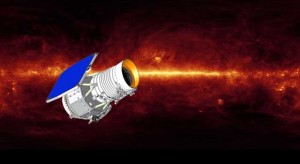
387827main_wise20090018-full[1]WISE observatory

WISE has made infrared measurements of more than 745 million objects, compiling the most comprehensive survey of the sky at mid-infrared wavelengths currently available. With its primary mission complete, the satellite was placed in hibernation in 2011. WISE was awoken in September 2013, renamed the Near-Earth Object Wide-field Infrared Survey Explorer (NEOWISE), and given a new mission to assist NASA’s efforts in identifying the population of potentially hazardous near-Earth objects (NEOs).

Facilities involved in follow-up studies of objects found with Disk Detective include Apache Point Observatory in Sunspot, New Mexico; Palomar Observatory on Palomar Mountain, California; the Fred Lawrence Whipple Observatory on Mount Hopkins, Arizona; the Leoncito Astronomical Complex in El Leoncito National Park, Argentina; and Las Campanas Observatory, located in the Atacama Desert of Chile.

NASA is exploring our solar system and beyond to understand the universe and our place in it. We seek to unravel the secrets of our universe, its origins and evolution, and search for life among the stars. Today’s announcement shares the discovery of our ever-changing cosmos, and brings us closer to learning whether we are alone in the universe.

Related Links
ESO: Dark nebula cloaks new stars in formation

The latest news from the European Southern Observatory (ESO):

Where Did All the Stars Go?
Dark cloud obscures hundreds of background stars

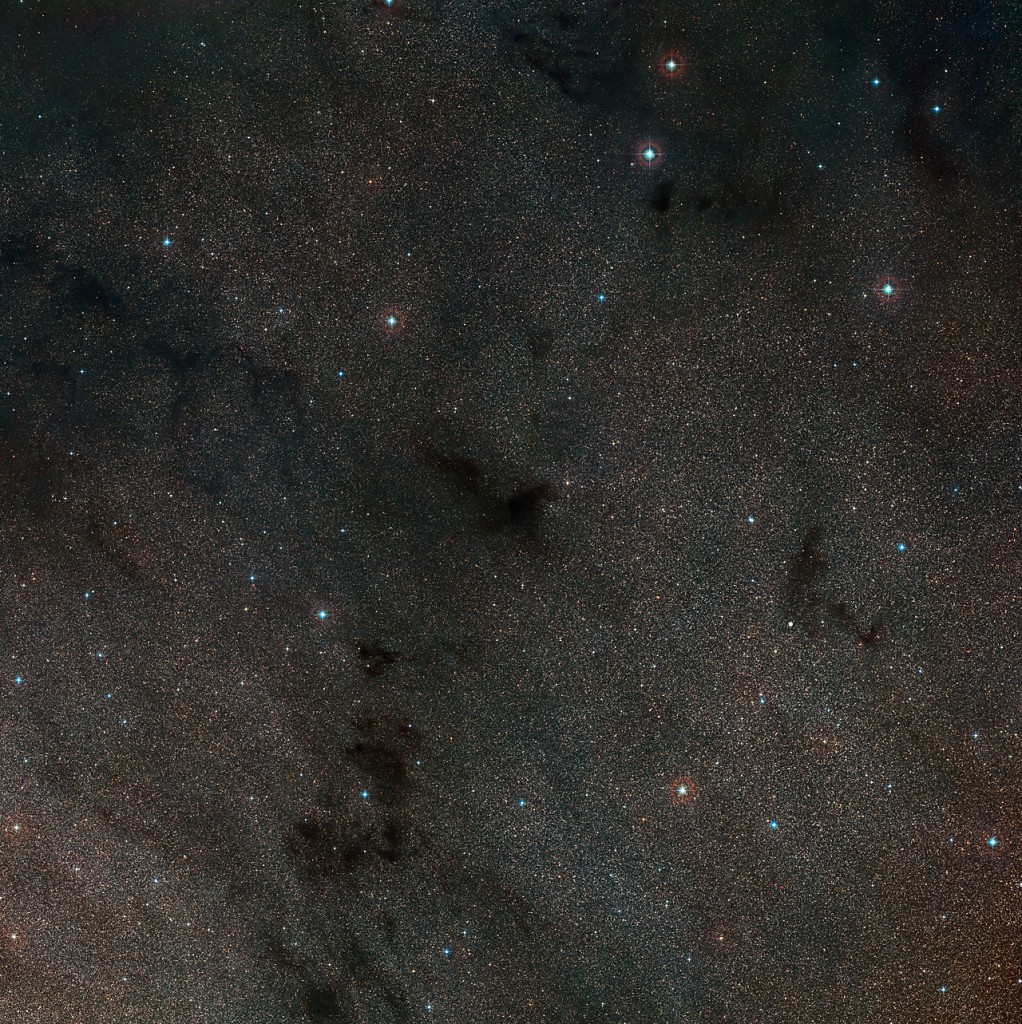
7 January 2015: Some of the stars appear to be missing in this intriguing new ESO image. But the black gap in this glitteringly beautiful starfield is not really a gap, but rather a region of space clogged with gas and dust. This dark cloud is called LDN 483 — for Lynds Dark Nebula 483. Such clouds are the birthplaces of future stars. The Wide Field Imager, an instrument mounted on the MPG/ESO 2.2-metre telescope at ESO’s La Silla Observatory in Chile, captured this image of LDN 483 and its surroundings.

Wide-field view of the sky around the dark nebula LDN 483

This visible-light wide-field image of the region around the dark nebula
LDN 483 was created from photographs forming part of the
Digitized Sky Survey 2. LDN 483 appears at the centre.
Credit: ESO and Digitized Sky Survey 2

LDN 483 [1] is located about 700 light-years away in the constellation of Serpens (The Serpent). The cloud contains enough dusty material to completely block the visible light from background stars. Particularly dense molecular clouds, like LDN 483, qualify as dark nebulae because of this obscuring property. The starless nature of LDN 483 and its ilk would suggest that they are sites where stars cannot take root and grow. But in fact the opposite is true: dark nebulae offer the most fertile environments for eventual star formation.

Astronomers studying star formation in LDN 483 have discovered some of the youngest observable kinds of baby stars buried in LDN 483’s shrouded interior. These gestating stars can be thought of as still being in the womb, having not yet been born as complete, albeit immature, stars.

In this first stage of stellar development, the star-to-be is just a ball of gas and dust contracting under the force of gravity within the surrounding molecular cloud. The protostar is still quite cool — about –250 degrees Celsius — and shines only in long-wavelength submillimetre light [2]. Yet temperature and pressure are beginning to increase in the fledgling star’s core.

This earliest period of star growth lasts a mere thousands of years, an astonishingly short amount of time in astronomical terms, given that stars typically live for millions or billions of years. In the following stages, over the course of several million years, the protostar will grow warmer and denser. Its emission will increase in energy along the way, graduating from mainly cold, far-infrared light to near-infrared and finally to visible light. The once-dim protostar will have then become a fully luminous star.

As more and more stars emerge from the inky depths of LDN 483, the dark nebula will disperse further and lose its opacity. The missing background stars that are currently hidden will then come into view — but only after the passage of millions of years, and they will be outshone by the bright young-born stars in the cloud [3].

This video gives a close-up view of an image of the dark nebula LDN 483 as seen with the Wide Field Imager (WFI) on the MPG/ESO 2.2-metre telescope at the La Silla Observatory. The object is a region of space clogged with gas and dust. These materials are dense enough to effectively eclipse the light of background stars.  Credit: ESO. Music: movetwo

ESA Video: 3D printing a lunar building

Here’s a video from ESA and the architectural firm Foster & Partners showing how a lunar structure could be built with a robotic rover  using a 3D printing

See also this earlier item: ESA: Building a lunar base with 3D printing.

Kepler verifies more exoplanets and finds 554 new candidates

Further analysis of data from the Kepler space observatory results in another big batch of candidate exoplanets plus eight former candidates are moving to the verified category. Several new candidates are in the earth sized range and orbit in their star system’s habitable zone where water can remain liquid if the atmosphere is dense enough.

NASA’s Kepler Marks 1,000th Exoplanet Discovery,
Uncovers More Small Worlds in Habitable Zones

How many stars like our sun host planets like our Earth? NASA’s Kepler Space Telescope continuously monitored more than 150,000 stars beyond our solar system, and to date has offered scientists an assortment of more than 4,000 candidate planets for further study — the 1,000th of which was recently verified.

15-004_0[1]Click for large image.

Using Kepler data, scientists reached this millenary milestone after validating that eight more candidates spotted by the planet-hunting telescope are, in fact, planets. The Kepler team also has added another 554 candidates to the roll of potential planets, six of which are near-Earth-size and orbit in the habitable zone of stars similar to our sun.

Three of the newly-validated planets are located in their distant suns’ habitable zone, the range of distances from the host star where liquid water might exist on the surface of an orbiting planet. Of the three, two are likely made of rock, like Earth.

“Each result from the planet-hunting Kepler mission’s treasure trove of data takes us another step closer to answering the question of whether we are alone in the Universe,” said John Grunsfeld, associate administrator of NASA’s Science Mission Directorate at the agency’s headquarters in Washington. “The Kepler team and its science community continue to produce impressive results with the data from this venerable explorer.”

To determine whether a planet is made of rock, water or gas, scientists must know its size and mass. When its mass can’t be directly determined, scientists can infer what the planet is made of based on its size.

Two of the newly validated planets, Kepler-438b and Kepler-442b, are less than 1.5 times the diameter of Earth. Kepler-438b, 475 light-years away, is 12 percent bigger than Earth and orbits its star once every 35.2 days. Kepler-442b, 1,100 light-years away, is 33 percent bigger than Earth and orbits its star once every 112 days.

Both Kepler-438b and Kepler-442b orbit stars smaller and cooler than our sun, making the habitable zone closer to their parent star, in the direction of the constellation Lyra. The research paper reporting this finding has been accepted for publication in The Astrophysical Journal.

“With each new discovery of these small, possibly rocky worlds, our confidence strengthens in the determination of the true frequency of planets like Earth,” said co-author Doug Caldwell, SETI Institute Kepler scientist at NASA’s Ames Research Center at Moffett Field, California. “The day is on the horizon when we’ll know how common temperate, rocky planets like Earth are.”

With the detection of 554 more planet candidates from Kepler observations conducted May 2009 to April 2013, the Kepler team has raised the candidate count to 4,175. Eight of these new candidates are between one to two times the size of Earth, and orbit in their sun’s habitable zone. Of these eight, six orbit stars that are similar to our sun in size and temperature. All candidates require follow-up observations and analysis to verify they are actual planets.

“Kepler collected data for four years — long enough that we can now tease out the Earth-size candidates in one Earth-year orbits”, said Fergal Mullally, SETI Institute Kepler scientist at Ames who led the analysis of a new candidate catalog. “We’re closer than we’ve ever been to finding Earth twins around other sun-like stars. These are the planets we’re looking for”.

These findings also have been submitted for publication in The Astrophysical Journal Supplement.

Work is underway to translate these recent discoveries into estimates of how often rocky planets appear in the habitable zones of stars like our sun, a key step toward NASA’s goal of understanding our place in the universe.

Scientists also are working on the next catalog release of Kepler’s four-year data set. The analysis will include the final month of data collected by the mission and also will be conducted using sophisticated software that is more sensitive to the tiny telltale signatures of small Earth-size planets than software used in the past.

Ames is responsible for Kepler’s mission operations, ground system development and science data analysis. NASA’s Jet Propulsion Laboratory in Pasadena, California, managed Kepler mission development. Ball Aerospace & Technologies Corp. in Boulder, Colorado, developed the Kepler flight system and supports mission operations with the Laboratory for Atmospheric and Space Physics at the University of Colorado in Boulder. The Space Telescope Science Institute in Baltimore archives, hosts and distributes Kepler science data. Kepler is NASA’s 10th Discovery Mission and was funded by the agency’s Science Mission Directorate in Washington.

For more information about the Kepler mission, visit: www.nasa.gov/kepler

Hubble: Andromeda galaxy in hi-def

Another release from the ESA/Hubble program:

Andromeda in HD
Hubble captures the sharpest ever view of neighbouring spiral Galaxy

The NASA/ESA Hubble Space Telescope has captured the sharpest and biggest image ever taken of the Andromeda galaxy — otherwise known as Messier 31. The enormous image is the biggest Hubble image ever released and shows over 100 million stars and thousands of star clusters embedded in a section of the galaxy’s pancake-shaped disc stretching across over 40 000 light-years.

Sharpest ever view of the Andromeda GalaxyClick for large image

This sweeping view shows one third of our galactic neighbour, the Andromeda Galaxy, with stunning clarity. The panoramic image has a staggering 1.5 billion pixels — meaning you would need more than 600 HD television screens to display the whole image [1]. It traces the galaxy from its central galactic bulge on the left, where stars are densely packed together, across lanes of stars and dust to the sparser outskirts of its outer disc on the right.

The large groups of blue stars in the galaxy indicate the locations of star clusters and star-forming regions in the spiral arms, whilst the dark silhouettes of obscured regions trace out complex dust structures. Underlying the entire galaxy is a smooth distribution of cooler red stars that trace Andromeda’s evolution over billions of years.

 Zooming in on the Andromeda Galaxy

The Andromeda Galaxy is a large spiral galaxy — a galaxy type home to the majority of the stars in the Universe — and this detailed view, which captures over 100 million stars, represents a new benchmark for precision studies of this galaxy type [2]. The clarity of these observations will help astronomers to interpret the light from the many galaxies that have a similar structure but lie much further away.

Because the Andromeda Galaxy is only 2.5 million light-years from Earth it is a much bigger target on the sky than the galaxies Hubble routinely photographs that are billions of light-years away. In fact its full diameter on the night sky is six times that of the full Moon. To capture the large portion of the galaxy seen here — over 40 000 light-years across — Hubble took 411 images which have been assembled into a mosaic image.

This panorama is the product of the Panchromatic Hubble Andromeda Treasury
(PHAT) programme. Images were obtained from viewing the galaxy in near-ultraviolet, visible, and near-infrared wavelengths, using the Advanced Camera for Surveys aboard Hubble. This view shows the galaxy in its natural visible-light colour as photographed in red and blue filters.

This image is too large to be easily displayed at full resolution and is best appreciated using the zoom tool.

The image was presented today at the 225th meeting of the American Astronomical Society in Seattle, Washington, USA.

Everyone can participate in space