Sci-Tech: Art, robots, and the future of work

An artist programs a robot to lay out pretty patterns on the beach :  Robot sand artist turns beach into giant canvas – New Scientist

This got me to thinking about the growing concern that as robots and AI systems become smarter and more mechanically capable, they will replace more and more people in a greater range of jobs. On the other hand, perhaps by using a robot assistant as this artist does, a person can accomplish much more than they would on their own. This in turn would greatly expand the types of products and services an individual or a small company can provide.

Automation reduces the labor needed to provide a particular product or service. Along with economies of scale and other factors, this has been key to increasing productivity and raising our standard of living. New types of products and services have always arisen to absorb the labor freed up as older industries became more automated.

There’s no reason this process cannot continue. For example, instead of an artist and a robot scraping sand, an entrepreneur and a fast-moving, intelligent robot mower could cut all the lawns in the neighborhood in a day at low-cost while doing enough lawns in total to make good money.

There is essentially an infinity of services and products that can be created and sold. Robots will allow many that were too expensive or impractical before to become affordable. Robots should be seen as partnering with people, not replacing them.

Oddities on Google Earth

Here’s an interesting collection of natural and man-made features as seen from space : 40 Bizarre and Cool Google Earth Photos – noupe.

Lovers Island is all heart for ValentinesThe isle of Galesnjak off the coast of Croatia has a Valentines look about it.
Photo: Google Earth/EUROPICS

South African Rocketry Association building and launching hybrid rockets

Justin Gomersall dropped me a note about SARA – South African Rocketry Association. He says that they

have been around since the early 90’s and have been experimenting in amateur rocketry ever since.

In 2013 we built, launched, tracked and recovered an N-class hybrid rocket (Vulcan 2) to 9.5 kilometers. We will have another attempt this year hopefully in March to go higher with Vulcan 3 – More info on www.sarocketry.co.za and on Facebook – SARA rocketry.

image020[1]Vulcan 2 hybrid rocket launch by SARA on Sept. 23, 2013.

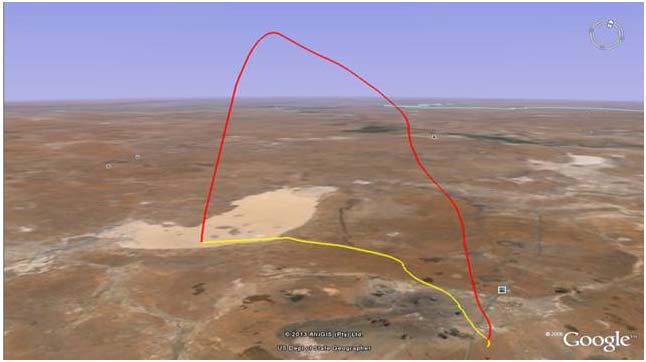
PIC10[1]GPS tracking of the Vulcan 2 trajectory. 

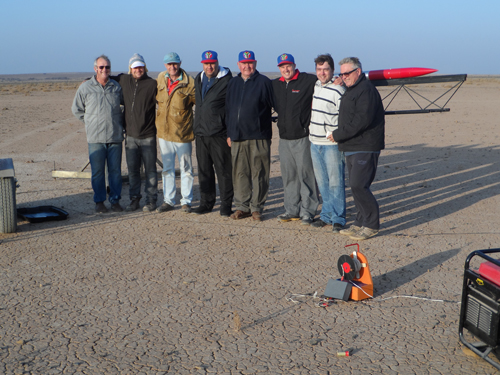
PIC3[1]The SARA team at the launch.

Space art: PlanetQuest Exoplanet Travel Posters

NASA’s PlanetQuest website, which provides info on the search for earth-like exoplanets, now offers beautiful posters in the Exoplanet Travel Series.  The set currently includes posters for three distant planets of particular interest:

Kepler-186f_39x27[1]


Kepler-186f is the first Earth-size planet discovered in the potentially ‘habitable zone’ around another star, where liquid water could exist on the planet’s surface. Its star is much cooler and redder than our Sun. If plant life does exist on a planet like Kepler-186f, its photosynthesis could have been influenced by the star’s red-wavelength photons, making for a color palette that’s very different than the greens on Earth. This discovery was made by Kepler, NASA’s planet hunting telescope.

HD_40307g_20x30[1]


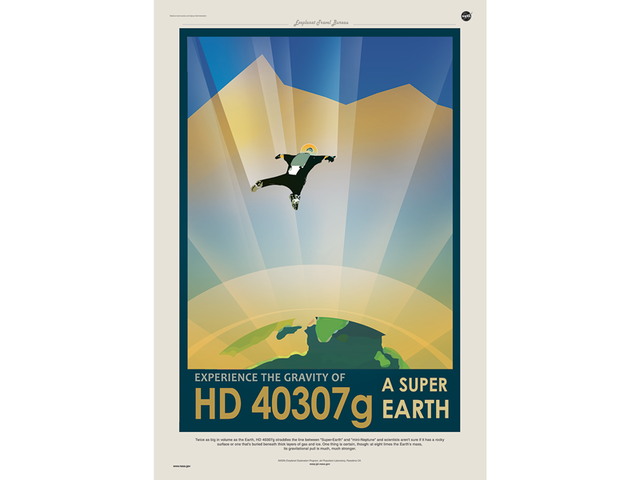
Twice as big in volume as the Earth, HD 40307g straddles the line between “Super-Earth” and “mini-Neptune” and scientists aren’t sure if it has a rocky surface or one that’s buried beneath thick layers of gas and ice. One thing is certain though: at eight time the Earth’s mass, its gravitational pull is much, much stronger.

Kepler-16b_20x-30[1]


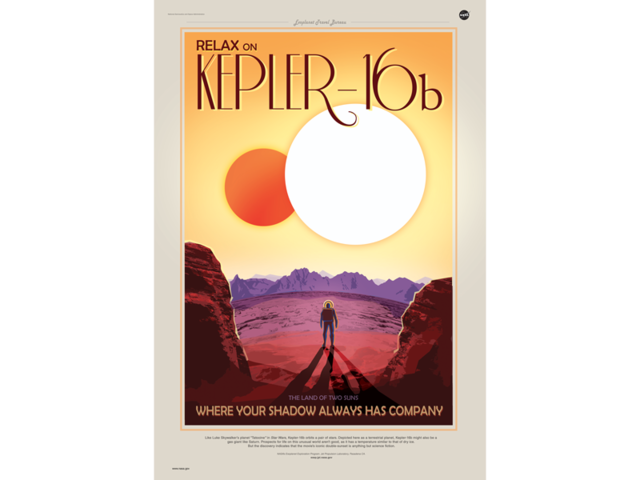
Like Luke Skywalker’s planet “Tatooine” in Star Wars, Kepler-16b orbits a pair of stars. Depicted here as a terrestrial planet, Kepler-16b might also be a gas giant like Saturn. Prospects for life on this unusual world aren’t good, as it has a temperature similar to that of dry ice. But the discovery indicates that the movie’s iconic double-sunset is anything but science fiction.

Low cost exoplanet hunting and gathering

A number of projects are showing that finding and studying exoplanets can be done with relatively low cost systems:   : Brave new world-hunters spot exoplanets on the cheap – New Scientist.

Such systems do not replace the space-based observatories like Kepler or the ground-based work by giant telescopes. These systems can look at thousands of stars with high resolution and sensitivity. Instead, the small guys can focus for long periods on just a handful of star systems. This can be done to hunt for new exoplanets or to gather more information on those found by the big systems.

Since Kepler’s staggering number of finds implied most stars probably have planets, astronomers are increasingly aiming for detailed planet studies instead of just making discoveries, Johnson says.

“This is no longer the day of swashbuckling scientists trying to get as many kills as possible,” [Greg Laughlin, an astronomer at the University of California at Santa Cruz,] says. “There is so much great science just sitting on the floor… with the Kepler statistics in hand, we’re no longer in the area of planet hunting. We’re in the era of planet gathering.”

For example, there is the Minerva exoplanet observatory, which describes itself as follows –

Minerva will be an array of small-aperture robotic telescopes outfitted for both photometry and high-resolution spectroscopy. It will be the first U.S. observatory dedicated to exoplanetary science capable of both precise radial velocimetry and transit studies. The multi-telescope concept will be implemented to either observe separate targets or a single target with a larger effective aperture. The flexibility of the observatory will maximize scientific potential and also provide ample opportunities for education and public outreach. The design and implementation of Minerva will be carried out by postdoctoral and student researchers at Caltech.

…

The primary science goal of Minerva is to discover Earth-like planets in close-in (less than 50-day) orbits around nearby stars, and super-Earths (3-15 times the mass of Earth) in the habitable zones of the closest Sun-like stars. The secondary goal will be to look for transits (eclipses) of known and newly-discovered extrasolar planets, which provide information about the radii and interior structures of the planets….

[]

Aqawan 1 and Telescope 1 at the Caltech
commissioning site. Image credit: M. Wong

Such a system is even accessible for (wealthy) amateurs. From the NS article:

Minerva uses four 0.7-metre-wide, 2.5-metre-tall commercial telescopes built by a company called PlaneWave, which also sells them to hobbyists for about $200,000 – Amazon founder Jeff Bezos bought one just before Minerva’s team.

The Mearth Project is another exoplanet observatory using arrays of off-the-shelf telescopes.

[]

There is also the HATNet Exoplanet Survey (Hungarian-made Automated Telescope Network) project.

[]

HATNet telescopes located at the Fred Lawrence Whipple Observatory (FLWO)
on Mount Hopkins in Arizona, USA (5 telescopes),

 

Everyone can participate in space