Adam Savage of Mythbusters fame interviews Andy Weir, author of The Martian: A Novel
The movie with Matt Damon as is now set to be released in October: Fox Moves Ridley Scott’s ‘The Martian’ to October – Hollywood Reporter.
Adam Savage of Mythbusters fame interviews Andy Weir, author of The Martian: A Novel
The movie with Matt Damon as is now set to be released in October: Fox Moves Ridley Scott’s ‘The Martian’ to October – Hollywood Reporter.
The latest images of Pluto from the New Horizons probe:
Different Faces of Pluto Emerging in New Images
from New Horizons
The surface of Pluto is becoming better resolved as NASA’s New Horizons spacecraft speeds closer to its July flight through the Pluto system.
A series of new images obtained by the spacecraft’s telescopic Long Range Reconnaissance Imager (LORRI) during May 29-June 2 show Pluto is a complex world with very bright and very dark terrain, and areas of intermediate brightness in between. These images afford the best views ever obtained of the Pluto system.

New Horizons scientists used a technique called deconvolution to sharpen the raw, unprocessed pictures that the spacecraft beams back to Earth; the contrast in these latest images has also been stretched to bring out additional details. Deconvolution can occasionally produce artifacts, so the team will be carefully reviewing newer images taken from closer range to determine whether some of the tantalizing details seen in the images released today persist. Pluto’s non-spherical appearance in these images is not real; it results from a combination of the image-processing technique and Pluto’s large variations in surface brightness.
Since April, deconvolved images from New Horizons have allowed the science team to identify a wide variety of broad surface markings across Pluto, including the bright area at one pole that scientists believe is a polar cap.
“Even though the latest images were made from more than 30 million miles away, they show an increasingly complex surface with clear evidence of discrete equatorial bright and dark regions—some that may also have variations in brightness,” says New Horizons Principal Investigator Alan Stern, of the Southwest Research Institute, Boulder, Colorado. “We can also see that every face of Pluto is different and that Pluto’s northern hemisphere displays substantial dark terrains, though both Pluto’s darkest and its brightest known terrain units are just south of, or on, its equator. Why this is so is an emerging puzzle.”
“We’re squeezing as much information as we can out of these images, and seeing details we’ve never seen before,” said New Horizons Project Scientists Hal Weaver, from the Johns Hopkins University Applied Physics Laboratory in Laurel, Maryland. “We’ve seen evidence of light and dark spots in Hubble Space Telescope images and in previous New Horizons pictures, but these new images indicate an increasingly complex and nuanced surface. Now, we want to start to learn more about what these various surface units might be and what’s causing them. By early July we will have spectroscopic data to help pinpoint that.”
New Horizons is approximately 2.9 billion miles (4.7 billion kilometers) from Earth and just 24 million miles (39 million kilometers) from Pluto. The spacecraft and payload are in good health and operating normally.

If you are in the Dallas area on July 18th, check out the Moon Day event at the Frontiers of Flight Museum.:
Moon Day is an annual Science, Technology, Engineering, and Math (STEM)-focused, space-themed public event sponsored by the Frontiers of Flight Museum and the National Space Society of North Texas. The event brings together space exploration-oriented groups, organizations and institutions in North Texas to share their activities and inspire new generations to embrace a scientific and technological future.

Activities, classes and exhibits will include:

 Girl Scouts and Boy Scouts Merit Badges and Moon Day patch: Sky, Night Owl, Home Scientist, Astronomy, and Space Exploration plus more STEM-related patches
Here is an announcement from The Moon Society:
THE MOON SOCIETY LUNAR ART PRIZE
Do you dream about our future in space? The Moon Society is holding an art contest for the most inspired works of art relating to humanity’s future on the Moon. This is your opportunity to help us show the world what that future looks like!
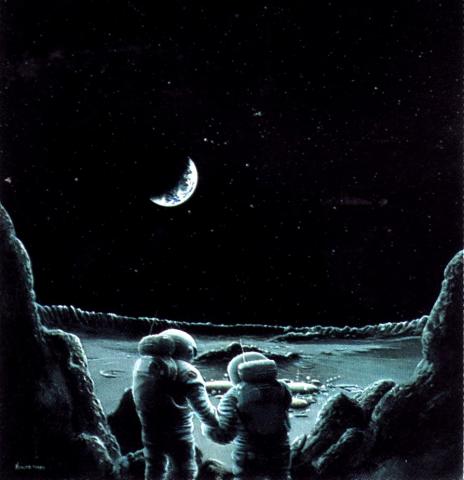
The Moon is increasingly recognized as a destination not only of scientific, but also of economic interest. Art has long been recognized as a powerful way for people to envision possible futures, and The Moon Society is seeking to encourage broader awareness of how our future on the Moon might unfold through art.
The Moon Society will use submitted art in the preparation of publicity materials, including banners for use at outreach events, membership brochures, and other marketing opportunities both online and in print, as well as in the Moon Miners’ Manifesto. All entries will be featured in an online gallery at the Moon Society website, and artists will always receive credit when their work is used.
Interested parties should submit their original compositions to Art@MoonSociety.org by midnight CDT June 30th, 2015. Submissions should be at a minimum 300 DPI, 1200 DPI preferred.
Prizes are as follows:
> 1st Place: $250
> 2nd Place: $125
> 3rd Place: $75
There will also be honorable mentions for additional outstanding works. Judging will be performed by Moon Society Officers and Directors whose decision is final. Digital submissions will become the property of the Moon Society; Artists will retain individual use rights for works created in other media and then digitized. Digital artists will also retain individual use rights for their works.
The list of winners will be announced by July 10th, and the first outreach banner will be unveiled at the Moon Day event in Dallas on July 18th.
The Moon Society was founded in 2000 as a not-for profit, education-focused organization incorporated under the laws of the State of Texas.
The Next Big Future blog hosts the latest Carnival of Space.