Hubble and other telescopes spot “galaxy cluster with bursting heart”

An announcement from the Hubble Space Telescope program.

Astronomers find galaxy cluster with bursting heart
Hubble, Spitzer, and the Canada-France-Hawaii Telescope
join forces for rare cosmic find

An international team of astronomers has discovered a gargantuan galaxy cluster with a core bursting with new stars — an incredibly rare find. The discovery, made with the help of the NASA/ESA Hubble Space Telescope, is the first to show that gigantic galaxies at the centres of massive clusters can grow significantly by feeding off gas stolen from other galaxies.
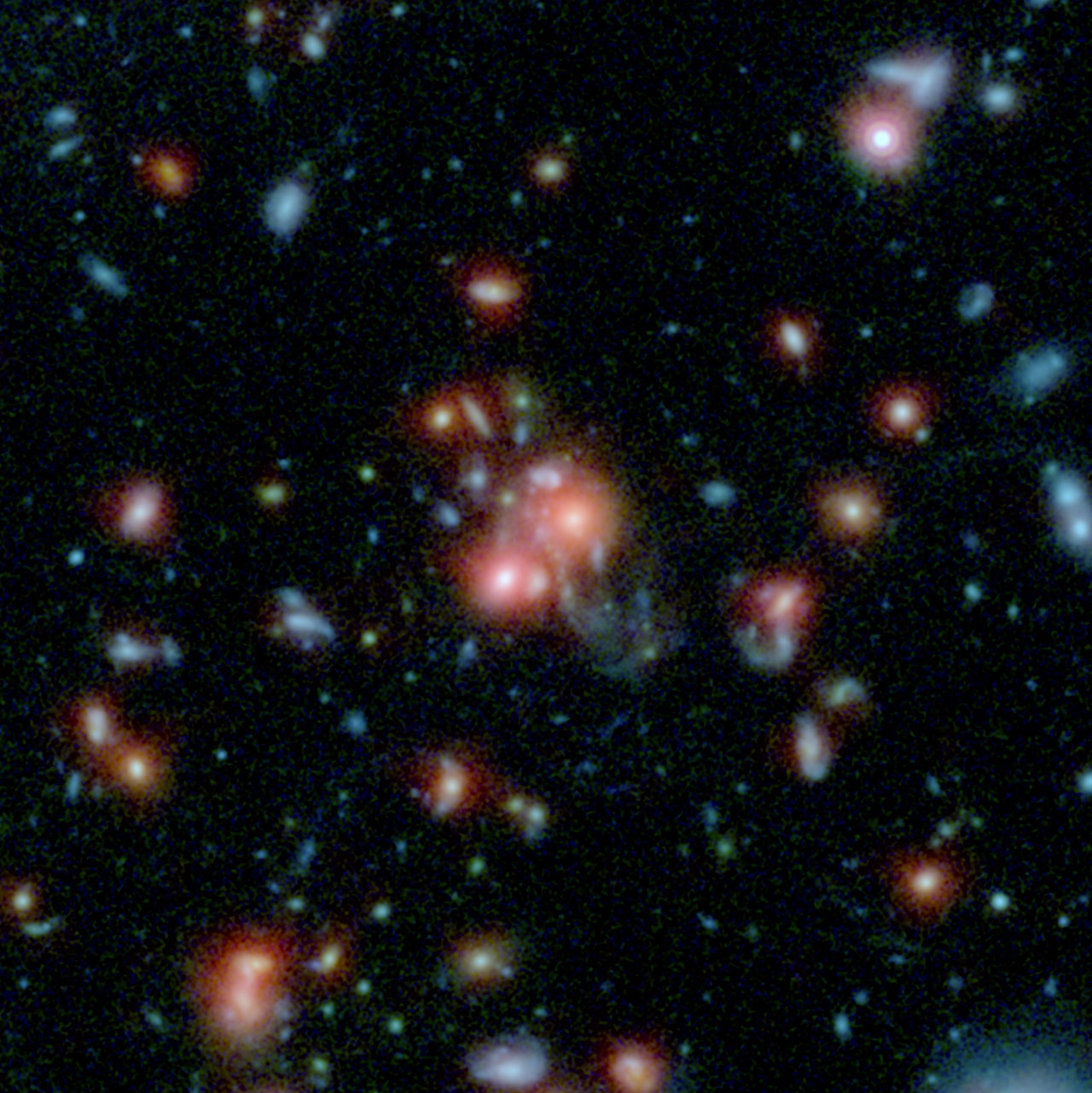
This image, using data from Spitzer and the Hubble Space Telescope, shows the galaxy cluster SpARCS1049.

Galaxy clusters are vast families of galaxies bound together by gravity. Our own galaxy, the Milky Way resides within a small galaxy group known as the Local Group, which itself is a member of the massive Laniakea supercluster.

Galaxies at the centres of clusters are usually made of stellar fossils — old, red or dead stars. However, astronomers have now discovered a giant galaxy at the heart of a cluster named SpARCS1049+56 that seems to be bucking the trend, instead forming new stars at an incredible rate.

“We think the giant galaxy at the centre of this cluster is furiously making new stars after merging with a smaller galaxy,” explained Tracy Webb of McGill University, Montreal, Canada, lead author of a new paper accepted for publication in The Astrophysical Journal.

This image, using data from Spitzer and the Hubble Space Telescope, shows the central region of the galaxy cluster SpARCS1049. The brightest cluster galaxy in the center of the cluster is currently undergoing a wet merger which produces enormous amounts of new stars. The tidal tail — an indicator of the merger — as well as the brightest cluster galaxy itself are shown.

The galaxy was initially discovered using NASA’s Spitzer Space Telescope and the Canada-France-Hawaii Telescope, located on Mauna Kea in Hawai`i and confirmed using the W.M. Keck Observatory, also on Mauna Kea. Follow-up observations using the NASA/ESA Hubble Space Telescope allowed the astronomers to explore the galaxy’s activity.

The SpARCS1049+56 cluster is so far away that its light took 9.8 billion years to reach us. It houses at least 27 galaxies and has a combined mass equal to 400 trillion Suns. It is a truly unique cluster in one aspect — its vibrant heart of new stars. The cluster’s brightest galaxy [1] is rapidly spitting out 800 new stars per year. The Milky Way forms two stars per year at most!

“The Spitzer data showed us a truly enormous amount of star formation in the heart of this cluster, something that has rarely been seen before, and certainly not in a cluster this distant,” commented co-author Adam Muzzin of the University of Cambridge, UK.

Spitzer picks up infrared light, so it can detect the warm glow of hidden, dusty regions of starbirth. Follow-up studies with Hubble in visible light helped to pinpoint what was fuelling the new star formation. It appears that a smaller galaxy has recently merged with the monster in the middle of the cluster, lending its gas to the larger galaxy and igniting a furious episode of new starbirth.

“Building on our other observations, we used Hubble to explore the galaxy in depth — and we weren’t disappointed,”added Muzzin. “Hubble found a trainwreck of a merger at the centre of this cluster. We detected features that looked like beads on a string.”

Beads on a string (heic1414) are telltale signs of something known as a wet merger. Wet mergers occur when gas-rich galaxies collide — this gas is converted quickly into new stars.
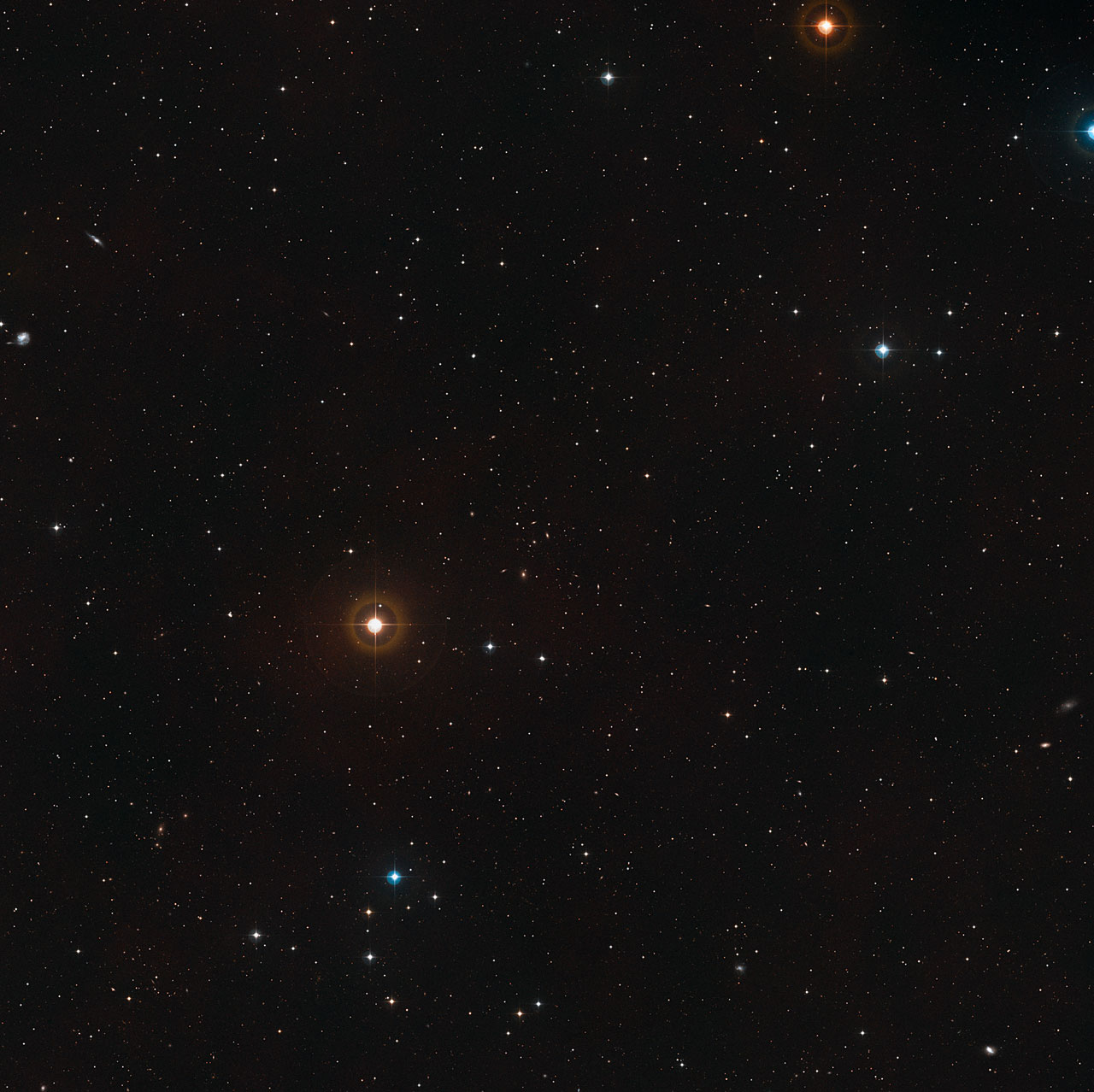
This image shows the region of sky around the the distant galaxy cluster SpARCS1049+56. It took the light of the cluster 9.8 billion light-years to reach us. The cluster houses at least 27 galaxies, probably more, and has a combined mass equal to 400 trillion Suns.

The new discovery is one of the first known cases of a wet merger at the core of a galaxy cluster. Hubble had previously discovered another closer galaxy cluster containing a wet merger, but it was not forming stars as vigorously. Other galaxy clusters grow in mass through dry mergers [2], or by siphoning gas towards their centres. For example, the mega galaxy cluster known as the Phoenix Cluster grows in size by sipping off gas that flows into its centre.

The astronomers now aim to explore how common this type of growth mechanism is in galaxy clusters. Are there other “messy eaters” out there similar to SpARCS1049+56, which also munch on gas-rich galaxies? SpARCS1049+56 may be an outlier — or it may represent an early time in our Universe when messy eating was the norm.

Notes

[1] At the core of most galaxy clusters lies a hulking galaxy called the brightest cluster galaxy, or BCG. This newly discovered starbursting galaxy is the BCG in SpARCS1049+56.

[2] Dry mergers involve the coming together of two galaxies lacking in gas. The two just mix their existing stars, rather than causing the birth of any new ones.

Video: Direct imaging of extrasolar planets and the discovery of a young Jupiter

In this SETI Institute seminar, Bruce Macintosh of Stanford talks about the Direct imaging of extrasolar planets and the discovery of a young Jupiter –

From the caption:

Learn about an exciting new exoplanet discovery—a Jupiter-like planet called “51 Eri b” that orbits a star a 100 light years away in the constellation of Eridanus.

Using a powerful new imaging device, astronomers have spied a Jupiter-like exoplanet 100 light-years distant in the constellation of Eridanus. Unlike most planets found around other stars, 51 Eri b has been seen directly. The instrument employed to make the discovery has also made a spectroscopic analysis of the light reflected from the planet, and has detected gases similar to those in Jupiter’s atmosphere.

Because GPI not only images exoplanets but also spreads their light for chemical analysis, astronomers can search for such common gases as water and methane in their atmospheres. Researchers had expected to see methane in directly-imaged exoplanets based on the temperature and chemistry of these worlds, but had failed to detect these molecules in large quantities using earlier instruments. However, the observations of 51 Eri b made with GPI have clearly revealed a methane-dominated atmosphere similar to that of Jupiter.

An extraordinarily complex instrument the size of a small car, GPI is attached to one of the world’s biggest telescopes – the 8-meter Gemini South instrument in Chile. It began its survey of stars last year.

The host star, 51 Eri, is very young, a mere 20 million years old, and is slightly hotter than the Sun. The exoplanet 51 Eri b, whose mass is estimated to be roughly twice that of Jupiter, appears to orbit its host star at a distance 13 times greater than the Earth-Sun distance. If placed in our own solar system, 51 Eri b’s orbit would lie between those of Saturn and Neptune.

Video: ‘Space to Ground’ ISS report – Sept.11.15

Here’s the latest NASA Space to Ground report on activities related to the Int. Space Station:

New Horizons: New images now online

It will take over a year to download all the images and scientific data collected when the New Horizons probe flew past the Pluto system. The mission team recently began downloading imagery again from the probe after a period of focusing on instrumentation data. Several new pictures have been posted in the Science Photos Gallery. Here are some examples (click on the images for larger versions): New Pluto Images from NASA’s New Horizons: It’s Complicated – NASA

Pluto’s Haze

Composite-Haze-Image-9-10-15[1]
Two different versions of an image of Pluto’s haze layers, taken by New Horizons as it looked back at Pluto’s dark side nearly 16 hours after close approach, from a distance of 480,000 miles (770,000 kilometers), at a phase angle of 166 degrees. Pluto’s north is at the top, and the sun illuminates Pluto from the upper right. These images are much higher quality than the digitally compressed images of Pluto’s haze downlinked and released shortly after the July 14 encounter, and allow many new details to be seen. The left version has had only minor processing, while the right version has been specially processed to reveal a large number of discrete haze layers in the atmosphere. In the left version, faint surface details on the narrow sunlit crescent are seen through the haze in the upper right of Pluto’s disk, and subtle parallel streaks in the haze may be crepuscular rays- shadows cast on the haze by topography such as mountain ranges on Pluto, similar to the rays sometimes seen in the sky after the sun sets behind mountains on Earth.
—

Pluto in Twilight

twilight-9-10-15[1]
This image of Pluto from NASA’s New Horizons spacecraft, processed in two different ways, shows how Pluto’s bright, high-altitude atmospheric haze produces a twilight that softly illuminates the surface before sunrise and after sunset, allowing the sensitive cameras on New Horizons to see details in nighttime regions that would otherwise be invisible. The right-hand version of the image has been greatly brightened to bring out faint details of rugged haze-lit topography beyond Pluto’s terminator, which is the line separating day and night. The image was taken as New Horizons flew past Pluto on July 14, 2015, from a distance of 50,000 miles (80,000 kilometers).
—

Charon’s Complexity

charon-9-10-15[1]
This image of Pluto’s largest moon Charon, taken by NASA’s New Horizons spacecraft 10 hours before its closest approach to Pluto on July 14, 2015 from a distance of 290,000 miles (470,000 kilometers), is a recently downlinked, much higher quality version of a Charon image released on July 15. Charon, which is 750 miles (1,200 kilometers) in diameter, displays a surprisingly complex geological history, including tectonic fracturing; relatively smooth, fractured plains in the lower right; several enigmatic mountains surrounded by sunken terrain features on the right side; and heavily cratered regions in the center and upper left portion of the disk. There are also complex reflectivity patterns on Charon’s surface, including bright and dark crater rays, and the conspicuous dark north polar region at the top of the image. The smallest visible features are 2.9 miles 4.6 kilometers) in size

(See also New Horizons Probes the Mystery of Charon’s Red Pole – Pluto New Horizons.)

—

Looking Over Pluto

Spherical-Mosaic-9-10-15[1]
This synthetic perspective view of Pluto, based on the latest high-resolution images to be downlinked from NASA’s New Horizons spacecraft, shows what you would see if you were approximately 1,100 miles (1,800 kilometers) above Pluto’s equatorial area, looking northeast over the dark, cratered, informally named Cthulhu Regio toward the bright, smooth, expanse of icy plains informally called Sputnik Planum. The entire expanse of terrain seen in this image is 1,100 miles (1,800 kilometers) across. The images were taken as New Horizons flew past Pluto on July 14, 2015, from a distance of 50,000 miles (80,000 kilometers).
—

Surface Variety

Surface-Features-Callouts-9-10-15[1]
Mosaic of high-resolution images of Pluto, transmitted by NASA’s New Horizons spacecraft from Sept. 5 to 7, 2015. The image is dominated by the informally-named icy plain Sputnik Planum, the smooth, bright region across the center. This image also features a tremendous variety of other landscapes surrounding Sputnik. The smallest visible features are 0.5 miles (0.8 kilometers) in size, and the mosaic covers a region roughly 1,000 miles (1,600 kilometers) wide. The image was taken as New Horizons flew past Pluto on July 14, 2015, from a distance of 50,000 miles (80,000 kilometers). The two white rectangles show the locations of the two closeup views by New Horizons, released separately.
The areas in the rectangles can be seen in more detail at Chaos Region and Dark Areas.

Astronaut Scholarship Foundation hosting online auction of space memorabilia

A message from the Astronaut Scholarship Foundation (ASF):

Astronaut Scholarship Foundation to Host
Bi-Annual Online Auction of Space Memorabilia
Money raised from sale of 46 collectibles and astronaut experiences
to help fund STEM scholarships for outstanding college students

KENNEDY SPACE CENTER, Fla. – From unique collectibles and signed memorabilia to one-of-a-kind flown artifacts, the public will have its chance to bid on some of the hottest space keepsakes when the Astronaut Scholarship Foundation (ASF) hosts its fall 2015 online auction beginning Sept. 19. Money raised from the auction will play a key role in funding college scholarships for outstanding science, technology, engineering and math (STEM) students across the United States.

“The Astronaut Scholarship Foundation is very fortunate to have such strong relationships with so many astronauts who are willing to donate their personal space memorabilia in support of our mission,” said Tammy Knowles, ASF’s executive director. “Our bi-annual online auction is filled with collectible items from more than five decades of space travel, all personally donated by astronauts and patrons. These generous gifts help us raise significant dollars to help shape the next generation of science and technology leaders.”

The auction will take place beginning at 9 a.m. Eastern on Saturday, Sept. 19 and run through Friday, Sept. 25 at 10 p.m. Eastern. A special preview of this year’s auction will open on Friday, Sept. 18 at 9 a.m. Eastern. The preview allows the public to register, obtain their bidding numbers and get a sneak peek at the items. This season, there are a total of 46 lots up for bid, including:

  • Official NASA Apollo Earth Orbit Chart signed by 13 Apollo astronauts, including four who walked on the Moon (Edwin “Buzz” Aldrin, Jr., Alan Bean, Eugene “Gene” Cernan and Charles “Charlie” Duke, Jr.). Entitled “Apollo Mission 12, For November 1969 Launch Dates,” this first edition chart measures approximately 13.5 inches by 42 inches.
  • Skylab Astronaut Maneuvering Unit (AMU) checklist cover, which was flown during Skylab 4 and worn on the cuffs of astronauts Gerald “Jerry” Carr, Edward Gibson and William Pogue as they worked in space.
  • Flown Apollo 14 beta cloth patch, silkscreened with the mission insignia and signed by astronaut Edgar Mitchell. The patch is made from the same material used to create fire-resistant space suits.
  • Skylab-Flown, serial-numbered pen and pencil, which were launched with the Skylab workshop in May 1973 and returned to Earth with the final Skylab crew in February 1974.

In addition, the ASF will auction four of its signature “Astronaut Experiences,” which offer bidders the chance to win a one-on-one encounter with a space explorer. This year’s experiences include:

  • A behind-the-scenes, VIP tour for two at the NASA Johnson Space Center in Houston, donated by Jacobs Technology, Inc., the corporate sponsor of ASF’s Workforce Initiative.
  • Two tickets, plus an astronaut special table guest, to the Astronaut Hall of Fame Induction Ceremony in May 2016.
  • Two breathtaking hiking adventures (one of which to take place in Shenandoah National Park).

For a complete listing of items, visit www.astronautscholarship.org/auction on Sept. 18.

While ASF has hosted live and silent auctions during its fundraising events over the past 30 years, the organization branched into online auctions in the early 2000s to appeal to a broader audience.

“Our online auction allows us to reach collectors around the world, who might not be able to attend one of our fundraising events,” Knowles said. “Over the past 10 years, auctions such as this one have helped us raise in excess of $1.5 million for our scholarship program.”

People interested in participating in the fall 2015 online auction must register in advance, beginning Sept. 18. Once the auction opens, participants may submit bids as many times as desired during the bidding period using the forms located on each lot page.

Winning bidders will be notified via email. Items will be shipped at the bidder’s expense. Cash, checks and credit cards will be accepted for payment of items. The full list of rules and regulations will be posted online on Sept. 18.

About the Astronaut Scholarship Foundation: Founded in 1984 by the surviving Mercury 7 astronauts, the Astronaut Scholarship Foundation (ASF) helps the United States retain its world leadership in science and technology. Through the garnered support of astronauts, industry leaders, educational institutions and patrons, ASF awards merit-based scholarships to the best and brightest university students who excel in science, technology, engineering and mathematics (STEM). The prestigious Astronaut Scholarship is known nationwide for being among the highest scholarships awarded to undergraduate STEM students. Since its inception, ASF has awarded in excess of $4 million in scholarships to more than 470 of the nation’s top scholars.

Everyone can participate in space