Commercial activity and opportunity in cislunar space – a report & podcast

The Cislunar Market Opportunities Report: In-Space Business within the Earth-Moon System was  recently released by NewSpace Global. I was the primary analyst on the report, which surveys a wide array of commercial activities and opportunities within  cislunar space, i.e. the region from low Earth orbit to the Moon, including the lunar surface.

The particular focus of the report is on those commercial sectors that support activities in space rather than those that deliver services to earth. In-space businesses include, for example, satellite servicing and space tugs in earth orbit and communications and navigation satellites around the Moon. Such endeavors constitute an in-space infrastructure that is forming and expanding before our eyes.
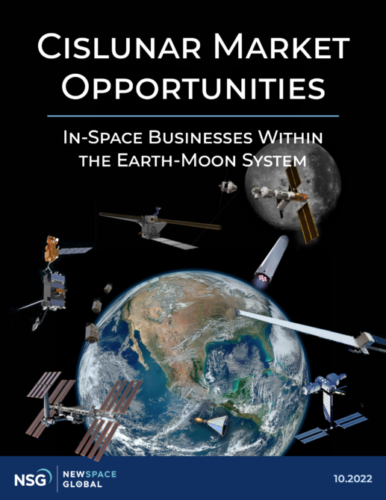
The Cislunar Market Opportunities Report: In-Space Business within the Earth-Moon System

I’ve followed commercial space development closely since the 1990s yet even I’m quite surprised by the current boom in cislunar endeavors. I initially planned just a brief update on a cislunar report I wrote in 2019  but soon realized that there had been major progress since then. Rather than just concepts and plans, in almost every sector there are companies with hardware already in space or with hardware in preparation for upcoming missions to space. It took 161 pages to describe the full scope of what is happening.

I discussed the report on the  Space Economy podcast with Marc Boucher, who is the President and COO of Multiverse Media Group LLC, which now owns NewSpace Global. (Dylan Taylor is the founder and chairman of Multiverse.) Check out our discussion: Insight Into the Cislunar Market Opportunities Report – SpaceQ

When we were finalizing the report, a big challenge was deciding when to stop incorporating the seemingly continuous in-flow of news and announcements of cislunar developments. Here is a sampling of cislunar in-space business news since the report was published:

=== Amazon Ads ===

Spacepower Ascendant:
Space Development Theory and a New Space Strategy

===

The Space Value of Money:
Rethinking Finance Beyond Risk & Time

Night sky highlights for December 2022

** What’s Up: December 2022 Skywatching Tips from NASA – NASA JPL

What are some skywatching highlights in December 2022?
The Moon sweeps past Jupiter twice this month, and actually covers Mars completely, in an event called an occultation, on Dec. 7. The event is visible across the U.S., except for the Southeast and East Coast, where the Moon will graze closely past Mars. And throughout the month, you can find Pegasus, the winged stallion, high overhead in the south.

0:00 Intro
0:11 Moon & planet highlights
0:38 Occultation: Mars disappears
1:54 The constellation Pegasus
3:12 December Moon phases

Additional information about topics covered in this episode of What’s Up, along with still images from the video, and the video transcript, are available at https://solarsystem.nasa.gov/skywatch….

** Tonight’s Sky: March – Space Telescope Science Institute – Tonight’s Sky

Step outside on a cold December night when the stars shine bright to find the Big Dipper, Cassiopeia, and Cepheus. They will help you locate a binary star system, a fan-shaped open star cluster, and a variable star. Stay tuned for space-based views of a ragged spiral galaxy, an open star cluster, and an edge-on galaxy.

** What to see in the night sky: December 2022 – BBC Sky at Night Magazine

Pete Lawrence and Paul Abel reveal this month’s night-sky highlights, including Mars at opposition, a lunar occultation of Mars, the Geminid meteor shower, the Ursid meteor shower and the best targets to see in the Orion constellation.

** Sky & Telescope’s Sky Tour Podcast – December 2022 – Sky & Telescope Youtube

Our monthly Sky Tour #astronomy #podcast provides an informative and entertaining 10-minute guided tour of the nighttime sky. Listen to the December episode and learn about the #solstice, #Mars, the #Geminids #meteor shower, and winter’s bright #stars.

Listen and subscribe to this podcast at https://skyandtelescope.org/observing/ and don’t forget to subscribe to S&T’s YouTube channel to get alerts about new videos, including this monthly podcast.

Learn more about #observing and #stargazing on our website, https://skyandtelescope.org/ and subscribe to our monthly magazine at https://skyandtelescope.org/subscribe.

This video is sponsored by Celestron – https://www.celestron.com/.

See also

** What’s in the Night Sky December 2022 #WITNS – Alyn Wallace

00:00 Intro
00:52 Northern Hemisphere Night Sky
04:45 Southern Hemisphere Night Sky
06:25 Trade In!
07:26 Lunar Occultation of Mars
08:25 Geminid Meteor Shower
10:16 Ursid Meteor Shower
11:00 #WITNS Winners

** Night Sky Notebook December 2022 – Peter Detterline

Astronomical events to see when you look up in December 2022.

** See also:

=== Amazon Ads ===

Celestron
70mm Travel Scope
Portable Refractor Telescope
Fully-Coated Glass Optics
Ideal Telescope for Beginners
BONUS Astronomy Software Package

==

Stellaris: People of the Stars

ESO: Distant black hole swallowing a star discovered in visible light

The latest report from the European Southern Observatory (ESO):

Most distant detection of a black hole swallowing a star

This artist’s impression illustrates how it might look when a star approaches too close to a black hole, where the star is squeezed by the intense gravitational pull of the black hole. Some of the star’s material gets pulled in and swirls around the black hole forming the disc that can be seen in this image. In rare cases, such as this one, jets of matter and radiation are shot out from the poles of the black hole. In the case of the AT2022cmc event, evidence of the jets was detected by various telescopes including the VLT, which determined this was the most distant example of such an event.

Earlier this year, the European Southern Observatory’s Very Large Telescope (ESO’s VLT) was alerted after an unusual source of visible light had been detected by a survey telescope. The VLT, together with other telescopes, was swiftly repositioned towards the source: a supermassive black hole in a distant galaxy that had devoured a star, expelling the leftovers in a jet. The VLT determined it to be the furthest example of such an event to have ever been observed. Because the jet is pointing almost towards us, this is also the first time it has been discovered with visible light, providing a new way of detecting these extreme events.

Stars that wander too close to a black hole are ripped apart by the incredible tidal forces of the black hole in what is known as a tidal disruption event (TDE). Approximately 1% of these cause jets of plasma and radiation to be ejected from the poles of the rotating black hole. In 1971, the black hole pioneer John Wheeler[1] introduced the concept of jetted-TDEs as “a tube of toothpaste gripped tight about its middle,” causing the system to “squirt matter out of both ends.”

“We have only seen a handful of these jetted-TDEs and they remain very exotic and poorly understood events,”

says Nial Tanvir from the University of Leicester in the UK, who led the observations to determine the object’s distance with the VLT. Astronomers are thus constantly hunting for these extreme events to understand how the jets are actually created and why such a small fraction of TDEs produce them.

As part of this quest many telescopes, including the Zwicky Transient Facility (ZTF) in the US, repeatedly survey the sky for signs of short-lived, often extreme, events that could then be studied in much greater detail by telescopes such as ESO’s VLT in Chile.

“We developed an open-source data pipeline to store and mine important information from the ZTF survey and alert us about atypical events in real time,”

explains Igor Andreoni, an astronomer at the University of Maryland in the US who co-led the paper published today in Nature together with Michael Coughlin from the University of Minnesota.

In February of this year the ZTF detected a new source of visible light. The event, named AT2022cmc, was reminiscent of a gamma ray burst — the most powerful source of light in the Universe. The prospect of witnessing this rare phenomenon prompted astronomers to trigger several telescopes from across the globe to observe the mystery source in more detail. This included ESO’s VLT, which quickly observed this new event with the X-shooter instrument. The VLT data placed the source at an unprecedented distance for these events: the light produced from AT2022cmc began its journey when the universe was about one third of its current age.

A wide variety of light, from high energy gamma rays to radio waves, was collected by 21 telescopes around the world. The team compared these data with different kinds of known events, from collapsing stars to kilonovae. But the only scenario that matched the data was a rare jetted-TDE pointing towards us. Giorgos Leloudas, an astronomer at DTU Space in Denmark and co-author of this study, explains that

“because the relativistic jet is pointing at us, it makes the event much brighter than it would otherwise appear, and visible over a broader span of the electromagnetic spectrum.“

The VLT distance measurement found AT2022cmc to be the most distant TDE to have ever been discovered, but this is not the only record-breaking aspect of this object.

“Until now, the small number of jetted-TDEs that are known were initially detected using high energy gamma-ray and X-ray telescopes, but this was the first discovery of one during an optical survey,”

says Daniel Perley, an astronomer at Liverpool John Moores University in the UK and co-author of the study. This demonstrates a new way of detecting jetted-TDEs, allowing further study of these rare events and probing of the extreme environments surrounding black holes.

Notes

[1] John Archibald Wheeler is also often credited with coining the term ‘black hole’ in a 1967 speech to NASA.

Links

=== Amazon Ads ===

An Infinity of Worlds:
Cosmic Inflation and the Beginning of the Universe

===

My Fifteen Years at IKI,
The Space Research Institute: Position-Sensitive Detectors
and Energetic Neutral Atoms Behind the Iron Curtain

The Space Show this week – Nov.28.2022

The guests and topics of discussion on The Space Show this week:

1. Tuesday, Nov. 29, 2022; 7 pm PST (9 pm CST, 10 pm EST): We welcome Tom Gardner to the program from Advanced Space to discuss the Capstone Project – Cubesats and the Moon!

2. Hotel Mars – Wednesday, Nov. 30, 2022; 1:00 pm PST (3:00 pm CST, 4:00 pm EST): Rick Fisher will talk with John Batchelor and Dr. David Livingston about China’s space program, rockets and more!

3. Friday, Dec.2, 2022; 9:30-11 am PST (11:30 am-1 pm CST, 12:30-2 pm EST): We welcome back Dr. Pete Worden for Breakthrough Prize updates and much much more. Don’t miss this discussion!

4. Sunday, Dec.4, 2022; 12-1:30 pm PST (2-3:30 pm CST, 3-4:30 pm EST): We welcome Gurbir Singh back to the show regarding his new book.

The Space Show Asks For Your Support For Our Annual Campaign

Nov. 25, 2022

Please support The Space Show during our Annual Campaign which makes possible our 2023 programming year.  We are 100% listener supported so your help .  is essential to Space Show programming.   If you like the programming, our guests, our format which connects you real time to the guests and other listeners, plus our blog for archive listeners that also connects you with our guests, then please donate and support us.  Your support is very important to us and makes possible our programming for the new year starting in January.  Use the PayPal link at the top of our home page, www.thespaceshow.com, or if you prefer mailing a check, please make it payable to One Giant Leap Foundation, C/O Dr. David Livingston, 11035 Lavender Hill Dr, Ste. 160-306, Las Vegas, NV  89135.

The Space Show thanks you. We look forward to working with you for 2023 as guests, listeners, getting your guest and programming suggestions and feedback.

All the best,

Dr. David Livingston, Host

Some recent shows:

** Friday, Nov.18.2022 – Brad Bergan discussed

his excellent new book, Space Race 2.0: SpaceX, Blue Origin, Virgin Galactic, NASA, and the Privatization of the Final Frontier [Amazon commission link].  Multiple topics from the book [were covered] plus we asked Brad many questions for this thoughts and opinions regarding space, commercial space and related topics.

** Thursday, Nov.17.2022 – Robert (Sam) Wilson, a policy analyst at The Aerospace Corporation’s Center for Space Policy and Strategy, discussed “his paper on the defense space budget and the congressional action that has followed, which particularly focuses on missile warning and tracking“.

** Tuesday, Nov.15.2022 – Dr. John Brandenburg returned to the show “to update us with some new information pertaining to his hypothesis about large nuclear bomb like explosions on Mars hundreds of million years ago“.

** See also:
* The Space Show Archives
* The Space Show Newsletter
* The Space Show Shop

The Space Show is a project of the One Giant Leap Foundation.

The Space Show - David Livingston
The Space Show – Dr. David Livingston

=== Amazon Ads ===

Spacepower Ascendant:
Space Development Theory and a New Space Strategy

===

Holy Stone HS440 Foldable FPV Drone
with 1080P WiFi Camera
for Adult Beginners and Kids;
Voice/Gesture Control RC Quadcopter with
Modular Battery for long flight time, Auto Hover, Carrying Case

Space in Miniature releases new “U.S. Space Missiles” ref book for modelers

Space in Miniature, led by Michael Mackowski, has released a new digital reference book for space model builders. Mike Mackowski describes the US Space Missiles SIM report:

The sixth installment in the Space In Miniature (SIM) digital-only “Tech Reports” series of reference booklets for spacecraft modelers is now available. This publication is a detailed review of the Atlantis re-issue of the old Monogram “U.S. Space Missiles” kit.

The initial version of this 1/128th scale kit came out in 1958 as the “United States Missile Arsenal” and Monogram updated it with a different mix of 36 missile subjects in 1969. The 1969 release, the 1983 version, and the recent Atlantis edition all use the same molds, with slightly different instructions. With the Atlantis Models release in 2022 making it readily available again, it seemed like a SIM Tech Report treatment would be popular.

The SIM Tech Report is based on a two-part kit review originally published in 1984 in Plastic Novelty Items, a publication of the Chicago Sprue Stretchers IPMS chapter. They included descriptions of most of the 36 missiles and was heavily illustrated with detailed drawings. The review covered the 1983 “Heritage Edition,” with text by Joe Suszynski and drawings by Jim Griffiths. After Joe passed away some years ago, I contacted Jim and made arrangements to use their work at some future time. That time has come. The SIM version adds photos of all the missiles and up-to-date drawings by model rocketry guru Peter Alway. Brian Nicklas, of the National Air and Space Museum and author of his own book on US missiles, also made contributions to this book.

SIM TR-6 US Space Missiles is available in digital (pdf) format only for $10 at spaceinminiature.com. There are 57 pages and 122 illustrations, many in color, resulting in a 178MB file.

This is the sixth in a series of special volumes in the Space In Miniature series called “Tech Reports”.

Some previous posts about SIM booklets:

== Amazon Ads ==

LEGO Ideas NASA Apollo Saturn V
Outer Space Model Rocket for Kids and Adults, Science Building Kit
(1900 pieces)

===

LEGO Ideas International Space Station Building Kit,
Adult Set for Display,
Makes a Great Christmas Present
(864 Pieces)

Everyone can participate in space