The latest weekly Space to Ground report from NASA about activities related to the International Space Station:
Here is a video of a launch this morning of a ULA Atlas V rocket with the TDRS-M communications satellite for NASA;
====
The latest weekly Space to Ground report from NASA about activities related to the International Space Station:
Here is a video of a launch this morning of a ULA Atlas V rocket with the TDRS-M communications satellite for NASA;
====
An earlier posting highlighted the launch on Monday of a SpaceX Dragon to the International Space Station. This video shows the arrival and berthing of the Dragon to the ISS on Wednesday morning:
Here is a fan video of SpaceX accomplishments set to a nice soundtrack:
====
NextBigFuture.com hosts the latest Carnival of Space.
From the latest Explore Mars newsletter comes news of the premier of a rock opera about settling Mars:
Explore Mars, Inc. excited about our sponsorship of the innovative rock opera, One Way Trip to Mars that will have its world theatrical premiere from August 24-27, 2017 at the Waterville Opera House in Waterville, Maine.

Composed by Peter Alexander and Johanna Harkness, and based on a story written by Dennis St. Pierre, the setting of this ambitious production is in the year 2033 when “…NASA sends the astronaut Paolo on a one-way trip to Mars to set up the infrastructure for a human colony, but he must leave behind forever everything he holds dear— including his loving wife Cassandra….”. The show features a professional cast that underwent an extensive auditioning process in New York City. [With “international recording artist Fantine playing the leading lady role”.]
“Explore Mars has always firmly believed that if the goal of landing humans on Mars in the 2030s is to be achieved, not only must the scientific, engineering, and policy communities are fully engaged but so too must the arts and entertainment community,” commented Explore Mars CEO, Chris Carberry. “One Way Trip to Mars is a unique show that will not only entertain theatergoers but also will help to build the necessary public support for actual human missions beginning by the year 2033.”
The production will also feature an Art and Science Fair to help engage students and the audience in the drama and science of Mars exploration and contribute to the public’s interest and support for future missions to Mars and beyond.
According to composer Peter Alexander, “One of the key features of our show is that the storyline is based on current science. The production highlights that human missions to Mars in the 2030s are both realistic and feasible, which is a message that has been espoused by Explore Mars, Inc. for many years and for which Explore Mars has gained great respect and credibility within the space exploration community. We are very pleased and excited to be able to partner with Explore Mars, Inc. in this endeavor.”
One Way Trip to Mars highlighted in the Portland Press Herald (http://www.pressherald.com/2017/06/18/one-way-trip-to-mars-set-for-take-off-in-waterville/)
Tickets are now on sale for One Way Trip to Mars at http://www.operahouse.org/
====
The lastest report from ESO (European Southern Observatory):
Supermassive Black Holes Feed on Cosmic Jellyfish
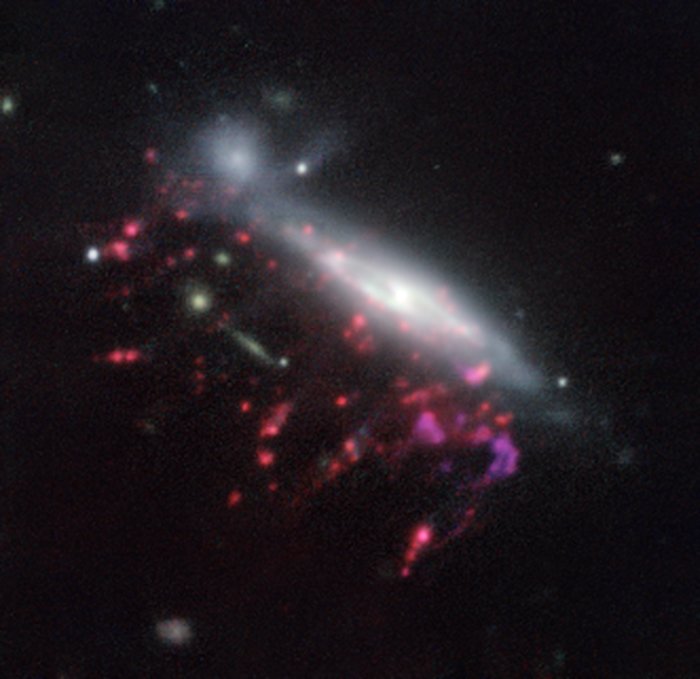
Observations of “Jellyfish galaxies” with ESO’s Very Large Telescope have revealed a previously unknown way to fuel supermassive black holes. It seems the mechanism that produces the tentacles of gas and newborn stars that give these galaxies their nickname also makes it possible for the gas to reach the central regions of the galaxies, feeding the black hole that lurks in each of them and causing it to shine brilliantly. This quick video explains the main points.
An Italian-led team of astronomers used the MUSE (Multi-Unit Spectroscopic Explorer) instrument on the Very Large Telescope (VLT) at ESO’s Paranal Observatory in Chile to study how gas can be stripped from galaxies. They focused on extreme examples of jellyfish galaxies in nearby galaxy clusters, named after the remarkable long “tentacles” of material that extend for tens of thousands of light-years beyond their galactic discs [1][2].
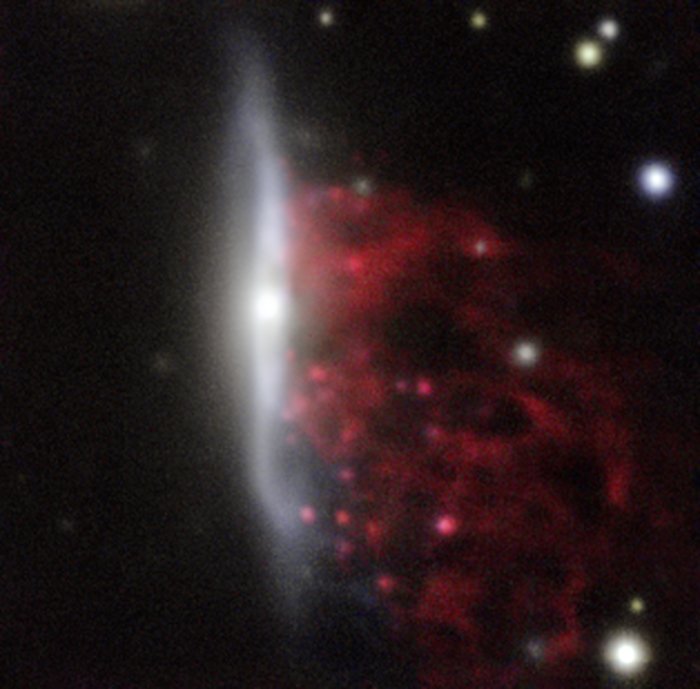
This visualisation shows a jellyfish galaxy in the three-dimensional view of the MUSE instrument on ESO’s Very Large Telescope. This combines the normal two-dimensional view with the third dimension of wavelength. This galaxy has undergone jam pressure stripping as it moves rapidly into the hot gas in a galaxy cluster, and streamers of gas and young stars are trailing behind it. These show up as the tentacles extending away from the galaxy as they have different velocities. A 3D interactive view of this galaxy is available. Credit: ESO/Callum Bellhouse and the GASP collaboration
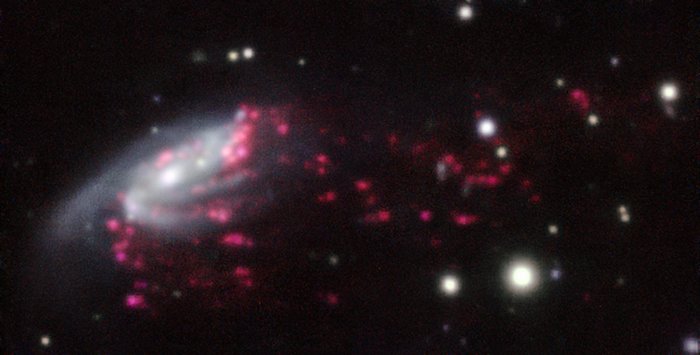
Six out of the seven jellyfish galaxies in the study were found to host a supermassive black hole at the centre, feeding on the surrounding gas [3]. This fraction is unexpectedly high — among galaxies in general the fraction is less than one in ten.
“This strong link between ram pressure stripping and active black holes was not predicted and has never been reported before,” said team leader Bianca Poggianti from the INAF-Astronomical Observatory of Padova in Italy. “It seems that the central black hole is being fed because some of the gas, rather than being removed, reaches the galaxy centre.” [4]
This artist’s illustration shows a spiral galaxy falling into a galaxy cluster. The galaxy is undergoing a process known as ram pressure stripping, where streaks of bright gas are being dragged out into space by the diffuse hot gas that it is moving through. Credit: NASA, ESA, and M. Kornmesser Acknowledgements: Ming Sun (UAH) and Serge Meunier
A long-standing question is why only a small fraction of supermassive black holes at the centres of galaxies are active. Supermassive black holes are present in almost all galaxies, so why are only a few accreting matter and shining brightly? These results reveal a previously unknown mechanism by which the black holes can be fed.
Yara Jaffé, an ESO fellow who contributed to the paper explains the significance: “These MUSE observations suggest a novel mechanism for gas to be funnelled towards the black hole’s neighbourhood. This result is important because it provides a new piece in the puzzle of the poorly understood connections between supermassive black holes and their host galaxies.”
The current observations are part of a much more extensive study of many more jellyfish galaxies that is currently in progress.
“This survey, when completed, will reveal how many, and which, gas-rich galaxies entering clusters go through a period of increased activity at their cores,” concludes Poggianti. “A long-standing puzzle in astronomy has been to understand how galaxies form and change in our expanding and evolving Universe. Jellyfish galaxies are a key to understanding galaxy evolution as they are galaxies caught in the middle of a dramatic transformation.”
This visualisation shows a jellyfish galaxy in the three-dimensional view of the MUSE instrument on ESO’s Very Large Telescope. This combines the normal two-dimensional view with the third dimension of wavelength. This galaxy has undergone ram pressure stripping as it moves rapidly into the hot gas in a galaxy cluster, and streamers of gas and young stars are trailing behind it. These show up as the tentacles extending away from the galaxy as they have different velocities. A 3D interactive view of this galaxy is available. Credit: ESO/Callum Bellhouse and the GASP collaboration
Notes
[1] To date, just over 400 candidate jellyfish galaxies have been found.
[2] The results were produced as part of the observational programme known as GASP (GAs Stripping Phenomena in galaxies with MUSE), which is an ESO Large Programme aimed at studying where, how and why gas can be removed from galaxies. GASP is obtaining deep, detailed MUSE data for 114 galaxies in various environments, specifically targeting jellyfish galaxies. Observations are currently in progress.
[3] It is well established that almost every, if not every, galaxy hosts a supermassive black hole at its centre, between a few million and a few billion times as massive as our Sun. When a black hole pulls in matter from its surroundings, it emits electromagnetic energy, giving rise to some of the most energetic of astrophysical phenomena: active galactic nuclei (AGN).
[4] The team also investigated the alternative explanation that the central AGN activity contributes to stripping gas from the galaxies, but considered it less likely. Inside the galaxy cluster, the jellyfish galaxies are located in a zone where the hot, dense gas of the intergalactic medium is particularly likely to create the galaxy’s long tentacles, reducing the possibility that they are created by AGN activity. There is therefore stronger evidence that ram pressure triggers the AGN and not vice versa.