Filmmaker Ridley Scott Creates
2018 International Space Station U.S. National Laboratory Mission Patch Mission patch represents all International Space Station U.S. National Laboratory research in 2018
Kennedy Space Center, FL (June 13th, 2018) —The Center for the Advancement of Science in Space (CASIS) today announced the unveiling of its latest mission patch, designed by award-winning filmmaker and producer, Sir Ridley Scott. The mission patch represents all payloads intended for the International Space Station (ISS) U.S. National Laboratory in calendar year 2018. CASIS is the organization tasked by NASA with managing research on the U.S. National Laboratory onboard the space station. Research leveraging the ISS National Lab is intended to utilize microgravity for the benefit of life on Earth.
The space station is an ever-evolving research platform capable of enabling research not possible on Earth. As manager of the ISS National Lab, CASIS is responsible for educating and expanding the research opportunities available through this one-of-a-kind facility. By working with Fortune 500 companies, innovative startups, esteemed academic institutions, other government agencies, and nonprofit organizations, the ISS National Lab is fostering a new era of space-based research. The mission patch collaboration with Ridley Scott (like other mission patches announced in recent years) seeks to engage and excite the general public, while representing hundreds of experiments expected to launch to the ISS National Lab in 2018.
During his career as a filmmaker, Ridley Scott has immersed himself in some of the more iconic science fiction feature films of the past five decades. Prominent movies within the science fiction community that Scott has directed or produced (through his production company, Scott Free Productions) include the Alien franchise, Blade Runner, Legend, and The Martian. His love of space exploration and his previous working relationships with NASA helped to forge this mission patch collaboration with CASIS and the ISS National Lab.
The patch design is focused on a female astronaut in full gear, in the infiniteness of space, looking toward the space station. Scott deemed astronauts to be saints for their brave efforts to explore on behalf of humanity. Within the patch, Scott intended the helmet of the astronaut to be interpreted as a halo, saying
“therefore the helmet itself would become… a subliminal suggestion of a saint.”
“I can feel these scientists, and they are so passionate about what they do. You’re a bunch of actual enthusiasts…which is exactly who I am,” Scott said.
To learn more about this collaboration, watch a video on the making of the mission patch here:
To understand the on-orbit capabilities of the ISS National Lab, including research initiatives launched in 2018, visit www.iss-casis.org
As happens occasionally, a giant dust storm has arisen on Mars and the resulting cloudy sky has cut power to the Opportunity rover. Unlike the nuclear powered Curiosity, “Oppy” uses solar panels to supply its energy needs. The rover has been operating since landing on the Red Planet on Jan. 25, 2004 and survived a big storm in 2007 but this one appears much worse and may last longer.
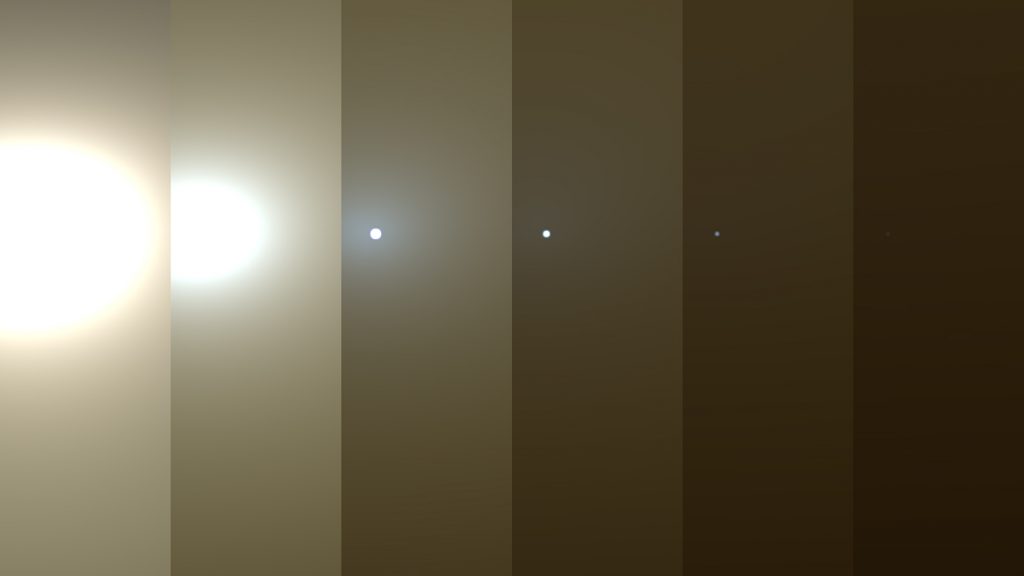
This series of images shows simulated views of a darkening Martian sky blotting out the Sun from NASA’s Opportunity rover’s point of view, with the right side simulating Opportunity’s current view in the global dust storm (June 2018). The left starts with a blindingly bright mid-afternoon sky, with the sun appearing bigger because of brightness. The right shows the Sun so obscured by dust it looks like a pinprick. Each frame corresponds to a tau value, or measure of opacity: 1, 3, 5, 7, 9, 11.
NASA engineers attempted to contact the Opportunity rover today but did not hear back from the nearly 15-year old rover. The team is now operating under the assumption that the charge in Opportunity’s batteries has dipped below 24 volts and the rover has entered low power fault mode, a condition where all subsystems, except a mission clock, are turned off. The rover’s mission clock is programmed to wake the computer so it can check power levels.
If the rover’s computer determines that its batteries don’t have enough charge, it will again put itself back to sleep. Due to an extreme amount of dust over Perseverance Valley, mission engineers believe it is unlikely the rover has enough sunlight to charge back up for at least the next several days.
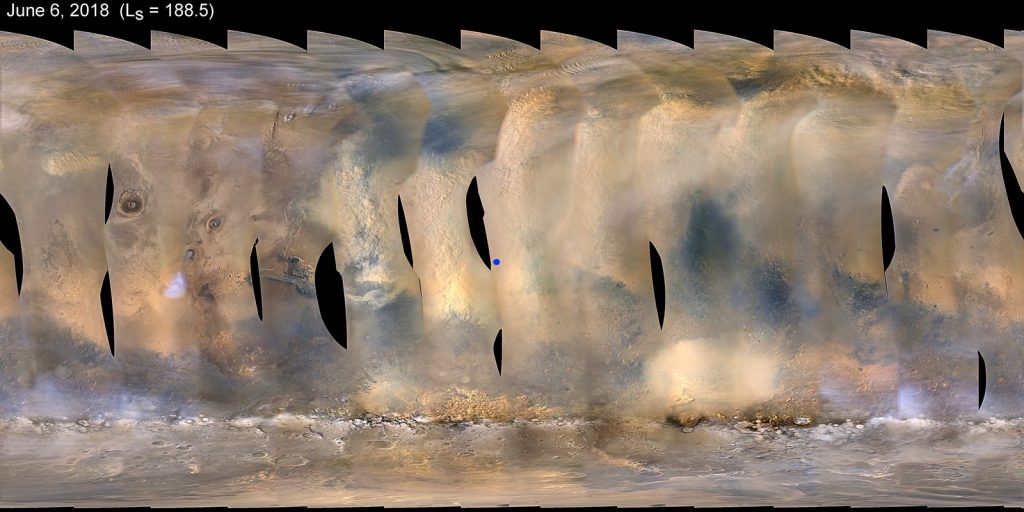
The Martian dust storm that has blotted out the sun above Opportunity has continued to intensify. The storm, which was first detected on May 30, now blankets 14-million square miles (35-million square kilometers) of Martian surface — a quarter of the planet.
This global map of Mars shows a growing dust storm as of June 6, 2018. The map was produced by the Mars Color Imager (MARCI) camera on NASA’s Mars Reconnaissance Orbiter spacecraft. The storm was first detected on June 1. The MARCI camera has been used to monitor the storm ever since. The blue dot indicates the approximate location of Opportunity.
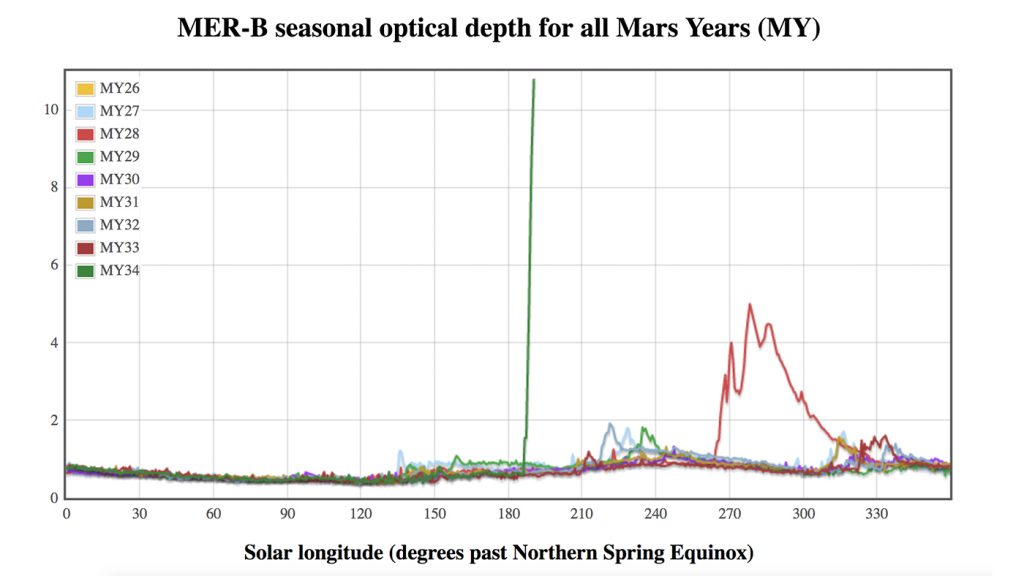
June 12, 2018: This graphic compares atmospheric opacity in different Mars years from the point of view of NASA’s Opportunity rover. The green spike in 2018 (Mars Year 34) shows how quickly the global dust storm building at Mars blotted out the sky. A previous dust storm in 2007 (red, Mars Year 28) was slower to build. The vertical axis shows atmospheric opacity and the horizontal access shows the Martian season, which is measured by where the Sun is in the Martian sky compared to its apparent position on Mars’ northern spring equinox
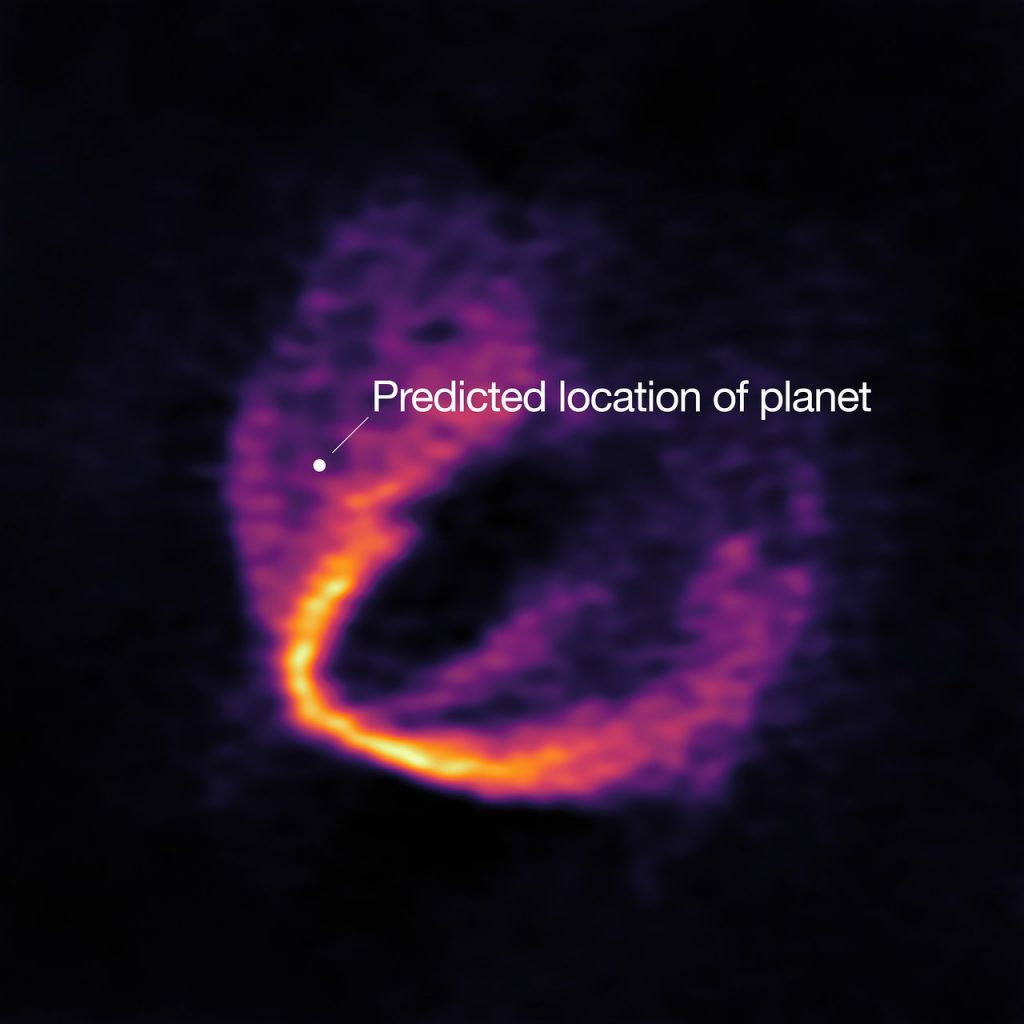
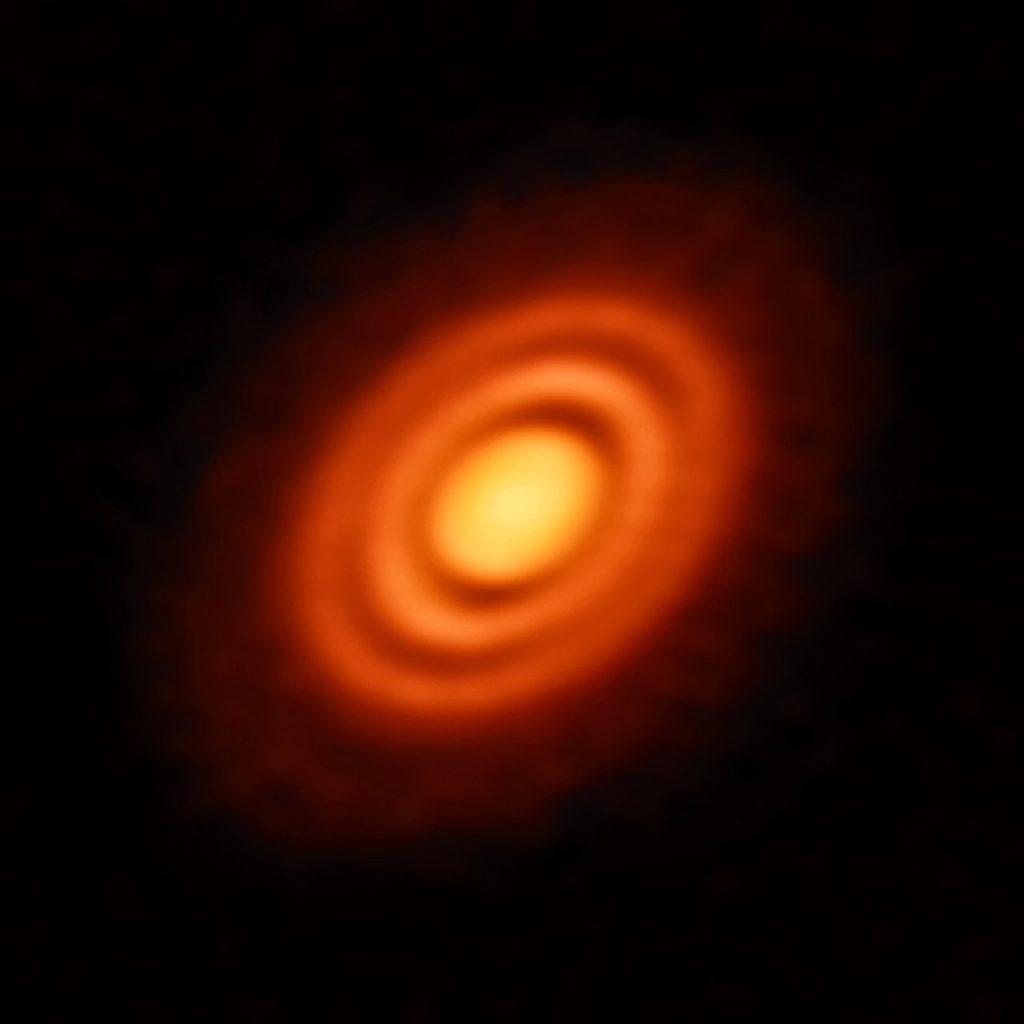
ALMA has uncovered convincing evidence that three young planets are in orbit around the infant star HD 163296. Using a novel planet-finding technique, astronomers have identified three discrete disturbances in the young star’s gas-filled disc: the strongest evidence yet that newly formed planets are in orbit there. These are considered the first planets discovered with ALMA.This image shows part of the ALMA data set at one wavelength and reveals a clear “kink” in the material, which indicates unambiguously the presence of one of the planets. The annotation shows the predicted position of the planet in question. [Hi-Res Images]The Atacama Large Millimeter/submillimeter Array (ALMA) has transformed our understanding of protoplanetary discs — the gas- and dust-filled planet factories that encircle young stars. The rings and gaps in these discs provide intriguing circumstantial evidence for the presence of protoplanets[1]. Other phenomena, however, could also account for these tantalising features.
Two independent teams of astronomers have used ALMA to uncover convincing evidence that three young planets are in orbit around the infant star HD 163296. Using a novel planet-finding technique, the astronomers identified three disturbances in the gas-filled disc around the young star: the strongest evidence yet that newly formed planets are in orbit there. These are considered the first planets to be discovered with ALMA.
But now, using a novel planet-hunting technique that identifies unusual patterns in the flow of gas within a planet-forming disc around a young star, two teams of astronomers have each confirmed distinct, telltale hallmarks of newly formed planets orbiting an infant star [2].
“Measuring the flow of gas within a protoplanetary disc gives us much more certainty that planets are present around a young star,” said Christophe Pinte of Monash University in Australia and Institut de Planétologie et d’Astrophysique de Grenoble (Université de Grenoble-Alpes/CNRS) in France, and lead author on one of the two papers. “This technique offers a promising new direction to understand how planetary systems form.”
To make their respective discoveries, each team analysed ALMA observations of HD 163296, a young star about 330 light-years from Earth in the constellation of Sagittarius (The Archer) [3]. This star is about twice the mass of the Sun but is just four million years old — just a thousandth of the age of the Sun.
“We looked at the localised, small-scale motion of gas in the star’s protoplanetary disc. This entirely new approach could uncover some of the youngest planets in our galaxy, all thanks to the high-resolution images from ALMA,” said Richard Teague, an astronomer at the University of Michigan and principal author on the other paper.
Rather than focusing on the dust within the disc, which was clearly imaged in earlier ALMA observations, the astronomers instead studied carbon monoxide (CO) gas spread throughout the disc. Molecules of CO emit a very distinctive millimetre-wavelength light that ALMA can observe in great detail. Subtle changes in the wavelength of this light due to the Doppler effect reveal the motions of the gas in the disc.
Our Solar System formed out of a huge, primordial cloud of gas and dust. The vast majority of that cloud formed the Sun, while the leftover disc of rotating material around it eventually coalesced into the orbiting planets we know — and live on — today. Astronomers can observe similar processes happening around other stars in the cosmos. This splendid Picture of the Week shows a disc of rotating, leftover material surrounding the young star HD 163296. Using the observing power of the Atacama Large Millimeter/submillimeter Array (ALMA) in Chile, astronomers have been able to discern specific features in the disc, including concentric rings of material surrounding the central star. They were even able to use ALMA to obtain high-resolution measurements of the gas and dust constituents of the disc. With these data they could infer key details of the formation history of this young stellar system. The three gaps between the rings are likely due to a depletion of dust and in the middle and outer gaps astronomers also found a lower level of gas. The depletion of both dust and gas suggests the presence of newly formed planets, each around the mass of Saturn, carving out these gaps on their brand new orbits. [Hi-Res images]The team led by Teague identified two planets located approximately 12 billion and 21 billion kilometres from the star. The other team, led by Pinte, identified a planet at about 39 billion kilometres from the star [4].
The two teams used variations on the same technique, which looks for anomalies in the flow of gas — as evidenced by the shifting wavelengths of the CO emission — that indicate the gas is interacting with a massive object [5].
The technique used by Teague, which derived averaged variations in the flow of the gas as small as a few percent, revealed the impact of multiple planets on the gas motions nearer to the star. The technique used by Pinte, which more directly measured the flow of the gas, is better suited to studying the outer portion of the disc. It allowed the authors to more accurately locate the third planet, but is restricted to larger deviations of the flow, greater than about 10%.
In both cases, the researchers identified areas where the flow of the gas did not match its surroundings — a bit like eddies around a rock in a river. By carefully analysing this motion, they could clearly see the influence of planetary bodies similar in mass to Jupiter.
This new technique allows astronomers to more precisely estimate protoplanetary masses and is less likely to produce false positives.
“We are now bringing ALMA front and centre into the realm of planet detection,” said coauthor Ted Bergin of the University of Michigan.
Both teams will continue refining this method and will apply it to other discs, where they hope to better understand how atmospheres are formed and which elements and molecules are delivered to a planet at its birth.
Notes
[1] Although thousands of exoplanets have been discovered in the last two decades, detecting protoplanets remains at the cutting edge of science and there have been no unambiguous detections before now. The techniques currently used for finding exoplanets in fully formed planetary systems — such as measuring the wobble of a star or the dimming of starlight due to a transiting planet — do not lend themselves to detecting protoplanets.
[2] The motion of gas around a star in the absence of planets has a very simple, predictable pattern (Keplerian rotation) that is nearly impossible to alter both coherently and locally, so that only the presence of a relatively massive object can create such disturbances.
[3] ALMA’s stunning images of HD 163296 and other similar systems have revealed intriguing patterns of concentric rings and gaps within protoplanetary discs. These gaps may be evidence that protoplanets are ploughing the dust and gas away from their orbits, incorporating some of it into their own atmospheres. A previous study of this particular star’s disc shows that the gaps in the dust and gas overlap, suggesting that at least two planets have formed there.
These initial observations, however, merely provided circumstantial evidence and could not be used to accurately estimate the masses of the planets.
[4] These correspond to 80, 140 and 260 times the distance from the Earth to the Sun.
[5] This technique is similar to the one that led to the discovery of the planet Neptune in the nineteenth century. In that case anomalies in the motion of the planet Uranus were traced to the gravitational effect of an unknown body, which was subsequently discovered visually in 1846 and found to be the eighth planet in the Solar System.
Solar Sci-Fi (i.e. hard science fiction involving near-term scenarios within our solar system) has gone big time in the past few years with the major financial successes of the films Gravity and The Martian. The TV series The Expanse, which depicts conflicts among settlers of Mars, the Asteroid Belt, and Earth, has lasted 3 seasons on the SyFy Channel and will now continue on Amazon Prime:
Set in the 2030s, the eight-episode first season is mainly set on Earth as the astronauts prepare for the journey to the red planet and NASA forms a partnership with a private company to support the trip.
And on the Solar Sci-Reality front, the film First Man with Ryan Gosling looks to be an epic re-telling of how Neil Armstrong came to take that first step onto the lunar surface: