Videos: “Space to Ground” & other space habitat reports – Oct.3.2023

This week’s selection of videos about space stations and living in space including NASA’s latest Space to Ground report for the International Space Station:

** Soyuz MS-23 International Space Station Hatch Closing – Sept. 27, 2023 – NASA Video

NASA astronaut Frank Rubio and Roscosmos cosmonauts Sergei Prokopyev and Dmitri Petelin gave farewell remarks ahead of hatch closure of the Roscosmos Soyuz MS-23 spacecraft on September 27. Following hatch closure, the spacecraft undocked from the International Space Station’s Prichal module, returning to Earth a few hours later for a parachute-assisted landing on the steppe of Kazakhstan. During his mission, Rubio broke the record for longest single spaceflight for a U.S. astronaut spending 371 consecutive days living and working aboard the microgravity laboratory to advance scientific knowledge and demonstrate new technologies for future human and robotic exploration missions as part of NASA’s Moon and Mars exploration approach, including lunar missions through NASA’s Artemis program. .

** Soyuz MS-23 International Space Station Undocking – Sept. 27, 2023 – NASA Video

NASA astronaut Frank Rubio and Roscosmos cosmonauts Sergei Prokopyev and Dmitri Petelin gave farewell remarks ahead of hatch closure of the Roscosmos Soyuz MS-23 spacecraft on September 27. Following hatch closure, the spacecraft undocked from the International Space Station’s Prichal module, returning to Earth a few hours later for a parachute-assisted landing on the steppe of Kazakhstan. During his mission, Rubio broke the record for longest single spaceflight for a U.S. astronaut spending 371 consecutive days living and working aboard the microgravity laboratory to advance scientific knowledge and demonstrate new technologies for future human and robotic exploration missions as part of NASA’s Moon and Mars exploration approach, including lunar missions through NASA’s Artemis program. 

** Astronaut Andreas Mogensen Talks with Herning, Denmark DI Business Summit – Sept. 28, 2023 – NASA Video

Aboard the International Space Station, Expedition 69 Flight Engineer and ESA (European Space Agency) astronaut Andreas Mogenson discussed living and working in space during an in-flight interview September 28 with industry stakeholders in Denmark. Mogenson launched in August on the SpaceX Dragon “Endurance” as part of NASA’s SpaceX Crew-7 which is a science mission living and working aboard the microgravity laboratory to advance scientific knowledge and demonstrate new technologies for future human and robotic exploration missions.

** Sierra Space | A Leading Pureplay Commercial Space Company – Sierra Space

Sierra Space is a leading, pureplay commercial space company at the forefront of innovation and the commercialization of space in the Orbital Age™, building an end-to-end business and technology platform in space to benefit life on Earth.

With more than 30 years and 500 missions of space flight heritage, the company is enabling the future of space transportation with Dream Chaser®, the world’s only commercial spaceplane, and is bringing LIFE™ (Large Integrated Flexible Environment) to Low Earth Orbit with its modular, three-story commercial habitation and science platform.

Sierra Space also builds and delivers a host of systems and subsystems across solar power, mechanics and motion control, environmental control, life support, propulsion and thermal control, offering myriad space-as-a-service solutions for the new space economy.

** See the Chinese space station assembly in animation & ground photos – VideoFromSpace

Watch the Tiangong space station assembly in this time-lapse animation along taken by satellites in orbit. Full Story: https://www.space.com/china-space-sta…

** Keynote: Gateway: Humanity’s First Lunar Space Station – Policy Studies Organization

A talk by Sean Fuller, international partner manager for NASA’s Gateway lunar orbital station program.

** Live Video from the International Space Station (Official NASA Stream) – NASA

Watch live video from the International Space Station, including inside views when the crew aboard the space station is on duty. Views of Earth are also streamed from an external camera located outside of the space station. During periods of signal loss due to handover between communications satellites, a blue screen is displayed.

The space station orbits Earth about 250 miles (425 kilometers) above the surface. An international partnership of five space agencies from 15 countries operates the station, and it has been continuously occupied since November 2000. It’s a microgravity laboratory where science, research, and human innovation make way for new technologies and research breakthroughs not possible on Earth. More: https://go.nasa.gov/3CkVtC8

Did you know you can spot the station without a telescope? It looks like a fast-moving star, but you have to know when to look up. Sign up for text messages or email alerts to let you know when (and where) to spot the station and wave to the crew: https://spotthestation.nasa.gov

====
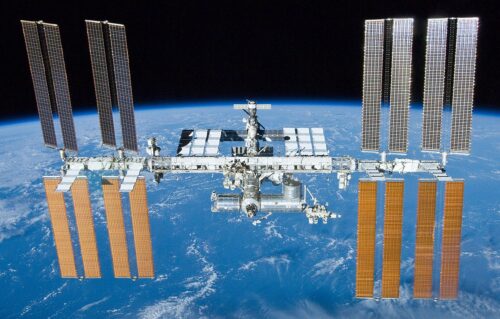
ISS after undocking of STS-132

=== Amazon Ads ===

Lego Ideas International Space Station
21321 Toy Blocks, Present, Space, Boys, Girls, Ages 16 and Up

====

Outpost in Orbit:
A Pictorial & Verbal History of the Space Station

Night sky highlights for October 2023

Check out the night sky this month, October 2023. Here are videos highlighting the top sights to observe.

** What’s Up: October 2023 Skywatching Tips from NASA – NASA JPL

A “ring of fire” solar eclipse across the Americas on Oct. 14 is this month’s top highlight! Plus the Moon, Jupiter, Saturn, and Venus strike some lovely poses for stargazers and planet watchers to enjoy.

0:00 Intro
0:12 Moon & planet highlights
1:29 Psyche mission launch
2:17 Annular solar eclipse
3:41 October Moon phases

Additional information about topics covered in this episode of What’s Up, along with still images from the video, and the video transcript, are available at https://solarsystem.nasa.gov/skywatch….

** Tonight’s Sky: October 2023 – Space Telescope Science Institute – Tonight’s Sky

Crisp, clear October nights are full of celestial showpieces. Find Pegasus, the flying horse of Greek myth, to pinpoint dense globular star clusters and galaxies, and keep watching for space-based views of M15, NGC 7331, and the Andromeda Galaxy.

** What to see in the night sky: October 2023 – BBC Sky at Night Magazine

Astronomers Pete Lawrence and Paul Abel reveal what to see in the night sky this month, including:

– Partial lunar eclipse on 28 October
– Making the most of Venus
– Bright beautiful Jupiter approaching opposition
– Observing Jupiter’s Galilean Moons
– Moon’s encounter with the Pleiades star cluster
– Cutlass effect on the Moon
– Draconid meteor shower and Orionid meteor shower
– Comet 103P/Hartley

** Sky & Telescope’s Sky Tour Podcast – October | An Annular Solar Eclipse and Orionid Meteor Shower – Sky & Telescope Youtube

Our monthly Sky Tour #astronomy #podcast provides an informative and entertaining 10-minute guided tour of the nighttime sky. Listen to the October episode and celebrate two #eclipses, check in with #jupiter and #Saturn, track down the evening’s bright #stars, and look for bits of Halley’s #Comet flashing across the sky. Grab your curiosity, and come along on this month’s Sky Tour.

Listen and subscribe to this podcast at https://skyandtelescope.org/observing/ and don’t forget to subscribe to S&T’s YouTube channel to get alerts about new videos, including this monthly podcast

Learn more about #observing and #stargazing on our website, https://skyandtelescope.org/ and subscribe to our monthly magazine at https://skyandtelescope.org/subscribe.

Guide to viewing the 2023 Annular Solar Eclipse | October 14, 2023 – Sky & Telescope Youtube

Here’s what to expect for the annular — or “ring of fire” — #solareclipse on October 14, 2023. Don’t miss seeing the #Moon partially cover the face of the #Sun in a run-up to the total solar #eclipse happening next year in April 2024. The editors of Sky & Telescope share what to expect and how to safely view all the phases of October’s celestial event. Learn more about this annular eclipse and safe eclipse viewing at skyandtelescope.org.

See also

** What’s in the Night Sky October 2023 – Annular Solar Eclipse | Orionid Meteor Shower – Alyn Wallace

00:00 Intro
00:30 Ring of Fire Eclipse
03:03 Partial Lunar Eclipse
05:18 Milky Way
06:43 Orionid Meteor Shower
08:53 Taurid Meteor Showers
10:58 Aurora
11:40 Moon and Planets
13:02 #WITNS Winners

** Night Sky Notebook October 2023 – Peter Detterline

** See also:

=== Amazon Ads ===

Celestron
70mm Travel Scope
Portable Refractor Telescope
Fully-Coated Glass Optics
Ideal Telescope for Beginners
BONUS Astronomy Software Package

==

Stellaris: People of the Stars

Videos: “Space to Ground” & other space habitat reports – Sept.26.2023

This week’s selection of videos about space stations and living in space including NASA’s latest Space to Ground report for the International Space Station:

** Vibrant Communities Beyond Earth are Possible – VideoFromSpace

Join the BEYOND EARTH SYMPOSIUM in Washington D.C., November 1-2: https://www.beyondearthsymposium.org The Beyond Earth Institute’s founder and senior staff explain their mission to drive policy and legal frameworks that will economically enable communities beyond Earth. This non-profit “think tank” focuses on catalyzing the technologies, support, and public policies needed to achieve a permanent, sustainable human presence in space. https://beyondearth.org/

** Reinventing the Space Station with LIFE Habitat – Sierra Space

Learn how Sierra Space is driving significant cost savings for operating on-orbit with the LIFE Habitat. This latest successful milestone and the first one in the testing campaign to include a metallic window sub-structure – or blanking plate – now propels Sierra Space into full-scale testing of LIFE by the end of this year. The milestone cements the company’s position as the industry leader in commercial space station development for use in low-Earth orbit (LEO) and deep space.

** The first steps of the Huginn mission – European Space Agency, ESA

ESA astronaut Andreas Mogensen has begun his Huginn mission, turning the International Space Station into his home and workplace. After piloting on Crew Dragon Endurance as the first non-US pilot, Andreas has started performing European experiments and technology demonstrations with many more to come throughout the mission.

** Andreas Mogensen becomes the new ISS commander – European Space Agency, ESA

ESA astronaut Andreas Mogensen became commander of the International Space Station (ISS) on September 26, 2023, in a traditional ceremony in which the departing commander, Sergey Prokopyev, handed over the symbolic key of the Space Station. Mogensen is the sixth European to take on the role of ISS commander.

Mogensen will serve as commander for the rest of his Huginn mission until early 2024. During his command, he will be responsible for overseeing the crew’s activities and ensuring the safety and operation of the Space Station.

** Shenzhou-16 Astronauts Play Ping Pong with Water Droplet in Space – CCTV Video News Agency

Shenzhou-16 astronauts showed off their table tennis skills during a space lecture on the Tiangong Space Station Thursday playing a game of ping pong using a droplet of water instead of a ball.

See also: China Space Station: LEO Lecture Hall | Leonard David – Sept.21.2023

** Chinese Astronaut Demonstrates Spherical Flame Experiment During Space Lecture – CCTV Video News Agency

China’s Shenzhou-16 astronauts conducted an experiment on Thursday to show the shape of flame in the unique environment inside the Mengtian Lab module of the Tiangong space station.

** Live Video from the International Space Station (Official NASA Stream) – NASA

Watch live video from the International Space Station, including inside views when the crew aboard the space station is on duty. Views of Earth are also streamed from an external camera located outside of the space station. During periods of signal loss due to handover between communications satellites, a blue screen is displayed.

The space station orbits Earth about 250 miles (425 kilometers) above the surface. An international partnership of five space agencies from 15 countries operates the station, and it has been continuously occupied since November 2000. It’s a microgravity laboratory where science, research, and human innovation make way for new technologies and research breakthroughs not possible on Earth. More: https://go.nasa.gov/3CkVtC8

Did you know you can spot the station without a telescope? It looks like a fast-moving star, but you have to know when to look up. Sign up for text messages or email alerts to let you know when (and where) to spot the station and wave to the crew: https://spotthestation.nasa.gov

====

ISS after undocking of STS-132

=== Amazon Ads ===

Lego Ideas International Space Station
21321 Toy Blocks, Present, Space, Boys, Girls, Ages 16 and Up

====

Outpost in Orbit:
A Pictorial & Verbal History of the Space Station

The Right Stuff – Folio Society edition

The Folio Society has released a special edition of The Right Stuff, Tom Wolfe’s famous book about the Mercury Seven astronauts. Andrew Chaikin, author of A Man on the Moon provided a new introduction and also worked

… closely with Folio and illustrator Tavis Coburn on the visual look and feel of the book, which takes its cue from 1940s comic art and Soviet posters of the time. The illustrations portray the astronauts as Cold War heroes, and Coburn’s beautiful retro-futurist cover design perfectly captures the aesthetic and spirit of the early Space Age.

Title page of The Right Stuff edition published by The Folio Society including one of the illustrations by Tavis Coburn.

When The Right Stuff hit the bookstore shelves in 1979, two decades had passed since the famous press conference that introduced the Mercury Seven astronauts to the nation. Long gone was that Space Race era of the late 1950s and 1960s when astronauts and rocket launches were spotlighted in a never ending parade of front page newspapers articles and magazine cover stories. The 1970s certainly saw major space developments including the  Apollo-Soyuz linkups in orbit, the construction of the Space Shuttles,  deep space science missions, and a revolution in communications, especially the distribution of TV programming, by commercial satellites. For most of the public, though, space began to fade quickly from view after Apollo 11 and was almost completely out of sight by the late 70s. The press considered space passé and relegated most space news to back-page science and aerospace niche categories.

So it was quite a surprise to many, especially cognoscenti of American culture, that a writer of Wolfe‘s stature and hipness would do something as odd as write a book about astronauts. Those Space Race era articles had consistently portrayed astronauts as rugged paragons of courage and patriotism at work and faithful husbands and steadfast fathers at home. Such trite eulogies left the astros looking like dull NASA figureheads rather than full-blooded frontiersmen. And worse, at least from the astronauts’ perspective, many people believed the astronauts did not actually pilot their spaceships but rode passively in capsules directed by bow-tied, white-shirted, chain-smoking nerds in Mission Control.

Readers of The Right Stuff discovered that the astronauts were, in fact, complex 3-dimensional individuals with diverse personalities and backgrounds, often with private lives that crossed rather than toed lines of strict decorum and restraint. Most of the 60s astronaut corps came from the military test pilot world where death defying  feats were daily duties and bar binges nightly rites.

Wolfe framed the Mercury Seven within that test pilot culture and its ethos of courage, deep technical know-how, and precise decision-making while under intense physical and mental stress. Proving you had the proverbial right stuff to handle any and every thing a fire-spewing capricious metal beast could hurl at you while far above the ground  was the test pilot’s central goal in life.

Wolfe held up Chuck Yeager as the iconic aviator with the most righteous right stuff of all.  Yeager had flown the first vehicle to break the sound barrier and was revered by his peers as one of the greatest pilots ever. The lack of a college degree disqualified him from the astronaut corps and he initially dismissed the astronaut’s  role in space missions as nothing more than spam in a can. The Mercury Seven, however, proved him wrong when they successfully fought to expand their role in the operation of their space vehicles far beyond what the hardware designers had envisioned.

The Right Stuff is thus primarily a book about that test pilot world and not about conquering space. As someone who was a space cadet from his earliest years, the book highlighted for me the fact that most of the astronauts were not born and bred space enthusiasts. From their earliest years, they wanted to pilot the fastest and highest-flying planes, not settle Mars. Regardless of their lack of keen interest in humanity’s expansion into space, they were clearly the best-qualified candidates to take the first vehicles there. And, of course, many of the astronauts did eventually become strong public advocates for space exploration and development.

It’s great to see the Folio Society honor a great book like The Right Stuff. It’s an important book that should be read by anyone who wants to learn more about the beginnings of the Space Age and the magnificent men who flew the first space machines.

Videos: “Space to Ground” & other space habitat reports – Sept.19.2023

This week’s selection of videos about space stations and living in space including NASA’s latest Space to Ground report for the International Space Station:

** Astronaut Frank Rubio Calls NASA Leadership From Space (Official NASA Broadcast) – NASA

Record-breaking astronaut Frank Rubio talks with NASA Administrator Bill Nelson and Deputy Administrator Pam Melroy about his historic mission during a space-to-ground call. On Sept. 11, 2023, Rubio surpassed the U.S. record for single longest duration spaceflight, a record previously set by astronaut Mark Vande Hei in 2022.

Rubio is set to return to Earth on Sept. 27, 2023, when he will have spent 371 days in space. His extended stay aboard the orbiting laboratory helps us see how the human body reacts to microgravity and informs future missions to deep space.

** NASA Astronaut Frank Rubio: A Year of Science in Space – NASA

NASA astronaut Frank Rubio is set to return to Earth this fall after setting the record for the longest single spaceflight by a U.S. astronaut. He arrived at the International Space Station on Sept. 21, 2022, and will return home after 371 days in space.

While on the orbiting lab, Rubio and his fellow crew members conducted dozens of scientific investigations and technology demonstrations.

Learn more about Frank Rubio’s year-long scientific journey aboard the space station: https://go.nasa.gov/3LrwS29

** Crew of 3 arrive at space station aboard Soyuz spacecraft in these docking highlights – VideoFromSpace

NASA astronaut Loral O’Hara, alongside Russian counterparts Oleg Kononenko and Nikolai Chub docked with the International Space Station about 3 hours after launching aboard their MS-24 Soyuz spacecraft.

** Soyuz MS-24 International Space Station Hatch Opening, Welcome Remarks – Sept. 15, 2023 – NASA Video

Roscosmos cosmonauts Oleg Kononenko and Nikolai Chub and NASA astronaut Loral O’ Hara launched on the Soyuz MS-24 spacecraft atop a Soyuz 2.1a rocket from the Baikonur Cosmodrome in Kazakhstan on September 15. Following a two-orbit rendezvous, the trio docked to the Rassvet module of the International Space Station where they will conduct long-duration missions aboard the orbital outpost.

** NSS Space Forum: NASA New Technologies: On-Orbit Servicing and Manufacturing with James Tomaka – National Space Society Channel

NASA New Technologies: On-Orbit Servicing and Manufacturing
With James Tomaka, Mission Systems Engineer, Goddard Space Flight Center

Although servicing of satellites has been theoretically considered since the early days of spaceflight, progress has been slow. However, in recent years, government and private industry is pursuing a more sustainable future in space.

In the past three decades, some of the most extraordinary successes in space exploration involved in-orbit repair and construction. Five servicing missions to the Hubble Space Telescope and countless spacewalks to assemble the International Space Station required astronauts to conduct activities outside the confines of their vehicle. Going forward, the next generation of space activities and construction can involve robotics to refuel satellites, perform orbit relocation, or building large structures in space and on the Moon.

Government entities and commercial industry are entering the fray to develop the necessary technologies for the nascent in-orbit servicing industry. Jim’s presentation covers NASA’s original 1960s concepts for satellite servicing through the Hubble Space Telescope. Jim then discusses NASA’s newest technologies to perform servicing missions robotically and provides a preview of the OSAM-1 mission which will, for the first time ever, robotically refuel a U.S. government satellite not designed to be serviced. Enjoy this informative space forum which will introduce you to technologies necessary for a sustained future in space.

James Tomaka is a mission systems engineer on NASA’s On-orbit Assembly and Manufacturing-1 (OSAM-1) mission scheduled to launch in 2026. OSAM-1 is part of NASA’s Exploration and In-space Services projects division, which develops groundbreaking, more sustainable technologies to service spacecraft and pioneer in-space assembly and manufacturing. Jim is assigned to the Goddard Space Flight Center (GSFFC) in Greenbelt MD and is employed by Science Applications International Corp (SAIC) as a senior principal systems engineer.

Jim previously worked for NASA’s Tracking and Data Relay Satellite (TDRS) program as an RF engineer for 25 years. His communications systems relayed data from the Hubble Space Telescope and for over 120 Space Shuttle missions. Other experiences included working in the Optics Department at White Sands Missile Range (WSMR) supporting a broad range of customers including the Defense Threat Reduction Agency (DTRA) and Defense Advanced Research Projects Agency (DARPA). His career started out at the Holloman High Speed Test Track in the timing/telemetry section collecting data from rocket sled tests.

Jim is a graduate of New Mexico State University in Las Cruces NM. He obtained a Bachelor of Science in Electronics and Computer Engineering and a Masters Certificate in Systems Engineering. Jim is also a board member with the International Space Hall of Fame Foundation supporting the New Mexico Museum of Space History in Alamogordo, NM. To unwind, Jim is an avid amateur astronomer (Astro-photographer) and performs outreach in southern New Mexico and west Texas parks and schools, encouraging the next generation of space explorers and engineers.

** Chinese taikonauts harvest space vegetables aboard Tiangong space station – VideoFromSpace

China’s Shenzhou-16 crew have a “garden of vegetables in space. “The plants that grow in the garden are watered in the opposite direction from that on Earth,” according to China Central Television.

** Live Video from the International Space Station (Official NASA Stream) – NASA

Watch live video from the International Space Station, including inside views when the crew aboard the space station is on duty. Views of Earth are also streamed from an external camera located outside of the space station. During periods of signal loss due to handover between communications satellites, a blue screen is displayed.

The space station orbits Earth about 250 miles (425 kilometers) above the surface. An international partnership of five space agencies from 15 countries operates the station, and it has been continuously occupied since November 2000. It’s a microgravity laboratory where science, research, and human innovation make way for new technologies and research breakthroughs not possible on Earth. More: https://go.nasa.gov/3CkVtC8

Did you know you can spot the station without a telescope? It looks like a fast-moving star, but you have to know when to look up. Sign up for text messages or email alerts to let you know when (and where) to spot the station and wave to the crew: https://spotthestation.nasa.gov

====

ISS after undocking of STS-132

=== Amazon Ads ===

Lego Ideas International Space Station
21321 Toy Blocks, Present, Space, Boys, Girls, Ages 16 and Up

====

Outpost in Orbit:
A Pictorial & Verbal History of the Space Station

Everyone can participate in space