Here is the latest episode in NASA’s Space to Ground weekly report on activities related to the International Space Station:
** What Launches to Space On SpaceX’s 19th Cargo Mission? – NASA
On its 19th resupply mission, SpaceX’s Dragon spacecraft will deliver cutting-edge scientific experiments to crew members aboard the International Space Station. Learn more about some of the scientific investigations riding on Dragon to the orbiting laboratory: [SpaceX Launching Research for Better Earth Images, Easier Leak Checks | NASA]
** Down to Earth – What Else is Out There? – NASA
One year ago today, NASA astronaut Anne McClain launched on her first spaceflight to the International Space Station. In this episode of “Down to Earth – What Else is Out There?” Anne recalls her first spacewalk and how it changed her perception of Earth. The shift in worldview is inspired by space philosopher Frank White
** How Astronauts On The Space Station Watch TV & Movies – Scott Manley
The information Parker has uncovered about how the Sun constantly ejects material and energy will help scientists rewrite the models they use to understand and predict the space weather around our planet, and understand the process by which stars are created and evolve. This information will be vital to protecting astronauts and technology in space – an important part of NASA’s Artemis program, which will send the first woman and the next man to the Moon by 2024 and, eventually, on to Mars.
The four papers, now available online from the journal Nature, describe Parker’s unprecedented near-Sun observations through two record-breaking close flybys. They reveal new insights into the processes that drive the solar wind – the constant outflow of hot, ionized gas that streams outward from the Sun and fills up the solar system – and how the solar wind couples with solar rotation. Through these flybys, the mission also has examined the dust of the coronal environment, and spotted particle acceleration events so small that they are undetectable from Earth, which is nearly 93 million miles from the Sun.
During its initial flybys, Parker studied the Sun from a distance of about 15 million miles. That is already closer to the Sun than Mercury, but the spacecraft will get even closer in the future, as it travels at more than 213,000 mph, faster than any previous spacecraft.
Solar scientists discuss the Parker findings:
Parker imagery shows outflow of particles from the Sun:
Video: The WISPR image on NASA’s Parker Solar Probe captured imagery of the constant outflow of material from the Sun during its close approach to the Sun in April 2019. Credits: NASA/NRL/APL
Astronomers using the NASA/ESA Hubble Space Telescope have observed a galaxy in the distant regions of the Universe which appears duplicated at least 12 times on the night sky. This unique sight, created by strong gravitational lensing, helps astronomers get a better understanding of the cosmic era known as the epoch of reionisation.
This new image from the NASA/ESA Hubble Space Telescope shows an astronomical object whose image is multiplied by the effect of strong gravitational lensing. The galaxy, nicknamed the Sunburst Arc, is almost 11 billion light-years away from Earth and has been lensed into multiple images by a massive cluster of galaxies 4.6 billion light-years away [1].
The mass of the galaxy cluster is large enough to bend and magnify the light from the more distant galaxy behind it. This process leads not only to a deformation of the light from the object, but also to a multiplication of the image of the lensed galaxy.
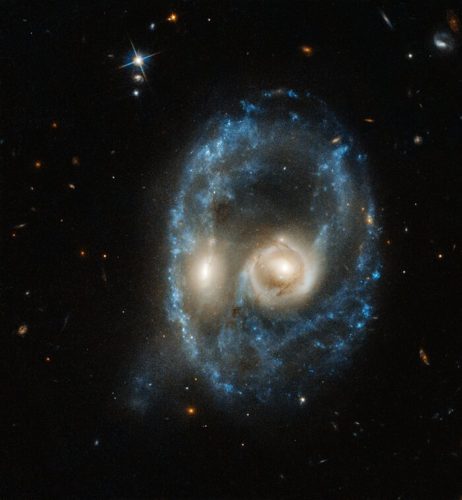
Although galaxy collisions are common — especially in the early universe — most are not head-on impacts like the collision that likely created this Arp-Madore system 704 million light-years from Earth. This violent encounter gives the system an arresting ring structure, but only for a short amount of time. The crash has pulled and stretched the galaxies’ discs of gas, dust, and stars outward, forming the ring of intense star formation that shapes the “nose” and “face” features of the system.
Ring galaxies are rare, and only a few hundred of them reside in our larger cosmic neighbourhood. The galaxies have to collide at just the right orientation so that they interact to create the ring, and before long they will have merged completely, hiding their messy past.
The side-by-side juxtaposition of the two central bulges of stars from the galaxies that we see here is also unusual. Since the bulges that form the “eyes” appear to be the same size, we can be sure that the two galaxies involved in the crash were of equal size. This is different from the more common collisions in which small galaxies are gobbled up by their larger neighbours.
This new image from the NASA/ESA Hubble Space Telescope captures two galaxies of equal size in a collision that appears to resemble a ghostly face. This observation was made on 19 June 2019 in visible light by the telescope’s Advanced Camera for Surveys. Residing 704 million light-years from Earth, this system is catalogued as Arp-Madore 2026-424 (AM 2026-424) in the Arp-Madore “Catalogue of Southern Peculiar Galaxies and Associations”.
** An interview with astronomer and astrophotographer Dylan O’Donnell of Australia:
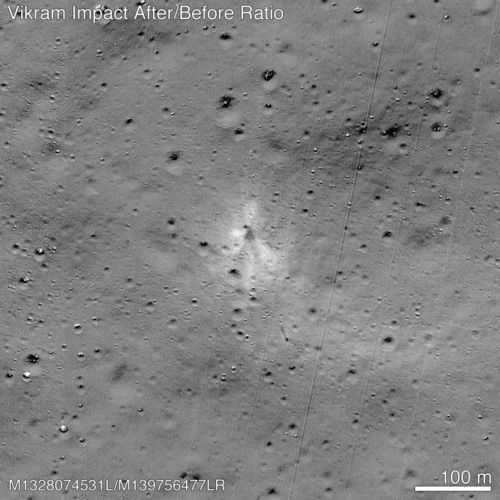
The Chandrayaan 2 Vikram lander was targeted for a highland smooth plain about 600 kilometers from the south pole; unfortunately the Indian Space Research Organisation (ISRO) lost contact with their lander shortly before the scheduled touchdown (Sept. 7 in India, Sept. 6 in the United States). Despite the loss, getting that close to the surface was an amazing achievement. The Lunar Reconnaissance Orbiter Camera team released the first mosaic (acquired Sept. 17) of the site on Sept. 26 and many people have downloaded the mosaic to search for signs of Vikram. Shanmuga Subramanian contacted the LRO project with a positive identification of debris.
After receiving this tip, the LROC team confirmed the identification by comparing before and after images. When the images for the first mosaic were acquired the impact point was poorly illuminated and thus not easily identifiable. Two subsequent image sequences were acquired on Oct. 14 and 15, and Nov. 11. The LROC team scoured the surrounding area in these new mosaics and found the impact site (70.8810°S, 22.7840°E, 834 m elevation) and associated debris field. The November mosaic had the best pixel scale (0.7 meter) and lighting conditions (72° incidence angle).
The debris first located by Shanmuga is about 750 meters northwest of the main crash site and was a single bright pixel identification in that first mosaic (1.3 meter pixels, 84° incidence angle). The November mosaic shows best the impact crater, ray and extensive debris field. The three largest pieces of debris are each about 2×2 pixels and cast a one pixel shadow.
“This before and after image ratio highlights changes to the surface; the impact point is near center of the image and stands out due the dark rays and bright outer halo. Note the dark streak and debris about 100 meters to the SSE of the impact point. Diagonal straight lines are uncorrected background artifacts. Credits: NASA/Goddard/Arizona State University”
** China’s Chang’e-4 lander module and Yutu-2 rover complete their 12th lunar day activities and are now shutting down for the 14 earth-day long lunar night.
China’s lunar rover Yutu-2 has driven 345.059 meters on the far side of the moon to conduct scientific exploration of the virgin territory.
…
Due to the complicated geological environment and the rugged and heavily cratered terrain on the far side of the moon, Chinese space engineers carefully planned the driving routes of the rover to ensure its safety.
Driving slowly but steadily, the Yutu-2 is expected to continue traveling on the moon and make more scientific discoveries, said CNSA.
** The FARSIDE project proposes to place a radio telescope array on the far side of the Moon:
FARSIDE (Farside Array for Radio Science Investigations of the Dark ages and Exoplanets) is a Probe-class concept to place a low radio frequency interferometric array on the farside of the Moon. A NASA-funded design study, focused on the instrument, a deployment rover, the lander and base station, delivered an architecture broadly consistent with the requirements for a Probe mission. This notional architecture consists of 128 dipole antennas deployed across a 10 km area by a rover, and tethered to a base station for central processing, power and data transmission to the Lunar Gateway, or an alternative relay satellite.
Asteroids & Comets
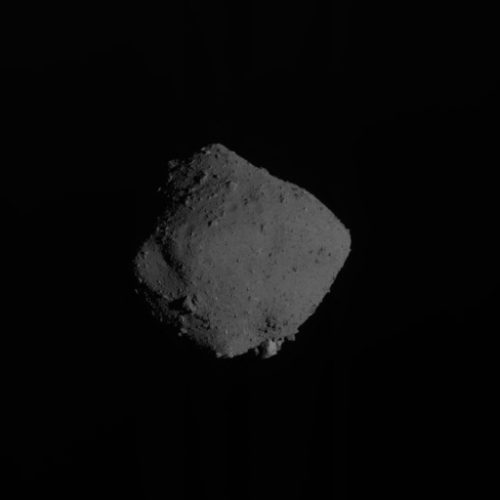
** Japan Hayabusa-2 probe returning with samples of the asteroid Ryugu. A capsule with the samples will reach the Australian Outback in late 2020.
” Asteroid Ryugu captured with the Optical Navigation Camera – Telescopic (ONC-T) immediately after departure. Image time is November 13 10:15 JST (onboard time), 2019. Image credit ※: JAXA, Chiba Institute of Technology, University of Tokyo, Kochi University, Rikkyo University, Nagoya University, Meiji University, University of Aizu, AIST.”
Using data from NASA’s Transiting Exoplanet Survey Satellite (TESS), astronomers at the University of Maryland (UMD), in College Park, Maryland, have captured a clear start-to-finish image sequence of an explosive emission of dust, ice and gases during the close approach of comet 46P/Wirtanen in late 2018. This is the most complete and detailed observation to date of the formation and dissipation of a naturally-occurring comet outburst. The team members reported their results in the November 22 issue of The Astrophysical Journal Letters.
“TESS spends nearly a month at a time imaging one portion of the sky. With no day or night breaks and no atmospheric interference, we have a very uniform, long-duration set of observations,” said Tony Farnham, a research scientist in the UMD Department of Astronomy and the lead author of the research paper. “As comets orbit the Sun, they can pass through TESS’ field of view. Wirtanen was a high priority for us because of its close approach in late 2018, so we decided to use its appearance in the TESS images as a test case to see what we could get out of it. We did so and were very surprised!”
“This animation shows an explosive outburst of dust, ice and gases from comet 46P/Wirtanen that occurred on September 26, 2018 and dissipated over the next 20 days. The images, from NASA’s TESS spacecraft, were taken every three hours during the first three days of the outburst. Credits: Farnham et al./NASA. View enlarged image“
Mars
** A big set of Mars images of interest have been examined Bob Zimmerman at Behind the Black:
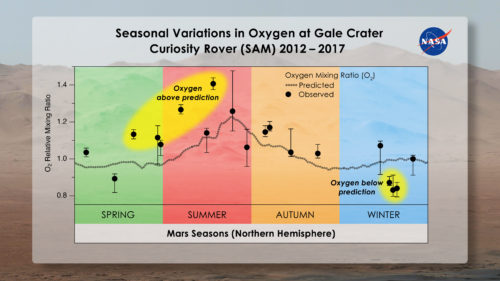
For the first time in the history of space exploration, scientists have measured the seasonal changes in the gases that fill the air directly above the surface of Gale Crater on Mars. As a result, they noticed something baffling: oxygen, the gas many Earth creatures use to breathe, behaves in a way that so far scientists cannot explain through any known chemical processes.
…
Within this environment, scientists found that nitrogen and argon follow a predictable seasonal pattern, waxing and waning in concentration in Gale Crater throughout the year relative to how much CO2 is in the air. They expected oxygen to do the same. But it didn’t. Instead, the amount of the gas in the air rose throughout spring and summer by as much as 30%, and then dropped back to levels predicted by known chemistry in fall. This pattern repeated each spring, though the amount of oxygen added to the atmosphere varied, implying that something was producing it and then taking it away.
“Seasonal Variations in Oxygen at Gale Crater: Graph showing oxygen concentration through Mars seasons. Image credit: Melissa Trainer/Dan Gallagher/NASA Goddard “
The findings from the Mars Exploration Rovers allowed the Mars science community to develop our strategy for Mars exploration beyond “follow the water” to the more complicated question of whether these watery environments were ever habitable. Very loosely defined, a habitable environment is one that has the 2 other essential requirements in addition to liquid water that are needed to support life as we know it: a source of carbon and a source of energy. The Mars Science Laboratory mission’s Curiosity rover, which landed on Mars in 2012, carried a larger and more complicated payload than the Mars Exploration Rovers. Curiosity is capable of finding evidence of all 3 of these requirements. In fact, it has succeeded: within its landing site at Gale crater, Curiosity found ancient river and lake deposits that preserved carbon-containing compounds as well as evidence for water chemistry that could power microbial metabolism. Today, we not only know that Mars was once wet—it was also habitable.
China has performed a hover and hazard avoidance test on a model the country’s first Mars rover, while engineers ready the real spacecraft for launch toward the red planet in mid-2020.
Comprising an orbiter, lander and rover, the mission aims to become the first Chinese spacecraft to reach Mars after lifting off aboard a Long March 5 rocket — the country’s most powerful launcher — during a several week window opening in July 2020.
The mission will launch from the Wenchang space center on Hainan Island, China’s newest spaceport.
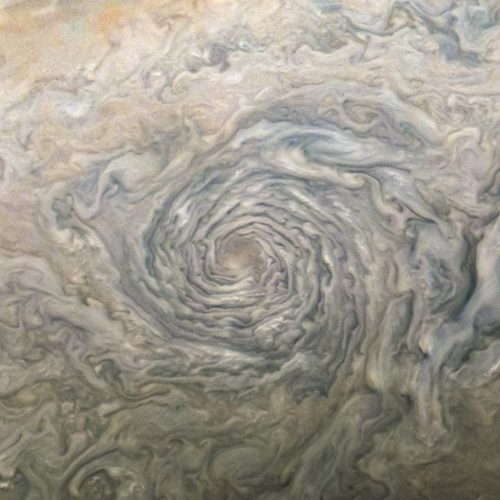
Juno captured this stunningly detailed look at a cyclonic storm in Jupiter’s atmosphere during its 23rd close flyby of the planet (also referred to as “perijove 23”).
Juno observed this vortex in a region of Jupiter called the “north north north north temperate belt,” or NNNNTB, one of the gas giant planet’s many persistent cloud bands. These bands are formed by the prevailing winds at different latitudes. The vortex seen here is roughly 1,200 miles (2,000 kilometers) wide.
Jupiter is composed mostly of hydrogen and helium, but some of the color in its clouds may come from plumes of sulfur and phosphorus-containing gases rising from the planet’s warmer interior.
Citizen scientist Kevin M. Gill created this image using data from the spacecraft’s JunoCam imager. It was taken on Nov. 3, 2019, at 2:08 p.m. PST (5:08 p.m. EST). At the time, the spacecraft was about 5,300 miles (8,500 kilometers) from Jupiter’s cloud tops above a latitude of about 49 degrees.
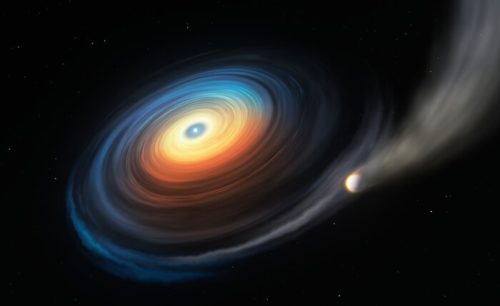
This illustration shows the white dwarf WDJ0914+1914 and its Neptune-like exoplanet. Since the icy giant orbits the hot white dwarf at close range, the extreme ultraviolet radiation from the star strips away the planet’s atmosphere. While most of this stripped gas escapes, some of it swirls into a disc, itself accreting onto the white dwarf.
Researchers using ESO’s Very Large Telescope [VLT] have, for the first time, found evidence of a giant planet associated with a white dwarf star. The planet orbits the hot white dwarf, the remnant of a Sun-like star, at close range, causing its atmosphere to be stripped away and form a disc of gas around the star. This unique system hints at what our own Solar System might look like in the distant future.
“It was one of those chance discoveries,”
says researcher Boris Gänsicke, from the University of Warwick in the UK, who led the study, published today in Nature.
The team had inspected around 7000 white dwarfs observed by the Sloan Digital Sky Survey and found one to be unlike any other. By analysing subtle variations in the light from the star, they found traces of chemical elements in amounts that scientists had never before observed at a white dwarf.
“We knew that there had to be something exceptional going on in this system, and speculated that it may be related to some type of planetary remnant.”
To get a better idea of the properties of this unusual star, named WDJ0914+1914, the team analysed it with the X-shooter instrument on ESO’s Very Large Telescope in the Chilean Atacama Desert. These follow-up observations confirmed the presence of hydrogen, oxygen and sulphur associated with the white dwarf. By studying the fine details in the spectra taken by ESO’s X-shooter, the team discovered that these elements were in a disc of gas swirling into the white dwarf, and not coming from the star itself.
“It took a few weeks of very hard thinking to figure out that the only way to make such a disc is the evaporation of a giant planet,”
says Matthias Schreiber from the University of Valparaiso in Chile, who computed the past and future evolution of this system.
The detected amounts of hydrogen, oxygen and sulphur are similar to those found in the deep atmospheric layers of icy, giant planets like Neptune and Uranus. If such a planet were orbiting close to a hot white dwarf, the extreme ultraviolet radiation from the star would strip away its outer layers and some of this stripped gas would swirl into a disc, itself accreting onto the white dwarf. This is what scientists think they are seeing around WDJ0914+1914: the first evaporating planet orbiting a white dwarf.
Combining observational data with theoretical models, the team of astronomers from the UK, Chile and Germany were able to paint a clearer image of this unique system. The white dwarf is small and, at a blistering 28 000 degrees Celsius (five times the Sun’s temperature), extremely hot. By contrast, the planet is icy and large—at least twice as large as the star. Since it orbits the hot white dwarf at close range, making its way around it in just 10 days, the high-energy photons from the star are gradually blowing away the planet’s atmosphere. Most of the gas escapes, but some is pulled into a disc swirling into the star at a rate of 3000 tonnes per second. It is this disc that makes the otherwise hidden Neptune-like planet visible.
“This is the first time we can measure the amounts of gases like oxygen and sulphur in the disc, which provides clues to the composition of exoplanet atmospheres,”
says Odette Toloza from the University of Warwick, who developed a model for the disc of gas surrounding the white dwarf.
“The discovery also opens up a new window into the final fate of planetary systems,”
adds Gänsicke.
Stars like our Sun burn hydrogen in their cores for most of their lives. Once they run out of this fuel, they puff up into red giants, becoming hundreds of times larger and engulfing nearby planets. In the case of the Solar System, this will include Mercury, Venus, and even Earth, which will all be consumed by the red-giant Sun in about 5 billion years. Eventually, Sun-like stars lose their outer layers, leaving behind only a burnt-out core, a white dwarf. Such stellar remnants can still host planets, and many of these star systems are thought to exist in our galaxy. However, until now, scientists had never found evidence of a surviving giant planet around a white dwarf. The detection of an exoplanet in orbit around WDJ0914+1914, located about 1500 light years away in the constellation of Cancer, may be the first of many orbiting such stars.
According to the researchers, the exoplanet now found with the help of ESO’s X-shooter orbits the white dwarf at a distance of only 10 million kilometres, or 15 times the solar radius, which would have been deep inside the red giant. The unusual position of the planet implies that at some point after the host star became a white dwarf, the planet moved closer to it. The astronomers believe that this new orbit could be the result of gravitational interactions with other planets in the system, meaning that more than one planet may have survived its host star’s violent transition.
“Until recently, very few astronomers paused to ponder the fate of planets orbiting dying stars. This discovery of a planet orbiting closely around a burnt-out stellar core forcefully demonstrates that the Universe is time and again challenging our minds to step beyond our established ideas,”
concludes Gänsicke.
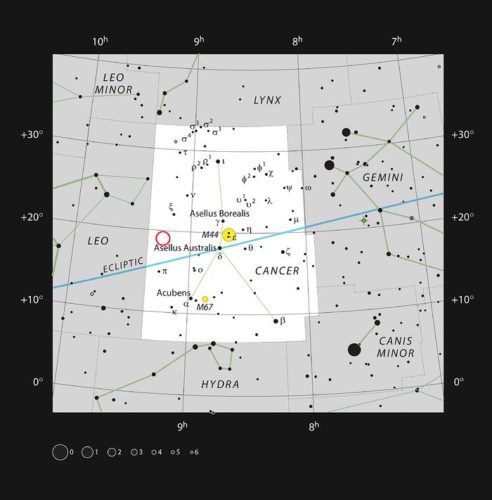
This chart shows the location of WDJ0914+1914 in the constellation of Cancer (The Crab). This map shows most of the stars visible to the unaided eye under good conditions, and WDJ0914+1914 itself is highlighted with a red circle on the image. This white dwarf is orbited by a Neptune-like exoplanet that is evaporating, the first ever giant planet found around a white dwarf.
A sampling of recent articles, videos, and images dealing with space transport (find previous roundups here):
[ Update Dec.4: Launch postponed due to high winds:
Standing down today due to upper altitude winds and high winds at sea creating dynamic conditions around the Of Course I Still Love You droneship – next launch opportunity is tomorrow at 12:29 p.m. EST, 17:29 UTC
1:30 p.m. Tuesday, Dec. 3 – NASA Social, What’s on Board science briefing highlighting research taking place on CRS-19
4 p.m. Tuesday, Dec. 3 – Prelaunch news conference from Kennedy with representatives from the International Space Station Program Science Office, SpaceX and the U.S. Air Force 45th Space Wing
In short, the ~350-km-downrange landing plan suggests that this Cargo Dragon launch may have a much smaller propellant margin than essentially every similar mission preceding it. This could be explained in a few ways. Maybe after Falcon 9 B1050’s surprise landing failure, SpaceX decided that all new Falcon 9 boosters will attempt drone ship landings after their first flight, minimizing the risk to Cape Canaveral in the event of a CRS-16 repeat. Another possibility, Crew Dragon capsule C205 – scheduled to support the spacecraft’s In-Flight Abort (IFA) test late this month or early next – may still be close to the Cape’s Landing Zones, another reason to avoid even the slightest chance of a catastrophic Falcon landing failure.
After [CRFS-19], SpaceX should return to the launch pad in the middle of the month for its next launch, which will send the JCSAT 18/Kacific 1 communications satellite into space. This commercial mission is currently slated for no earlier than December 15, also from Space Launch Complex-40 at Cape Canaveral Air Force Station in Florida. If the flight occurs on time, it will require a relatively quick turnaround at the launch pad.
On top of that, there are potentially two more missions before the end of the year—although the schedule for each may slip into January. SpaceX has not yet announced a launch date for the In-Flight Abort test of its Crew Dragon spacecraft, a dramatic test as part of NASA’s Commercial Crew Program that will see the Dragon pull rapidly away from the rocket. SpaceX employees are still working toward a launch by the end of December for the test.
SpaceX also may launch its third batch of 60 Starlink satellites into low-Earth orbit before the end of this month, although the company has not announced an official launch date for this mission either.
The launch of Boeing’s uncrewed Orbital Flight Test to the International Space Station, as part of NASA’s Commercial Crew Program, now is targeted for 6:59 a.m. EST Thursday, Dec. 19. NASA, Boeing and United Launch Alliance (ULA) agreed to target the new date to allow ULA sufficient time to resolve an issue with the rocket’s purge air supply. Boeing’s CST-100 Starliner spacecraft will launch atop a ULA Atlas V rocket from Space Launch Complex 41 at Cape Canaveral Air Force Station in Florida.
** Scott Manley reviews Chinese launcher systems:
China is now the number one nation in terms of rocket launches, with most of its launchers tracing their design heritage back to the Dong Feng 5 ICBM. This includes the Long March 2, 3 & 4 – all propelled by YF-20 family Engines burning UDMH & NTO The Newer Long March 5,6 &7 all use new cryogenic propulsion systems. Long March 11 is a solid rocket based system.
** Update on the Rocket Lab Electron launch that was postponed from last week:
Work on the Stage 2 umbilical that caused us to stand down from last week’s launch is nearing completion, however poor weather conditions are driving a launch attempt no earlier than 07:56 UTC, Friday 6 Dec. Stay tuned for updates as we continue to assess weather this week.
**Leo Aerospace is developing a high-altitude balloon Launch System: The goal is to offer low cost orbital and suborbital launch services. In addition, the platform can be used for long-loiter high-altitude applications.
Leo Aerospace Regulus high altitude balloon launch system.
Regulus Orbital is Leo Aerospace’s premier high-altitude orbital launch platform. A fully and rapidly reusable craft, Regulus requires minimal refurbishment over lifetime operations. Autonomous flight control provides optimized flight capabilities in a range of weather and mission envelopes. Additionally, its on-board, autonomous, command and control infrastructure continuously assesses system health. Regulus is equipped with a rotational control system, comprised of a series of bipropellant thrusters. This system is capable of controlling the entire platform’s yaw and roll profiles. Regulus Orbital is designed for a typical mission of placing 25 kg to 550 km sun-synchronous orbit but can service a range of missions with payload capacity up to 57 kg with no fixed ground infrastructure.
** Update on construction of second SpaceShipTwo from Virgin Galactic:
Watch our team install the Main Oxidiser Tank into the next spaceship in our fleet. The MOT forms part of the structure, connecting the forward and aft part of the spaceship. This holds the oxidiser for the rocket motor which powers the spaceship to space https://t.co/6CHRILJGbFpic.twitter.com/RTYPiQfd6T
However, Michael Sheetz of CNBC reports that the Florida Starship activities are paused rather than ended:
SpaceX has not recently laid off employees, telling me that it gave those working on Starship in Florida the choice of either continuing work in Texas or supporting other SpaceX activities in Florida. A few temporary employees decided to leave instead.
A check around SpaceX Boca Chica – December 2, 2019 Features: Ongoing site preparation, more deliveries and Big Yellow gets dismantled. Footage and photos from Mary (@bocachicagal) for NSF.
LabPadre – Dec.3.2019:
It appears that SpaceX is breaking ground for their new launch control center here at Boca Chica, Texas. Fast paced progress ahead for the push of MK-3. Video Credit: Maria Pointer
A sampling of links to recent space policy, politics, and government (US and international) related space news and resource items that I found of interest (find previous space policy roundups here):
Harriet Brettle is a business analyst at Astroscale, a commercial space company dedicated to cleaning up orbital debris. Her journey into the Space industry began when, as a young girl, her dad let her down easy: being a witch was not a viable career option. But she could get excited about the planets, sciences and math, which is just what she did. Discover how Harriet went from graduating from university with a degree in mathematics, to a career in finance, to Outreach Coordinator of the Planetary Society, to that fateful day when she landed a major role as part of the Astroscale team. Harriet’s story will make you laugh, feel inspired, and most importantly, remember to never doubt yourself. Space needs Harriet. And space needs you.
The annual Canadian Space Summit was an opportunity for stakeholders to get together to learn the latest from their colleagues and in the case of this years conference, the public unveiling of a new government conceived SatCom consortium.
In this weeks SpaceQ podcast we’re doing something a little different. In this episode I’m going to fly solo and provide a recap of the conference.






 ”
”