Space policy roundup

A look at budget issues for space in the coming fiscal year: What To Watch For In The 2014 Budget – The Planetary Society

—

Another Congressional hearing on the threats to earth from asteroids and comets: Next week: “Threats from Space,” the sequel – Space Politics

—

Some of the legal issues involved in space settlements: Space settlement and future of space law – Babak Shakouri/The Space Review.

—

The latest Res Communis collection of space and aviation law, regulation and policy links: Library: A Round-up of Reading.

Mar orbiter images Curiosity parachute flapping in the wind

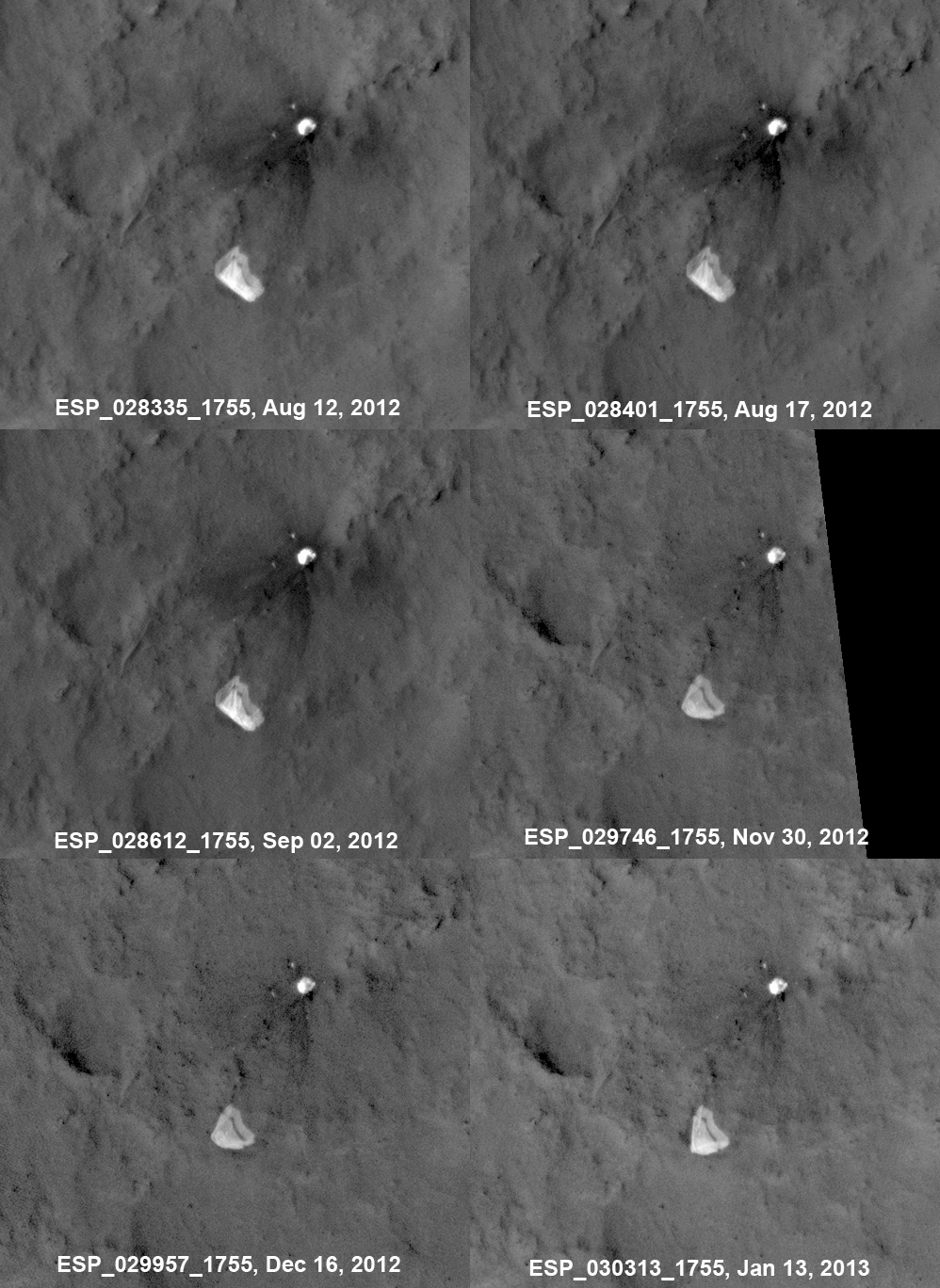
The Mars Reconnaissance Orbiter spots the parachute used to bring the Curiosity rover onto the Red Planet surface:

Mars Science Laboratory: Used Parachute On Mars Flaps In The Wind
PIA16813-br

Curiosity’s Parachute Flapping in the Wind
This sequence of seven images from the High Resolution Imaging Science Experiment  (HiRISE) camera on NASA’s Mars Reconnaissance Orbiter shows wind-caused changes in the parachute of NASA’s Mars Science Laboratory spacecraft as the chute lay on the Martian ground during months after its use in safe landing of the Curiosity rover.

PASADENA, Calif. – Photos from NASA’s Mars Reconnaissance Orbiter show how the parachute that helped NASA’s Curiosity rover land on Mars last summer has subsequently changed its shape on the ground.

The images were obtained by the High Resolution Imaging Science Experiment (HiRISE) camera on Mars Reconnaissance Orbiter.

Seven images taken by HiRISE between Aug. 12, 2012, and Jan. 13, 2013, show the used parachute shifting its shape at least twice in response to wind.

The images in the sequence of photos are available online at http://uahirise.org/releases/msl-chute.php and at http://photojournal.jpl.nasa.gov/catalog/PIA16813 .

Researchers have used HiRISE to study many types of changes on Mars. Its first image of Curiosity’s parachute, not included in this series, caught the spacecraft suspended from the chute during descent through the Martian atmosphere.

HiRISE is operated by the University of Arizona, Tucson. The instrument was built by Ball Aerospace & Technologies Corp., Boulder, Colo. The Mars Reconnaissance Orbiter Project and Curiosity are managed by NASA’s Jet Propulsion Laboratory, Pasadena, Calif., for NASA’s Science Mission Directorate, Washington. JPL is a division of the California Institute of Technology in Pasadena.

For more information about the Mars Reconnaissance Orbiter, which has been studying Mars from orbit since 2006, visit http://www.nasa.gov/mro .

Sci-Tech: MIT study finds promise in Ion Wind propulsion

An MIT study finds the so-called ion wind technique, something hobbyists and students have been experimenting with for many years, might offer a practical propulsion system if it can be scaled up: A mighty wind: Thrusters powered by ionic wind may be an efficient alternative to conventional atmospheric propulsion technologies. – MIT News


Copenhagen Suborbitals: Sapphire rocket update

Copenhagen Suborbitals posts a video about their Sapphire rocket project. From the video caption:

Copenhagen Suborbitals is just weeks away from our first actively guided rocket flight. The Sapphire rocket has a liftoff mass of 200 kg, and stands six meters tall. Its nitrous oxide / polyurethane HATV type hybrid, controlled by servo operated copper jet vanes in the rocket jet. These powerful motors have a flawless record.

The instrumentation and payload is now passing parachute separation tests – and the two test performed confirmed our expectations for the parachute system.

The purpose of Copenhagen Suborbitals is to launch a human into space. You can god to space with a passive stable finn only rocket – but the initial acceleration needed to stay on course is too high for humans to endure. Therefore CS must master active guidance.

The fist and last purpose of the Sapphire mission is to test active guidance.

Everyone can participate in space