Space sciences roundup – Oct.19.2020

A sampling of recent articles, videos, and images from space-related science news items (find previous roundups here):

** Asteroids and Comets

** OSIRIS-REx set to touch down briefly on Bennu – The Long Arm of NASA: The OSIRIS-REx Spacecraft Gets Ready To Grab An Asteroid Sample – IEEE Spectrum

Sixteen years after NASA’s OSIRIS-REx mission was first proposed and two years after the robotic spacecraft went into orbit around asteroid 101955 Bennu, mission team members are now counting down to the moment when it will descend to the surface, grab a sample—and then get out of there before anything can go wrong.

The sampling is set for next Tuesday, Oct. 20. If it works, it will be a first for the United States. (A Japanese probe is currently returning to Earth with samples from asteroid 162173 Ryugu.)

Though the mission plan has so far been executed almost flawlessly, an outsider might be forgiven for thinking there’s something a bit…well, counterintuitive about it. The spacecraft has no landing legs, because it will never actually land. Instead, the OSIRIS-REx spacecraft vaguely resembles an insect with a long snout—a honeybee, perhaps, hovering over a flower to pollinate it. The “snout” is actually an articulated arm with a 30.5 cm round collection chamber at the end. It’s called TAGSAM – short for Touch-And-Go Sample Acquisition Mechanism. You’ve doubtless heard the old expression, “I wouldn’t touch that with a 10-foot pole.” The TAGSAM arm is an 11-foot pole.

** Watch the event on NASA TV: Update: NASA to Broadcast OSIRIS-REx Activities | NASA

** A discussion of the OSIRIS-REx mission: NASA EZScience

The OSIRIS-REx spacecraft is scheduled to touch down on the asteroid Bennu on October 20, 2020, for its first sample collection attempt. To kick off the second season of #EZScience, NASA associate administrator for science Dr. Thomas Zurbuchen and National Air and Space Museum director Dr. Ellen Stofan discuss this exciting and innovative mission to return samples from an asteroid to Earth and the scientific opportunities it opens up.

** An interview with an OSIRIS REx mission scientist: Hotel Mars – John Batchelor Show/The Space Show – Dr. Harold C. Connolly talked about

…the OSIRIS REx mission to asteroid Bennu and the sample return from Bennu. We discussed landing at the Nightingale landing site on Bennu and why, the actual quantity of material being collected for sample return, material changes on the way back to Earth, instrumentation operational status, asteroid ejecta, Bennu collisions with asteroid material, Vesta rocks on Bennu, the expectation of finding organic prebiotic compounds in the sample and more.

** A simulation of the sampling maneuver using the SpaceMissionstm app from BINARY SPACE (see posting here):

This video shows a simulation of the NASA probe OSIRIS-REx’s sample collection on Asteroid Bennu planned for October 20, 2020:

00:00 Approach Burn
00:09 Solar Panels folding back

00:23 Samples Collection Arm Deployment
01:06 Samples Collection
02:21 Samples Weighting
03:42 Storing Samples in Return Container
06:04 Solar Panels unfolding

06:15 Approach Trajectory

The above mentioned application is a 3D solar system and space missions simulator available in the Microsoft® Store: https://www.microsoft.com/store/apps/…

More about OSIRIS-REx and Bennu:

** Amateur astronomer spots a big NEO: Planetary Society Grant Winner Discovers Large Near-Earth Asteroid – The Planetary Society

An amateur astronomer has discovered a kilometer-wide asteroid that would create global devastation if it were to hit the Earth. Thankfully that won’t happen: the asteroid will miss our planet by 40 million kilometers as it passes on 10 September 2020, more than 100 times the distance between Earth and the Moon. But the fact that this relatively large near-Earth object, or NEO, wasn’t detected until now serves as a reminder that there’s much work to be done when it comes to defending our planet from dangerous asteroids.

Amateur astronomer Leonardo Amaral discovered the asteroid at the Campo dos Amarais observatory in Brazil. The Planetary Society in 2019 awarded Amaral an $8,500 grant to purchase a more stable telescope mount for better tracking and longer camera exposures. The Society’s Shoemaker NEO Grant program funds advanced amateur astronomers around the world who find, track, and characterize potentially dangerous space rocks. Much of this work follows up on asteroids discovered by large-scale sky surveys, providing observations crucial to orbit determination or asteroid characterization.

** A sizable and previously unknown asteroid recently passed by close by the Earth: School Bus-Size Asteroid to Safely Zoom Past Earth | NASA

Roughly 15 to 30 feet wide, the object will make its closest approach on Sept. 24.

A small near-Earth asteroid (or NEA) will briefly visit Earth’s neighborhood on Thursday, Sept. 24, zooming past at a distance of about 13,000 miles (22,000 kilometers) above our planet’s surface. The asteroid will make its close approach below the ring of geostationary satellites orbiting about 22,000 miles (36,000 kilometers) away from Earth.

Based on its brightness, scientists estimate that 2020 SW is roughly 15 to 30 feet (5 to 10 meters) wide – or about the size of a small school bus. Although it’s not on an impact trajectory with Earth, if it were, the space rock would almost certainly break up high in the atmosphere, becoming a bright meteor known as a fireball.

Venus

** Discovery of phosphine in the clouds of Venus ignites speculation that it is produced by microbial life. However, there are inorganic processes that could produce it as well. Possible Marker of Life Spotted on Venus | ESO

An international team of astronomers today announced the discovery of a rare molecule — phosphine — in the clouds of Venus. On Earth, this gas is only made industrially or by microbes that thrive in oxygen-free environments. Astronomers have speculated for decades that high clouds on Venus could offer a home for microbes — floating free of the scorching surface but needing to tolerate very high acidity. The detection of phosphine could point to such extra-terrestrial “aerial” life.

“When we got the first hints of phosphine in Venus’s spectrum, it was a shock!”, says team leader Jane Greaves of Cardiff University in the UK, who first spotted signs of phosphine in observations from the James Clerk Maxwell Telescope (JCMT), operated by the East Asian Observatory, in Hawaiʻi. Confirming their discovery required using 45 antennas of the Atacama Large Millimeter/submillimeter Array (ALMA) in Chile, a more sensitive telescope in which the European Southern Observatory (ESO) is a partner. Both facilities observed Venus at a wavelength of about 1 millimetre, much longer than the human eye can see — only telescopes at high altitude can detect it effectively. 

The international team, which includes researchers from the UK, US and Japan, estimates that phosphine exists in Venus’s clouds at a small concentration, only about twenty molecules in every billion. Following their observations, they ran calculations to see whether these amounts could come from natural non-biological processes on the planet. Some ideas included sunlight, minerals blown upwards from the surface, volcanoes, or lightning, but none of these could make anywhere near enough of it. These non-biological sources were found to make at most one ten thousandth of the amount of phosphine that the telescopes saw.

To create the observed quantity of phosphine (which consists of hydrogen and phosphorus) on Venus, terrestrial organisms would only need to work at about 10% of their maximum productivity, according to the team. Earth bacteria are known to make phosphine: they take up phosphate from minerals or biological material, add hydrogen, and ultimately expel phosphine. Any organisms on Venus will probably be very different to their Earth cousins, but they too could be the source of phosphine in the atmosphere.

More about the discovery:

This finding greatly increases scientific and public interest in Venus, which has been visited by spacecraft far less often than Mars. The Venusian surface is a hell-scape with an atmospheric pressure over 90 times that of earth and temperatures close to 500 degrees Celsius. So the bare surface and thin atmosphere of Mars make it seem benign in comparison. However, there is the possibility of human habitats floating atop the thick Venusian atmosphere, though there would the challenge of dealing with the sulfuric acid present at such altitudes. Venus is similar to Earth in terms of gravity and so for human visitors it has at least this one advantage over the Red Planet, where gravity is about a third that of Earth’s.

** Interview with a member of the team that found evidence of phosphine in the Venusian clouds:

Could life exist elsewhere in the Solar System? Astronomers have announced the presence of phosphine in the clouds of Venus, which could be evidence of microbial life around the hellish planet. Dr Emily Drabek-Maunder, one of the astronomers behind the discovery, reveals how they did it, and why we need a new mission to explore Venus.

** BepiColombo spacecraft flies by Venus to adjust its orbit closer to Mercury, the target of its mission: BepiColombo flies by Venus en route to Mercury – ESA

The ESA-JAXA BepiColombo mission has completed the first of two Venus flybys needed to set it on course with the Solar System’s innermost planet, Mercury.

The closest approach of the flyby took place at 03:58 GMT (05:58 CEST) this morning at a distance of about 10 720 km from the planet’s surface.

The Venus flyby offered an opportunity to test the science instruments on the spacecraft and to investigate the cloudy planet:

Seven of the eleven science instruments onboard the European Mercury Planetary Orbiter, plus its radiation monitor, and three of five onboard the Japanese Mercury Magnetospheric Orbiter were active during the flyby. While the suite of sensors are designed to study the rocky, atmosphere-free environment at Mercury, the flyby offered a unique opportunity to collect valuable science data at Venus.
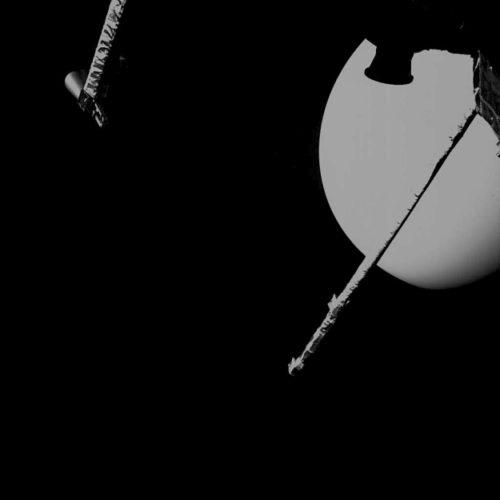
BepiColombo returns images of Venus during close approach. Credits: ESA

** The Parker Solar Probe flew by Venus, taking advantage of the planet’s gravity to adjust its orbit as well: Parker Solar Probe Speeds toward Record-Setting Close Approach to the Sun – Parker Solar Probe – Sept.25.2020

This weekend’s perihelion was set up by the probe’s third Venus flyby. On July 11, the spacecraft came within 518 miles above Venus’ surface — much lower than the previous two flybys but still well above Venus’ atmosphere — putting it on a path that brings it 3.25 million miles closer to the Sun than the last perihelion, on June 7. Mission Design and Navigation Manager Yanping Guo of APL noted that the gravity assist provided the mission’s largest orbital speed reduction since launch, trimming the spacecraft’s velocity by 8,438 miles per hour (13,579 kilometers per hour).

More at:

Mars

Continue reading Space sciences roundup – Oct.19.2020 →

Space policy roundup – Oct.19.2020

A sampling of links to recent space policy, politics, and government (US and international) related space news and resource items that I found of interest (find previous space policy roundups here):

International space

Webcasts:

** Episode 25 Update on The Artemis Accords – Space Thoughts/Michael Listner, Space Law & Policy Solutions

The full text of the Artemis Accords can be accessed here: https://www.nasa.gov/specials/artemis-accords/img/Artemis-Accords-signed-13Oct2020.pdf

** Webinar Replay | Space Traffic Management: Why Commerce, Why Now, What’s Next – SpaceNews

In August, the National Academy of Public Administration (NAPA) published a report requested by Congress that affirmed the decision in Space Policy Directive 3 to give space traffic management responsibilities to the Commerce Department’s Office of Space Commerce. Former NASA Administrator Sean O’Keefe, who served on the NAPA panel that produced the report, and Office of Space Commerce Director Kevin O’Connell talk with SpaceNews about the report’s conclusions and what’s next in the effort to improve civil space traffic management.

Speakers:

    • Kevin O’Connell Office of Space Commerce director, U.S. Commerce Department
    • Sean O’Keefe Former NASA administrator and university professor at Syracuse University’s Maxwell School of Citizen and Public Affairs
    • MODERATOR Jeff Foust SpaceNews senior staff writer

** NASA and International Partners Sign Artemis Accords – NASA

On October 13, 2020, NASA and international partners from Australia, Canada, Italy, Japan, Luxembourg, the United Arab Emirates and the United Kingdom signed the Artemis Accords agreements for international participation in the agency’s Artemis program, during a virtual meeting of the International Astronautical Congress. While NASA is leading the Artemis program, international partnerships will play a key role in achieving a sustainable and robust presence on the Moon while preparing to conduct a historic human mission to Mars. International cooperation on Artemis will bolster space exploration and enhance peaceful relationships between nations. The Artemis Accords will also reinforce the principles of the Outer Space Treaty.

More: [NASA, International Partners Advance Cooperation with Artemis Accords | NASA]

** The Space Show – Tuesday Oct.13.2020 – Gary Oleson discussed his Space News Op-Ed, A critical mission for human spaceflight: a quest for value, published on August 18, 2020.

** Wednesday Oct. 14.2020 – Hotel Mars – Joint John Batchelor Show/The Space Show production – John Batchelor and Dr. David Livingston spoke with CBS News space reporter William Harwood about “the leak on the ISS that has yet to be repaired plus the last Soyuz flight to the ISS carrying an American Astronaut and the record breaking time it took to get to the ISS which was about 3 hours 4 minutes“.

** Friday Oct.16, 2020 – The Space Show – Dr. Deana Weibel talked about her article, The Overview Effect and the Ultraview Effect: How Extreme Experiences in/of Outer Space Influence Religious Beliefs in Astronauts, and related topics.

** Debating the Weaponization of Space (with Mick Gleason and Robin Dickey) – Aerospace Corp – Center for Space Policy & Strategy (CSPS)

** #SpaceWatchGL Column: Dongfang China Aerospace News Roundup 12-18 Oct 2020 – SpaceWatch.Global

** Engaging the Artemis Generation: A Virtual Q&A with Astronaut Michael Barratt plus Congresswoman Herrera Beutler and Administrator Jim Bridenstine – NASA

** NS-13 Full Interview With NASA Administrator Jim Bridenstine – Blue Origin

NASA Administrator Jim Bridenstine joined the New Shepard NS-13 webcast to talk about a key experiment on board, the Deorbit, Descent, and Landing Sensor Demonstration with NASA’s Space Technology Mission Directorate under a Tipping Point partnership.

** NASA Space Communications and Navigation Program’s Move to Commercial Communications Services – NASA

To support the early space program, then our continuous human presence in low Earth orbit (LEO), NASA had, literally, to build all communications infrastructure from the ground up. Now we’re looking to transition our missions to commercial services by 2030.

** 2020 Mars Society Virtual Convention – Day 4 Morning Plenaries – Mars Society

Our four-day event is free, and brings together prominent scientists, policymakers, entrepreneurs and space advocates to discuss the significance of the latest scientific discoveries, technological advances and political-economic-social developments that could affect plans for the human exploration and settlement of Mars. As always, the convention will involve a wide variety of timely plenary talks, panel discussions and public debates concerning key issues bearing on human Mars exploration.

** October 13, 2020 Zimmerman/Batchelor podcast

** October 16, 2020 Zimmerman/Batchelor podcast

====

=== Amazon Ad ===

Space Is Open for Business:
The Industry That Can Transform Humanity

The Space Show this week – Oct.19.2020

The guests and topics of discussion on The Space Show this week:

1. Monday, Oct. 19, 2020; 7 pm PDT (9 pm CDT, 10 pm EDT: No program today.

2. Tuesday, Oct. 20, 2020; 7 pm PDT (9 pm CDT, 10 pm EDT): We welcome Amanda Dreeschler and Michael Livingston to discuss their Covid lockdown special film, We Can’t Go On. For details see the upcoming show menu and the blog.

3. Wednesday, Oct. 21, 2020: Hotel Mars TBA pre-recorded. See upcoming show menu on the home page for program details.

4. Thursday, Oct. 22, 2020; 7-8:30 pm PDT (9-10:30 pm CDT, 10-11:30 pm EDT): No program today.

5. Friday, Oct.23, 2020; 9:30-11 am PDT (11:30 am-1 pm CDT, 12:30-2 pm EDT): We welcome back Tory Bruno, CEO of United Launch Alliance (ULA).

6. Sunday, Oct.25, 2020; 12-1:30 pm PDT (3-4:30 pm EDT, 2-3:30 pm CDT): Dr. Erik Seedhouse returns to share his latest books and news with us.

Some recent shows:

** Tuesday Oct.13.2020 – Gary Oleson discussed his Space News Op-Ed, A critical mission for human spaceflight: a quest for value, published on August 18, 2020.

** Wednesday Oct. 14.2020 – Hotel Mars – Joint John Batchelor Show/The Space Show production – John Batchelor and Dr. David Livingston spoke with CBS News space reporter William Harwood about “the leak on the ISS that has yet to be repaired plus the last Soyuz flight to the ISS carrying an American Astronaut and the record breaking time it took to get to the ISS which was about 3 hours 4 minutes“.

** Friday Oct.16, 2020 – The Space Show – Dr. Deana Weibel talked about her article, The Overview Effect and the Ultraview Effect: How Extreme Experiences in/of Outer Space Influence Religious Beliefs in Astronauts, and related topics.

** Sunday Oct.18.2020 – The Space Show – Dr. Jay Pasachoff, chair of the Astronomy Department at Williams College, talked about “art and science, eclipses, sunspots, climate change, comets and more“.

** See also:
* The Space Show Archives
* The Space Show Newsletter
* The Space Show Shop

The Space Show is a project of the One Giant Leap Foundation.

The Space Show - David Livingston
The Space Show – Dr. David Livingston

=== Amazon Ad ===

Xtronaut:
The Game of Solar System Exploration

Videos: “Space to Ground” + Other ISS reports – Oct.16.2020

Here is the latest episode in NASA’s Space to Ground weekly report on activities related to the International Space Station:

** Down to Earth – A Perfect Planet – NASA Johnson – YouTube

In this episode of Down to Earth, NASA Astronaut Andrew Morgan speaks about his spacewalk experiences, and discusses the importance of caring for our home planet. #SpaceStation20th

** Kate Rubins: Science on the Space Station – NASA Johnson – YouTube

Kate Rubins is both a scientist and a NASA astronaut. There is no better place to be than the International Space Station for someone with those two occupations. In this video, Kate explains how the space station is the perfect place to conduct research. Free from Earth’s gravity, the orbiting laboratory offers endless opportunities for discovery!

** Expedition 63 Inflight with the Department of Health and Human Services – October 16, 2020 – NASA

Aboard the International Space Station, Expedition 63 Commander Chris Cassidy and Flight Engineer Kate Rubins of NASA discussed research on the orbital outpost during an in-flight event Oct. 16 with representatives from the Department of Health and Human Services and the President’s Council on Sports, Fitness and Nutrition. Cassidy is in the final week of his six-and-a-half month mission on the station while Rubins arrived on the station Oct. 14 for her second six-month mission.

** Expedition 64 Crew Docks to Station to Begin Six-Month Mission – NASA

The Expedition 64 crew has arrived at the station’s Rassvet module docking at 4:48 a.m. EDT inside the Soyuz MS-17 crew ship. More… https://blogs.nasa.gov/spacestation/2…

** Hatches Open, Station Crew Expands to Six – NASA

The space station crew expanded to six people today when the Soyuz crew ship hatch opened at 7:07 a.m. EDT just a few hours after the Expedition 64 crew launched from Kazakhstan. More… https://blogs.nasa.gov/spacestation/2…

** Space Station Special | Podcasts | Naked Scientists

To celebrate 20 years of people living on the International Space Station, we feature only ISS astronauts in this special edition of Space Boffins. NASA Astronaut Nicole Stott joins Richard Hollingham and Sue Nelson and we revisit interviews with Chris Hadfield, Cady Coleman, Scott Kelly, Sergei Krikalev, Luca Parmitano and Michael Foale. Conversations range from space walking to space toilets, science to watercolour painting in space and the future of the ISS. What other podcast on the planet gives you seven astronauts in an hour?

=== Amazon Ads ===

Outpost in Orbit:
A Pictorial & Verbal History of the Space Station

======

LEGO Ideas International Space Station Building Kit,
Adult Set for Display,
Makes a Great Birthday Present
(864 Pieces)

Space transport roundup – Oct.14.2020

A sampling of recent articles, videos, and images dealing with space transport (find previous roundups here):

** A Soyuz launched a new ISS crew early this morning US time and the spacecraft reached the ISS just three hours later. A few hours later the crew, including NASA astronaut Kate Rubins, and cosmonauts Sergey Ryzhikov (Soyuz commander) and Sergey Kud-Sverchkov (flight engineer), entered the station. They expand the ISS contingent to a total of six.

** Blue Origin flew a New Shepard vehicle on Tuesday Oct. 13th above 100 km for the 13th time, the 7th time for this particular vehicle. The flight had been postponed several times from the original target date of September 24th by a series of weather and technical issues. New Shepard Successfully Completes Mission with NASA Precision Lunar Landing Technology Onboard – Blue Origin

There were 12 payloads onboard including the Deorbit, Descent, and Landing Sensor Demonstration under the NASA Tipping Point partnership. The lunar landing sensor demo was the first payload to be mounted on the exterior of a New Shepard booster and tested technology designed to achieve high accuracy landing. This will enable long-term lunar exploration, as well as future Mars missions.

“Today’s flight was inspiring. Using New Shepard to simulate landing on the Moon is an exciting precursor to what the Artemis program will bring to America,” said Bob Smith, CEO, Blue Origin. “Thanks to NASA for partnering with us, and congrats to the Blue Origin team on taking another step toward returning to the Moon to stay.”

As indicated by the press release, the company focused  on the dozen scientific and technology payloads tested during the flight, particularly the NASA lunar landing systems placed on the outside of the booster. NASA and the other payload owners paid for their rides in a commercial fee-for-service framework. This was not a NASA funded mission. For more info about the payloads, see New Shepard Mission NS-13 Launch Updates – Blue Origin.

This was the first flight of 2020. The 12th New Shepard launch took place last December. There was little info during the webcast regarding an increase in the flight rate or when flights with people on board will happen.

Liftoff is at around 37:16 into this replay of the mission webcast:

This video highlights the NASA funded technology tested during the flight:

On Tuesday, October 13, 2020, Blue Origin launched mission NS-13 to space and back. On this flight, New Shepard flew 12 commercial payloads, including the Deorbit, Descent, and Landing Sensor Demonstration with NASA’s Space Technology Mission Directorate under a Tipping Point partnership. This was the first payload to fly mounted on the exterior of a New Shepard booster, opening the door to a wide range of future high-altitude sensing, sampling, and exposure payloads.

See also:

** Northrop Grumman Cygnus cargo vessel berthed to the ISS following launch on an Antares rocket from Wallops Island on October 2nd: Northrop Grumman Successfully Launches 14th Cargo Delivery Mission to the International Space Station | Northrop Grumman

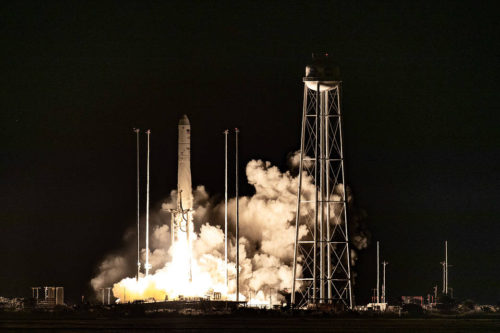
“A Northrop Grumman Antares rocket, with the company’s Cygnus spacecraft aboard, launches at 9:16 p.m. EDT, Friday, Oct. 2, 2020, from the Mid Atlantic Regional Spaceport’s Pad-0A, at NASA’s Wallops Flight Facility in Virginia. Northrop Grumman’s 14th contracted cargo resupply mission for NASA to the International Space Station is carrying nearly 8,000 pounds of science and research, crew supplies, and vehicle hardware to the orbital laboratory and its crew. On Monday, Oct. 5, Cygnus was successfully berthed to the space station.” Image Credit: NASA/Terry Zaperach

The Cygnus arrived at the station October 5th and successfully berthed soon after:

Northrop Grumman Corporation’s (NYSE: NOC) Cygnus spacecraft was successfully captured by Commander Chris Cassidy of NASA using the International Space Station’s robotic Canadarm2 at 5:32 a.m. EDT [Oct.5th] after its launch on the company’s Antares rocket on Oct. 2 from Wallops Island.

The S.S. Kalpana Chawla executed a series of thruster burns during its three day journey to the station. Once Cygnus was in close range, crew members grappled the spacecraft with the station’s robotic arm. Cygnus was then guided to its berthing port on the Earth facing side of the station’s Unity module and officially installed to the space station at 8:01 a.m. EDT.

…

Cygnus will remain berthed to the International Space Station for approximately three months while more than 8,000 pounds of cargo is unloaded and astronauts reload the vehicle with disposal cargo. Cygnus will then undock and complete its secondary mission of hosting both the Northrop Grumman-built SharkSat payload and the Saffire-V experiment. The SharkSat prototype payload is mounted to Cygnus and will collect performance data of new technologies in low Earth orbit. To learn more about these payloads, visit Northrop Grumman’s website.

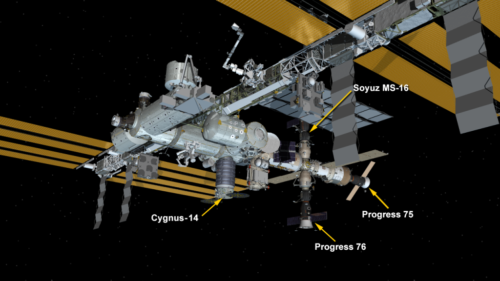
“Oct. 5, 2020: International Space Station Configuration. Four spaceships are docked to the space station including Russia’s Progress 75 and 76 resupply ships and Soyuz MS-16 crew ship and Northrop Grumman’s Cygnus-14 resupply ship.” Credits: NASA

** Virgin Orbit update: Here is a video about Virgin Orbit‘s progress towards a second test flight of the LauncherOne:

The company is trying to raise a couple hundred million dollars to sustain itself until it reaches operational status: Richard Branson’s Virgin Orbit Seeks $1 Billion Valuation in Fundraising – WSJ.

** ExoTerra Resource to develop a solar electric powered upper stage for Virgin Orbit’s LauncherOne rocket. The stage will enable payloads to reach GEO and lunar orbits and beyond. ExoTerra to develop upper stage for Virgin Orbit LauncherOne – SpaceNews

With ExoTerra’s Solar Electric Propulsion Upper Stage, LauncherOne customers could reach destinations including geostationary orbit, trans-lunar injection orbit, Earth-Moon Lagrange points and low lunar orbit, according to the ExoTerra news release.

“This win allows ExoTerra to begin development of an upper stage that will deliver up to 150 kilograms of payload to the moon,” according to the news release. The upper stage also could transport 180-kilogram payloads to geostationary orbit, the release added.

** Rocket Lab is also aiming for destinations beyond low earth orbit: #SpaceWatchGL Interviews – Peter Beck of Rocket Lab: “I don’t have 50 or 60 years to wait” – SpaceWatch.Global

Rocket Lab belongs to the top private launcher companies globally. With 14 launches and 55 deployed satellites, the company is one of the most vibrant actors in the space launcher market. SpaceWatch.Global Editor-in-Chief Markus Payer got the chance to talk to Peter Beck, Founder and CEO of Rocket Lab, to discuss Rocket Lab’s ambitions to go to Venus, its strategy, vertical integration and fundamental questions of humanity.

New Zealand is proud of the country’s rocket company: ‘Most successful startup since SpaceX’ – Americans hail Rocket Lab – NZ Herald.

** Firefly takes a big step towards first Alpha launch as booster passes final certification test firings:

** Relativity Space advances 3D printing of large structures: Inside Relativity Space HQ: 3D printer rocket ‘factory of the future’ – CNBC

Relativity is currently building the first iteration of its Terran 1 rocket. But unlike other rockets, Relativity is using multiple 3D-printers, all developed in-house, to build Terran 1. The rocket is designed to have about 95% of its parts be 3D-printed, which allows Relativity’s rocket to be less complex, and faster to build or modify, than traditional rockets. Additionally, Relativity says its simpler process will eventually be capable of turning raw material into a rocket on the launchpad in under 60 days.

While Relativity had made progress testing its 3D-printing technology, the company’s 120,000 square foot headquarters will serve as the foundation for its manufacturing and launch business. Relativity is now on its third generation of 3D-printers, capable of manufacturing a single piece of metal up to 32 feet tall – as high as the new ceiling allows.

The first launch is targeted for late 2021. They are aiming for a price of $12M per flight.

** China launches another Gaofen observation satellite on a Long March-3B rocket. Liftoff was from the Xichang Satellite Launch Center in southwest China:

** A review of commercial launch in China: The English language podcast Dongfang Hour focuses on Chinese aerospace and technology. Here is a two-part program about the development and status of commercial launch industry in China:

**** China’s Long March to Commercial Launch

This week, we discussed the history of China’s commercial launch industry, and commercial space industry more generally. This included:

00:00 – Introduction 04:47 – The 1980s and the Origins of Chinese Commercial Launch
13:19 – From Encouraging Growth experience to a shift after multiple failures by Chinese launch vehicles: the 1990s
21:17 – Post-2000 China in the ITAR Export Control Environment
36:14 – Residual Deals between China and Western Countries: ITAR-Free Products and Services
39:38 – Digging Into China’s Family of Long March Rockets
43:06 – The future of Chinese commercial launch, including discussion on the plethora of commercial companies entering the market

**** What’s the Situation with Chinese Private Launch Startups ?

Last time we left off at the dawn of China’s private launch era. Having discussed the major state-owned companies and their respective rockets, we will now shift our attention to the plethora of privately-owned launch companies entering the Chinese market today. On today’s episode, we will discuss: Who are China’s private launcher companies, and what type of rockets are they building? What is the relationship between state-owned and privately-owned launcher companies in China? Who do the private launcher companies hope to sell their services to? What are some of the similarities and differences between Chinese private launcher companies and their western counterparts? The episode timestamps can be found below:

00:53 – Introduction
03:01 – Historical perspective
04:31 – Why has China allowed private companies to enter the launch industry?
09:51 – Two generations of private launch companies
17:03 – The founding teams
22:34 – Strong ties with provincial governments
25:00 – Propulsion technology and reusability
34:56 – Comparing Private and state-owned launch vehicles
37:55 – Is there enough market demand to sustain so many launch companies?
45:29 – Implication of Chinese tech companies in space

Continue reading Space transport roundup – Oct.14.2020 →

Everyone can participate in space