A couple of items from the Juno mission at Jupiter:
NASA Juno Findings – Jupiter’s Jet-Streams Are Unearthly
Data collected by NASA’s Juno mission to Jupiter indicate that the atmospheric winds of the gas-giant planet run deep into its atmosphere and last longer than similar atmospheric processes found here on Earth. The findings will improve understanding of Jupiter’s interior structure, core mass and, eventually, its origin.
Other Juno science results released today include that the massive cyclones that surround Jupiter’s north and south poles are enduring atmospheric features and unlike anything else encountered in our solar system. The findings are part of a four-article collection on Juno science results being published in the March 8 edition of the journal Nature.
“These astonishing science results are yet another example of Jupiter’s curve balls, and a testimony to the value of exploring the unknown from a new perspective with next-generation instruments. Juno’s unique orbit and evolutionary high-precision radio science and infrared technologies enabled these paradigm-shifting discoveries,” said Scott Bolton, principal investigator of Juno from the Southwest Research Institute, San Antonio. “Juno is only about one third the way through its primary mission, and already we are seeing the beginnings of a new Jupiter.”
The depth to which the roots of Jupiter’s famous zones and belts extend has been a mystery for decades. Gravity measurements collected by Juno during its close flybys of the planet have now provided an answer.
“Juno’s measurement of Jupiter’s gravity field indicates a north-south asymmetry, similar to the asymmetry observed in its zones and belts,” said Luciano Iess, Juno co-investigator from Sapienza University of Rome, and lead author on a Nature paper on Jupiter’s gravity field.
On a gas planet, such an asymmetry can only come from flows deep within the planet; and on Jupiter, the visible eastward and westward jet streams are likewise asymmetric north and south. The deeper the jets, the more mass they contain, leading to a stronger signal expressed in the gravity field. Thus, the magnitude of the asymmetry in gravity determines how deep the jet streams extend.
“Galileo viewed the stripes on Jupiter more than 400 years ago,” said Yohai Kaspi, Juno co-investigator from the Weizmann Institute of Science, Rehovot, Israel, and lead author of a Nature paper on Jupiter’s deep weather layer. “Until now, we only had a superficial understanding of them and have been able to relate these stripes to cloud features along Jupiter’s jets. Now, following the Juno gravity measurements, we know how deep the jets extend and what their structure is beneath the visible clouds. It’s like going from a 2-D picture to a 3-D version in high definition.”
The result was a surprise for the Juno science team because it indicated that the weather layer of Jupiter was more massive, extending much deeper than previously expected. The Jovian weather layer, from its very top to a depth of 1,900 miles (3,000 kilometers), contains about one percent of Jupiter’s mass (about 3 Earth masses).
“By contrast, Earth’s atmosphere is less than one millionth of the total mass of Earth,” said Kaspi “The fact that Jupiter has such a massive region rotating in separate east-west bands is definitely a surprise.”
The finding is important for understanding the nature and possible mechanisms driving these strong jet streams. In addition, the gravity signature of the jets is entangled with the gravity signal of Jupiter’s core.
Another Juno result released today suggests that beneath the weather layer, the planet rotates nearly as a rigid body.
“This is really an amazing result, and future measurements by Juno will help us understand how the transition works between the weather layer and the rigid body below,” said Tristan Guillot, a Juno co-investigator from the Université Côte d’Azur, Nice, France, and lead author of the paper on Jupiter’s deep interior. “Juno’s discovery has implications for other worlds in our solar system and beyond. Our results imply that the outer differentially-rotating region should be at least three times deeper in Saturn and shallower in massive giant planets and brown dwarf stars.”
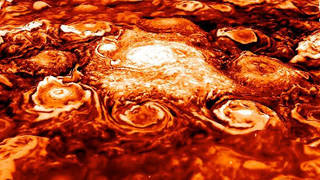
A truly striking result released in the Nature papers is the beautiful new imagery of Jupiter’s poles captured by Juno’s Jovian Infrared Auroral Mapper (JIRAM) instrument. Imaging in the infrared part of the spectrum, JIRAM captures images of light emerging from deep inside Jupiter equally well, night or day. JIRAM probes the weather layer down to 30 to 45 miles (50 to 70 kilometers) below Jupiter’s cloud tops.
“Prior to Juno we did not know what the weather was like near Jupiter’s poles. Now, we have been able to observe the polar weather up-close every two months,” said Alberto Adriani, Juno co-investigator from the Institute for Space Astrophysics and Planetology, Rome, and lead author of the paper. “Each one of the northern cyclones is almost as wide as the distance between Naples, Italy and New York City — and the southern ones are even larger than that. They have very violent winds, reaching, in some cases, speeds as great as 220 mph (350 kph). Finally, and perhaps most remarkably, they are very close together and enduring. There is nothing else like it that we know of in the solar system.”
Jupiter’s poles are a stark contrast to the more familiar orange and white belts and zones encircling the planet at lower latitudes. Its north pole is dominated by a central cyclone surrounded by eight circumpolar cyclones with diameters ranging from 2,500 to 2,900 miles (4,000 to 4,600 kilometers) across. Jupiter’s south pole also contains a central cyclone, but it is surrounded by five cyclones with diameters ranging from 3,500 to 4,300 miles (5,600 to 7,000 kilometers) in diameter. Almost all the polar cyclones, at both poles, are so densely packed that their spiral arms come in contact with adjacent cyclones. However, as tightly spaced as the cyclones are, they have remained distinct, with individual morphologies over the seven months of observations detailed in the paper.
“The question is, why do they not merge?” said Adriani. “We know with Cassini data that Saturn has a single cyclonic vortex at each pole. We are beginning to realize that not all gas giants are created equal.”
Abstracts of the March 8 Juno papers can be found online:
- The measurement of Jupiter’s asymmetric gravity field: http://nature.com/articles/doi:10.1038/nature25776
- Jupiter’s atmospheric jet-streams extending thousands of kilometers deep: http://nature.com/articles/doi:10.1038/nature25793
- A suppression of differential rotation in Jupiter’s deep interior: http://nature.com/articles/doi:10.1038/nature25775
- Clusters of Cyclones Encircling Jupiter’s Poles: http://nature.com/articles/doi:10.1038/nature25491
To date, Juno has completed 10 science passes over Jupiter and logged almost 122 million miles (200 million kilometers), since entering Jupiter’s orbit on July 4, 2016. Juno’s 11th science pass will be on April 1.
Juno launched on Aug. 5, 2011, from Cape Canaveral, Florida. During its mission of exploration, Juno soars low over the planet’s cloud tops — as close as about 2,200 miles (3,500 kilometers). During these flybys, Juno is probing beneath the obscuring cloud cover of Jupiter and studying its auroras to learn more about the planet’s origins, structure, weather layer and magnetosphere.
NASA’s Jet Propulsion Laboratory, Pasadena, California, manages the Juno mission for the principal investigator, Scott Bolton, of the Southwest Research Institute in San Antonio. Juno is part of NASA’s New Frontiers Program, which is managed at NASA’s Marshall Space Flight Center in Huntsville, Alabama, for NASA’s Science Mission Directorate. The Italian Space Agency (ASI), contributed two instruments, a Ka-band frequency translator (KaT) and the Jovian Infrared Auroral Mapper (JIRAM). Lockheed Martin Space, Denver, built the spacecraft.
The public can follow the mission on Facebook and Twitter at:
More information on Jupiter can be found at: https://www.nasa.gov/jupiter
===
Another beautiful view of Jupiter created by a citizen scientist:
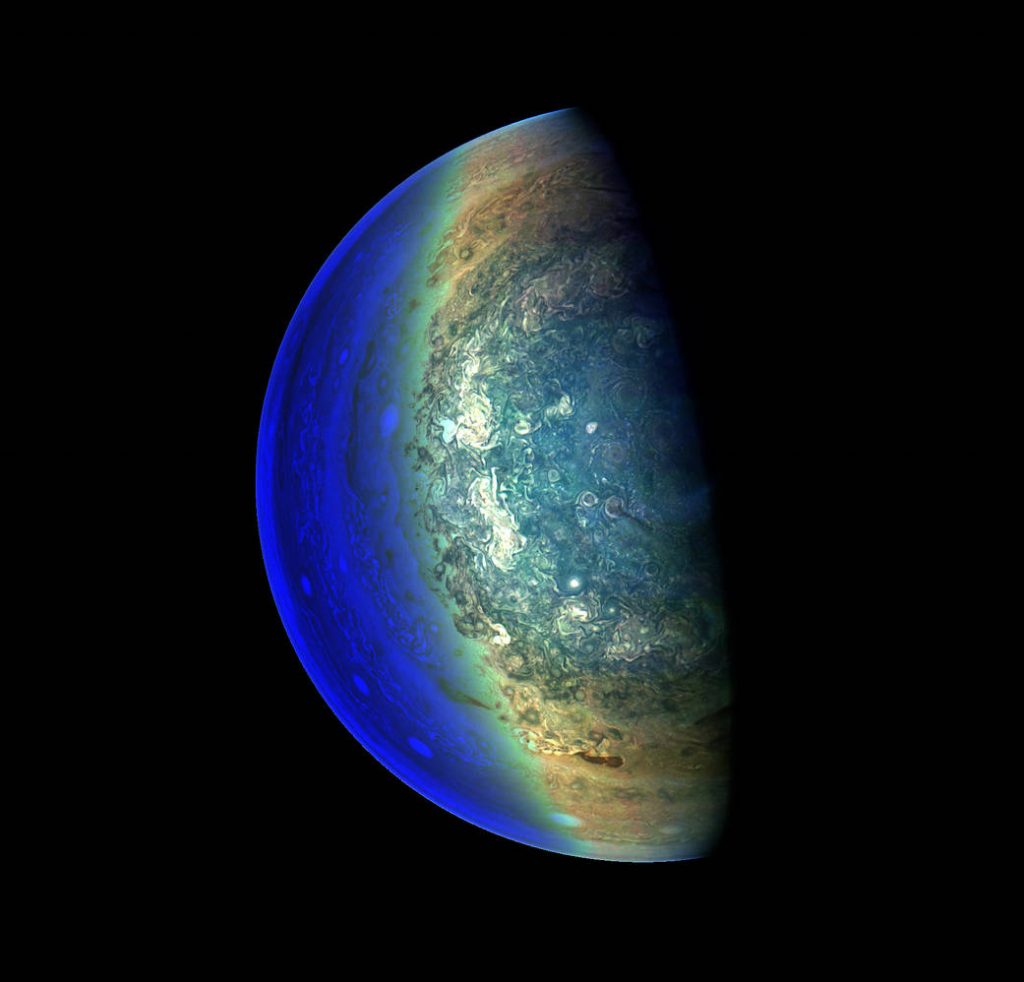
This image captures the swirling cloud formations around the south pole of Jupiter, looking up toward the equatorial region.
NASA’s Juno spacecraft took the color-enhanced image during its eleventh close flyby of the gas giant planet on Feb. 7 at 7:11 a.m. PST (10:11 a.m. EST). At the time, the spacecraft was 74,896 miles (120,533 kilometers) from the tops of Jupiter’s clouds at 84.9 degrees south latitude.
Citizen scientist Gerald Eichstädt processed this image using data from the JunoCam imager. This image was created by reprocessing raw JunoCam data using trajectory and pointing data from the spacecraft. This image is one in a series of images taken in an experiment to capture the best results for illuminated parts of Jupiter’s polar region.
To make features more visible in Jupiter’s terminator — the region where day meets night — the Juno team adjusted JunoCam so that it would perform like a portrait photographer taking multiple photos at different exposures, hoping to capture one image with the intended light balance. For JunoCam to collect enough light to reveal features in Jupiter’s dark twilight zone, the much brighter illuminated day-side of Jupiter becomes overexposed with the higher exposure.
JunoCam’s raw images are available for the public to peruse and process into image products at:
www.missionjuno.swri.edu/junocam
More information about Juno is at:
https://www.nasa.gov/juno and http://missionjuno.swri.edu
Image credits: NASA/JPL-Caltech/SwRI/MSSS/Gerald Eichstädt
====