NASA declares winners in annual Moonbuggy races held in Huntsville

NASA held its latest NASA Rover Challenge in Huntsville, Alabama on Friday and Saturday:

Academy of Arts, Careers and Technology in Reno, Nev., and University of Puerto Rico
at Humacao Win Top Honors at First NASA Human Exploration Rover Challenge

NASA today declared the winners of the first NASA Human Exploration Rover Challenge, held April 11-12 at the U.S. Space & Rocket Center in Huntsville, Ala. Student racers from the Academy of Arts, Careers and Technology in Reno, Nev., claimed first place in the high school division; the University of Puerto Rico at Humacao Team 2 won the top prize in the college division.

team4_0fd0612First place, college race: University of Puerto Rico at Humacao, Team 2.
Image Credit: NASA/MSFC/Fred Deaton

They raced to victory against 70 high school, college and university teams from 19 states, Puerto Rico, Germany, India, Mexico and Russia. All told, more than 500 students — drivers, engineers and mechanics, plus team advisers and “cheering sections” — took part in the competition.

The winning teams posted the fastest vehicle assembly and race times in their divisions, with the fewest on-course penalties. The team from the Academy of Arts, Careers and Technology finished the half-mile course in 3 minutes, 37 seconds. The University of Puerto Rico at Humacao Team 2 finished in 4 minutes, 9 seconds. In addition to the winning trophy, first-place teams received a cash prize of $3,000, courtesy of The Boeing Co. of Huntsville.
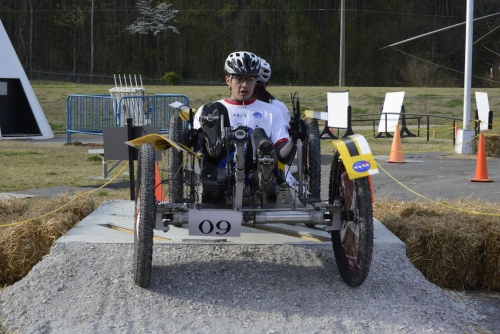
team9_0fd0644First place, high school race: Academy of Arts, Careers & Tech, Reno, Nev.
Image Credit: NASA/MSFC/Fred Deaton

Finishing in second place in the high school division was Team 2 from the Vocational High School Teodoro Aguilar Mora in Yabucoa, Puerto Rico. In third place was the International Space Education Institute team from Moscow, Russia. Southern Illinois University Carbondale Team 2 won second place in the college division and Team 1 from the school finished in third place. (For a complete list of additional awards for design, most improved and spirit, see below.)

Organized by NASA’s Marshall Space Flight Center in Huntsville and building on two decades of competitive student innovation in the NASA Great Moonbuggy Race (held in the “Rocket City” from 1994-2013), the new event challenges students to design, build and race lightweight, human-powered roving vehicles, solving technical problems along the way just like NASA engineers must do.

Those NASA engineers are paying attention: Students’ most innovative vehicle and hardware designs could help inform NASA’s own development of rovers and other space transportation systems for future exploration missions across the solar system.


Video streaming by Ustream
One of several videos from the event.

Just as importantly, the experience is designed to provide the future workforce to realize those new missions, inspiring students to pursue careers in the technical “STEM” fields — science, technology, engineering and mathematics — so crucial to the agency’s endeavors.

The NASA Human Exploration Rover Challenge is sponsored by the Human Exploration and Operations Mission Directorate at NASA Headquarters in Washington, and organized by the Marshall Center’s Academic Affairs Office. Major corporate sponsors for the race are The Boeing Co., Lockheed Martin Corp., Aerojet Rocketdyne, Jacobs Engineering ESSSA Group, and Northrop Grumman Corp., all with operations in Huntsville.

Full replays of the race will be available in coming days on the Marshall Center’s official UStream site, where Marshall Center media personnel and television crews provided continuous, streaming coverage of the event: http://www.ustream.tv/channel/nasa-msfc

For more information about the race, visit: www.nasa.gov/roverchallenge

Race enthusiasts are encouraged to follow the annual event via social media channels:  www.facebook.com/roverchallenge and www.twitter.com/roverchallenge

For information about other NASA education programs, visit: http://education.nasa.gov

—-

Continue to list of award winners.

AMSAT, student and space radio news – April.13.14

Go to AMSAT News for the latest headlines about developments in amateur and student satellites and for updates about amateur radio on the ISS.

ANS 103 Weekly AMSAT Bulletin – April 12, 2014:
* March/April 2014 AMSAT Journal is Ready
* NASA, SpaceX Officials Continue Preparations for 14 April Launch
* KickSat CubeSat to Deploy Smallest Earth-Orbiting Satellites
* AMSAT at the Dayton Hamvention – 2nd call for volunteers
* N8PK appears with students in YouTube video
* ISS HamTV moves to 2369 MHz
* FUNcube/AO-73 Transponder plans for the future
* Upcoming AMSAT Events
* ARISS News
* Satellite Shorts From All Over

===

More AMSAT/student sat news:

Space policy roundup – April.13.14

More space policy/politics related links:

Webcasts:

Dr. Clay Moltz, Friday, 4-11-14 – Thespaceshow’s Blog – Dr. Moltz talked about his new book, Crowded Orbits: Conflict and Cooperation in Space,

Dr. Moltz told us why he wrote the book which was to address orbital crowding, possible conflict in space and to bring these issues and others to the attention of the general public as space impacts everyone everyday.  A major topic for our discussion was space debris.  Using this field as an example, Dr. Moltz  made a very strong case for rules of the road, space traffic control issues, and responsible behavior by both governments and the private sector.  We talked about entrepreneurs and private groups resisting a more regulated environment and he made the case for the need for cooperation to avoid conflicts.  


Sci-Tech: Update on General Fusion

The Canadian General Fusion project, whose investors include Jeff Bezos of Amazon.com fame,  is aiming to start building a working prototype of their innovative fusion power system this year:

On their website it says,

In the next phase of development, General Fusion will be constructing a full scale prototype system.  The prototype will be designed for single pulse testing, demonstrating full net energy gain on each pulse, a world first.

Here’s a video showing a schematic of their design:

Contests: Name Cassini’s final phase + The 2014 Mars Society poster winner

The Planetary Society opens a new contest to provide a cool name for the orbital gymnastics the Cassini spacecraft will do in the final phase of its mission at Saturn : Help name the last phase of the Cassini mission! – The Planetary Society

The name “proximal orbits” is a Vulcan-sounding phrase, all logic and science. But getting this science is going to take navigational bravery of which Captain Kirk would be proud. To help the public understand just how cool this part of the mission is going to be, the Cassini team is asking the public to learn about Cassini’s final phase and then weigh in on a name for the final phase that has more punch to it. You can either cast a vote for one of the team’s suggestions, or write in your own.

Meanwhile, the Mars Society selects a winner of its poster contest:

Winner of 2014 Mars Society Poster Contest Announced 

The Mars Society is pleased to announce that the winner of the 2014 Mars Society Poster Contest is Scott Porter, a Ph.D. student studying architecture at the University of Strathclyde in Glasgow, Scotland. Each participant (12 in total) in this year’s competition was required to submit a poster design that best represented the theme – ‘Blazing the Path to Mars’ – for the 17th Annual International Mars Society Convention, to be held August 7-10 in League City, Texas (just outside Houston).

In addition, the Mars Society would like to express its appreciation to the second and third place winners – Jamie Polancic and Miguel Cooper (respectively). The organization would also like to recognize two additional artists for honorable mention – Katarina Eriksson Marka and Joseph Sweeney.

To view the winning poster as a PDF document, please click here.