Kepler space telescope finds first earth-size planet in habitable zone

An announcement from the NASA Kepler mission:

NASA’s Kepler Telescope Discovers First
Earth-Size Planet in ‘Habitable Zone’

Using NASA’s Kepler Space Telescope, astronomers have discovered the first Earth-size planet orbiting a star in the “habitable zone” — the range of distance from a star where liquid water might pool on the surface of an orbiting planet. The discovery of Kepler-186f confirms that planets the size of Earth exist in the habitable zone of stars other than our sun.
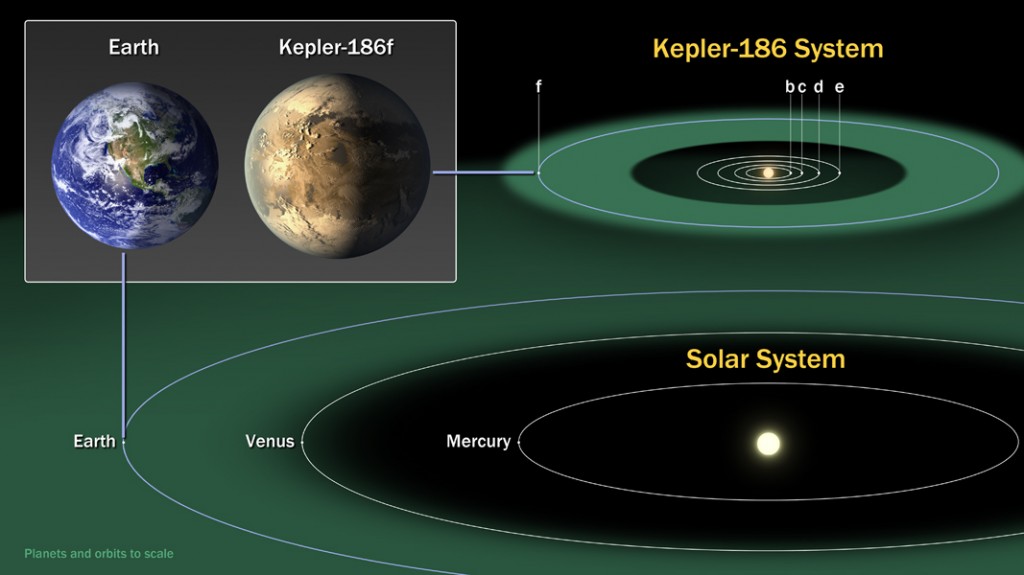
PIA18000_ip

The diagram compares the planets of our inner solar system to Kepler-186,
a five-planet star system about 500 light-years from Earth in the constellation
Cygnus. Image credit: NASA Ames/SETI Institute/JPL-Caltech

› Full image and caption

While planets have previously been found in the habitable zone, they are all at least 40 percent larger in size than Earth, and understanding their makeup is challenging. Kepler-186f is more reminiscent of Earth.

“The discovery of Kepler-186f is a significant step toward finding worlds like our planet Earth,” said Paul Hertz, NASA’s Astrophysics Division director at the agency’s headquarters in Washington. “Future NASA missions, like the Transiting Exoplanet Survey Satellite and the James Webb Space Telescope, will discover the nearest rocky exoplanets and determine their composition and atmospheric conditions, continuing humankind’s quest to find truly Earth-like worlds.”

pia17999-640The artistic concept of Kepler-186f is the result of scientists and artists
collaborating to imagine the appearance of these distant worlds.
 › Full image and caption
Image credit: NASA Ames/SETI Institute/JPL-Caltech

Although the size of Kepler-186f is known, its mass and composition are not. Previous research, however, suggests that a planet the size of Kepler-186f is likely to be rocky.

“We know of just one planet where life exists — Earth. When we search for life outside our solar system, we focus on finding planets with characteristics that mimic that of Earth,” said Elisa Quintana, research scientist at the SETI Institute at NASA’s Ames Research Center in Moffett Field, Calif., and lead author of the paper published today in the journal Science. “Finding a habitable zone planet comparable to Earth in size is a major step forward.”

Kepler-186f resides in the Kepler-186 system, about 500 light-years from Earth in the constellation Cygnus. The system is also home to four companion planets, which orbit a star half the size and mass of our sun. The star is classified as an M dwarf, or red dwarf, a class of stars that makes up 70 percent of the stars in the Milky Way galaxy.

“M dwarfs are the most numerous stars,” said Quintana. “The first signs of other life in the galaxy may well come from planets orbiting an M dwarf.”

Kepler-186f orbits its star once every 130 days and receives one-third the energy from its star that Earth gets from the sun, placing it nearer the outer edge of the habitable zone. On the surface of Kepler-186f, the brightness of its star at high noon is only as bright as our sun appears to us about an hour before sunset.

“Being in the habitable zone does not mean we know this planet is habitable. The temperature on the planet is strongly dependent on what kind of atmosphere the planet has,” said Thomas Barclay, research scientist at the Bay Area Environmental Research Institute at Ames, and co-author of the paper. “Kepler-186f can be thought of as an Earth-cousin rather than an Earth-twin. It has many properties that resemble Earth.”

The four companion planets, Kepler-186b, Kepler-186c, Kepler-186d and Kepler-186e, whiz around their sun every four, seven, 13 and 22 days, respectively, making them too hot for life as we know it. These four inner planets all measure less than 1.5 times the size of Earth.

The next steps in the search for distant life include looking for true Earth-twins — Earth-size planets orbiting within the habitable zone of a sun-like star — and measuring their chemical compositions. The Kepler Space Telescope, which simultaneously and continuously measured the brightness of more than 150,000 stars, is NASA’s first mission capable of detecting Earth-size planets around stars like our sun.

Ames is responsible for Kepler’s ground system development, mission operations, and science data analysis. NASA’s Jet Propulsion Laboratory in Pasadena, Calif., managed Kepler mission development. Ball Aerospace & Technologies Corp. in Boulder, Colo., developed the Kepler flight system and supports mission operations with the Laboratory for Atmospheric and Space Physics at the University of Colorado in Boulder. The Space Telescope Science Institute in Baltimore archives, hosts and distributes Kepler science data. Kepler is NASA’s 10th Discovery Mission and was funded by the agency’s Science Mission Directorate.

The SETI Institute is a private, nonprofit organization dedicated to scientific research, education and public outreach. The mission of the SETI Institute is to explore, understand and explain the origin, nature and prevalence of life in the universe.

For more information about the Kepler mission, visit: http://www.nasa.gov/kepler

===

Here’s an animation of the Kepler 186 system:

Update May.3.14: Here is another video about Kepler 186f plus two other small planets in the habitable zones of their planets:
The Space Project: More info + Two songs

Here’s an article about the Space Project  album mentioned here earlier: The Sounds of Space, in Indie Music – Science Friday

And here are two of the songs on the album:

Webcasts: NASA LADEE, JP Aerospace, Virgin Galactic, Neil deGrasse Tyson, and more

Here’s sampling of recent space audio webcasts of interest:

John Batchelor Hotel Mars, Wednesday, 4-16-14 | Thespaceshow’s Blog –

Dr. Haym Benaroya from Rutgers University […] discussed the NASA LADEE mission, lunar dust issues, the lunar surface, the importance our astronauts returning to the Moon and the Lunar Dust Experiment which so far has proven to be inconclusive regarding the questions it was to solve. Dr. Benaroya went over the toxic and corrosive nature of lunar dust to both humans and equipment, had similar things to say about Martian dust, and talked about how important it is for us to go back to the Moon.

John Powell, Tuesday, 4-15-14 | Thespaceshow’s Blog

John Powell of JP Aerospace gave an update on their airship programs, PongSats, Airship to Orbit (ATO) project, and more.

*  Planetary Radio Live at Yuri’s Night—Under Space Shuttle Endeavour | The Planetary Society 

We’re back at the California Science Center, final home of Endeavour, the shuttle that made 25 flights into space. Join the party as we celebrate the 53rd anniversary of humanity’s transition to spacefaring species with Yuri’s Night Executive Director Loretta Hidalgo Whitesides, Virgin Galactic CEO and Yuri’s Night co-founder George Whitesides, and astronaut Ron Garan, who heads Fragile Oasis. You’ll also get a Curiosity update from Emily Lakdawalla, and we’ll find out what happened this week in space history with Bruce Betts.

Cosmic Queries: A Stellar Sampling | StarTalk Radio Show by Neil deGrasse Tyson

This episode is bursting with conspiracy theories and strange hypotheses, but that doesn’t stop your own personal astrophysicist Neil deGrasse Tyson from dropping some serious science. You’ll learn why the government isn’t secretly using HAARP to manipulate weather and why we shouldn’t dispose of pollution in our atmosphere. Find out where black holes go when they die, why there is no speed of dark, what would happen to the planets if we moved the Sun, the difference between black holes and white holes, and whether we could use quantum teleportation to explore inside a black hole. Neil also explains atmosphere, air pressure and vacuums, why hot air rises but air is colder at higher altitudes, and why time passes differently on Jupiter than on Earth. Plus, he tells comic co-host Eugene Mirman how to use physics to communicate with a 3-meter tall alien “gummy bear.”

===

Find more space radio programs in the HobbySpace SpaceCasts section.

Hubble image captures galaxies near and far and in-between

A report from ESA/Hubble:

A cross-section of the Universe

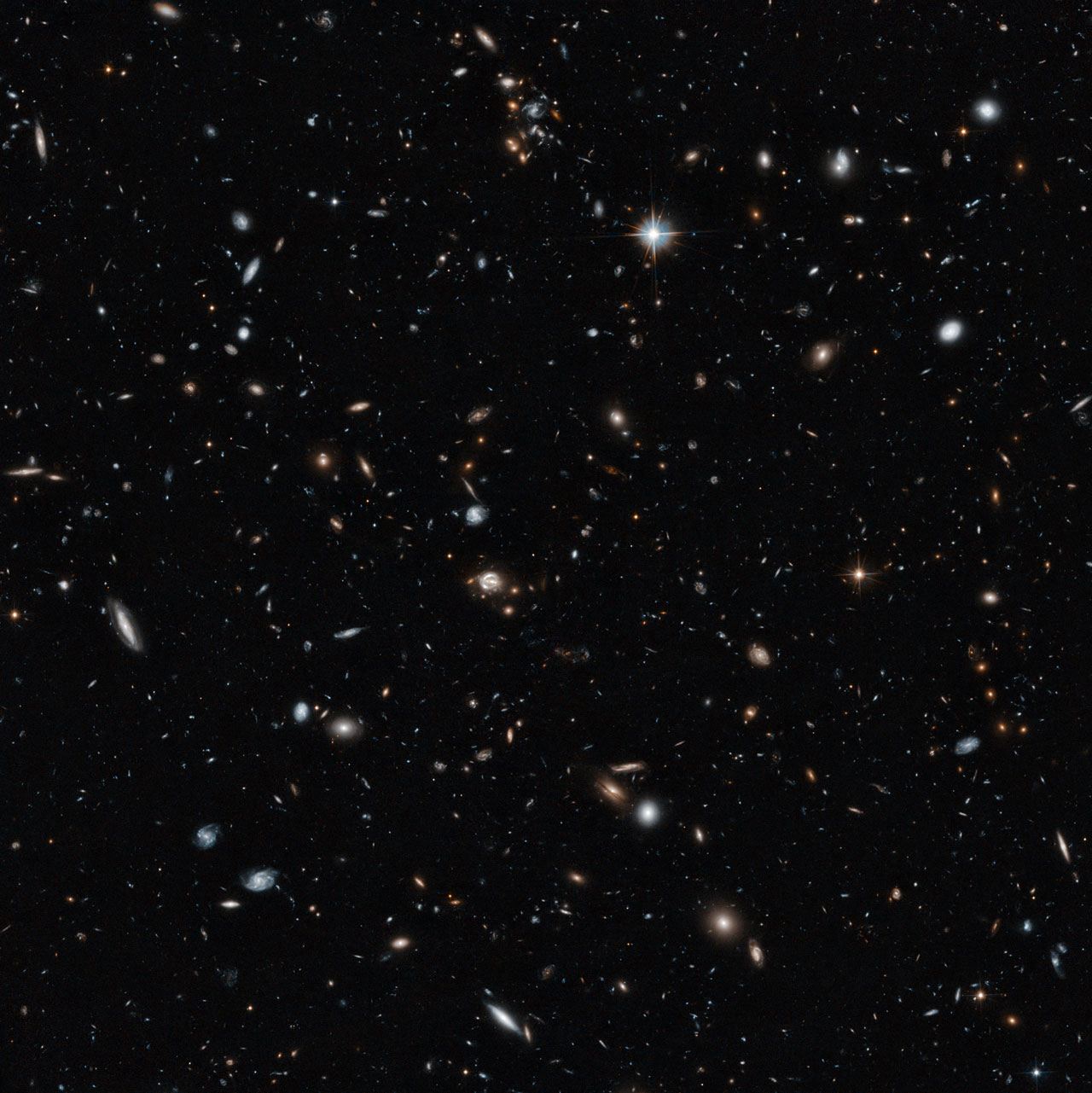
An image of a galaxy cluster taken by the NASA/ESA Hubble Space Telescope gives a remarkable cross-section of the Universe, showing objects at different distances and stages in cosmic history. They range from cosmic near neighbours to objects seen in the early years of the Universe. The 14-hour exposure shows objects around a billion times fainter than can be seen with the naked eye.

heic1408a(Larger version)

This new Hubble image showcases a remarkable variety of objects at different distances from us, extending back over halfway to the edge of the observable Universe. The galaxies in this image mostly lie about five billion light-years from Earth but the field also contains other objects, both significantly closer and far more distant.

Studies of this region of the sky have shown that many of the objects that appear to lie close together may actually be billions of light-years apart. This is because several groups of galaxies lie along our line of sight, creating something of an optical illusion. Hubble’s cross-section of the Universe is completed by distorted images of galaxies in the very distant background.

These objects are sometimes distorted due to a process called gravitational lensing, an extremely valuable technique in astronomy for studying very distant objects [1]. This lensing is caused by the bending of the space-time continuum by massive galaxies lying close to our line of sight to distant objects.

One of the lens systems visible here is called CLASS B1608+656, which appears as a small loop in the centre of the image. It features two foreground galaxies distorting and amplifying the light of a distant quasar the known as QSO-160913+653228. The light from this bright disc of matter, which is currently falling into a black hole, has taken nine billion years to reach us — two thirds of the age of the Universe.

As well as CLASS B1608+656, astronomers have identified two other gravitational lenses within this image. Two galaxies, dubbed Fred and Ginger by the researchers who studied them, contain enough mass to visibly distort the light from objects behind them. Fred, also known more prosaically as [FMK2006] ACS J160919+6532, lies near the lens galaxies in CLASS B1608+656, while Ginger ([FMK2006] ACS J160910+6532) is markedly closer to us. Despite their different distances from us, both can be seen near to CLASS B1608+656 in the central region of this Hubble image.

To capture distant and dim objects like these, Hubble required a long exposure. The image is made up of visible and infrared observations with a total exposure time of 14 hours.

Zoom in on CLASS B1608+656
This video begins with a view of the night sky before zooming in towards galaxy
cluster CLASS B1608+656. It homes in first on a view of the area around the
cluster from the Digitized Sky Survey (produced with a ground-based
telescope), before focusingon Hubble observations of the cluster.

Hubble’s very long exposure (14 hours) combined with advanced
instrumentation and a unique location above the distorting atmosphere
means that its observations are both much sharper and much brighter than
those taken from the ground-based telescope. Hubble’s image is clearly
visible as a square of brighter galaxies near the end of the zoom video.
Credit: NASA, ESA, Digitised Sky Survey 2, N. Risinger (
skysurvey.org)

Space policy roundup – April.16.14 [Update]

A critique of recent bombast in Congressional hearings : Editorial | A Feckless Blame Game on ISS Crew Access – SpaceNews.com

Those who bemoan NASA’s reliance on Russia, yet shortchange the very program designed to fix that problem, are at the same time adamant that the agency spend nearly $3 billion per year on SLS and Orion, vehicles that for all their advertised capability still have no place to go. Their size and cost make them poorly suited for space station missions, even as a backup to commercial crew taxis, and in any case the first SLS-Orion crewed test flight won’t happen before 2021.

NASA currently lacks an independent crew launching capability because of decisions made a decade ago, the consequences of which were fully understood and accepted at the time. The longer this situation lasts, however, the more culpable the current group of decision-makers will become. 

In that vein, the current criticisms of NASA and the White House might be viewed as a pre-emptive strike by lawmakers who sense their own culpability. But in pressing arguments that fail to stand up to even modest scrutiny, they not only undermine their credibility, they give NASA cover to pursue a Commercial Crew Program approach that might not be sustainable.  

If restoring independent U.S. access to station is as important as the administration’s congressional detractors say, they should fully fund the Commercial Crew Program, even if that means slowing development work on SLS and Orion, while ratcheting up the pressure on NASA to select a single provider. Only then can Congress truly say it has done its part to resolve the matter.

More space policy/politics related links:

Update:

Webcasts:

Tues 4/15/14 Hr 4 | John Batchelor Show – Bob Zimmermans twice-weekly report on space news and policy