Yesterday a SpaceX Falcon 9 rocket launched a spysat for the National Reconnaissance Office (NRO) from Kennedy Space Center. The first stage returned for a successful landing at the Cape. Here are some photos and videos of the launch and booster return.
The Everyday Astronaut explains why last week’s re-flight of a SpaceX Falcon 9 first stage booster that flew last year was a major advance towards affordable access to space:
And here’s a nice photo of the booster coming down for a landing:
The booster returned to Port Canaveral this week. This video shows the booster by the dock. The scale of the rocket can be appreciated by seeing the workers underneath the landing legs
SpaceX today successfully launched a communications satellite into orbit and also flew the first stage booster back down for a safe landing onto a floating platform at sea. This launch and landing are historic because the booster had flown once before (April 2016). This was the first time an orbital rocket booster had been re-flown.
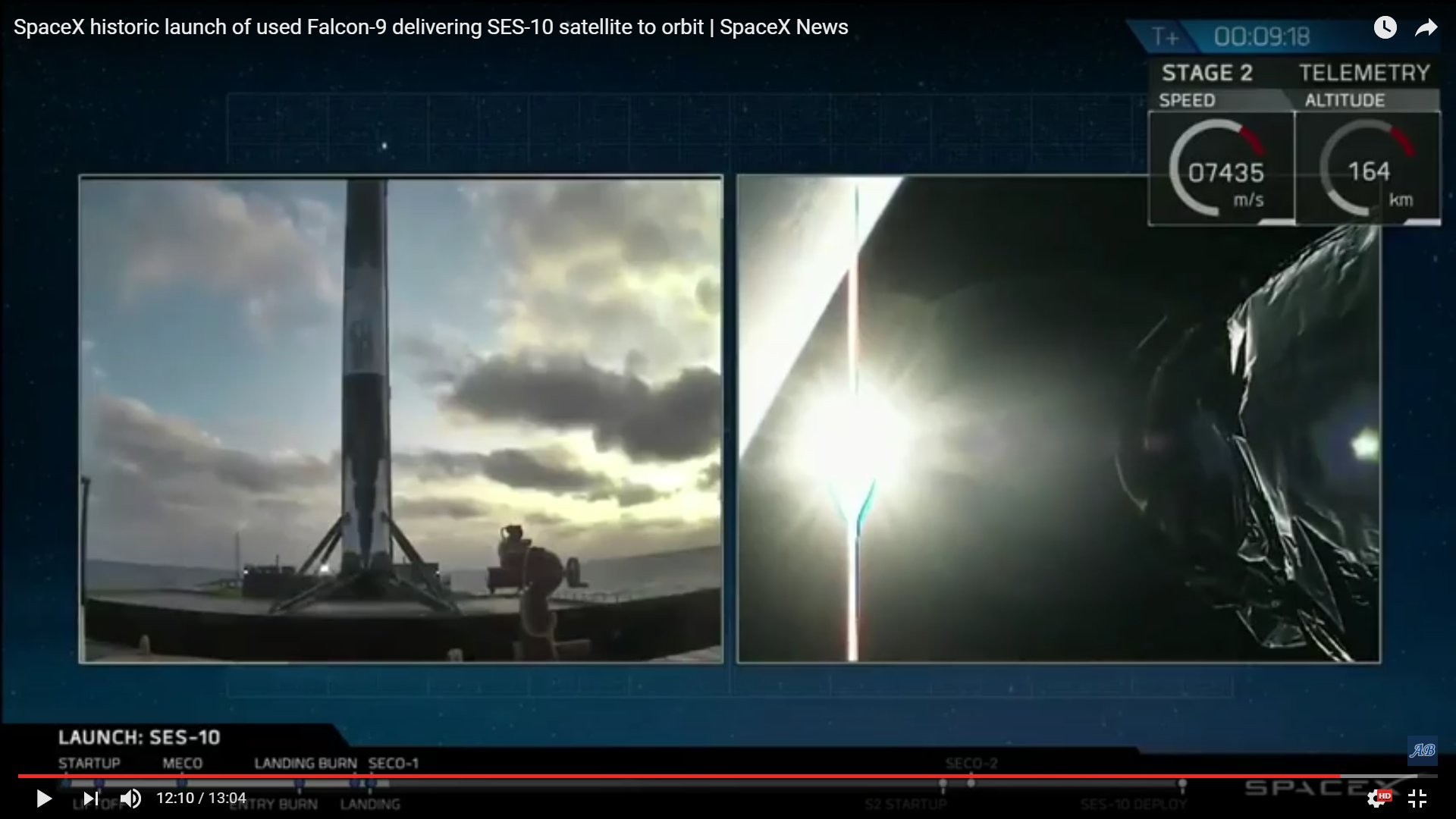
Screen capture of SpaceX webcast shows the booster shortly after it landed on the company’s floating platform in the Atlantic Ocean.
Here is a video clip from the webcast showing video from the booster as it came down towards the sea. The video transmission dropped out briefly (the antenna on the platform is shaken by the plume of the rocket) but then the image comes of the rocket in the center of the ship:
Some words from Elon Musk about the successful mission:
Artist Stanley Von Medvey offers some nicely made video tutorials for the general reader on rockets and the challenges of getting to space. Episode 2 Part 2 just came out yesterday.
** Stan Draws Spaceships 1: Expendable Launch Vehicles
** Stan Draws Spaceships Episode 2, Part 1: The Space Shuttle
** Stan Draws Spaceships Episode 2 Part 2: Falcon and Skylon
Author and journalist Bob Zimmerman points me to a report, sponsored by the Center for a New American Security (CNAS), in which he examines the current state of development of space transportation by NASA and by the private sector. He focuses in particular on a comparison between NASA’s Space Launch System (SLS) rocket and Orion crew spacecraft programs versus the commercial vehicles developed in partnership with NASA via the Commercial Cargo and Crew programs.
CNAS Report Capitalism In Space (pdf) – Full report with several tables summarizing costs for SLS, Orion, NASA commercial cargo and crew programs, etc.
Bob talked about the report with John Batchelor this week:
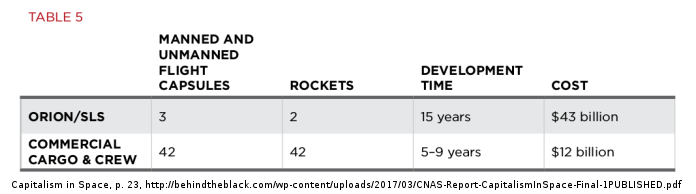
As this table from Bob’s report illustrates, the cost of development of the SLS/Orion is enormous:
Furthermore, an operational SLS/Orion will only launch once every year or two. So with an annual budget of $2B or more, that means each launch will cost at least $2B, not counting the above development costs. (Often NASA officials will quote something in the range of $500M per launch but this is a mythical “marginal” cost number that includes only what was paid for fuel, metals, etc. for one rocket, not the full expense required to make the launch happen.)
Meanwhile, SpaceX has already pushed launch costs 2-3 times lower for NASA and commercial satellite customers compared to a few years ago. And SpaceX, Blue Origin and others are developing reusable launch systems and spacecraft that will dramatically lower the cost of getting to space below today’s prices.
The SLS rocket was forced on NASA by Congress (or more accurately by the space policy and budget committees dominated by Senators and Representatives of states and districts with NASA centers and major contractors), which actually dictated most of the design of the all-throwaway rocket.
The money saved by dropping SLS/Orion and instead flying on competitively sourced commercial space transport services could be redirected by NASA to develop crucially needed space technologies such as in-space tugs, propellant depots, lunar and asteroid mining and manufacturing systems, rotating habitats to provide spin-gravity, etc. These technologies are required to make travel beyond earth affordable and space settlement feasible.
Here is a video preview of Blue Origin’s New Glenn, which will start flying in 2020 (a factory to build the New Glenn is under construction on Cape Canaveral):
And here is a NASA video from an interview with Dan Rasky, who worked as a Senior Scientist for NASA on the Commercial Orbital Transportation Systems (COTS) program, talking about how SpaceX built the Falcon 9 for a factor of 10 less than the NASA/USAF procurement cost model said it should cost (and the model usually underestimates aerospace project cost):

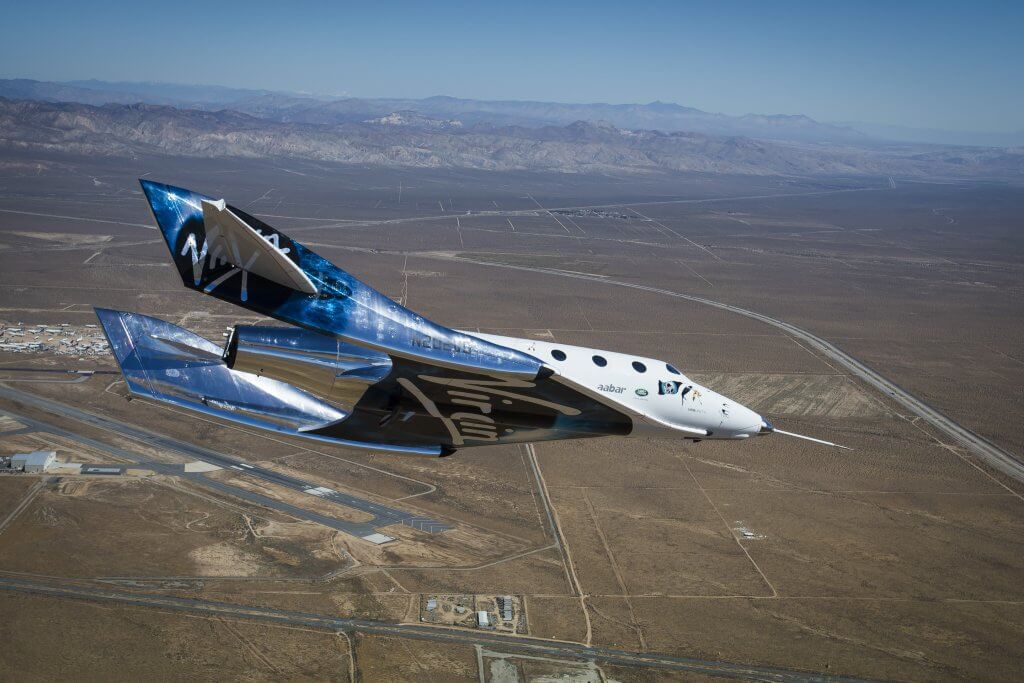 VSS Unity glides back for a landing at the Mojave Air & Space Port.