Category Archives: Rockets

Two rockets set to launch: A SpaceX Falcon 9 and Blue Origin’s New Shepard

[ Update Dec.18 #3: : All the launches set for today have been scrubbed:

Update Dec.18 #2: The Falcon 9 has also been scrubbed for today. No reason yet provided. They will try again tomorrow during a launch window that opens at 9:07 am EST (1407 GMT).

Update Dec.18: The Falcon 9 launch is now set for 9:34 EST. The New Shepard flight has been postponed:

Three other launches are also expected in the next day:

** ULA Delta-4 Heavy to launch a military payload from Vandenberg AFB in California this evening at 5:57 p.m. PST, 8:57 p.m. EST, 0157 GMT (19th)

** Indian Geosynchronous Satellite Launch Vehicle Mk. 2 (GSLV Mk.2) will launch the GSAT 7A communications satellite for the Indian military. Liftoff currently set for 5:40 a.m. EST (1040 GMT) on Wed. Dec. 19.

** Russian/Arianespace Soyuz from Guiana Space Center in South America with a military reconnaissance satellite for France. Liftoff set for 11:37:14 a.m. EST (1637:14 GMT) on Wed. Dec.19.

]

Two rocket launches are scheduled for Tuesday morning within half hour of one another:

** GPS III SV01 MISSION | SpaceX – A Falcon 9 rocket is to place a USAF upgraded GPS satellite into orbit:

SpaceX is targeting Tuesday, December 18 for launch of the United States Air Force’s first Global Positioning System III space vehicle (SV) from Space Launch Complex 40 (SLC-40) at Cape Canaveral Air Force Station, Florida. The 26-minute launch window opens at 9:11 a.m. EST, or 14:11 UTC. The satellite will be deployed to medium Earth orbit approximately 1 hour and 56 minutes after liftoff. A 26-minute backup launch window opens on Wednesday, December 19 at 9:07 a.m. EST, or 14:07 UTC.

Due to mission requirements, SpaceX will not attempt to land Falcon 9’s first stage after launch.

You can watch the live launch webcast below, starting about 15 minutes before liftoff, and find out more about the mission in our press kit.

** Blue Origin New Shepard NS-10 – Nine NASA sponsored experiments will ride Blue‘s reusable New Shepard suborbital rocket to over 100 km in altitude:

New Shepard to fly 9 NASA-sponsored Payloads to Space on NS-10

Blue Origin’s next New Shepard mission (NS-10) is currently targeting liftoff tomorrow at 8:30 am CST [9:30 am EST] / 14:30 UTC. This will be the 10th New Shepard mission and is dedicated to bringing nine NASA-sponsored research and technology payloads into space through NASA’s Flight Opportunities program.

NASA’s Flight Opportunities program is an essential program for researchers providing access to microgravity for technology development. Blue supports NASA’s Flight Opportunities program and its role in perfecting technology for a future human presence in space.

The payloads flying with us on NS-10 include:

Carthage College Space Sciences Program: The Modal Propellant Gauging experiment led by Dr. Kevin Crosby is a joint effort with the NASA Kennedy Space Center Cryogenics Laboratory. It demonstrates a way to measure fuel levels in microgravity by using sound waves.

Controlled Dynamics Inc.: The Vibration Isolation Platform (VIP) aims to separate payloads from the normally occurring vibrations experienced during spaceflight. The payload led by Dr. Scott Green allows researchers to have a clear understanding of microgravity’s effects on their research results.

Johns Hopkins University Applied Physics Lab: On its second flight with Blue, the EM Field experiment will observe and collect data on the naturally occurring electromagnetic fields both inside and outside New Shepard during the launch. Principal Investigator Dr. Todd Smith will use success of this experiment to determine how global measurements of the Earth’s electromagnetic field can be conducted in the future.

NASA Goddard Space Flight Center: Cooling tightly-packed electronics onboard a spacecraft can be challenging, and many solutions have not been able to undergo robust testing. Principal Investigator Franklin Robinson will test one of these solutions in his Flow Boiling in Microgap Coolers experiment.

NASA Johnson Space Center: On its third flight on New Shepard, the Suborbital Flight Experiment Monitor-2 (SFEM-2) led by Dr. Katy Hurlbert will analyze various aspects of the flight environment during New Shepard’s mission profile, measuring cabin pressure, temperature, CO2, acoustic conditions, acceleration and more. The data collected will help future researchers on New Shepard design the most effective experiments for the vehicle.

Purdue University: Dr. Steven Collicott’s payload looks at Zero-Gravity Green Propellant Management Technology, which aims to help advance the use of a safer and more environmentally friendly rocket propellant by better understanding the fuel’s behavior in microgravity.

University of Central Florida: Two teams led by Dr. Josh Colwell and Dr. Addie Dove both have planetary science payloads on NS-10. The Collisions Into Dust Experiment (COLLIDE) aims to understand how dust particles react after surface contact during exploration missions to places such as the Moon, Mars and asteroids. The Collection of Regolith Experiment (CORE) addresses the unique challenge of collecting and analyzing material samples in microgravity.

University of Florida: Dr. Rob Ferl and Dr. Anna-Lisa Paul are adapting technology designed for the ISS to suborbital uses with their experiment, Validating Telemetric Imaging Hardware for Crew-Assisted and Crew-Autonomous Biological Imaging in Suborbital Applications. By recalibrating the way data is collected, the experiment will enable more biological research on suborbital missions.

Make sure to follow us on Twitter for launch day updates and join us at BlueOrigin.com to watch the launch live!

====

Telescopes and Binoculars at Amazon

Videos: Rocket Lab launches Electron rocket with NASA sponsored CubeSats

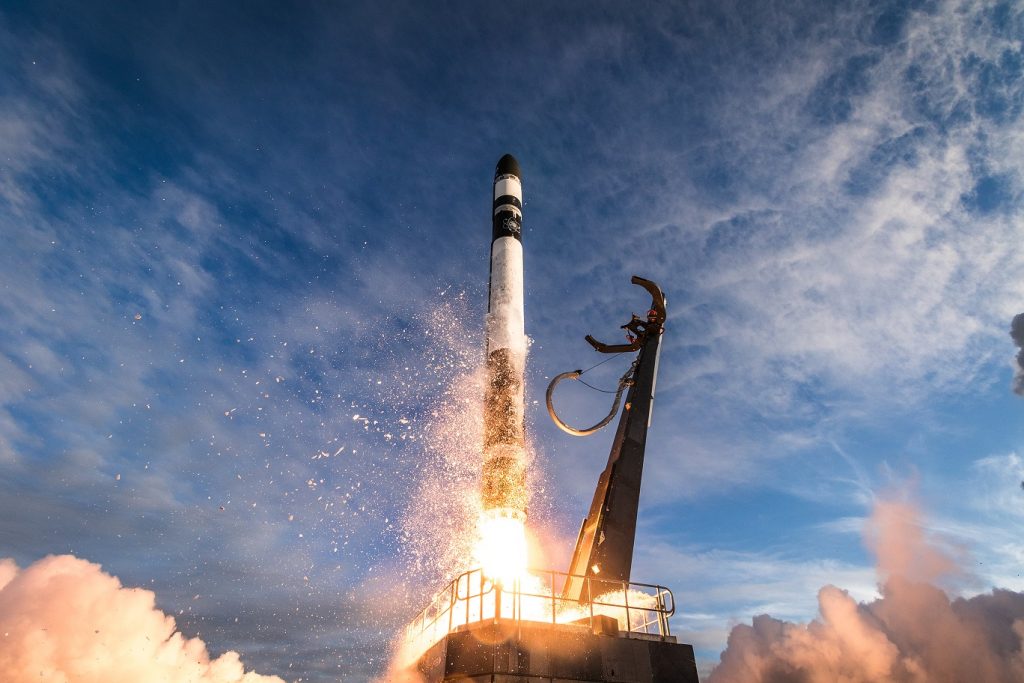
Rocket Lab today successfully launched an Electron rocket from the Launch Complex 1 on Mahia Peninsula, New Zealand. The vehicle reached low earth orbit and its kick stage later circularized its orbit and then deployed 13 small satellites sponsored by NASA, including several university built CubeSats:

Here is a view of the liftoff from a nearby observer:

A statement released by the company:

Rocket Lab successfully launches NASA CubeSats to orbit
on first ever Venture Class Launch Services mission

The mission follows just five weeks after the successful ‘It’s Business Time’ launch in November,
and marks Rocket Lab’s third orbital launch for 2018

ELaNa-19 mission launches on Rocketlab Electron. Photo credit: Trevor Mahlmann

Huntington Beach, California – December 16, 2018 – US small satellite launch company Rocket Lab has launched its third orbital mission of 2018, successfully deploying satellites to orbit for NASA. The mission, designated Educational Launch of Nanosatellites (ELaNa)-19 , took place just over a month after Rocket Lab’s last successful orbital launch, ‘It’s Business Time.’ Rocket Lab has launched a total of 24 satellites to orbit in 2018.

On Sunday, December 16, 2018 UTC, Rocket Lab’s Electron launch vehicle successfully lifted off at 06:33 UTC (19:33 NZDT) from Rocket Lab Launch Complex 1 on New Zealand’s Māhia Peninsula. After being launched to an elliptical orbit, Electron’s Curie engine-powered kick stage separated from the vehicle’s second stage before circularizing to a 500×500 km orbit at an 85 degree inclination. By 56 minutes into the mission, the 13 satellites on board were  individually deployed to their precise, designated orbits.

Until now, launch opportunities for small satellites have mostly been limited to rideshare-type arrangements, flying only when space is available on large launch vehicles. This mission, awarded under a Venture Class Launch Services (VCLS) Agreement, marks the first time NASA CubeSats received a dedicated ride to orbit on a commercial launch vehicle. VCLS is managed by NASA’s Launch Services Program headquartered at Kennedy Space Center in Florida.  Rocket Lab founder and CEO Peter Beck says the ELaNa-19 mission represents a forward-thinking approach from NASA to acquiring launch services and recognizes the increasingly significant role small satellites are playing in exploration, technology demonstration, research and education.

[ Rocket Lab CEO and founder Peter Beck says, ]

“The ELaNa-19 mission was a significant one for NASA, the Rocket Lab team and the small satellite industry overall. To launch two missions just five weeks apart, and in the first year of orbital flights, is unprecedented. It’s exactly what the small satellite industry desperately needs, and Rocket Lab is proud to be delivering it. Regular and reliable launch is now a reality for small satellites. The wait is over,” […] “We’re providing small satellite customers with more control than they’ve ever had, enabling them to launch on their own schedule, to precise orbits, as frequently as they need to.”

NASA ELaNa-19 Mission Manager Justin Treptow adds,

“The CubeSats of ELaNa-19 represent a large variety of scientific objectives and technology demonstrations. With this the first launch of a Venture Class Launch Service on the Rocket Lab Electron, NASA now has an option to match our small satellite missions with a dedicated small launch vehicle to place these satellites in an optimal orbit to achieve big results.”

The ELaNa-19 launch webcast can be viewed in full at http://youtu.be/F7Kr3664hJs and images from the mission are available in the media library at www.rocketlabusa.com/news/updates/link-to-rocket-lab-imagery-and-video

The next Rocket Lab Electron vehicle will be on the pad at Launch Complex 1 in January 2019. For real-time updates and mission announcements, follow Rocket Lab on Twitter @RocketLab.

====

More about the launch and the satellites:

====

Einstein’s Monsters: The Life and Times of Black Holes

Videos: DIY rocketeer profile, Retrieving a big wet rocket, Blue Origin’s giant lifter, & More about Virgin Galactic’s SS2

Some miscellaneous rocket/space related videos:

** The DIY Rocketeer Building SpaceX Replicas of Self-Landing Rockets: A Motherboard profile of Joe Barnard, who is about developing model rockets with vectored thrust and landing capabilities (see posts here and here):

Joe Barnard left his background in videography and music production to launch his life of amateur rocketry, and he shares his DIY adventures in building rockets on his YouTube channel BPS.space.

** SpaceX CRS-16 booster recovery: Reports from www.USLaunchReport.com on what has been happening with that SpaceX Falcon 9 first stage that landed in the water during the launch of a Dragon cargo ship to the ISS:

**** SpaceX CRS-16 Booster Towed To Port 12-07-2018

**** SpaceX – Rise Of The Machines

** What went wrong: Tim Dodd, the Everyday Astronaut, explains what caused the booster to land offshore:

** Blue Origin’s New Glenn: And here Dodd profiles Jeff Bezos’s giant rocket:

** Commercial astronauts visit space: Scott Manley describes the significance of the Virgin Galactic SpaceShipTwo flight this week:

====

Telescopes and Binoculars at Amazon

Virgin Galactic: Richard Branson hails first SpaceShipTwo spaceflight

A release from Virgin Galactic about today’s SpaceShipTwo spaceflight:

[ Update: A new video from the flight:

]

Richard Branson Welcomes Astronauts Home from Virgin Galactic’s Historic First Spaceflight

Virgin Galactic’s First Spaceflight on December 13th 2018

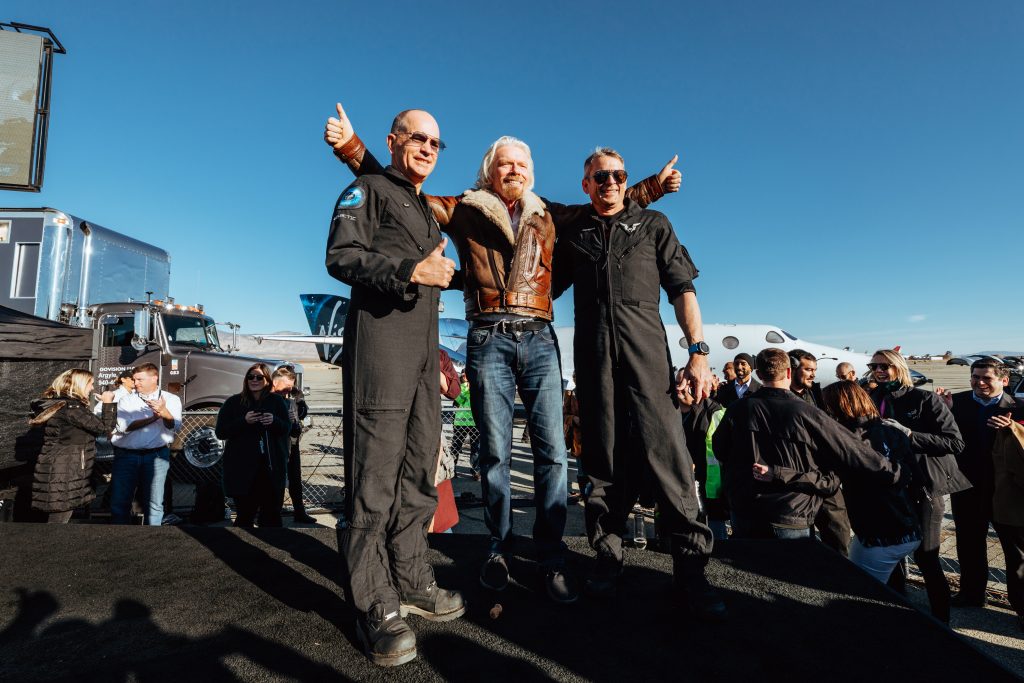
History has been made and a long-anticipated dream realised in Mojave, CA, today as Virgin Galactic’s SpaceShipTwo, VSS Unity, landed from her maiden spaceflight to cheers from Richard Branson and the teams from Virgin Galactic and The Spaceship Company.

Not only is this the first human spaceflight to be launched from American soil since the final Space Shuttle mission in 2011, but the very first time that a crewed vehicle built for commercial, passenger service, has reached space.

The historic achievement has been recognised by the Federal Aviation Administration (FAA) who announced today that early next year they will present pilots Mark “Forger” Stucky and Frederick “CJ” Sturckow with FAA Commercial Astronaut Wings at a ceremony in Washington DC.  CJ, as a four-time Space Shuttle pilot, will become the only person to have been awarded NASA and FAA wings.

Today’s accomplishment has also been recognised by the NASA Flight Opportunities Program, which flew four space science and technology experiments on VSS Unity, making this Virgin Galactic’s first revenue generating flight.

Richard Branson and Virgin Galactic’s first two astronauts.

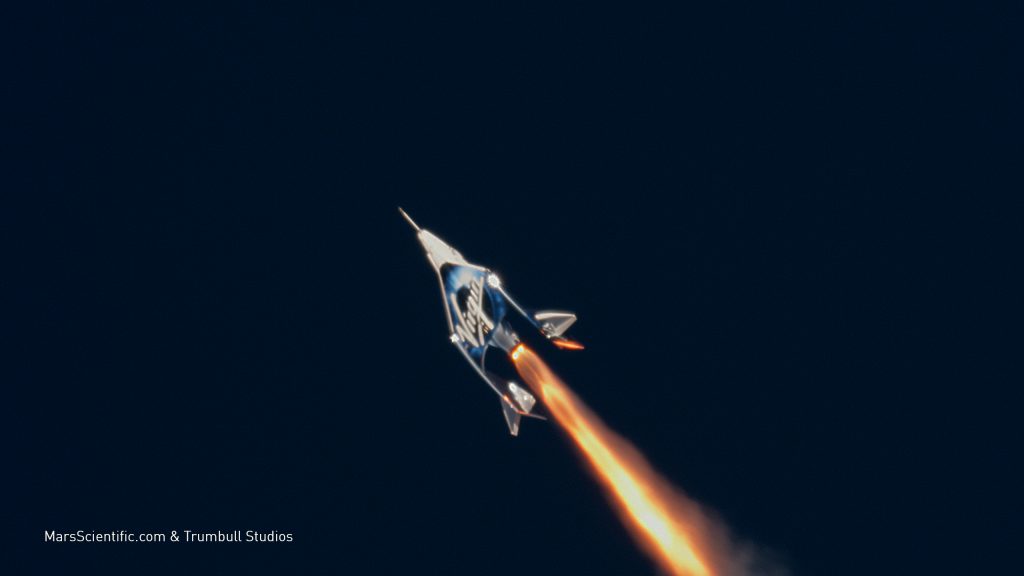
The spectacular spaceflight, which was witnessed by a large crowd of staff and their families, as well as special guests and media, saw a 60 second planned rocket motor burn which propelled VSS Unity to almost three times the speed of sound and to an apogee of 51.4 miles.

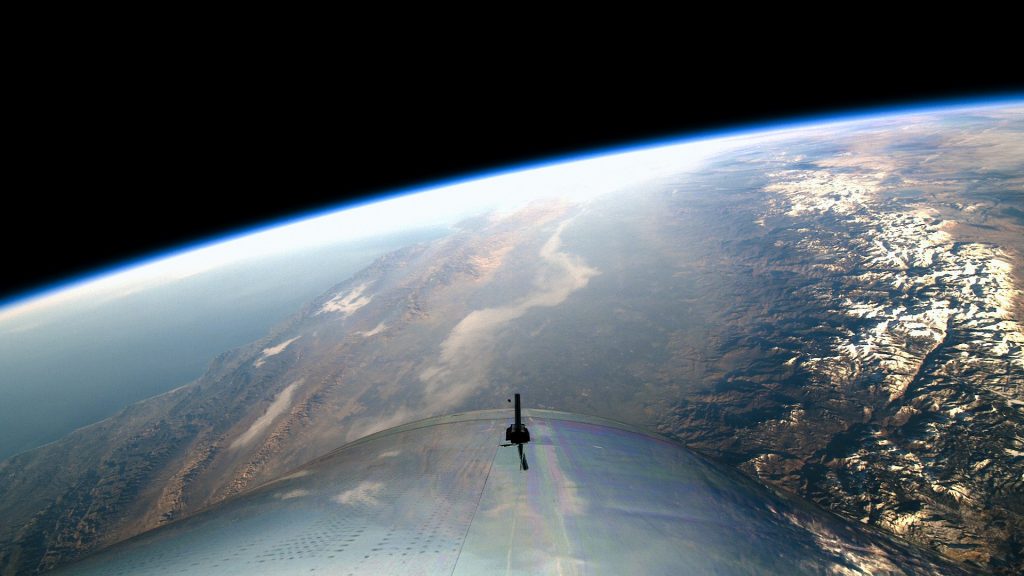
As VSS Unity coasted upwards through the black sky and into space, Virgin Galactic Mission Control confirmed the news and congratulated the two astronaut pilots: “ Unity, Welcome to Space”.

Virgin Galactic’s First Spaceflight on December 13th 2018

After a Mach 2.5 supersonic re-entry into the atmosphere, which utilised Unity’s unique “feathering” configuration, Forger and CJ guided the spaceship down to a smooth runway landing and an emotional homecoming welcome.

Commenting from the flight line Richard Branson said:

“Many of you will know how important the dream of space travel is to me personally. Ever since I watched the moon landings as a child I have looked up to the skies with wonder. We started Virgin nearly 50 years ago dreaming big and loving a challenge. Today, as I stood among a truly remarkable group of people with our eyes on the stars, we saw our biggest dream and our toughest challenge to date fulfilled. It was an indescribable feeling: joy, relief, exhilaration and anticipation for what is yet to come.

“Today, for the first time in history, a crewed spaceship, built to carry private passengers, reached space. Today we completed our first revenue generating flight and our pilots earned their Commercial Astronaut Wings. Today, we have shown that Virgin Galactic really can open space to change the world for good. We will now push on with the remaining portion of our flight test program, which will see the rocket motor burn for longer and VSS Unity fly still faster and higher towards giving thousands of private astronauts an experience which provides a new, planetary perspective to our relationship with the Earth and the cosmos. This is a momentous day and I could not be more proud of our teams who together have opened a new chapter of space exploration.”

George Whitesides, CEO of Virgin Galactic and The Spaceship Company, said:

“What we witnessed today is more compelling evidence that commercial space is set to become one of the twenty-first century’s defining industries. Reusable vehicles built and operated by private companies are about to transform our business and personal lives in ways which are as yet hard to imagine. New enterprises are being created which will become hugely valuable, while enabling humanity to better manage some of its greatest future challenges. Today was a remarkable achievement brought about by the skill, dedication and support of our shareholders, staff, customers, partners and many other stakeholders. We extend our congratulations and thanks to each and every one of them.”

For downloadable assets from today’s flight test please visit our Press FTP https://www.image.net/virgingalactic

Virgin Galactic’s First Spaceflight on December 13th 2018

====

Check out the Best Selling Electronics at Amazon

Virgin Galactic’s SpaceShipTwo rocket vehicle makes its first suborbital space flight [Update]

[ Update: Here is a video released by Virgin Galactic with highlights of the flight:

]

This morning two pilots for Virgin Galactic successfully flew SpaceShipTwo “Unity” to over 50 miles (82 km) in altitude.

While 100 km (62 miles) is held by many as the “official” boundary to space, the USAF and NASA have awarded space wings to X-15 pilots who flew above 50 miles. So C.J. Sturckow and Mark ‘Forger’ Stucky can reasonably claim they have been to space today.

Here is a view of the takeoff of WhiteKnightTwo “Eve” with the SS2 slung beneath it from Mojave Air & Space Port in southern California:

After reaching 42,000 feet (about 8 miles or 13 km), the SS2 dropped from the WK2 and the motor was fired:

Virgin Galactic hopes to begin flying paying customers to space in the coming year. The company actually made some money on today’s flight by carrying four experiments from NASA: Four NASA-Sponsored Experiments Set to Launch | NASA.

While this type of suborbital flight requires far less energy and velocity than required to reach orbit, developing a rocket powered vehicle that can routinely (eventually weekly and perhaps even daily) to such altitudes will be a tremendous technological achievement. It has taken VG over a decade to get a SS2 to space.

Will post videos of the SS2 flight when they become available.

====

Telescopes and Binoculars at Amazon