Category Archives: Amateur/Student Satellite

Student and amateur CubeSat news roundup – Mar.18.2020

A sampling of recent articles, press releases, etc. related to student and amateur CubeSat / SmallSat projects and programs (find previous smallsat roundups here):

** The student-led GU Orbit program at the University of Glasgow aims to

bring students into the world of space systems. It will primarily focus on developing micro-satellites with a specific mission in mind and getting them launched into orbit. Students from various disciplines are welcome to become members as we hope to create an interdisciplinary environment and ultimately provide members with an industrial-like setting so that they can get a feel of what it is like to work in the space technology sector.

The program recently arranged for getting their first satellite, Astraeus-01, to orbit via the Responsive Access launch broker: University of Glasgow GU Orbit Team Signs Smallsat Mission Agreement with Responsive Access – Satnews

Responsive Access Ltd. aims to simplify access to space through the use of innovative software and key partner relationships that provide a one-stop-shop for the launch of CubeSats and other small payloads into orbit.

While the search for a suitable rocket gets underway, GU Orbit are focusing on the technical development of their satellite, which is set to become the first ever to be fully built by a Scottish university. The University of Glasgow’s satellite could be set for launch by as early as next year, creating the possibility for it to be one of the first payloads to reach space from a developing UK spaceport.

GU Orbit’s President, Philip Voudouris, explained that thanks to the tremendous effort from the team members, significant progress on the cubesat, Astraeus-01, has been made, finally bringing ideas and ambitions to life as prototypes are manufactured and tested. The University of Glasgow has a strong reputation regarding its involvement in space technology and having opened its first space lab just last year, it has shown that it is prepared to push the boundaries of human presence in space. With Responsive Access helping to plan the mission ahead and selecting a suitable launch vehicle for Astraeus-01, the company is now one large step closer to seeing this satellite reach orbit and subsequently opening an exciting new frontier for students and researchers with a passion in space.

Astraeus-01 is intended “to demonstrate two innovative technologies: a deployable drag sail and a graphics processing unit (GPU)” (ref).  More at GU Orbit on Facebook.

** Environmental monitoring MeznSat cubesat, built by UAE based university teams, will launch on a Soyuz rocket this summer:

MeznSat is a nanosatellite for climate observation, manufactured by Khalifa University of Science and Technology (KUST) in partnership with the American University of Ras Al-Khaimah (AURAK) and funded by the UAE Space Agency. The satellite’s primary payload will be a shortwave infrared (SWIR) spectrometer that makes observations in the 1000-1650 nm wavelength range to derive atmospheric greenhouse gas concentrations.

The secondary payload on MeznSat will consist of a VGA camera for post-processing that brings increased precision and accuracy to the SWIR spectrometer data. The combination of visible and SWIR bands will make MeznSat a unique CubeSat mission, specifically designed to generate a rich dataset for exploring atmospheric correction algorithms.

** Univ. of Iowa Halosat is demonstrating effective astrophysics observations on a cubesat platform: HaloSat Offers Galactic X-Ray Measurements on Shoestring Budget – SPIE

The entire scientific instrument weighs in at less than 3 kg and consumes about 4 W. The control system brings the package up to 12 kg, while the entire satellite is about the size of a thick book.

HaloSat was launched in 2018, and its mission has been extended until mid-2020. So far, it has mapped x-ray emissions from the Milky Way and the Crab Nebula. The simple mapping spectrometer has delivered remarkably clean data, which will enable a few years of analysis and insights.

Live fast, die young

HaloSat will deorbit before the end of 2020 due to drag, so the mission cannot be extended much longer. Such temporal limitation is part of the life of a CubeSat-they are the mayfly of spacecraft. The question is not if the satellite will live longer, but if useful scientific results can be gained from such a short mission. The researchers have proven the affirmative: low-cost, short-lived satellite missions can deliver useful results.
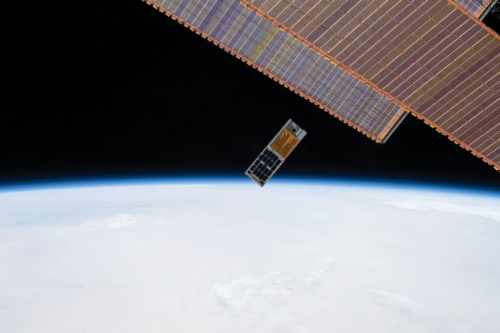
Deployment of HaloSat and RainCube cubesats from the ISS on July 13, 2018. Credits: NASA & Nature Magazine

Here is a technical paper published about the project: Design and construction of the x-ray instrumentation onboard the HaloSat CubeSat, D.M. LaRocca et al, J. or Astronoical Telescopes, Instruments, and Systems – SPIE

HaloSat is the first mission funded by NASA’s Astrophysics Division to use the CubeSat platform. Using three co-aligned silicon drift detectors, the HaloSat observatory measures soft (0.4 to 7 keV) x-ray emission from sources of diffuse emission such as the hot, gaseous halo of the Milky Way. We describe the design and construction of the science payload on HaloSat and the reasoning behind many of the choices. As a direct result of the design choices and adherence to best practices during construction, the HaloSat science payload continues to perform well after more than one year on-orbit.

This NASA video mentions HaloSat:

** AMSAT news on student and amateur CubeSat/smallsat projects: ANS-075 AMSAT News Service Special Bulletin

  • 38th Annual AMSAT Space Symposium and Annual General Meeting Announced
  • Update from the AMSAT President
  • ARISS Video of SpaceX CRS-20 Launch Carrying IORS
  • Minor Update to FoxTelem Released
  • Use the NO-84 PSK31 Transponder Now!
  • ARISS News
  • Hamfests, Conventions, Maker Faires, and Other Events
  • Upcoming Satellite Operations
  • Satellite Shorts from All Over

General CubeSat/SmallSat info:

== Amazon Ad ==

Introduction to CubeSat Technology and Subsystem:
Orbit Design, Debris Impact, and Orbital Decay Prediction

Student and amateur CubeSat news roundup – March.12.2020

A sampling of recent articles, press releases, etc. related to student and amateur CubeSat / SmallSat projects and programs (find previous smallsat roundups here):

** The A&A CubeSat Team at the University of Wisconsin is building SOC-1  or Satellite for Optimal Control and Imaging:

The SOC-i mission will carry an advanced guidance, navigation and control (GNC) payload capable of reorienting the spacecraft while satisfying multiple pointing constraints. SOC-i will also carry an Earth imaging camera, enabling it to take pictures of specified ground locations.

The mission will operate in space for 6 months, and will be supported by a UW ground station being developed in the Aerospace Engineering Research Building. It is a stated goal of the mission to be completely open-source, maintain code on our team’s GitHub page .

See also: Down the rabbit hole of UW’s STEM RSOs – dailyuw.com

Members collaborate throughout the entire design process of the CubeSat, developing different aspects, from its guidance navigation control, electrical power system, physical structure, communications, command and data handling, and imaging configuration.

“Space engineering is such a multifaceted discipline that really, if you show up and just do 10 hours of work, you’re going to learn a hundred new things,” Tormey said. “The thing you get out of it is experience. Even if the work is grueling and hard, knowing that ultimately you’re going to send something up into space is the best motivator ever.”

** The BUSAT (Boston University SATellite) program will see ANDESITE launched on a Rocket Lab Electron rocket. Trisept completes Cubesat integration for NASA ELaNa 32 Andesite Mission – SpaceDaily.com

“Our ANDESITE mission with NASA will demonstrate how CubeSats can play a vital role in providing an unprecedented view into the variations of electrical activity racing through space and its impact on our lives here on earth. GPS services, for example, can be directly affected,” explained Josh Semeter, an electrical engineering professor with Boston University’s Center for Space Physics who first conceptualized the ANDESITE mission.

“If all goes as planned, our CubeSat will release eight small satellite sensors in space to form a first-of-its-kind free-flying mesh network capable of delivering uniquely comprehensive data mapping of magnetic fields and space weather to our smart phones here on campus.”

“TriSept, the University spacecraft team and NASA have completed the initial integration of the ANDESITE mission by installing the CubeSat into the dispenser device and preparing the spacecraft for shipment to Rocket Lab in New Zealand,” said Jason Armstrong, TriSept’s Director of Launch Integration Services.

Illustration of the ANDESITE 6U CubeSat with picosat deployed to study currents in the magnetosphere. Credits: BUSAT

Here is a BUSAT video from 2015 about the ANDESITE project:

** AMSAT news on student and amateur CubeSat/smallsat projects: ANS-068 AMSAT News Service Special Bulletin

  • Welcome Back XW-2D
  • PSAT3 Launch CANCELED [See also Cancellation of PSAT3 Launch Means No DARPA Launch Challenge Winner – ARRL]
  • AMSAT Academy to be Held Prior to Dayton Hamvention
  • The 23cm Satellite Band is Under Scrutiny in Europe
  • Replacing the International Space Station?
  • FO-29 Operational Schedule
  • ARISS News
  • AMSAT Will be at ScienceCity in Tucson, March 14-15
  • Hamfests, Conventions, Maker Faires, and Other Events
  • Upcoming Satellite Operations
  • Satellite Shorts from All Over

General CubeSat/SmallSat info:

** Michael Maloney – Satellite Design For Recovery – Cold Star Project S02E23

Michael Maloney, founder of the advocacy organization Satellite Design for Recovery, is on the Cold Star Project with host Jason Kanigan to talk about the need for including a critical but not-yet-required component to the design of all objects launched into Earth orbit. Satellites and other orbital objects should have mandated design requirements for rendezvous, capture and disposal. The cost of not doing so will be chaos in orbit. Mike is here to tell us about these consequences. Satellite Design for Recovery website: https://satdfr.org/

=== Amazon Ad ===

Introduction to CubeSat Technology and Subsystem:
Orbit Design, Debris Impact, and Orbital Decay Prediction

Student and amateur CubeSat news roundup – March.6.2020

A sampling of recent articles, press releases, etc. related to student and amateur CubeSat / SmallSat projects and programs (find previous smallsat roundups here):

** Killick-1 CubeSat is a undergrad and grad engineering student project at Memorial University in Newfoundland, Canada. The satellite will  measure the thicknesses of sheet ices. ‘Launch’ forth: Students designing and building small satellite to collect big data – MUN Gazette

Since the project was announced in 2018, the team has worked on the conceptual design and definition of the cubesat’s mission. They moved on to the design and building phases in the fall of 2019.

When the cubesat is completed in 2022, it will be launched from the International Space Station – something the team is very excited about.

“We have our very own slot to go into space,” said Mr. Power. “That is very cool and exciting.”

When the satellite is launched into space, it will orbit 400 kilometres above Earth and use global navigation satellite system reflectometry to collect sea ice, waves and wind data.

This involves receiving direct and reflected signals from GPS satellites to measure geophysical features of the ocean such as temperature, salinity and wave height.

** Students at Fryeburg Academy, a private high school in Maine, will build a payload for MESAT-1, a CubeSat project supported by the Maine Space Grant Consortium and recently selected by NASA for a ride to orbit (see previous Smallsat Roundup) : NASA Selects MESAT1 Satellite with Fryeburg Academy’s CubeSat Experiment – Fryeburg Academy

Fryeburg Academy is pleased to announce its proposed CubeSat experiment, chosen by the Maine Space Grant Consortium last fall,  will launch on the MESAT1 satellite—the very first satellite from the State of Maine. It’s one of 18 small research satellites selected by NASA to carry auxiliary payloads into space between 2021–23, and is part of NASA’s CubeSat Launch Initiative that provides opportunities for nanosatellite science and technology payloads built by universities, schools, and nonprofit organizations to rideshare on space launches.

“We began this venture last year with the formation of our Space Raiders club and working with CubeSat simulators,” says FA’s science teacher Dr. Warren Ziegler. “Since then, we’ve partnered with UMaine Orno and The Wells Estuarine Research Reserve and other partners to leverage their resources and knowledge on our chosen experiment that determines water quality and biological markers through imaging coastal estuaries.”

Ziegler and his club will work with Dr. Ali Abedi from UMaine Orno to assemble the CubeSat satellite experiment— aptly named IMAGER— and Dr. Jason Goldstein who leads the Wells Estuarine Research Reserve in Maine. “Our contributions thus far for the project are the remote sensing and spacecraft attitude control sequences that allow the CubeSat to be controlled inflight,” continues Ziegler. “ The goal is to develop a remote sensing tool by modifying a digital camera to image shallow, coastal waters to distinguish water quality properties such as turbidity and phytoplankton concentration.”

See also:

** AcubeSAT – Physical Architecture – A.S.A.T.

The Aristotle Space & Aeronautics Team (ASAT) is composed of students from the Aristotle University of Thessaloniki. ASAT is developing a 3U CubeSat to conduct a biological experiment that investigates molecular mechanisms that are affected by the space conditions. In particular, they will probe the dynamic regulation of gene expression of eukaryotic cells in Low Earth Orbit, using advances in Synthetic Biology and micro-electro-mechanical systems (MEMS).


** CSUM projects – Centre spatial universitaire

In France, the CSUM is the leader in the development of student nanosatellites. We are also a European center of reference devoted to bringing together equipment and skills for the development, production, testing and operation of nanosatellites. These projects involve student interns and encourage regional economic development.

The MTCube underwent vibration and other tests by ExoLaunch before its launch in July 2019. Credtis: CSUM

(Item via nanosat.eth (@myfirstsatellit) / Twitter.)

** AMSAT news on student and amateur CubeSat/smallsat projects: ANS-061 AMSAT News Service Special Bulletin

  • Upcoming SpaceX CRS-20 Launch
  • FO-29 Operational Schedule
  • Georgia Institute of Technology GT-1 To Feature Amateur Radio Robot Operation
  • K7UAZ Radio Club Helps Prepare Satellite Radio Station for Space Camp at Biosphere 2
  • New QO-100 Band Plan Announced
  • ARISS News
  • Hamfests, Conventions, Maker Faires, and Other Events
  • Upcoming Satellite Operations
  • Satellite Shorts from All Over

General CubeSat/SmallSat info:

** Students [sent] homemade satellite into space | Nine News Australia – About the Australis OSCAR 5 amateur satellite built by a group of Melbourne university students and launched into orbit in January 1970.

== Amazon Ad ==

Introduction to CubeSat Technology and Subsystem:
Orbit Design, Debris Impact, and Orbital Decay Prediction

Student and amateur CubeSat news roundup – Feb.27.2020

A sampling of recent articles, press releases, etc. related to student and amateur CubeSat / SmallSat projects and programs (find previous smallsat roundups here):

** Univ. of Maine MESAT1 CubeSat project to involve high schools in environmental data analysis:

“We offered to kind of lead this effort,” said Ali Abedi, a professor of electrical and computer engineering at UMaine and director of UMaine’s Center for Undergraduate Research. “The University of Maine will build the satellite, will work with NASA to launch it, and we’ll provide the data to middle schools and high schools.”

Graduate students from UMaine and undergraduate students from the University of Southern Maine will be involved in designing, developing and testing the small satellite, which will be about the size of a loaf of bread.

** Two university CubeSat projects underway in the Philippines: Scholars develop nanosatellites – Manila Bulletin News

Two nanosatellites which will be the first “Philippine university-built”, are slated for launch in the last quarter of the year, the Department of Science and Technology (DOST) said.

The Maya 3 and Maya 4 cube satellites (CubeSat) are currently being developed by the first batch of scholars under the local nanosatellite engineering track in the Master of Science/Master of Electrical Engineering (MSEE/MSEE) graduate program at the University of the Philippines (UPD), through a scholarship grant from the DOST – Science Education Institute (DOST-SEI).

See also Maya-4 @ Nanosats Database.

** AMSAT news on student and amateur CubeSat/smallsat projects: ANS-054 AMSAT News Service Special Bulletin

  • QARMAN and Phoenix CubeSats Deployed from ISS
  • AMSAT Files Comments Opposing Deletion of 3.4 GHz Band
  • NEMO-1 Buoy Report
  • GNU Radio Conference – Tickets and Call for Papers
  • U.S. Naval Academy’s PSAT3 Scheduled to Launch in Mid-March
  • Changes to AMSAT-NA TLE Distribution
  • “Getting Started with Amateur Satellites” Available with Membership
  • ARISS Radio Telebridge Stalwart Gerald Klatzko, ZS6BTD, SK
  • Upcoming ARISS Contacts
  • Hamfests, Conventions, Maker Faires, and Other Events
  • Upcoming Satellite Operations
  • Satellite Shorts From All Over

General CubeSat/SmallSat info:

** ASU’s Phoenix CubeSat deployment from the ISS:

** Nanoracks CubeSat Deployer – On Orbit Assembly – Drew Morgan

Check out this great time lapse of Astronaut Drew Morgan preparing the 17th Nanoracks CubeSat Deployment Mission on the International Space Station! Nanoracks deployed nine satellites in February 2020 as a part of this mission.

** Building CubeSats to test electrodynamic tethering in space with MiTEE

Electrodynamic tethering could enable coordinated fleets of tens to hundreds of miniature satellites, transforming the way we monitor natural disasters, space weather and the broader space environment by eliminating the need for propellant to maintain a proper orbit and formation: http://clasp-research.engin.umich.edu...

Mi-TEE (Miniature Tether Electrodynamics Experiment) is a University of Engineering project that aims to test the tethering technology in space. The project was selected by NASA in 2015 as part of its CubeSat Launch Initiative. The experiment is currently expected to launch in 2020.

The project is currently organized through U-M’s Multidisciplinary Design Program, and is advised by Brian Gilchrist, professor of electrical engineering and computer science and director of U-M’s Space Physics Research Laboratory (SPRL). http://www.sprl.umich.edu/

** Jeff Dillon – Cubesat to Mars – 22nd Annual International Mars Society Convention

== Amazon Ad ==

Introduction to CubeSat Technology and Subsystem:
Orbit Design, Debris Impact, and Orbital Decay Prediction

Student and amateur CubeSat news roundup – Feb.20.2020

A sampling of recent articles, press releases, etc. related to student and amateur CubeSat / SmallSat projects and programs (find previous smallsat roundups here):

** Several university CubeSats deployed from Cygnus spacecraft by Nanoracks system: Nanoracks Completes 17th Commercial Space Station CubeSat Deployment Mission | Nanoracks

Nanoracks’ 17th CubeSat deployment mission included satellites launched to the International Space Station on both Northrop Grumman’s NG-12 flight and the SpaceX CRS-19 mission. The deployer packs were then assembled together on orbit by the astronaut crew.

“The diversity of users on each CubeSat mission is growing with every flight,” says Nanoracks Senior External Payloads Mission Manager, Tristan Prejean. “Our 17th CubeSat mission has satellites built by university students, international space agencies and research institutes, commercial companies reaching the ISS for the first time, and by our friends at NASA. Commercial access to low-Earth orbit is enabling an unprecedented cohort of users from around the world to make discoveries in space – and we are watching this grow year by year.”

The satellites released on February 19, 2020 and their deployment times were:
– RadSat-u (Montana State University) – 07:10:01 GMT
– Phoenix (Arizona State University) – 09:35:00 GMT
– QARMAN (von Karman institute) – 11:20:00 GMT
– CryoCube (Sierra Lobo Incorporated/NASA Kennedy) and AzTechSat-1 (Collaborative
program between NASA Ames and Universidad Popular Autónoma del Estado de Puebla
[UPAEP] in Mexico) – 12:55:01 GMT
– SOCRATES (University of Minnesota) – 14:30:00 GMT
– HARP (University of Maryland, Baltimore County) and ARGUS-02 (Saint Louis University) – 16:00:00 GMT
– SORTIE (Astra LLC)- 17:40:00 GMT

…

Notably, AzTechSat-1 is the first satellite built by students in Mexico for deployment from the Space Station and is the first CubeSat built as a collaboration between the Mexican Space Agency and NASA. The investigation demonstrates communication within a satellite network in low-Earth orbit. Such Intra-satellite communication could reduce the need for ground stations, lowering the cost and increasing the number of data downloads possible for satellite applications.

Additionally, HARP marked the 100th CubeSat project for which launch and deployment was funded by NASA’s CubeSat Launch Initiative (CSLI), which offers universities, high schools and non-profit organizations the opportunity to fly small satellites. Launches for CSLI selectees are provided through Educational Launch of Nanosatellites (ELaNa) missions facilitated by NASA’s Launch Services Program (LSP). HARP, RadSat-u, Phoenix, SOCRATES, CryoCube, AzTechSat-1, SORTIE, and ARGUS-02 missions were all part of the ELaNa 25 mission managed by NASA LSP.

See also

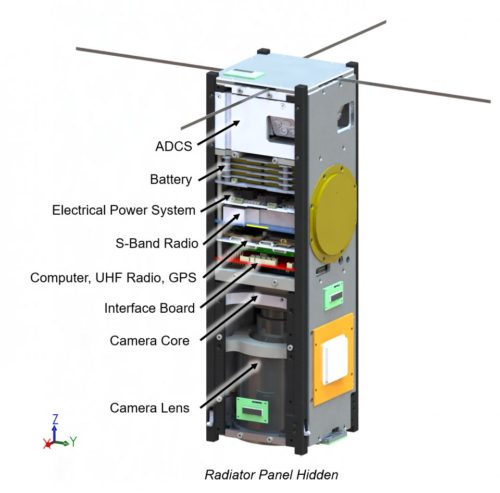
ASU Phoenix Cubesat Diagram
Component diagram of the ASU Phoenix Cubesat.

** More about the NASA’s CubeSat Launch Initiative program: CubeSat Launch Initiative Celebrates 100th Mission Deployment | NASA

Today the Hyper-Angular Rainbow Polarimeter (HARP) CubeSat made history by becoming the 100th CubeSat Launch Initiative (CSLI) selected mission deployed into space. This mission marks nearly 12 years of the CSLI providing CubeSat developers rideshare opportunities to space via Educational Launch of Nanosatellites (ELaNa) missions.

“This 100th mission is extremely noteworthy because it highlights just how special and valuable CSLI is. Not only does the initiative provide real-life, hands-on experience to the next generation of space exploration professionals, it also adds tremendous value and moves NASA’s mission forward in meaningful ways,” said Jim Norman, director, Launch Services at NASA Headquarters in Washington. “I want to thank all the university students, faculty and staff, industry partners and NASA centers who have participated in this program for their contributions.”

Lucky 100—Hyper-Angular Rainbow Polarimeter (HARP)

HARP is a 3U CubeSat designed to measure the microphysical properties of atmospheric aerosols, cloud water and ice particles. It is a precursor for a new generation of imaging polarimeters to be used for the detailed measurements of aerosol and cloud properties in larger missions. The wide field-of-view imager splits three spatially identical images into three independent polarizer and detector arrays. This technique achieves simultaneous imagery of the three polarization states and is the key innovation to achieve a high polarimetric accuracy with no moving parts. The mission is expected to spend nearly a year in orbit with three months dedicated to technology demonstrations and an extended science data period of an additional seven months.  

Funded by NASA’s Earth Science Technology Office, HARP launched Nov. 2, 2019, as part of the ELaNa 25 mission on Northrup Grumman’s 12th Commercial Resupply Services mission to the International Space Station.

** Space BD of Japan to assist launch of Cubesat built by team at Australia’s Curtin University: Japanese space startup Space BD to launch Curtin University CubeSats into orbit – Curtin University, Perth, Western Australia

Space BD Inc is the official service provider selected by JAXA in the area of ISS utilisation and satellite launch service.

Curtin University has been planning and developing the satellites named Binar-1 (1U CubeSat) and Binar-2 (3U CubeSat) since 2018. These satellites will be the first pair of satellites launched from Curtin University as well as the first from Western Australia.

The project is led by Professor Phil Bland at the Space Science and Technology Centre at Curtin University. Professor Bland, along with a team of 12 Curtin staff and student engineers have developed the miniaturised satellites.

See also: Curtin to test ‘mini’ satellite in orbit with European Space Agency –  Curtin University, Perth, Australia.

** AMSAT news on student and amateur CubeSat/smallsat projects: ANS-047 AMSAT News Service Special Bulletin

  • AMSAT-OSCAR 85 Declared End of Mission
  • HuskySat-1 Update
  • Update from AMSAT President Clayton Coleman, W5PFG
  • Free Digital Copy of “Getting Started with Amateur Satellites” Available for New or Renewing Members
  • Apogee View – January/February 2020
  • 5 Tips on Etiquette and Good Manners on the FM Ham Radio Satellites
  • Changes to AMSAT-NA TLE Distribution for February 13, 2020
  • Upcoming ARISS Contacts
  • Upcoming AMSAT Events
  • Upcoming Satellite Operations
  • Satellite Shorts From All Over

General CubeSat/SmallSat info:

== Amazon Ad ==

Introduction to CubeSat Technology and Subsystem:
Orbit Design, Debris Impact, and Orbital Decay Prediction