“The goals of the Amateur Radio station at the World Scout Jamboree are to introduce Amateur Radio to Scouts and Scout leaders through hands-on participation in two-way communication with other stations across the globe. This activity will also serve as the Amateur Radio voice of the Jamboree,” the World Scout Jamboree Amateur Radio Exhibit Operational Vision document states. Other facets of Amateur Radio at the Jamboree will include Amateur Radio direction finding (ARDF), Amateur Radio satellite contacts, and a scheduled Amateur Radio on the International Space Station (ARISS) contact with an ISS crew member.
Mentored by experts from the Indian Space Research Organisation (Isro), undergraduate students at Birla Institute of Technology, Pilani, are inching closer to their dream of designing and launching a nano-satellite or cubesat — of the size of a shoebox – with a special camera that will help study the earth’s surface for response during natural hazards and track carbon dioxide (CO2) emissions.
The country’s first student-run undergraduate research group, which is on a mission to launch a one-of-its-kind nano-satellite with hyperspectral imager, has been christened Team Anant. It has 40 members across all engineering branches and batches at the Rajasthan-based institute.
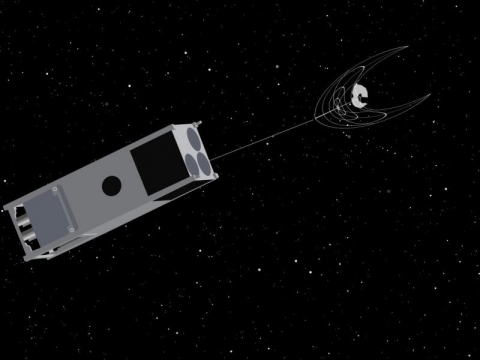
** Students at Rensselaer Polytechnique Institute (RPI) are building OSCaR (Obsolete Spacecraft Capture and Removal) smallsat to test techniques for de-orbiting space debris
OSCaR (Obsolete Spacecraft Capture and Removal) is a 3U CubeSat in development at Rensselaer Polytechnic Institute that aims to de-orbit space debris.
From the RPI article:
… [Professor Kurt] Anderson and his students are developing OSCaR, a small device that will be able to inexpensively be sent into space aboard larger vehicles and then released to nearly autonomously seek out, capture, and then de-orbit space debris.
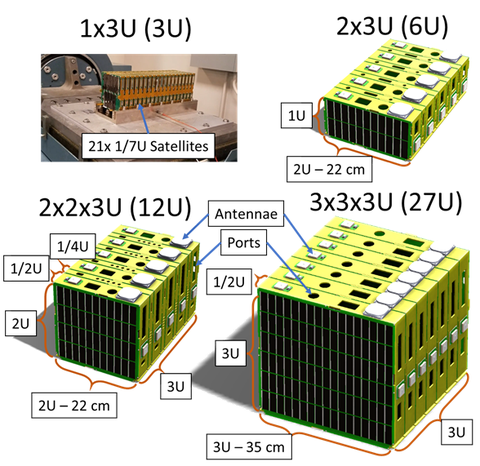
OSCaR is a three-unit member of a class of very small satellites known as CubeSats. Each unit is a small and light 10 cm x 10 cm x 10 cm cube.
One of those CubeSat units will house the “brains” of OSCaR including GPS, data storage, and communication, as well as the power and thermal management systems. Another will hold propellant and the system’s propulsion module to drive OSCaR forward. The third unit will contain four gun barrels, nets, and tethers to physically capture debris, one piece at a time. This capture module will also have optical, thermal, and RADAR imaging sensors to help OSCaR locate debris in the vastness of its surrounding space.
After it is done collecting debris, OSCaR will be programmed to deorbit itself within five years, destroying itself and the debris it caught.
Mission Success yesterday for Indiana’sNearSpace Launch Inc. (NSL)ThinSat constellations launched off the Antares NG-11 on route to International Space Station. The 60 ThinSat were developed for Virginia Space as a STEM program for middle and high schools. Over 400 students participated in the testing and delivering of experiments in orbit today. The school teams were overseen by Twiggs Space Labs.
Co-founder of Twiggs Space Labs and Co-Inventor of the CubeSat, Bob Twiggs, states, “Our goal is to inspire future generations of engineers and scientists through innovation in the field of space.” Twiggs goes further to say, “To me, this (ThinSat launch) is the most exciting day of my career.”
ThinSat is a new pioneering model for satellites that are scalable, simpler, and more affordable. Their focus is to broaden access to space for educational and space research participants.
The ThinSat comes in an array of sizes that comply with the CubeSat launcher. The 11.2 cm by 11.7 cm by 2 cm ThinSat version was the first model to launch this week. The ThinSat team choose to use EyeStar radios and Alta Devices solar technology. The NSL’s EyeStar radios allow for 24/7 connectivity via Globalstar’s constellation. Alta Devices solar cells provide a unique modular, lightweight, flexible form factor with high efficiency characteristics.
The ThinSat inventor and co-founder of NSL, Hank Voss states, “ThinSats will travel in a region of the atmosphere that is important to climate and space weather forecasts, but rarely studied because atmospheric drag makes it hard to keep satellites there,” Voss also expressed, as an emeritus professor, he is “thankful to Virginia Space and Twiggs Space Labsfor investing into the project that has a such strong STEM and research outreach.”
** 3 CubeSats of BIRDS-3 program reach ISS after launch on Northrop-Grumman Cygnus cargo vehicle. BIRDS-3 is
led by Kyushu Institute of Technology in Japan and involves students from Sri Lanka, Bhutan, Nepal and Japan.
The goal is for the participating countries to create indigenous space programs “by designing, building, testing, launching and operating, [their] first satellite(s)”.
The 3 satellites – Uguisu, NepaliSat-1, and Raavana-1 (Sri Lanka) – are expected to be deployed from the Japanese Experiment Module (JEM) “Kibo” in May or June.
** Other student CubeSats launched to the ISS aboard the Cygnus included the three Virginia university projects described here in previous roundups plus several other college spacecraft:
EntrySat – Students at ISAE-SUPAERO institute in France built this CubeSat to study space debris reentry.
SASSI2 – “a CubeSat designed, built, and tested by undergraduate students at the University of Illinois and Purdue University”.
Aeternitas, Cetes and Liberta: Three CubeSats sponsored by the Virginia CubeSat Constellation (VCC) program and built by undergraduates at the University of Virginia, Old Dominion University, Virginia Tech and Hampton University.
SpooQy 1 – National University of Singapore project to demonstrate quantum entanglement technologies on a CubeSat.
KRAKSat – “a project focused on sending scientific satellite into space, made by students of University of Science and Technology and Jagiellonian University. Not only it is one of the first Cubesat type satellites in Poland but also the first satellite in the world which uses magnetic liquid, called ferrofluid, for orientation control”.
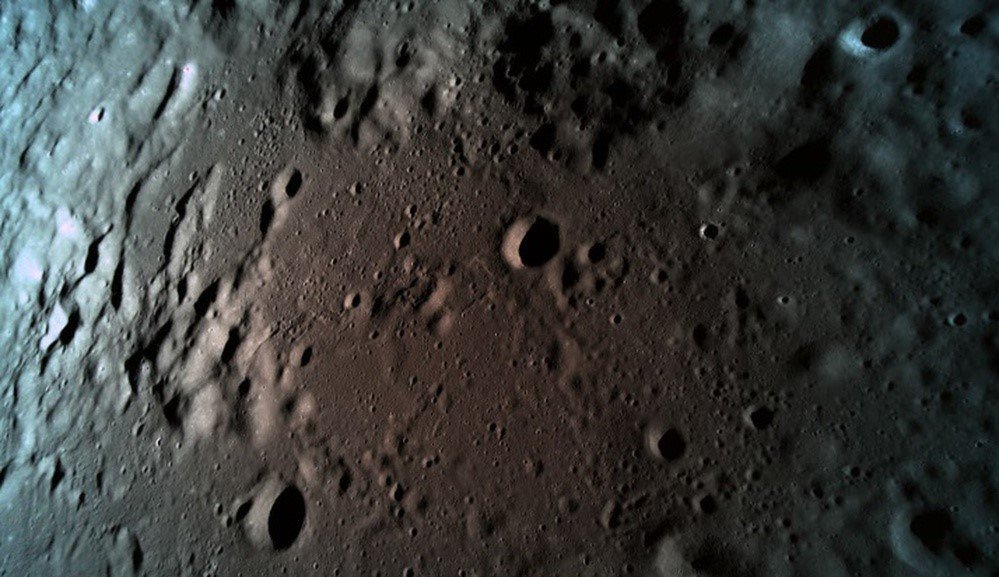
The attempt by SpaceIL, a private non-profit organization, to land the Beresheet craft softly on the Moon last week went awry just a few minutes before it was to set down onto the surface. Initial results of an investigation into what went wrong were released today:
Here are the findings of the preliminary investigation of #Beresheet’s landing maneuver: It appears that during the landing process a command was entered that led to a chain reaction, which caused the main engine to switch off and prevented it from being reactivated.
The teams of #SpaceIL and Israel Aerospace Industries (IAI) will continue to investigate what occurred during the mission. In the coming weeks, the final results of the investigation will be released.
The Arch Lunar Library contains 100GB, or 30 million pages of text and pictures, literally embedded in 25 nickel disks in the tiniest type you can possibly imagine. You don’t need anything more specialized than a microscope to read it, and the etchings should survive for billions of years.
This library was supposed to be delivered to the surface of the moon — specifically, the Sea of Serenity — by Israel’s Beresheet Mission last week. The bad news: After a glitch that turned its engine off and on again at the worst possible moment, the Beresheet lander smashed into the moon at 300 miles per hour.
The good news: Those disks were designed to be indestructible. And the Arch Foundation is all but certain its payload survived the crash.
“We have either installed the first library on the moon,” says Arch Mission co-founder Nova Spivack, “or we have installed the first archaeological ruins of early human attempts to build a library on the moon.”
In a giant leap for Virginia Tech, the first satellite built by undergraduate students is scheduled to be launched into space on April 17, 2019.
One small step closer to reaching space, a group of Virginia Tech undergraduate students recently delivered their small satellite to Houston to be incorporated into NanoRacks’ commercially developed CubeSat deployer. Virginia Tech’s satellite, along with two satellites from other Virginia universities, is scheduled to launch on the payload section of Northrop Grumman’s Antares rocket and then will be headed to the International Space Station.
Back in January we started crowdfunding on the Patreon platform and by the end of November the amount of donations has reached more than $1,100 per month. This amount has increased particularly after the aforementioned article in Quartz magazine.
Moreover, since November we have a donor-organization in the Kyrgyz space program — the Internews organization will donate sufficient amount of money that will cover expenses on building, testing and launching two (!) nanosatellites.
This does not mean that we no longer need patrons — there are quite a few unforeseen crazy ideas (for example, to test a prototype of the satellite in the mountains of the Issyk-Kul region), the costs of which are not included in the Internews grant, but are necessary to make the satellite launch happen.
** Canada’s Western University and Nunavut Arctic College will build a CubeSat to test
a novel imaging system for the engineering technology demonstration with the potential to provide virtual reality-ready images. This imagin system has future applications in the Earth observation and space exploration.
Eu:CROPIS – DLR – “The launch of the German Aerospace Center (Deutsches Zentrum für Luft- und Raumfahrt; DLR) Eu:CROPIS satellite on 3 December 2018 marked the beginning of DLR’s mission with the same name, in which a satellite equipped with two greenhouses – each containing a symbiotic system consisting of bacteria in a biofilter, tomato seeds, single-celled algae and synthetic urine – orbits the Earth. The aim of the mission is to determine whether biological waste can be recycled in space and used to grow fresh food. Astronauts on long-duration missions would benefit from fresh vegetables, but so too would people in extreme terrestrial habitats. The two greenhouses will operate for a total of 62 weeks – one under Martian gravitational conditions, and the other under lunar gravitational conditions, which will be simulated by adjusting the satellite’s rotation rate.”