A sampling of recent articles, press releases, etc. related to student and amateur CubeSat / SmallSat projects and programs (find previous smallsat roundups here):
“Concrete and asphalt tend to retain the heat of the sun and heat the place. We want to know exactly why, where, and when the cities are heating up,” De La Vega stated.
Once the satellite gets deployed by astronauts onboard the International Space Station in January, the team will be testing, calibrating, and hopefully, receiving data from the satellite for further research.
[SOCRATES} is the first-ever made by the university in a joint venture featuring university professors and students from a variety of space-related fields and engineering. The project is under NASA’s Undergraduate Student Instrument Project, which was started three years ago to give students opportunities to build and launch satellites into space.
More than 30 students from the university were interested in the program, led by Kyle Houser, the chief engineer and Burgett, the project manager. The SOCRATES was developed in the university’s Small Satellite Project Lab, founded by Demoz Gebre and physics professor Lindsay Glesener for a small satellite study.
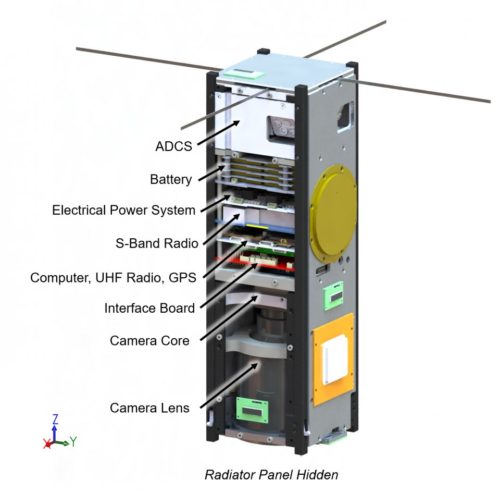
The SOCRATES is fitted with state-of-the-art X-ray detection sensors to provide navigation when GPS is inaccessible. The satellite will also be able to capture information on electronic acceleration from solar flares to aid in the study of the solar phenomenon. The SOCRATES will be released to orbit the Earth in January 2020 from the International Space Station, where it is held at the moment.
A sampling of recent articles, press releases, etc. related to student and amateur CubeSat / SmallSat projects and programs (find previous smallsat roundups here):
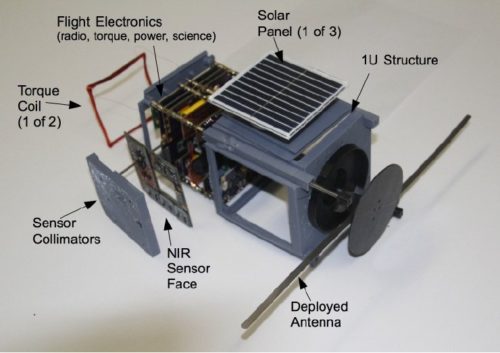
Sonoma State received funding for EdgeCube in June 2016, after physics and astronomy professor Lynn Cominsky wrote a proposal to NASA. The proposal called for monitoring the “red edge” of the chlorophyll spectrum in large patches of homogeneous vegetation using a CubeSat or a small satellite. Since then, approximately 30 students have worked on the project from Sonoma State, Santa Clara University and Morehead State. Professor Matt Clark from SSU’s Department of Geography and Environmental Planning was the originator of the idea to measure the “red edge,” hence the name “EdgeCube”.
** Virginia Tech inspireFly team wins SEDS SAT-2 contest. SEDS (Students for the Exploration and Development of Space), Astranis, and NanoRacks sponsored the competition. The winning team will receive a free ride to the ISS for their CubeSat, which will then be deployed into orbit.
Students for the Exploration and Development of Space (SEDS), the largest student-run space and science advocacy organization in the world, today announced that Virginia Tech’s inspireFly team is the winner of the Astranis SEDS SAT-2 competition. Astranis, a manufacturer and operator of small geostationary satellites, contributed to the cost of the launch, while competition co-sponsor Nanoracks, a leading provider of commercial access to space, will launch and deploy the winning CubeSat on the International Space Station in the next two to three years.
Open to U.S. SEDS chapters, the competition tasked teams with submitting a design for a novel 1U CubeSat. The competition kicked off at SpaceVision in November 2018, where interested teams had the opportunity to attend an Astranis/Nanoracks workshop on designing, building, and integrating a CubeSat for low Earth orbit.
Thirteen chapters from across the country entered the competition and submitted proposals. The judging panel included members of the SEDS-USA Board of Advisors and Directors, as well as employees from Astranis and Nanoracks. Proposals were judged on their technical merits, the non-technical capabilities of the team to develop and support the design, the professionalism of proposal, the novelty of the proposed CubeSat mission, and the demographic makeup of the design team and their mentors.
Virginia Tech’s team was selected as the winner for its ContentCube project, a selfie-stick for space that will take pictures of an external LCD screen–featuring publicly-submitted photos–with Earth in the background.
A sampling of recent articles, press releases, etc. related to student and amateur CubeSat / SmallSat projects and programs (find previous smallsat roundups here):
Students from Arizona State University have launched a small, NASA-funded research satellite to study the urban heat island in seven U.S. cities, including Phoenix.
The Phoenix CubeSat is one of seven nanosatellites selected through NASA’s CubeSat Launch Initiative, which supports projects designed, built and operated by students, teachers and faculty, as well as NASA centers and nonprofit organizations.
…
An interdisciplinary group of around 100 ASU undergraduates took part in the effort, which will use an off-the-shelf thermal infrared camera to study changes in the heat properties of cities across the U.S. over time.
The term “urban heat island” describes an urban area that experiences warmer conditions than its surroundings due to human activities, the thermal properties of building materials and other related factors.
** Univ. Minnesota SOCRATES smallsat reaches the ISS on the same Cygnus.
The cube satellite, Signal Opportunity CubeSat Ranging and Timing Experiment System (SOCRATES), is the first small satellite created by the University sent into space by NASA. The satellite is equipped with high energy X-ray sensor detectors that can help with “deep space navigation” when GPS is not available. SOCRATES will also collect data related to electronic accelerations in sun flares to help research on solar anomalies.
The project is a collaboration between University faculty and students of different disciplines, like aerospace engineering, physics and astrophysics. SOCRATES is currently on the International Space Station and is expected to be released back into Earth’s orbit in January 2020.
The National Design and Research Forum (NDRF) has invited student teams from high schools across the country to take part in its National Space Challenge 2020 contest of flying small or cube satellites on a balloon.
Teams of five students from class 8 to class 12 can send in innovative proposals by November 25, the Bengaluru-based engineering research and development promotion body said in a release.
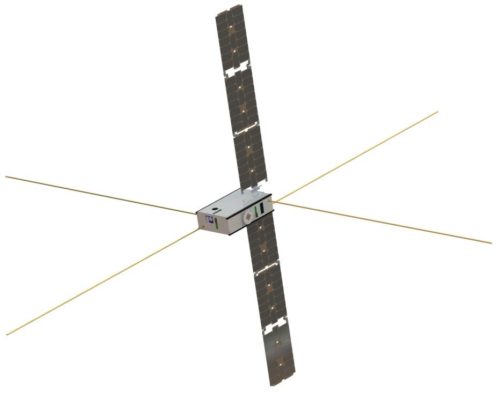
A student-built satellite about twice the size of a Rubik’s Cube has passed a series of tests to travel to space this December as part of a NASA-funded project involving three universities including Sonoma State. Built in partnership with Santa Clara University and Morehead State University in Kentucky, the “EdgeCube” satellite is scheduled to fly aboard a Space X Falcon 9 rocket on its way to the International Space Station. From there it will be boosted into orbit 500 kilometers above the Earth to collect data on vegetation health in ecosystems around the globe.
** “Are CubeSats the future of space exploration” – TMRO.tv program about CubeSats.
Built at the U.S. NRL (Navel Research Laboratory), the smallsat was launched on a SpaceX Falcon Heavy last June. The spacecraft is expected to soon separate into two parts connected by the 1 kilometer long tether.
Electrodynamic propulsion works on electromagnetic principles similar to an electric motor. The magnetic field in an electric motor attracts an electric current that flows through the windings of the armature causing the armature to spin. In space, the Earth has a naturally occurring magnetic field and for TEPCE, the tether wire serves the purpose of the armature. By inducing an electric current to flow along the tether, a mutual attraction between the Earth’s magnetic field and the tether will occur. This electromagnetic attraction can propel TEPCE to higher altitudes or to change the orientation of its orbit.
“U.S. Naval Research Laboratory’s Tether Electrodynamic Propulsion CubeSat Experiment‘s CubeSat split into two and connected by a tether.” Credits: Cameron Crippa/U.S. NRL.
HEPTA-Sat (Hands-on Education Program for Technical Advancement) is a hands-on study of small satellite design and engineering over several days of intensive practical lessons. HEPTA-Sat hand-on course puts it focus on establishing the knowledge of system engineering by going through the whole process of system integration. During the course student will learn how the system is broken down into different subsystem (requirement), how to integrate those different subsystem (requirement) into a fully functioning system, and how to test/debug it once it has been integrated. HEPTA-Sat teaching methods are designed to be implemented in existing universities anywhere. The program is supported by a vibrant instructor community and is open to people of any educational or professional background.
A sampling of recent articles, press releases, etc. related to student and amateur CubeSat / SmallSat projects and programs (find previous smallsat roundups here):
** NG Cygnus carries HuskySat-1, built by Univ. Washington students, to ISS.
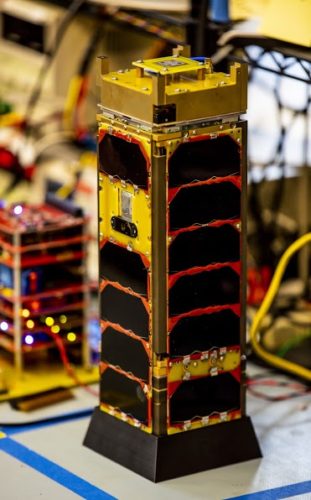
HuskySat-1 is being developed by an interdisciplinary team at the University of Washington and will be launched into Low Earth Orbit to become the first amateur satellite from Washington state. This CubeSat will demonstrate the capabilities of new technologies being developed at the University of Washington and expand the capabilities of CubeSats as a whole. In particular, a high-thrust pulsed plasma thruster (PPT), and high-gain communications system will form the core technology suite on board the satellite. The HuskySat-1 will also be flying a newly developed Amateur Radio Linear Transponder developed by AMSAT which will contribute to the worldwide communication networks built and operated by ham radio enthusiasts.
Some of the student-built parts will still be in test mode. A custom-built thruster uses sparks to vaporize small amounts of solid sulfur as a propellant. The thruster will fire about 100 times as the satellite passes over Seattle, only enough thrust to provide a slight nudge. A high-bandwidth communications system built by former graduate student Paul Sturmer, now at Blue Origin, transmits at 24 Gigahertz, allowing the satellite to quickly send reams of data. That system will send down a test packet from space.
“Usually people buy most of the satellite and build one part of it. We built all the parts,” Northway said. “It was a pretty serious undertaking.”
On Saturday, seven small research satellites, or CubeSats, developed by students from eight universities across the nation will fly on Northrop Grumman’s Antares rocket from NASA’s Wallops Flight Facility in Wallops, Virginia, targeting a launch at 9:59 a.m. EDT.
All seven CubeSats were selected through NASA’s CubeSat Launch Initiative (CSLI) and are a part of the 25thEducational Launch of Nanosatellites (ELaNa) mission. CSLI enables the launch of CubeSat projects designed, built and operated by students, teachers and faculty, as well as NASA Centers and nonprofit organizations. ELaNa missions provide launch and deployment opportunities and ride-shares to space for CubeSats selected through CSLI. Students are heavily involved in all aspects of the mission from developing, assembling, and testing payloads to working with NASA and the launch vehicle integration teams. The ELaNa CubeSats are held to rigorous standards similar to those adhered to by the primary spacecraft.
Five of the CubeSats were developed through NASA’s Undergraduate Student Instrument Project or USIP.
The 5 USIP CubeSats flying on Antares are:
RadSat-u – Montana State University – Bozeman
Phoenix – Arizona State University – Tempe
SOCRATES (Signal of Opportunity CubeSat Ranging and Timing ExperimentS) – University of Minnesota – Minneapolis
HuskySat-1 – University of Washington – Seattle
SwampSat II – University of Florida – Gainesville
…
The additional two CubeSats flying through CSLI are:
Argus-02 – St. Louis University – Missouri
HARP (Hyper Angular Rainbow Polarimeter) – University of Maryland, Baltimore County – Baltimore and Utah State University – Logan
A constellation of South African nanosatellites will be put in orbit next year to monitor shipping to prevent the poaching of marine resources such as abalone and sharks, while they will also track fires so ground-based personnel can move livestock out of harm’s way and prevent the spread of the fire.
The technology for this constellation is being proven right now as the ZACube 2 research nanosatellite from the Cape Peninsula University of Technology (CPUT) will log its 300th day in orbit on the 23rd October 2019. ZACube 1, also known as TshepisoSat, was launched on 21st November 2013 and is still communicating with the ground station.
…
The ZACube 2 satellite is performing well in orbit and proving the technology that the university has developed,” Professor Robert van Zyl, the Director of French South African Institute of Technology (FSATI) said.
A sampling of recent articles, press releases, etc. related to student and amateur CubeSat / SmallSat projects and programs (find previous smallsat roundups here):
** Lightweight 3D printed composite CubeSat structure built by French university students with industrial partners:
LISA, an Italian-based company specialist for over 25 years in the use and development of advanced additive manufacturing technologies and materials, has collaborated with the Laboratoire InterUniversitaire des Système Atmosphérique (LISA) of Universite Paris-est Creteil (UPEC) on the construction of a nano-satellite that is a 3U CubeSat formfactor.
The project was carried by students under CNES and Space Campus University supervision. The goal was to develop a demonstrator that can be flight-ready in Low Earth Orbit. The engineering team at LISA and CNES decided to rely on CRP Technology and its Windform Top-Line family of high-performance materials for the manufacturing of the nano-satellite.