Category Archives: Space Radio

Student and amateur CubeSat news roundup – Jan.6.2020

A sampling of recent articles, press releases, etc. related to student and amateur CubeSat / SmallSat projects and programs (find previous smallsat roundups here):

** Guatemalan university student team’s Quetzal-1 CubeSat heading for the ISS for deployment from the Japanese Kibo module: Guatemalan first CubeSat delivered to JAXA : Experiment – International Space Station – JAXA

On December 3, 2019, the CubeSat “Quetzal-1” designed and built by students and researchers of the Universidad del Valle de Guatemala (University of the Valley of Guatemala) was delivered to the JAXA at Tsukuba Space Center by the satellite development team.

“Quetzal-1” is the Guatemalan first satellite, selected at the second round of the KiboCUBE Programme which has been jointly promoted by JAXA and United Nations Office for Outer Space Affairs (UNOOSA). Since the first orbital deployment of CubeSats from Kibo in 2012, this is the 13th mission of CubeSat deployment using the JEM Small Satellite Orbital Deployer (J-SSOD). Quetzal-1 will be deployed from the ISS Kibo in the spring of 2020.
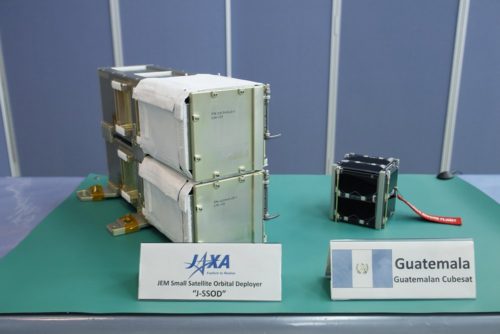
JAXA’s JEM CubeSat deployer on left and the Quetzal-1 CubeSat built by students at the Universidad del Valle de Guatemala. Credit: JAXA

See also  An University Team from Guatemala Selected for Second Round of KiboCUBE- JAXA.

** The UC Irvine CubeSat  team gives an update on their project:

** AMSAT news on student and amateur CubeSat/smallsat projects: ANS-005 AMSAT News Service Special Bulletin

  • AMSAT Member KC9ZJX Receives 2020 Martin Luther King Jr. Award
  • Changes to AMSAT-NA TLE Distribution for January 2, 2020
  • Space Fence nearing operational acceptance by U.S. Air Force
  • VUCC Awards-Endorsements for January 2020
  • Winter Field Day to Include Limited Satellite Operations
  • Hamfests, Conventions, Maker Faires, and Other Events
  • Upcoming Satellite Operations
  • Satellite Shorts From All Over

General CubeSat/SmallSat info:

    • How Tiny Satellites Can Help Us Weather Through Hurricanes | Dr. Kerri Cahoy | TEDxBocaRaton:

Kerri Cahoy is an Associate Professor in Aeronautics and Astronautics at the Massachusetts Institute of Technology. Kerri leads the Space Telecommunications, Astronomy, and Radiation (STAR) Laboratory, and design, builds, launches, and operates shoebox-sized satellites called CubeSats. Kerri works with CubeSats to improve hurricane tracking using an instrument called a microwave radiometer. Her team flies miniature microwave radiometers on CubeSats and has shown that they work as well as larger and more expensive satellites with the Microsized Microwave Atmospheric Satellite (MicroMAS-2A). The next step is to go from only having one CubeSat in orbit to several, so that they can fly over the same location more often, like every fifteen minutes instead of only two or three times a day. Kerri has a Ph.D. and master’s in Electrical Engineering from Stanford University, and a bachelor’s in Electrical Engineering from Cornell University.

Join Spire Aviation from Freightwaves for an introduction to impactful uses of our global ADS-B data to illuminate trends in aircraft operation. In addition, we will also demonstrate our Aviation Weather Product.

== Amazon Ad ==

Introduction to CubeSat Technology and Subsystem:
Orbit Design, Debris Impact, and Orbital Decay Prediction

Student and amateur CubeSat news roundup – Jan.2.2020

A sampling of recent articles, press releases, etc. related to student and amateur CubeSat / SmallSat projects and programs (find previous smallsat roundups here):

** “Kesari” CubeSat built by Indian students in six months. After launch to orbit on an Indian rocket, the team at the NRI Institute of Technology (NRIIT) at Agiripalli in Krishna district will upload their country’s national anthem to the demonstration spacecraft: Satellite built by students to beam anthem from space – The Hindu

“The satellite will start functioning once put in orbit. Antennas fixed to ‘Kesari’ will beam the anthem in Morse code as high-frequency radio waves. The anthem can be heard by ham radio operators and on walkie talkies across the world,” Mr. Salvendar told The Hindu on Friday.

Mr. Manoj Kumar said that ‘Kesari’ will have a lifespan of more than six months if equipped with solar panels. He thanked faculty Sk. Abdul Rehaman and the institute management for encouraging them in designing the mini satellite.

NRIIT Placement Cell director N.V. Surendra Babu said that Mr. Salvendar and his team designed the 450-gram satellite in just 45 days. The students said they drew inspiration from Sputnik-1 designed by Russian scientists.

** PocketQubes will enable satellite projects for educational and non-profit organizations at even lower costs than CubeSats.

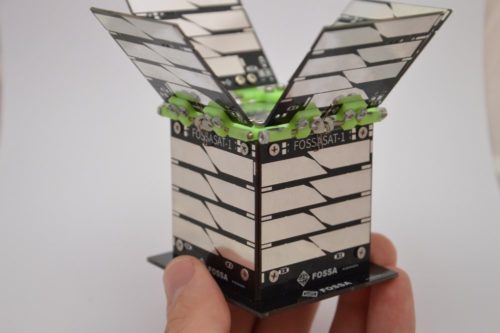
FOSSASAT-1, for example, is a PocketQube demo mission recently launched for Fossa Systems on a Rocket Lab Electron rocket.

FossaSat is a pocketqube satellite which is being developed using free and open source ethics, more detailed information about the hardware and software involved in this project can be found here.

It will create the world’s first free and open source IoT network. The satellite will test the new LoRa spread spectrum modulation, allowing unprecedented link budgets with <5$ receivers, democratizing telecommunications to millions of students and individuals worldwide.

Based on the 5x5x5cm PocketQube standard, it will truly reduce the barrier to entry for launching a satellite with launch and development costs under 30000 EUR.

FOSSASAT-1 is built to the PocketQube standard with a size of 5 × 5 × 5 centimeters. Image credits: Fossa Systems

Initial results are generally positive:

** AMSAT news on student and amateur CubeSat/smallsat projects: ANS-363 AMSAT News Service Special Bulletin

  • First Element of ARISS Next Generation Radio System Readied for Launch on SpaceX CRS-20
  • ARISS SSTV Event Planned for December 28 – January 1
  • Reminder: AMSAT CW Day on January 1
  • Changes to AMSAT TLE Distribution for December 26
  • Upcoming Satellite Operations
  • Satellite Shorts From All Over

General CubeSat/SmallSat info:

== Amazon Ad ==

Introduction to CubeSat Technology and Subsystem:
Orbit Design, Debris Impact, and Orbital Decay Prediction

Student and amateur CubeSat news roundup – Dec.9.2019

A sampling of recent articles, press releases, etc. related to student and amateur CubeSat / SmallSat projects and programs (find previous smallsat roundups here):

**AzTechSat-1 CubeSat built by Mexican students reaches the ISS: Mexican Students Launch a Small Satellite to the Space Station | NASA

The first satellite built by students in Mexico for launch from the International Space Station is smaller than a shoebox but represents a big step for its builders.

The project is part of NASA’s CubeSat Launch Initiative, which offers universities, high schools and non-profit organizations the opportunity to fly small satellites. Innovative technology partnerships keep down the cost, providing students a way to obtain hands-on experience developing flight hardware.

A multidisciplinary team of students at Universidad Popular Autónoma del Estado de Puebla (UPAEP), in Puebla, Mexico, built the CubeSat for AzTechSat-1. The investigation demonstrates communication within a satellite network in low-Earth orbit. Such Intra-satellite communication could reduce the need for ground stations, lowering the cost and increasing the number of data downloads possible for satellite applications.

“Jose Cortez of NASA Ames (left) and Joel Contreras of UPAEP (right), conduct final integration of AzTechSat-1 into the Nanoracks CubeSat Deployer (NRCSD) in preparation for launch to the International Space Station. Credits: NASA”

** University of the Philippines team building STAMINA4Space CubeSat: Meet the future of Philippine space exploration | ABS-CBN News

After a series of tests and screening, Wee and seven others from different science backgrounds and regions were accepted into UP’s graduate program for electrical engineering and into the Space Technology and Applications Mastery, Innovation and Advancement (STAMINA4Space) program of the DOST.

For Dr. Joel Joseph Marciano, who heads the STAMINA4Space program and the DOST-ASTI, said making cube satellites locally is an important step for the Philippines.

“Building satellites is one way you can be in space,” he said. “These smaller satellites are becoming more powerful, can take meaningful missions, experiments in space.”

** AMSAT news on student and amateur CubeSat/smallsat projects: ANS-342 AMSAT News Service Special Bulletin

  • AMSAT Member Melissa Pore, KM4CZN, Named 2020 Carole Perry Educator of the Year
  • AMSAT Vice President – Educational Relations Alan Johnston, KU2Y, Participates in Hackaday Hack Chat
  • AMSAT to Join ARRL in Opposition to FCC Proposal to Eliminate 3.3 – 3.5 GHz Amateur Allocation
  • Chris Taron, NK1K, Completes Satellite DXCC via LEO Satellites
  • Duchifat3 with V/u FM Transponder to Launch December 11
  • Donate to AMSAT Tax-Free From Your IRA
  • AZTECHSAT-1 Cubesat to Transmit Emergency Traffic using WINLINK
  • AMSAT-SA to Shift Main Focus to AfriCUBE, a Digital SDR CubeSat
  • LSF Heads Back to Orbit with the Qubik Mission
  • VUCC Awards And Endorsements for November 2019
  • Upcoming ARISS Activities
  • Upcoming Satellite Operations
  • Satellite Shorts From All Over

See also

General CubeSat/SmallSat info:

== Amazon Ad ==

Introduction to CubeSat Technology and Subsystem:
Orbit Design, Debris Impact, and Orbital Decay Prediction

Student and amateur CubeSat news roundup – Dec.2.2019

A sampling of recent articles, press releases, etc. related to student and amateur CubeSat / SmallSat projects and programs (find previous smallsat roundups here):

** The Community Satellite Project aims to crowd-develop CubeSats

The Community Satellite Project is an online group of international space professionals and students, collaborating to launch BATSAT, a crowd-developed cubesat. The group was initially founded in early November 2019 via r/space, following a reputable space company’s offer of a free launch.

Our goals are not only to develop and use BATSAT to conduct cutting edge aerospace research, but to facilitate mentorship between space experts and students.

We are currently in the recruiting and mission defining stages of this process.

If you are interested in becoming part of the team, please get in touch via our Join Us page.

This article profiles one of the project’s founders and describes their plans: Southland teenager on mission to build satellite | Stuff.co.nz

More than 740 people have joined the online group, including aerospace engineers, avionics and payload experts, cloud engineers, satellite ground station engineers and university students from all over the world. 

Of this, 260 supporters with specialist skills have been assigned to various teams to confirm the parameters of the project, with regular conversations held using an online meeting app. 

The collective decision is to build two small satellites, each about the size of a Rubik’s Cube, to test a theory about whether electro-magnetic tether straps can be used to de-orbit a satellite once it has come to the end of its life.

More about the project:

** Freeport, New York high school team building CubeSat funded with NASA grant:  Freeport High School prepares for liftoff | Herald Community Newspapers – www.liherald.com

The students have broken their project into phases, and are now in the construction phase. Once Strong and Johnson finish building the satellite, they will conduct environmental tests to expose it to vibration, vacuum and temperature conditions closely identical to space.

Then the students will work with NASA to prepare to launch it into space. After the launch, the seniors will perform satellite operations and conduct space experiments. Once the space mission is complete, the nanosatellite will fall to Earth, possibly burning up in the atmosphere.

See also District Wins Grant to Build CubeSat – Freeport Public Schools.

** AMSAT news on student and amateur CubeSat/smallsat projects: ANS-335 AMSAT News Service Special Bulletin

  • AMSAT Fox Leaderboard Will Show Monthly Leaders
  • AMSAT Will Be at Superstition Superfest Hamfest
  • Electron Booster on the Pad for Rocket Lab’s 10th Mission
  • FCC Seeks to Clear Radio Amateurs Out of 3.4 GHz
  • WRC-19 Final Report: Small Satellites and the 1240-1300 MHz Band
  • AMSAT Auction Celebrating 45th Birthday of AO-7 Raises $480
  • Upcoming ARISS Contact Schedule
  • Upcoming Satellite Operations
  • Satellite Shorts From All Over

General CubeSat/SmallSat info:

The Juventas radar CubeSat to be deployed by the Hera mission to study the Didymos asteroids. Credits: ESA

== Amazon Ad ==

Introduction to CubeSat Technology and Subsystem:
Orbit Design, Debris Impact, and Orbital Decay Prediction

Student and amateur CubeSat news roundup – Nov.24.2019

A sampling of recent articles, press releases, etc. related to student and amateur CubeSat / SmallSat projects and programs (find previous smallsat roundups here):

** Update on Arizona State’s Phoenix CubeSat, which reached the ISS on the recent Northrop Grumman Cygnus cargo mission: Arizona State University students design satellite to research Urban Heat Island – abc15.com

“Concrete and asphalt tend to retain the heat of the sun and heat the place. We want to know exactly why, where, and when the cities are heating up,” De La Vega stated.

Once the satellite gets deployed by astronauts onboard the International Space Station in January, the team will be testing, calibrating, and hopefully, receiving data from the satellite for further research.

ASU Phoenix Cubesat Diagram
Component diagram of the ASU Phoenix Cubesat.

** And an update on the Univ. of Minnesota’s SOCRATES cubesat, which also rode the Cygnus to the ISS: The University of Minnesota Sends CubeSat to Space – Food & Beverage Herald

[SOCRATES} is the first-ever made by the university in a joint venture featuring university professors and students from a variety of space-related fields and engineering. The project is under NASA’s Undergraduate Student Instrument Project, which was started three years ago to give students opportunities to build and launch satellites into space.

More than 30 students from the university were interested in the program, led by Kyle Houser, the chief engineer and Burgett, the project manager. The SOCRATES was developed in the university’s Small Satellite Project Lab, founded by Demoz Gebre and physics professor Lindsay Glesener for a small satellite study.

The SOCRATES is fitted with state-of-the-art X-ray detection sensors to provide navigation when GPS is inaccessible. The satellite will also be able to capture information on electronic acceleration from solar flares to aid in the study of the solar phenomenon. The SOCRATES will be released to orbit the Earth in January 2020 from the International Space Station, where it is held at the moment.

** AMSAT news on student and amateur CubeSat/smallsat projects: ANS-328 AMSAT News Service Special Bulletin

  • AMSAT Auction Celebrating the 45th Birthday of AO-7 Now Live
  • November 18 Marked 2nd Anniversary On Orbit for AMSAT-OSCAR 91
  • November 21 Marked 6th Anniverary of AMSAT-UK’s AO-73 FUNcube-1
  • Proposed FCC Auction of C-Band Increases Competition for Allocations
  • Satellite Operations From the Queen Mary on December 14
  • Donate to AMSAT Tax-Free From Your IRA
  • Open Source ‘APRS to Discord’ Bridge Project Begins Testing
  • ARISS Activities
  • Upcoming Satellite Operations
  • The Voyage Home: Japan’s Hayabusa-2 Probe Heads Back to Earth
  • Satellite Shorts From All Over

General CubeSat/SmallSat info:

== Amazon Ad ==

Introduction to CubeSat Technology and Subsystem:
Orbit Design, Debris Impact, and Orbital Decay Prediction