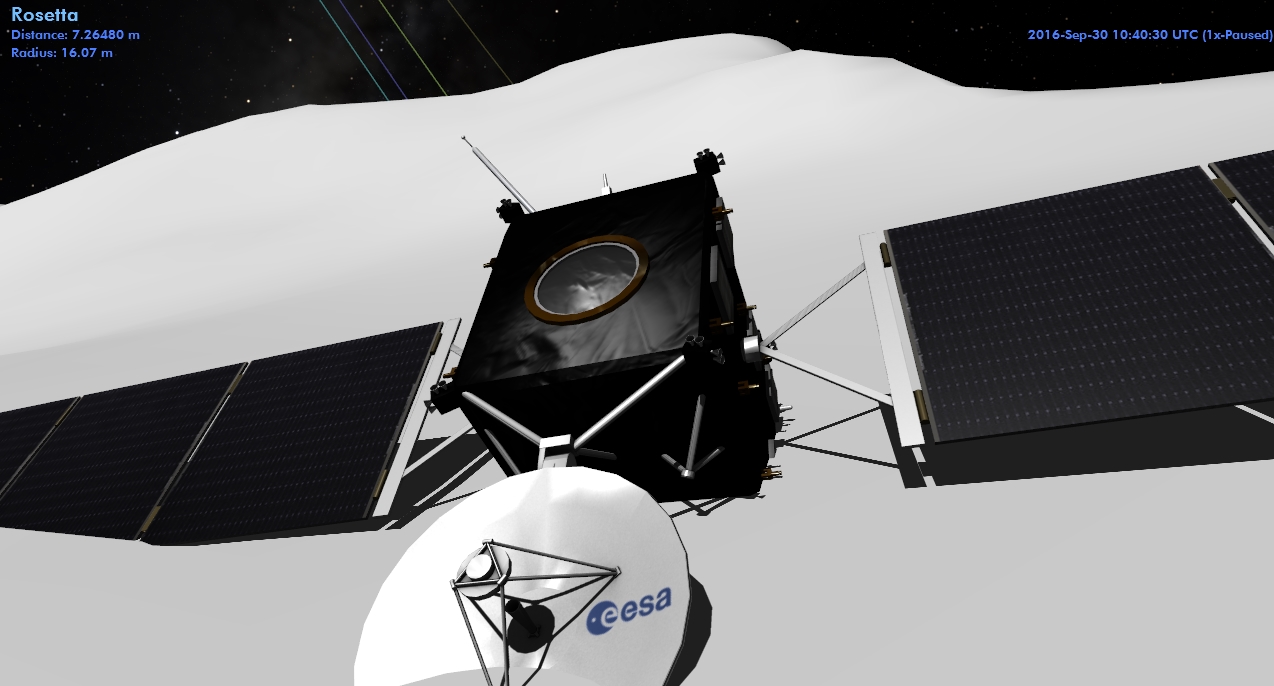
The European Space Agency’s Rosetta mission to the Comet 67P/Churyumov-Gerasimenko will end soon with the spacecraft touching down onto the icy rock sometime around September 29-30, 2016.
This video animation of Rosetta’s mission end was created with BINARY SPACE’s SpaceTraveller™, “the ultimate Solar System & Space Missions Simulator”:
The SpaceTraveller™ is a 3D Solar System & Space Missions Simulator designed for the Microsoft® Windows® platform (Microsoft® Windows® 7 or higher only). Download it and have a try for free: http://www.binary-space.com/products….
A lonely 3-mile-high (5-kilometer-high) mountain on Ceres is likely volcanic in origin, and the dwarf planet may have a weak, temporary atmosphere. These are just two of many new insights about Ceres from NASA’s Dawn mission published this week in six papers in the journal Science.
Ceres’ lonely mountain, Ahuna Mons, is seen in this simulated perspective view. The elevation has been exaggerated by a factor of two. The view was made using enhanced-color images from NASA’s Dawn mission. Images taken using blue (440 nanometers), green (750 nanometers) and infrared (960 nanometers) spectral filters were combined to create the view. The spacecraft’s framing camera took the images from Dawn’s low-altitude mapping orbit, from an altitude of 240 miles (385 kilometers) in August 2016. The resolution of the component images is 120 feet (35 meters) per pixel.Chris Russell, principal investigator of the Dawn mission, based at the University of California, Los Angeles, said
“Dawn has revealed that Ceres is a diverse world that clearly had geological activity in its recent past”
Ahuna Mons as a Cryovolcano
Ahuna Mons is a volcanic dome unlike any seen elsewhere in the solar system, according to a new analysis led by Ottaviano Ruesch of NASA’s Goddard Space Flight Center, Greenbelt, Maryland, and the Universities Space Research Association. Ruesch and colleagues studied formation models of volcanic domes, 3-D terrain maps and images from Dawn, as well as analogous geological features elsewhere in our solar system. This led to the conclusion that the lonely mountain is likely volcanic in nature. Specifically, it would be a cryovolcano — a volcano that erupts a liquid made of volatiles such as water, instead of silicates.
“This is the only known example of a cryovolcano that potentially formed from a salty mud mix, and that formed in the geologically recent past,” Ruesch said.
A surprising finding emerged in the paper led by Russell: Dawn may have detected a weak, temporary atmosphere. Dawn’s gamma ray and neutron (GRaND) detector observed evidence that Ceres had accelerated electrons from the solar wind to very high energies over a period of about six days. In theory, the interaction between the solar wind’s energetic particles and atmospheric molecules could explain the GRaND observations.
A temporary atmosphere would be consistent with the water vapor the Herschel Space Observatory detected at Ceres in 2012-2013. The electrons that GRaND detected could have been produced by the solar wind hitting the water molecules that Herschel observed, but scientists are also looking into alternative explanations.
“We’re very excited to follow up on this and the other discoveries about this fascinating world,” Russell said.
Ceres: Between a Rocky and Icy Place
While Ahuna Mons may have erupted liquid water in the past, Dawn has detected water in the present, as described in a study led by Jean-Philippe Combe of the Bear Fight Institute, Winthrop, Washington. Combe and colleagues used Dawn’s visible and infrared mapping spectrometer (VIR) to detect probable water ice at Oxo Crater, a small, bright, sloped depression at mid-latitudes on Ceres.
The small, bright crater Oxo (6 miles, 10 kilometers wide) on Ceres is seen in this perspective view. The elevation has been exaggerated by a factor of two. The view was made using enhanced-color images from NASA’s Dawn mission. Dawn’s visible and infrared mapping spectrometer (VIR) has found evidence of water ice at this crater. The results were published in the journal Science in Sept. 2016. Images taken using blue (440 nanometers), green (750 nanometers) and infrared (960 nanometers) spectral filters were combined to create the view. The spacecraft’s framing camera took the images from Dawn’s low-altitude mapping orbit, from an altitude of 240 miles (385 kilometers) in August 2016. The resolution of the component images is 120 feet (35 meters) per pixel.Exposed water-ice is rare on Ceres, but the low density of Ceres, the impact-generated flows and the very existence of Ahuna Mons suggest that Ceres’ crust does contain a significant component of water-ice. This is consistent with a study of Ceres’ diverse geological features led by Harald Hiesinger of the Westfälische Wilhelms-Universität, Münster, Germany. The diversity of geological features on Ceres is further explored in a study led by Debra Buczkowski of the Johns Hopkins Applied Physics Laboratory, Laurel, Maryland.
Impact craters are clearly the most abundant geological feature on Ceres, and their different shapes help tell the intricate story of Ceres’ past. Craters that are roughly polygonal — that is, shapes bounded by straight lines — hint that Ceres’ crust is heavily fractured. In addition, several Cerean craters have patterns of visible fractures on their floors.
Some, like tiny Oxo, have terraces, while others, such as the large Urvara Crater (106 miles, 170 kilometers wide), have central peaks. There are craters with flow-like features, and craters that imprint on other craters, as well as chains of small craters. Bright areas are peppered across Ceres, with the most reflective ones in Occator Crater. Some crater shapes could indicate water-ice in the subsurface.
The dwarf planet’s various crater forms are consistent with an outer shell for Ceres that is not purely ice or rock, but rather a mixture of both — a conclusion reflected in other analyses. Scientists also calculated the ratio of various craters’ depths to diameters, and found that some amount of crater relaxation must have occurred. Additionally, there are more craters in the northern hemisphere of Ceres than the south, where the large Urvara and Yalode craters are the dominant features.
“The uneven distribution of craters indicates that the crust is not uniform, and that Ceres has gone through a complex geological evolution,” Hiesinger said.
Distribution of Surface Materials
What are the rocky materials in Ceres’ crust? A study led by Eleonora Ammannito of the University of California, Los Angeles, finds that clay-forming minerals called phyllosilicates are all over Ceres. These phyllosilicates are rich in magnesium and also have some ammonium embedded in their crystalline structure. Their distribution throughout the dwarf planet’s crust indicates Ceres’ surface material has been altered by a global process involving water.
Although Ceres’ phyllosilicates are uniform in their composition, there are marked differences in how abundant these materials are on the surface. For example, phyllosilicates are especially prevalent in the region around the smooth, “pancake”-like crater Kerwan (174 miles, 280 kilometers in diameter), and less so at Yalode Crater (162 miles, 260 kilometers in diameter), which has areas of both smooth and rugged terrain around it. Since Kerwan and Yalode are similar in size, this may mean that the composition of the material into which they impacted may be different. Craters Dantu and Haulani both formed recently in geologic time, but also seem to differ in composition.
“In comparing craters such as Dantu and Haulani, we find that their different material mixtures could extend beneath the surface for miles, or even tens of miles in the case of the larger Dantu,” Ammannito said.
Looking Higher
Now in its extended mission, the Dawn spacecraft has delivered a wealth of images and other data from its current perch at 240 miles (385 kilometers) above Ceres’ surface, which is closer to the dwarf planet than the International Space Station is to Earth. The spacecraft will be increasing its altitude at Ceres on Sept. 2, as scientists consider questions that can be examined from higher up.
Dawn’s mission is managed by JPL for NASA’s Science Mission Directorate in Washington. Dawn is a project of the directorate’s Discovery Program, managed by NASA’s Marshall Space Flight Center in Huntsville, Alabama. UCLA is responsible for overall Dawn mission science. Orbital ATK Inc., in Dulles, Virginia, designed and built the spacecraft. The German Aerospace Center, Max Planck Institute for Solar System Research, Italian Space Agency and Italian National Astrophysical Institute are international partners on the mission team. For a complete list of mission participants, visit: http://dawn.jpl.nasa.gov/mission
More information about Dawn is available at the following sites:
The European Space Agency (ESA) announced today that the Philae spacecraft, deployed from the Rosetta mother ship on November 14, 2014 to land on Comet 67P/Churyumov–Gerasimenko has finally been found. After several bounces it had ended up in a shadowed area. After a short time it went silent since the solar panels could not replenish its battery and before its location could be determined.
Less than a month before the end of the mission, Rosetta’s high-resolution camera has revealed the Philae lander wedged into a dark crack on Comet 67P/Churyumov–Gerasimenko.
Rosetta’s lander Philae has been identified in OSIRIS narrow-angle camera images taken on 2 September 2016 from a distance of 2.7 km. The image scale is about 5 cm/pixel. Philae’s 1 m-wide body and two of its three legs can be seen extended from the body. The images also provide proof of Philae’s orientation. A Rosetta Navigation Camera image taken on 16 April 2015 is shown at top right for context, with the approximate location of Philae on the small lobe of Comet Churyumov-Gerasimenko marked.The images were taken on 2 September by the OSIRIS narrow-angle camera as the orbiter came within 2.7 km of the surface and clearly show the main body of the lander, along with two of its three legs.
The images also provide proof of Philae’s orientation, making it clear why establishing communications was so difficult following its landing on 12 November 2014.
Close-up of the Philae lander, imaged by Rosetta’s OSIRIS narrow-angle camera on 2 September 2016 from a distance of 2.7 km. The image scale is about 5 cm/pixel. Philae’s 1 m-wide body and two of its three legs can be seen extended from the body. The images also provide proof of Philae’s orientation. The image is a zoom from a wider-scene, and has been interpolated.
“With only a month left of the Rosetta mission, we are so happy to have finally imaged Philae, and to see it in such amazing detail,”
says Cecilia Tubiana of the OSIRIS camera team, the first person to see the images when they were downlinked from Rosetta yesterday.
“After months of work, with the focus and the evidence pointing more and more to this lander candidate, I’m very excited and thrilled that we finally have this all-important picture of Philae sitting in Abydos,”
says ESA’s Laurence O’Rourke, who has been coordinating the search efforts over the last months at ESA, with the OSIRIS and SONC/CNES teams.
An OSIRIS narrow-angle camera image taken on 2 September 2016 from a distance of 2.7 km in which Philae was definitively identified. The image has been processed to adjust the dynamic range in order to see Philae while maintaining the details of the comet’s surface. Philae is located at the far right of the image, just above centre. The image scale is about 5 cm/pixel.Philae was last seen when it first touched down at Agilkia, bounced and then flew for another two hours before ending up at a location later named Abydos, on the comet’s smaller lobe.
After three days, Philae’s primary battery was exhausted and the lander went into hibernation, only to wake up again and communicate briefly with Rosetta in June and July 2015 as the comet came closer to the Sun and more power was available.
A number of Philae’s features can be made out in this image taken by Rosetta’s OSIRIS narrow-angle camera image on 2 September 2016. The images were taken from a distance of 2.7 km, and have a scale of about 5 cm/pixel. Philae’s 1 m wide body and two of its three legs can be seen extended from the body. Several of the lander’s instruments are also identified, including one of the CIVA panoramic imaging cameras, the SD2 drill and SESAME-DIM (Surface Electric Sounding and Acoustic Monitoring Experiment Dust Impact Monitor).However, until today, the precise location was not known. Radio ranging data tied its location down to an area spanning a few tens of metres, but a number of potential candidate objects identified in relatively low-resolution images taken from larger distances could not be analysed in detail until recently.
While most candidates could be discarded from analysis of the imagery and other techniques, evidence continued to build towards one particular target, which is now confirmed in images taken unprecedentedly close to the surface of the comet.
At 2.7 km, the resolution of the OSIRIS narrow-angle camera is about 5 cm/pixel, sufficient to reveal characteristic features of Philae’s 1 m-sized body and its legs, as seen in these definitive pictures.
“This remarkable discovery comes at the end of a long, painstaking search,” says Patrick Martin, ESA’s Rosetta Mission Manager. “We were beginning to think that Philae would remain lost forever. It is incredible we have captured this at the final hour.”
[ Matt Taylor, ESA’s Rosetta project scientist says,]
“This wonderful news means that we now have the missing ‘ground-truth’ information needed to put Philae’s three days of science into proper context, now that we know where that ground actually is!” …
[ Holger Sierks, principal investigator of the OSIRIS camera adds,]
“Now that the lander search is finished we feel ready for Rosetta’s landing, and look forward to capturing even closer images of Rosetta’s touchdown site,” …
The discovery comes less than a month before Rosetta descends to the comet’s surface. On 30 September, the orbiter will be sent on a final one-way mission to investigate the comet from close up, including the open pits in the Ma’at region, where it is hoped that critical observations will help to reveal secrets of the body’s interior structure.
Further information on the search that led to the discovery of Philae, along with additional images, will be made available soon.
![PIA20915-640x350[1]](http://hobbyspace.com/Blog/wp-content/uploads/2016/09/PIA20915-640x3501.jpg)
![pia20916_inc[1]](http://hobbyspace.com/Blog/wp-content/uploads/2016/09/pia20916_inc1.jpg)
![ESA_Rosetta_PhilaeFound-1024x640[1]](http://hobbyspace.com/Blog/wp-content/uploads/2016/09/ESA_Rosetta_PhilaeFound-1024x6401-1024x640.jpg)
![Philae_close-up_node_full_image_2[1]](http://hobbyspace.com/Blog/wp-content/uploads/2016/09/Philae_close-up_node_full_image_21.png)
![OSIRIS_narrow-angle_camera_image_with_Philae_2_September_node_full_image_2[1]](http://hobbyspace.com/Blog/wp-content/uploads/2016/09/OSIRIS_narrow-angle_camera_image_with_Philae_2_September_node_full_image_21.png)
![Philae_close-up_labelled_node_full_image_2[1]](http://hobbyspace.com/Blog/wp-content/uploads/2016/09/Philae_close-up_labelled_node_full_image_21.jpg)