Category Archives: Space Systems

Video: Alan Stern and David Grinspoon talk about the “Epic First Mission to Pluto”

Dr. Alan Stern (Southwest Research Inst) and Dr. David Grinspoon (Planetary Science Inst) recently gave a public lecture on the New Horizon  mission to Pluto and beyond:  

In July 2015, the New Horizons spacecraft flew by Pluto, revealing its surface to our view for the first time. In this program, Drs. Stern and Grinspoon give us an insider’s view of how this complex mission came to be and what it discovered at the edge of our solar system. Their new book (like the talk and with the same title) tells the full story of the mission, its ground-breaking discoveries at Pluto, and where it’s going next. Here is new science, straight from the source, with great insight into what it’s like to be part of a pioneering planetary mission.

Grinspoon and Stern have written a well-reviewed new book about the New Horizon project: Chasing New Horizons: Inside the Epic First Mission to Pluto.

And the two have refuted the silly assertion that Pluto is not a planet: Why Pluto is a planet and many moons are, too – The Washington Post

… the process for redefining planet was deeply flawed and widely criticized even by those who accepted the outcome. At the 2006 IAU conference, which was held in Prague, the few scientists remaining at the very end of the week-long meeting (less than 4 percent of the world’s astronomers and even a smaller percentage of the world’s planetary scientists) ratified a hastily drawn definition that contains obvious flaws. For one thing, it defines a planet as an object orbiting around our sun — thereby disqualifying the planets around other stars, ignoring the exoplanet revolution, and decreeing that essentially all the planets in the universe are not, in fact, planets.

Even within our solar system, the IAU scientists defined “planet” in a strange way, declaring that if an orbiting world has “cleared its zone,” or thrown its weight around enough to eject all other nearby objects, it is a planet. Otherwise it is not. This criterion is imprecise and leaves many borderline cases, but what’s worse is that they chose a definition that discounts the actual physical properties of a potential planet, electing instead to define “planet” in terms of the other objects that are — or are not — orbiting nearby. This leads to many bizarre and absurd conclusions. For example, it would mean that Earth was not a planet for its first 500 million years of history, because it orbited among a swarm of debris until that time, and also that if you took Earth today and moved it somewhere else, say out to the asteroid belt, it would cease being a planet.

See also Pluto’s demotion ignores astronomical history | Science News

====
Videos: “Space to Ground” ISS report for May.25.2018

Here is the latest Space To Ground report from NASA on activities related to the International Space Station:

And here’s a report on what’s been happening at Kennedy Space Center

====

Videos: Orbital ATK Cygnus cargo spacecraft arrives at the ISS

The Orbital ATK Cygnus spacecraft launched on Monday made its scheduled rendezvous with the International Space Station this morning. NASA astronaut Scott Tingle controlled a robotic arm on the station to capture the craft and bring it up to the Unity module where it was attached.

A brief overview of some of the research payloads delivered to the station:

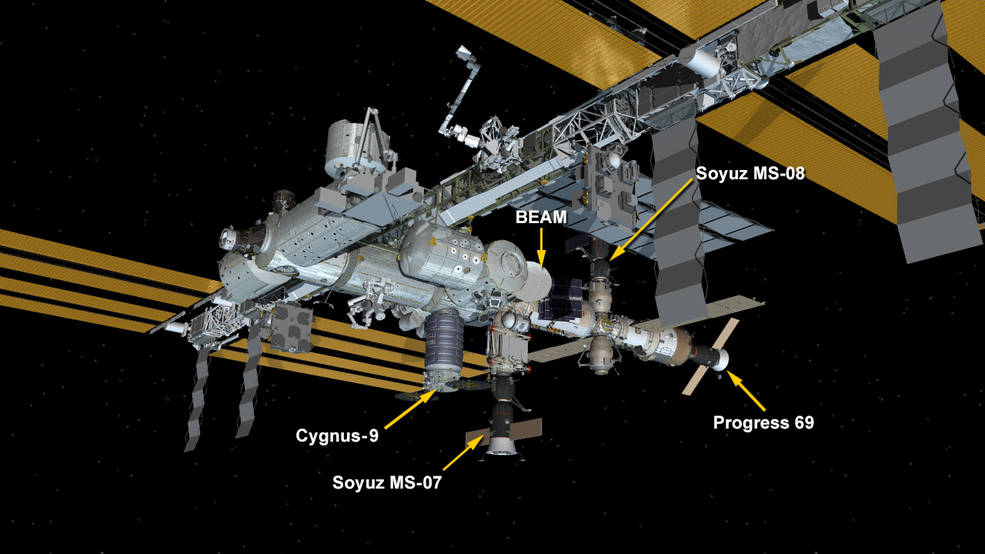
This diagram shows where the Cygnus is berthed on the station as well as where other vehicles are located:

May 24, 2018: International Space Station Configuration. Four spaceships are attached to the space station including the Orbital ATK Cygnus resupply ship, the Progress 69 resupply ship and the Soyuz MS-07 and MS-08 crew ships.

=====

Videos: Rockets launched by SpaceX and Orbital ATK

Two launches by US commercial rocket companies took place this week:

** A SpaceX Falcon 9 launched on Tuesday from Vandenberg Air Force Base on the coast of California with seven satellites. First released after reaching a low earth orbit were the two GRACE-FO (Gravity Recovery and Climate Experiment Follow-on) research spacecraft sponsored by NASA and the German Research Centre for Geosciences (GFZ). After a coast period and a brief firing of the upper stage engine, five Iridium NEXT communications satellites were deployed successfully.

The GRACE-FO spacecraft

will continue a study begun by the original GRACE mission, which proved that water movement can be tracked with high precision by its effect on Earth’s gravitational field. GRACE-FO will continue the record of regional variations in gravity, telling us about changes in glaciers, ground water, sea levels and the health of our planet as a whole. 

The five NEXT satellites join 50 others launched previously by SpaceX, ten at a time. There will be two more F9 launches of NEXT satellites this year to complete the constellation.

Another video of the mission:

also find lots of great pictures of the launch at Official SpaceX Photos | Flickr

IRIDIUM-6/GRACE-FO MISSION

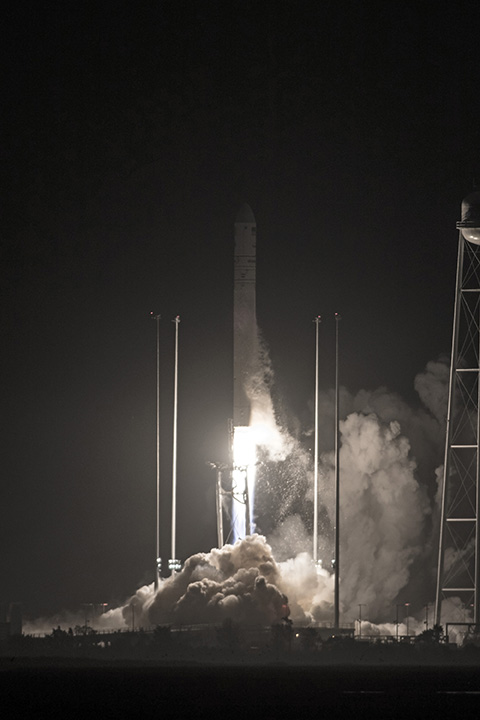
** An Orbital ATK Antares rocket launched early Monday morning from Wallops Island, Virginia with a Cygnus cargo spacecraft that is carrying over 3.3 tons of supplies, equipment, and science and technology R&D payloads to the International Space Station. The Cygnus will reach the ISS on Thursday morning. See the OA-9 Mission Page for updates.

A view of the launch:

The Antares lifts off from the pad a Wallops Island with the OA-9 Cygnus cargo spacecraft.

====

Videos: “Space to Ground” report on the ISS – May.18.2018

Here is the latest Space to Ground report from NASA on activities related to the International Space Station:

A video about a new low-temperature research system going to the ISS:

An experiment in self-replicating systems on the ISS:


=====