Category Archives: Space Systems

Videos: Parker Solar Probe set to launch on mission to study the Sun up close

On August 4th, United Launch Alliance (ULA) aims to launch a big Delta IV Heavy rocket from Cape Canaveral to send NASA’s Parker Solar Probe into an orbit that will bring it far closer to our home star than any previous spacecraft has dared go. (Perhaps your name is aboard the probe.) A cutting-edge heat shield enables the probe to fly directly through the corona, which is the extremely hot ionized plasma that surrounds the Sun.

Here is a new NASA video about the mission:

More about the mission at Parker Solar Probe: Humanity’s First Visit to a Star | NASA:

In order to unlock the mysteries of the Sun’s atmosphere, Parker Solar Probe will use Venus’ gravity during seven flybys over nearly seven years to gradually bring its orbit closer to the Sun. The spacecraft will fly through the Sun’s atmosphere as close as 3.8 million miles to our star’s surface, well within the orbit of Mercury and more than seven times closer than any spacecraft has come before. (Earth’s average distance to the Sun is 93 million miles.)

Flying into the outermost part of the Sun’s atmosphere, known as the corona, for the first time, Parker Solar Probe will employ a combination of in situ measurements and imaging to revolutionize our understanding of the corona and expand our knowledge of the origin and evolution of the solar wind. It will also make critical contributions to our ability to forecast changes in Earth’s space environment that affect life and technology on Earth.

A simulation of the orbit that will bring the probe closer and closer to the sub at perigee:

====

 

Videos: “Space to Ground” report on the ISS – July.6.2018

Here is this week’s Space to Ground report form NASA on activities related to the International Space Station:

A report on medical research on the ISS:

And here is a report on other news from NASA:

====


Videos: “Space to Ground” ISS report + SpaceX Falcon 9 launches a Dragon to the ISS

Here is the latest Space to Ground report from NASA about activities related to the International Space Station:

These videos show more highlights of this morning’s SpaceX launch of a Cargo Dragon to the ISS on a Falcon 9 rocket:

A brief overview of science and technology payloads going to the ISS on the Dragon:

And a longer briefing held on Thursday about the science/tech payloads:

====


Video: PlanetVac tested on Masten Space’s Xodiac rocket

I’ve previously posted about the PlanetVac system for gathering a sample of the surface of celestial bodies. It was developed by Honeybee Robotics and supported financially by the Planetary Society. Here is a video report on a recent test using Masten Space Systems‘s Xodiac vertical takeoff and landing reusable rocket.

From the caption:

Taking samples of other worlds is an important step towards discovery, but it is an expensive and complex process. Honeybee Robotics and The Planetary Society
teamed up to solve this problem. This is PlanetVac.

Learn more: http://www.planetary.org/planetvac/

After a few prototypes, PlanetVac is ready to be tested in Mojave, CA on a Xodiac rocket made by Masten Space Systems. NASA selected PlanetVac to fly on a Xodiac rocket as part of its Flight Opportunities program. If this PlanetVac Xodiac test is successful, it will significantly increase its chance of being selected on a real space mission.

PlanetVac Xodiac was supported by Planetary Society members. Over 800 people joined the team by donating. Thank you to the 887 donors from 35 countries who supported PlanetVac Xodiac in 2018. Special thanks to Pendleton Ward and Dustin Roberts who provided generous matching funds to inspire the community in support of the project.

====

Voyager mission posters and infographics

The two Voyager spacecraft were launched in 1977 and successfully visited the gas giant planets of our solar system before heading out into interstellar space. The nuclear powered vehicles are still operating and sending data back to earth.

Check out these posters and infographics from NASA JPL in celebration of the Voyager missions.

The Grand Tour – JPL Travel Poster: NASA’s Voyager mission took advantage of a once-every-175-year alignment of the outer planets for a grand tour of the solar system. The twin spacecraft revealed details about Jupiter, Saturn, Uranus and Neptune – using each planet’s gravity to send them on to the next destination. Voyager set the stage for such ambitious orbiter missions as Galileo to Jupiter and Cassini to Saturn. Today both Voyager spacecraft continue to return valuable science from the far reaches of our solar system.
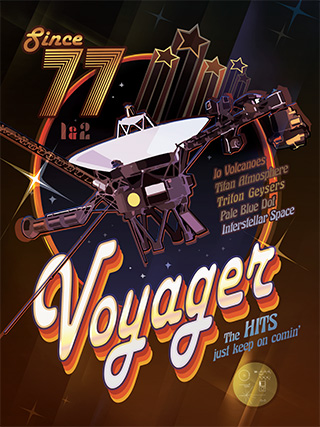
The Voyagers Rock On: Thanks to the twin Voyager spacecraft, music is truly universal: Each carries a Golden Record with sights, sounds and songs from Earth as it sails on through the Milky Way. Recalling the classic rock era of the late 1970s when the Voyagers launched, this poster is an homage to the mission’s greatest hits. Some of the most extraordinary discoveries of the probes’ first 40 years include the volcanoes on Jupiter’s moon Io, the hazy nitrogen atmosphere of Saturn’s moon Titan and the cold geysers on Neptune’s moon Triton. Voyager 1 is also the first spacecraft to deliver a portrait of our planets from beyond Neptune, depicting Earth as a ‘pale blue dot,’ and, as of Aug. 25, 2012, to enter interstellar space. Voyager 2 is expected to enter interstellar space in the coming years. Even after 40 years, the Voyagers’ hits just keep on coming.
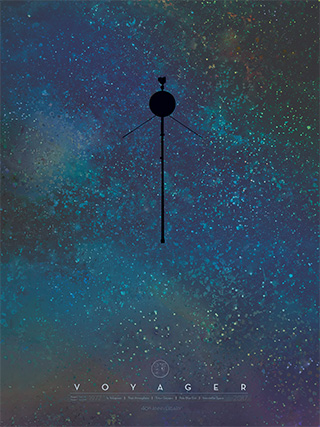
The Voyagers: Reaching for the Stars: The twin Voyager spacecraft, which launched in 1977, are our ambassadors to the rest of the Milky Way, destined to continue orbiting the center of our galaxy for billions of years after they stop communicating with Earth. On Aug. 25, 2012, Voyager 1 became the first human-made object to enter interstellar space, and Voyager 2 is expected to cross over in the next few years. At age 40, the Voyagers are the farthest and longest-operating spacecraft and still have plenty more to discover. This poster captures the spirit of exploration, the vastness of space and the wonder that has fueled this ambitious journey to the outer planets and beyond.

Infographics:

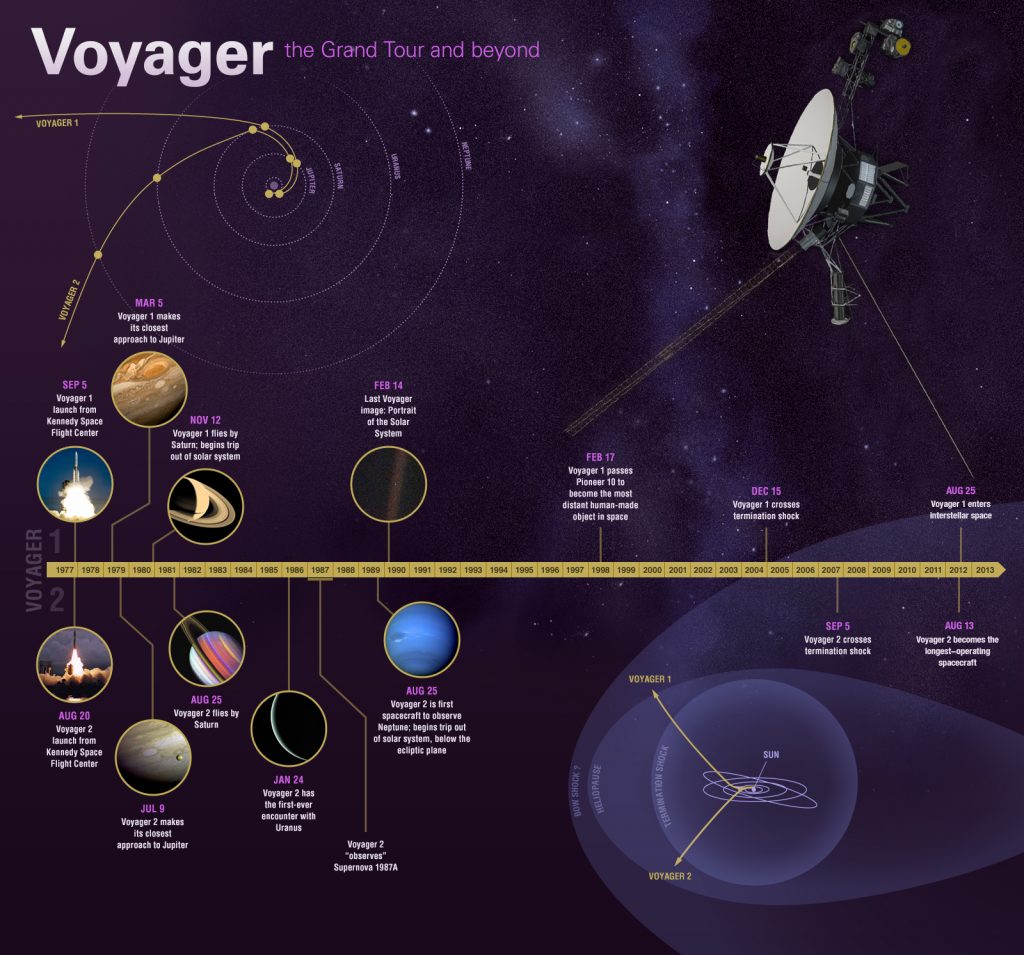
Voyager Mission Timeline

a

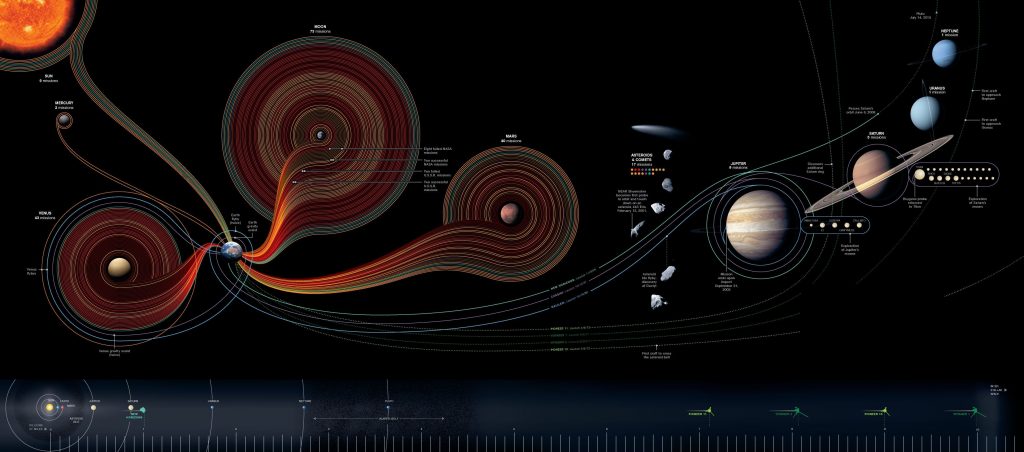
JPL Mission Paths: See how many NASA/JPL past & present missions flew around the universe.

====