Category Archives: Space Systems

Rocket launches: Chinese Long March-2D + Soyuz-2.1a

A couple of launches by China and Russia finish out a busy year of global rocket traffic:

** Chinese Long March-2D/YZ-3 (Chang Zheng-2D/YZ-3) rocket launch today with six atmospheric environment research satellites from the Jiuquan Satellite Launch Center –

More at

** Russian Soyuz-2.1a launched two remote sensing satellites plus 26 educational and commercial small satellites:

From the caption:

A Soyuz-2.1a (Союз-2.1а) launch vehicle, with a Fregat (Фрегат) upper stage, launched the Kanopus-V №5 (Канопус-В № 5) and Kanopus-V №6 (Канопус-В № 6) remote sensing satellites from the Vostochny Cosmodrome in Amur Oblast, Russia, on 27 December 2018, at 02:07 UTC (11:07 local time). As secondary payloads, Soyuz-2.1a launched 26 small satellites: GRUS (Axelspace), Flock 3k (twelve Planet Labs Inc 3U Dove CubeSats), ZACube-2, Lume-1 cubesat, D-Star ONE (iSat), D-Star ONE (Sparrow), eight Lemur-class satellites (Spire Global Inc) and UWE-4 (Würzburg University).

More at:

====


Check out the Best Selling Electronics at Amazon

New Horizons to make New Years flyby of Ultima Thule

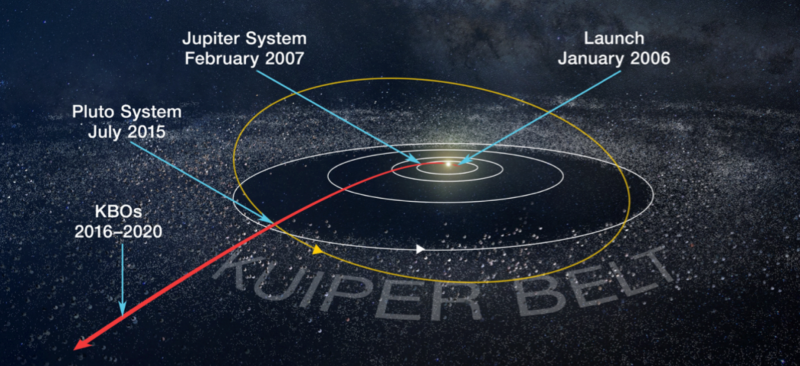
The New Horizons probe made its flyby of Pluto in July of 2015 and then sped on into the Kuiper Belt, a vast region of space inhabited by debris from the earliest era in the formation of the solar system. As a mission bonus, the trajectory of the spacecraft was subsequently nudged by its engine to send the craft past the recently discovered Kuiper object labeled 2014 MU69. With the help of a public contest, the object was given the more interesting name of Ultima Thule –

Thule was a mythical, far-northern island in medieval literature and cartography. Ultima Thule means “beyond Thule”– beyond the borders of the known world—symbolizing the exploration of the distant Kuiper Belt and Kuiper Belt objects that New Horizons is performing, something never before done.

On New Years Day 2019 at 12:33 am EST, New Horizons will make its closest approach to Ultima Thule, which is about 30 kilometers (20 miles) in size. In fact, it will fly three times closer than its nearest distance from the surface of Pluto. Ultima Thule will be the farthest object ever targeted by a spacecraft from earth.

The Kuiper Belt lies in the so-called “third zone” of our solar system, beyond the terrestrial planets (inner zone) and gas giants (middle zone). This vast region contains billions of objects, including comets, dwarf planets like Pluto and “planetesimals” like Ultima Thule. The objects in this region are believed to be frozen in time — relics left over from the formation of the solar system. Credits: NASA/JHUAPL/SwRI

Here is an update: All About Ultima: New Horizons Flyby Target is Unlike Anything Explored in Space – New Horizons – Dec.26.2018

Marc Buie, New Horizons co-investigator from the Southwest Research Institute in Boulder, Colorado, and members of the New Horizons science team discovered Ultima using the Hubble Space Telescope in 2014. The object is so far and faint in all telescopes, little is known about the world beyond its location and orbit. In 2016, researchers determined it had a red color. In 2017, a NASA campaign using ground-based telescopes traced out its size — just about 20 miles (30 kilometers) across — and irregular shape when it passed in front of a star, an event called a “stellar occultation.”

From its brightness and size, New Horizons team members have calculated Ultima’s reflectivity, which is only about 10 percent, or about as dark as garden dirt. Beyond that, nothing else is known about it — basic facts like its rotational period and whether or not it has moons are unknown.

“All that is about to dramatically change on New Year’s Eve and New Year’s Day,” said New Horizons Principal Investigator Alan Stern, also of SwRI. “New Horizons will map Ultima, map its surface composition, determine how many moons it has and find out if it has rings or even an atmosphere. It will make other studies, too, such as measuring Ultima’s temperature and perhaps even its mass. In the space of one 72-hour period, Ultima will be transformed from a pinpoint of light — a dot in the distance — to a fully explored world. It should be breathtaking!”

A sequence of images from the New Horizons camera shows the object growing larger in the field of view:

Here is a preview discussion of the flyby:

Members of the New Horizons team previewed the mission’s New Year’s 2019 flyby of the Kuiper Belt object nicknamed Ultima Thule during a media briefing at the American Astronomical Society’s Division for Planetary Sciences Meeting in Knoxville, Tennessee. The Ultima flyby, with closest approach set for 12:33 a.m. EST in Jan. 1, will be the most distant planetary encounter in history. Team members covered the significance and challenges of this flyby, its science goals and operational timelines, and the Kuiper Belt in the context of solar system exploration.

Presenters are: Alan Stern, principal investigator, Southwest Research Institute Carey Lisse, science team collaborator, Johns Hopkins Applied Physics Laboratory Hal Weaver, project scientist, Johns Hopkins Applied Physics Laboratory Kelsi Singer, co-investigator, Southwest Research Institute

More resources:

====

Chasing New Horizons: Inside the Epic First Mission to Pluto

Mars: Curiosity rover’s itinerary + InSight puts 1st instrument on surface + Insight imaged by itself and by MRO

[ Update: A brief video report from NASA JPL on Mars exploration news:

]

Bob Zimmerman looks at where the Curiosity rover is heading in the coming weeks: Curiosity’s future travels | Behind The Black.

The peak of Mount Sharp is quite a distance to the south, far beyond the bottom of the photograph. Even in these proposed travels the rover will remain in the mountain’s lowest foothills, though the terrain will be getting considerably more dramatic.

===

And here is a NASA JPL update on what Curiosity has been doing recently: Sol 2264: Science and Good Times at Rock Hall – Curiosity Mission Updates – Dec.18.2018

We are still very excited and happy that the final drill hole, “Rock Hall,” on Vera Rubin Ridge was successful over the weekend. Now we get to analyze the drilled sample with rover instruments. We are planning one sol today, and the big event will be delivering some of the Rock Hall sample to the CheMin instrument.

===

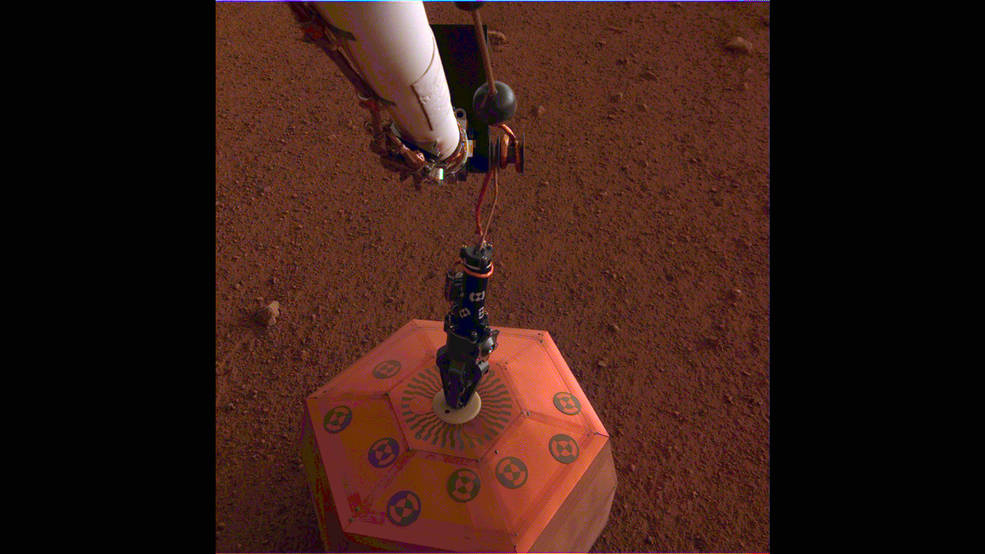
The InSight Lander continues to prepare its equipment for examining the interior of the Red Planet. The seismometer has now been placed on the ground: NASA’s InSight Places First Instrument on Mars | NASA

NASA’s InSight lander has deployed its first instrument onto the surface of Mars, completing a major mission milestone. New images from the lander show the seismometer on the ground, its copper-colored covering faintly illuminated in the Martian dusk. It looks as if all is calm and all is bright for InSight, heading into the end of the year.

“InSight’s timetable of activities on Mars has gone better than we hoped,” said InSight Project Manager Tom Hoffman, who is based at NASA’s Jet Propulsion Laboratory in Pasadena, California. “Getting the seismometer safely on the ground is an awesome Christmas present.”  

NASA’s InSight lander placed its seismometer on Mars on Dec. 19, 2018. This was the first time a seismometer had ever been placed onto the surface of another planet. Credits: NASA/JPL-Caltech

The InSight team has been working carefully toward deploying its two dedicated science instruments onto Martian soil since landing on Mars on Nov. 26. Meanwhile, the Rotation and Interior Structure Experiment (RISE), which does not have its own separate instrument, has already begun using InSight’s radio connection with Earth to collect preliminary data on the planet’s core. Not enough time has elapsed for scientists to deduce what they want to know — scientists estimate they might have some results starting in about a year.

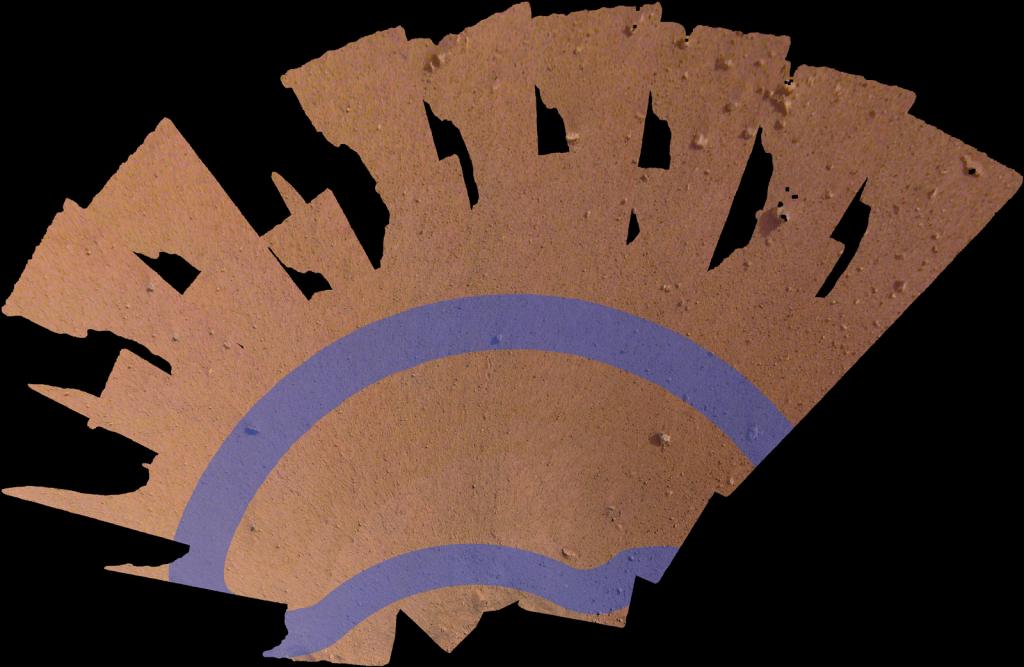
An image of the ground around the lander shows that Insight picked a good spot for its work:

This mosaic, made of 52 individual images from NASA’s InSight lander, shows the workspace where the spacecraft will eventually set its science instruments. The workspace is roughly 14 by 7 feet (4 by 2 meters). The lavender annotation shows where InSight’s seismometer (called the Seismic Experiment for Interior Structure, or SEIS) and heat flow probe (called the Heat Flow and Physical Properties Package, or HP3) can be placed. . Full Image and Caption

In the coming weeks, scientists and engineers will go through the painstaking process of deciding where in this workspace the spacecraft’s instruments should be placed. They will then command InSight’s robotic arm to carefully set the seismometer (called the Seismic Experiment for Interior Structure, or SEIS) and heat-flow probe (known as the Heat Flow and Physical Properties Package, or HP3) in the chosen locations. Both work best on level ground, and engineers want to avoid setting them on rocks larger than about a half-inch (1.3 cm).

“The near-absence of rocks, hills and holes means it’ll be extremely safe for our instruments,” said InSight’s Principal Investigator Bruce Banerdt of NASA’s Jet Propulsion Laboratory in Pasadena, California. “This might seem like a pretty plain piece of ground if it weren’t on Mars, but we’re glad to see that.”

InSight’s landing team deliberately chose a landing region in Elysium Planitia that is relatively free of rocks. Even so, the landing spot turned out even better than they hoped. The spacecraft sits in what appears to be a nearly rock-free “hollow” — a depression created by a meteor impact that later filled with sand. That should make it easier for one of InSight’s instruments, the heat-flow probe, to bore down to its goal of 16 feet (5 meters) below the surface.

===

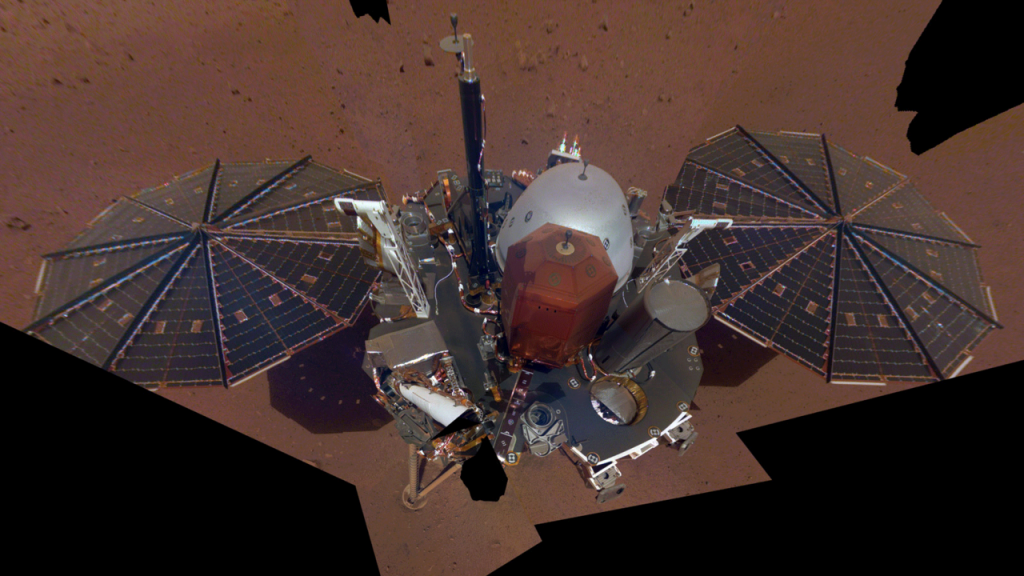
InSight did take some time off recently to do a selfie: NASA’s InSight Takes Its First Selfie – NASA’s InSight Mars Lander

This is NASA InSight’s first full selfie on Mars. It displays the lander’s solar panels and deck. On top of the deck are its science instruments, weather sensor booms and UHF antenna. Image Credit: Nasa/JPL-Caltech. Full Image and Caption

NASA’s InSight lander isn’t camera-shy. The spacecraft used a camera on its robotic arm to take its first selfie — a mosaic made up of 11 images. This is the same imaging process used by NASA’s Curiosity rover mission, in which many overlapping pictures are taken and later stitched together. Visible in the selfie are the lander’s solar panel and its entire deck, including its science instruments.

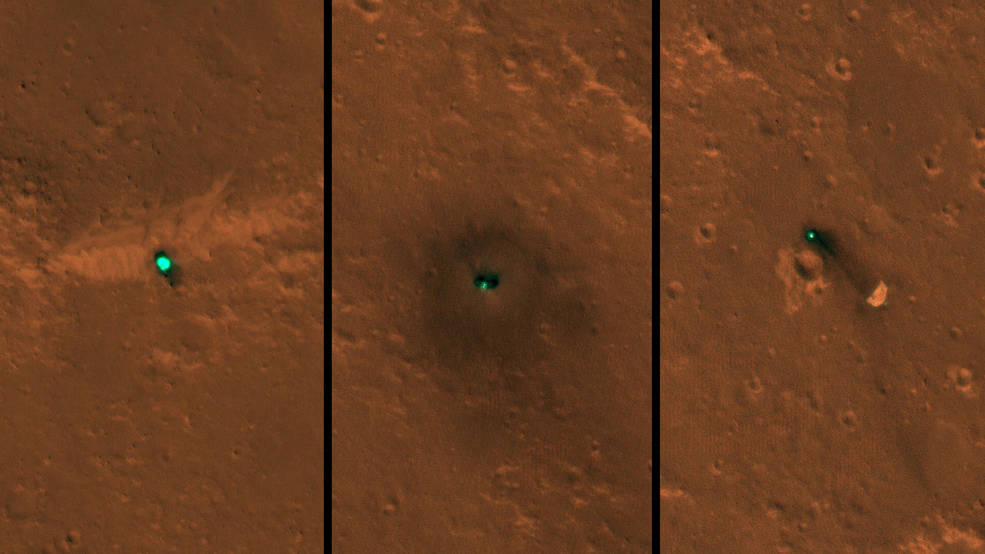
And the HiRISE camera on the Mars Reconnaissance Orbiter (MRO) captured images of InSight, plus its heat shield and parachute, sitting on the ground : Mars InSight Lander Seen in First Images from Space | NASA

NASA’s InSight spacecraft, its heat shield and its parachute were imaged on Dec. 6 and 11 by the HiRISE camera onboard NASA’s Mars Reconnaissance Orbiter. Credits: NASA/JPL-Caltech/University of Arizona. Full image and caption

====

Chasing New Horizons: Inside the Epic First Mission to Pluto

Two rockets set to launch: A SpaceX Falcon 9 and Blue Origin’s New Shepard

[ Update Dec.18 #3: : All the launches set for today have been scrubbed:

Update Dec.18 #2: The Falcon 9 has also been scrubbed for today. No reason yet provided. They will try again tomorrow during a launch window that opens at 9:07 am EST (1407 GMT).

Update Dec.18: The Falcon 9 launch is now set for 9:34 EST. The New Shepard flight has been postponed:

Three other launches are also expected in the next day:

** ULA Delta-4 Heavy to launch a military payload from Vandenberg AFB in California this evening at 5:57 p.m. PST, 8:57 p.m. EST, 0157 GMT (19th)

** Indian Geosynchronous Satellite Launch Vehicle Mk. 2 (GSLV Mk.2) will launch the GSAT 7A communications satellite for the Indian military. Liftoff currently set for 5:40 a.m. EST (1040 GMT) on Wed. Dec. 19.

** Russian/Arianespace Soyuz from Guiana Space Center in South America with a military reconnaissance satellite for France. Liftoff set for 11:37:14 a.m. EST (1637:14 GMT) on Wed. Dec.19.

]

Two rocket launches are scheduled for Tuesday morning within half hour of one another:

** GPS III SV01 MISSION | SpaceX – A Falcon 9 rocket is to place a USAF upgraded GPS satellite into orbit:

SpaceX is targeting Tuesday, December 18 for launch of the United States Air Force’s first Global Positioning System III space vehicle (SV) from Space Launch Complex 40 (SLC-40) at Cape Canaveral Air Force Station, Florida. The 26-minute launch window opens at 9:11 a.m. EST, or 14:11 UTC. The satellite will be deployed to medium Earth orbit approximately 1 hour and 56 minutes after liftoff. A 26-minute backup launch window opens on Wednesday, December 19 at 9:07 a.m. EST, or 14:07 UTC.

Due to mission requirements, SpaceX will not attempt to land Falcon 9’s first stage after launch.

You can watch the live launch webcast below, starting about 15 minutes before liftoff, and find out more about the mission in our press kit.

** Blue Origin New Shepard NS-10 – Nine NASA sponsored experiments will ride Blue‘s reusable New Shepard suborbital rocket to over 100 km in altitude:

New Shepard to fly 9 NASA-sponsored Payloads to Space on NS-10

Blue Origin’s next New Shepard mission (NS-10) is currently targeting liftoff tomorrow at 8:30 am CST [9:30 am EST] / 14:30 UTC. This will be the 10th New Shepard mission and is dedicated to bringing nine NASA-sponsored research and technology payloads into space through NASA’s Flight Opportunities program.

NASA’s Flight Opportunities program is an essential program for researchers providing access to microgravity for technology development. Blue supports NASA’s Flight Opportunities program and its role in perfecting technology for a future human presence in space.

The payloads flying with us on NS-10 include:

Carthage College Space Sciences Program: The Modal Propellant Gauging experiment led by Dr. Kevin Crosby is a joint effort with the NASA Kennedy Space Center Cryogenics Laboratory. It demonstrates a way to measure fuel levels in microgravity by using sound waves.

Controlled Dynamics Inc.: The Vibration Isolation Platform (VIP) aims to separate payloads from the normally occurring vibrations experienced during spaceflight. The payload led by Dr. Scott Green allows researchers to have a clear understanding of microgravity’s effects on their research results.

Johns Hopkins University Applied Physics Lab: On its second flight with Blue, the EM Field experiment will observe and collect data on the naturally occurring electromagnetic fields both inside and outside New Shepard during the launch. Principal Investigator Dr. Todd Smith will use success of this experiment to determine how global measurements of the Earth’s electromagnetic field can be conducted in the future.

NASA Goddard Space Flight Center: Cooling tightly-packed electronics onboard a spacecraft can be challenging, and many solutions have not been able to undergo robust testing. Principal Investigator Franklin Robinson will test one of these solutions in his Flow Boiling in Microgap Coolers experiment.

NASA Johnson Space Center: On its third flight on New Shepard, the Suborbital Flight Experiment Monitor-2 (SFEM-2) led by Dr. Katy Hurlbert will analyze various aspects of the flight environment during New Shepard’s mission profile, measuring cabin pressure, temperature, CO2, acoustic conditions, acceleration and more. The data collected will help future researchers on New Shepard design the most effective experiments for the vehicle.

Purdue University: Dr. Steven Collicott’s payload looks at Zero-Gravity Green Propellant Management Technology, which aims to help advance the use of a safer and more environmentally friendly rocket propellant by better understanding the fuel’s behavior in microgravity.

University of Central Florida: Two teams led by Dr. Josh Colwell and Dr. Addie Dove both have planetary science payloads on NS-10. The Collisions Into Dust Experiment (COLLIDE) aims to understand how dust particles react after surface contact during exploration missions to places such as the Moon, Mars and asteroids. The Collection of Regolith Experiment (CORE) addresses the unique challenge of collecting and analyzing material samples in microgravity.

University of Florida: Dr. Rob Ferl and Dr. Anna-Lisa Paul are adapting technology designed for the ISS to suborbital uses with their experiment, Validating Telemetric Imaging Hardware for Crew-Assisted and Crew-Autonomous Biological Imaging in Suborbital Applications. By recalibrating the way data is collected, the experiment will enable more biological research on suborbital missions.

Make sure to follow us on Twitter for launch day updates and join us at BlueOrigin.com to watch the launch live!

====

Telescopes and Binoculars at Amazon

Student and amateur CubeSat news roundup – Dec.5.2018

A sampling of recent articles, press releases, etc. about student and amateur CubeSat / SmallSat projects and programs:

** Weiss School students part of SpaceX project – wptv.com

As a Space X Falcon 9 rocket launched into orbit on Monday, the students at Weiss School in Palm Beach Gardens cheered over a small piece of cargo that is theirs.

A group of middle schoolers has spent the last three years working on a small satellite known as a “cube sat” which is holding bacteria to be studied in space.

“We’ve been working on this for so long,” says 13-year-old Zoey Freedman.

** Crown Prince announces launch of first Jordanian mini satellite | Jordan Times

On this occasion, CPF’s CEO Tamam Mango was quoted in the statement as saying: “We proudly announce the launch of the first Jordanian mini satellite, designed and built by Jordanian engineers.”

She noted that the satellite was designed and built by 18 young engineering students, with support from five academics and consultants, in various engineering fields, from Jordanian universities. “Jordan has entered both the design sector and implementation of satellites, two elements in line with the Crown Prince Foundation’s mission, providing Jordanian youth with pivotal skills and tools to branch into various sectors, enhancing their capabilities, simultaneously enhancing Jordan’s position/status on various levels.”

** Asia-Pacific satellites on SpaceX’s SSO-A mission | SpaceTech Asia

Among the satellites launched were 13 satellites for Asia-Pacific (APAC) companies or those with a presence here – including the first private satellite ever launched by an Indian company. [Seven of the 13 satellites are from educational institutions.]

** AMSAT’s Fox-1Cliff Amateur Radio CubeSat Launched Successfully – ARRL

 A SpaceX Falcon 9 vehicle carried Fox-1Cliff and several other satellites into space on December 3 at approximately 1334 UTC from Vandenberg Air Force Base in California, following a 1-day launch delay. (See the launch on YouTube.) According to AMSAT, at approximately 0030 UTC on December 4, several stations in Brazil — including PS8MT, PT9BM, and PT2AP — reported hearing the voice beacon “Fox-1Cliff Safe Mode,” confirming that the satellite was alive.

“Just before 0040 UTC, AMSAT Fox-1 Team Member Burns Fisher, WB1FJ, was the first to submit and upload telemetry to the AMSAT servers,” AMSAT reported on its website. “Initial telemetry values show the satellite to be in good health. Thanks to the 29 stations that contributed telemetry during Fox-1Cliff’s initial orbits.”

** Micro satellite ExseedSAT1 to fly on SpaceX – The Hindu BusinessLine

This satellite is freely available for all radio amateurs across the world. It is an open radio transponder that works on ham radio frequencies. One has to pay just Rs 100 license from the WPC to communicate through this satellite.

The Indian government has waived the need for security clearances for amateur radio, enabling a lot of students to quickly apply and obtain radio amateur license, Farhan told BusinessLine.

ExseedSAT1 aims to provide a major boost to private radio operators after ISRO-manufactured micro-satellite, HAMSAT, ceased operations about four years ago. The amateur radio services provide vital communication links during natural disasters.

** Annabelle Grant named winner of Yukon College CubeSat idea contest | Yukon College

Out of 15 submitted ideas from 15 contest participants, Annabelle Grant has been named the winner of the Yukon CubeSat idea contest. 

Grant’s name was pulled from a hat last week. Her idea for the micro-satellite payload is to have it track solid waste in oceans through photographs from low earth orbit.

Other notable ideas submitted to the contest last month involve using data collected from space for education and outreach with the public, using the CubeSat to transmit Yukon stories through amateur radio frequencies, and capturing visual and magnetic studies of the aurora.

As the contest winner, Grant’s name will be featured on the 10cm x 10cm x 20cm satellite due to be launched into orbit in 2020.

See also the Canadian CubeSat Project – Canada.ca.

** USI blasts off into space – The Shield

“Once I heard the word, ‘space’ and ‘USI to be involved with it,’ I immediately asked him how I could jump in on the project,” Loehrlein said. “And he said if he got the grant I’d be asked to be on the team.”

Loehrlein, a senior engineering and finance major, said it felt amazing when the university received the grant.

“It was kind of a mind-blowing opportunity,” Loehrlein said. “I didn’t really expect a small university like USI to originally get a NASA grant for two hundred thousand dollars. So hearing we actually got it and that I could work on a satellite while at USI, it was, honestly, something I couldn’t even fathom at the time.”

* AMSAT news on student and amateur CubeSat/smallsat projects: ANS-336 AMSAT News Service Special Bulletin

  • Fox-1Cliff Launch Targeted for December 2nd
  • AMSAT Web Adds Donation Portal
  • Amateur Radio Contest for Receiving PW-Sat2 Telemetry
  • Additional Amateur Radio Communication Cubesats Launch on SSO-A
  • AMSAT-DL Provides Update for Es’hail-2/P4A Geosynchronous Orbit
  • Nihon University NEXUS VU-mode Linear Transponder Launch Announcement
  • AMSAT Rover Award Updates
  • VUCC Awards-Endorsements for November 2018
  • Upcoming Satellite Operations Reported by KE4AL
  • ESA and RaspberryPi.org Collaborate on Astro Pi Mission Zero
  • MarCo Cubesats Relay NASA’s InSight Mars Lander Touchdown
  • Happy 20th Anniversary to the International Space Station
  • Satellite Shorts From All Over

Other CubeSat and smallsat news & info:

====

The High Frontier: An Easier Way