Category Archives: Space Systems

ISEE-3 Reboot Project investigating possible solution to propulsion failure

The ISEE-3 Reboot Project (see posts here, here, and here) appeared to suffer a serious and irreversible setback this week when they were unable to fire the propulsion system to change the spacecraft’s trajectory. While hydrazine fuel still remained in the tank, there did not appear to be any nitrogen to push the fuel into the engine : Curtain Falls on ISEE-3 Reboot Project as Propulsion System Fails – SpaceNews.com.

Now there is some hope that the nitrogen has not leaked out but has dissolved into the hydrazine. The group is asking for help from anyone who might know how to deal with this:

The team asks:

 Did the Nitrogen pressurizing gas dissolve in the Hydrazine in the tanks?

This is something that we would like to research and for efficiencies sake and to get the job done quicker, we would like our project fans out there to help us in this research. I am reading an old USAF document on this now and it may be nothing, but it also may be something. We need to research the following:

– What is the solubility of Nitrogen in Hydrazine?
– What is the temperature dependence?
– Most important, what is the time required to dissolve 1 kg of Nitrogen in 15 kg of Hydrazine? This is an approximation for both tank systems of course.

This is important. Don’t just throw stuff on the wall, help us research this.
Improvised CO2 scrubber saved the Apollo 13 crew

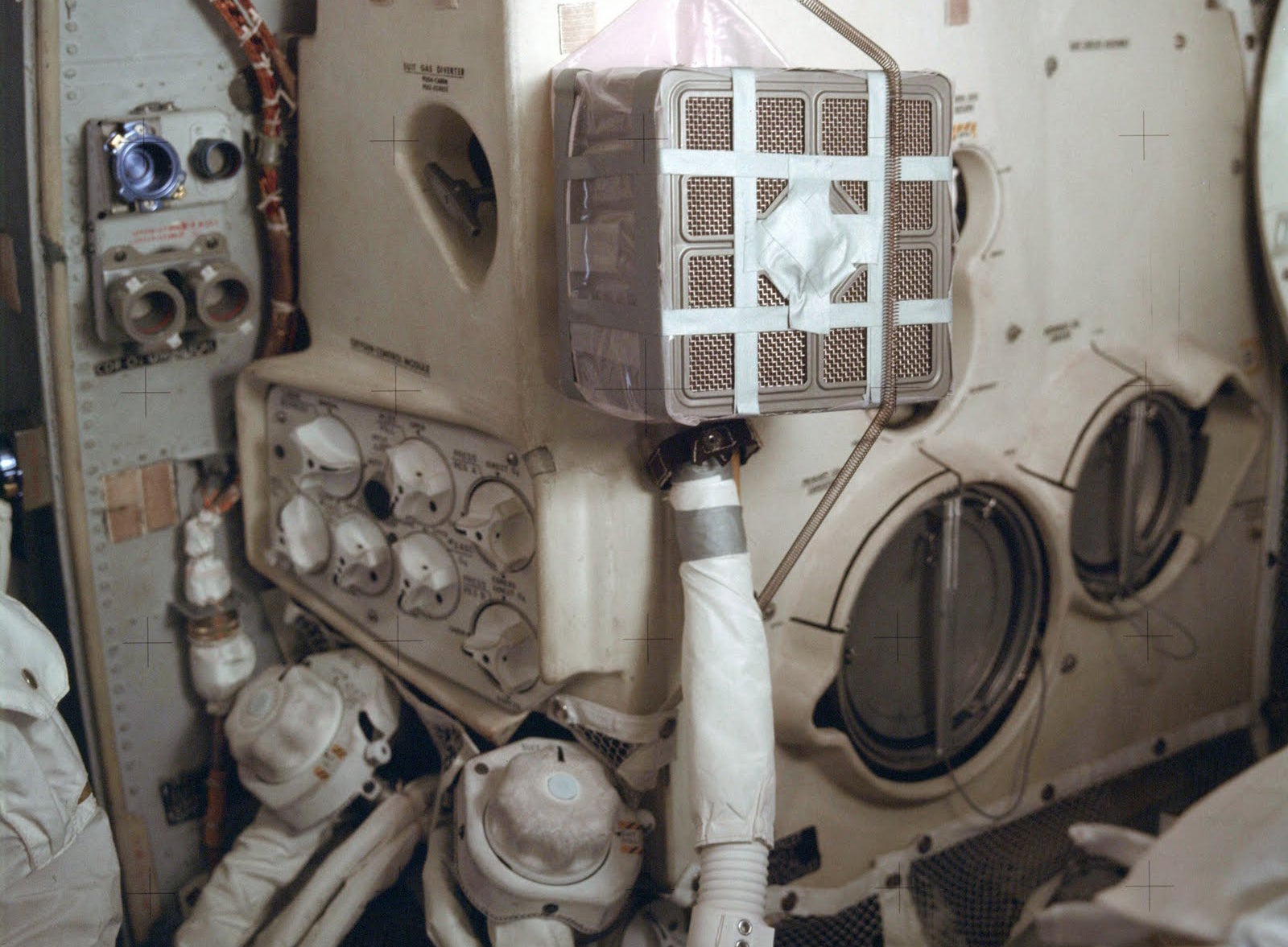
A reader points me to this interesting post with lots of details and images showing how the Apollo 13 crew and support team on the ground devised an improvised CO2 scrubber from miscellaneous items available in the Command and Lunar Modules : This is the actual hack that saved the astronauts of the Apollo XIII – Sploid

After Mission Control decided to cancel Apollo XIII’s moon landing following an explosion of an oxygen tank in the Service Module, the astronauts moved to the Lunar Module in order to save power that was going to be needed later for re-entry.

The only problem with this plan was that the Lunar Module was designed for only two people for a 36-hour period, not three astronauts for 96 hours. They quickly discovered that carbon dioxide was building up fast, putting their lives in extreme danger. They had to change the circular CO2 scrubbers in the Lunar Module for clean ones, but they only had spare square CO2 scrubbers from the Command Module.

In record time, the Crew Systems Division put together an improvised adapter using all sort of weird and random parts, like a flight manual cover, suit parts, and socks. CAPCOM (Capsule Communicator) transmitted the instructions to the astronauts in order to assemble this “mailbox” rig—as they called it—working against the clock and trying to surive fight the effects of the poisonous gas which was quickly asphyxiating their brains.

Apollo13CO2Scrubber_564x415
A picture of the “hacked” CO2 scrubber in the Apollo 13 module.

Video: ‘Space to Ground’ ISS update + US astros pay the price for US loss to Germany

Here’s the latest update on activities aboard the International Space Station:

The US loss to Germany in the World Cup led to some loss of hair on the ISS:

Video: Cassini arrives at Saturn

On June 30th it will be 10 years since the Cassini-Huygens spacecraft, built by a US/Europe collaboration, went into orbit around Saturn. Huygens successfully landed on the moon Titan in 2005 and Cassini has continued to provide tremendous information and imagery of Saturn, its rings and moons.  Here is a NASA video about the day it arrived at Saturn:

Curiosity’s first Martian year went by fast

A brief review of what the Curiosity rover has accomplished during its first full Martian year (687 earth days or 1.88 earth years) on the Red Planet: NASA’s Mars Curiosity Rover Marks First Martian Year with Mission Successes – Mars Science Laboratory

Here’s a map showing how far Curiosity has roved and where it is going: Curiosity’s Progress on Route to Mount Sharp

PIA18391_Sol663map-small-br2[1]