Category Archives: Space Systems

Mars Opportunity rover reaches driving distance milestone

The Opportunity rover takes the lead in distance roved off-earth:

NASA’s Long-Lived Mars Opportunity Rover
Sets Off-World Driving Record

NASA’s Opportunity Mars rover, which landed on the Red Planet in 2004, now holds the off-Earth roving distance record after accruing 25 miles (40 kilometers) of driving. The previous record was held by the Soviet Union’s Lunokhod 2 rover.

“Opportunity has driven farther than any other wheeled vehicle on another world,” said Mars Exploration Rover Project Manager John Callas, of NASA’s Jet Propulsion Laboratory (JPL) in Pasadena, California. “This is so remarkable considering Opportunity was intended to drive about one kilometer and was never designed for distance. But what is really important is not how many miles the rover has racked up, but how much exploration and discovery we have accomplished over that distance.”

Trek of NASA's Mars Exploration Rover Opportunity
NASA’s Mars Exploration Rover Opportunity, working on Mars since January 2004,
passed 25 miles of total driving on July 27, 2014. The gold line on this map shows
Opportunity’s route from the landing site inside Eagle Crater (upper left) to its
location after the July 27 (Sol 3735) drive. 
Image Credit:  NASA/JPL-Caltech/MSSS/NMMNHS

A drive of 157 feet (48 meters) on July 27 put Opportunity’s total odometry at 25.01 miles (40.25 kilometers). This month’s driving brought the rover southward along the western rim of Endeavour Crater. The rover had driven more than 20 miles (32 kilometers) before arriving at Endeavour Crater in 2011, where it has examined outcrops on the crater’s rim containing clay and sulfate-bearing minerals. The sites are yielding evidence of ancient environments with less acidic water than those examined at Opportunity’s landing site.

If the rover can continue to operate the distance of a marathon — 26.2 miles (about 42.2 kilometers) — it will approach the next major investigation site mission scientists have dubbed “Marathon Valley.” Observations from spacecraft orbiting Mars suggest several clay minerals are exposed close together at this valley site, surrounded by steep slopes where the relationships among different layers may be evident.

The Russian Lunokhod 2 rover, a successor to the first Lunokhod mission in 1970, landed on Earth’s moon on Jan. 15, 1973, where it drove about 24.2 miles (39 kilometers) in less than five months, according to calculations recently made using images from NASA’s Lunar Reconnaissance Orbiter (LRO) cameras that reveal Lunokhod 2’s tracks.

Irina Karachevtseva at Moscow State University of Geodesy and Cartography’s Extraterrestrial Laboratory in Russia, Brad Jolliff of Washington University in St. Louis, Tim Parker of JPL, and others, collaborated to verify the map-based methods for computing distances are comparable for Lunokhod-2 and Opportunity.

14-202b[1]
This chart provides a comparison of the distances driven by various wheeled
vehicles 
on the surface of Mars and Earth’s moon. Of the vehicles shown,
NASA’s Mars 
rovers Opportunity and Curiosity are still active and the totals
listed are 
distances driven as of July 28, 2014. Image Credit:  NASA/JPL-Caltech

“The Lunokhod missions still stand as two signature accomplishments of what I think of as the first golden age of planetary exploration, the 1960s and ’70s,” said Steve Squyres of Cornell University in Ithaca, New York, and principal investigator for NASA’s twin Mars rovers, Opportunity and Spirit. “We’re in a second golden age now, and what we’ve tried to do on Mars with Spirit and Opportunity has been very much inspired by the accomplishments of the Lunokhod team on the moon so many years ago. It has been a real honor to follow in their historical wheel tracks.”

As Opportunity neared the mileage record earlier this year, the rover team chose the name Lunokhod 2 for a crater about 20 feet (6 meters) in diameter on the outer slope of Endeavour’s rim on Mars.

The Mars Exploration Rover Project is one element of NASA’s ongoing and future Mars missions preparing for a human mission to the planet in the 2030s. JPL manages the project for NASA’s Science Mission Directorate (SMD), in Washington. NASA’s Goddard Space Flight Center, in Greenbelt, Maryland, manages LRO for SMD.

For more information about NASA’s Mars rovers Spirit and Opportunity, visit: www.nasa.gov/rovers and marsrovers.jpl.nasa.gov

Follow the project on Twitter at: twitter.com/MarsRovers

On Facebook, visit: www.facebook.com/mars.rovers

An image of Lunokhod 2’s tracks, as imaged by NASA’s LRO, is available online at: lroc.sese.asu.edu/posts/774

NASA Mars orbiters prepare for comet passing close by

Quite possible that someday a comet will pass near earth. (If it is headed into earth, there will be little we can do about it in time unless we have a sophisticated in-space infrastructure in place.)

NASA’s Mars Spacecraft Maneuvers to Prepare for Close Comet Flyby

NASA is taking steps to protect its Mars orbiters, while preserving opportunities to gather valuable scientific data, as Comet C/2013 A1 Siding Spring heads toward a close flyby of Mars on Oct. 19.

The comet’s nucleus will miss Mars by about 82,000 miles (132,000 kilometers), shedding material hurtling at about 35 miles (56 kilometers) per second, relative to Mars and Mars-orbiting spacecraft. At that velocity, even the smallest particle — estimated to be about one-fiftieth of an inch (half a millimeter) across — could cause significant damage to a spacecraft.

This graphic depicts the orbit of comet C/2013 A1 Siding Spring as it swings around the sun in 2014. On Oct. 19, the comet will have a very close pass at Mars. Its nucleus will miss Mars by about 82,000 miles (132,000 kilometers). The comet's trail of dust particles shed by the nucleus might be wide enough to reach Mars or might also miss it. For more information about this comet, see http://mars.nasa.gov/comets/sidingspring/.
This graphic depicts the orbit of comet C/2013 A1 Siding Spring as it swings
around the sun in 2014. On Oct. 19, the comet will have a very close pass
at Mars. Its nucleus will miss Mars by about 82,000 miles (132,000 kilometers).
Image Credit: NASA/JPL-Caltech
NASA currently operates two Mars orbiters, with a third on its way and expected to arrive in Martian orbit just a month before the comet flyby. Teams operating the orbiters plan to have all spacecraft positioned on the opposite side of the Red Planet when the comet is most likely to pass by.

“Three expert teams have modeled this comet for NASA and provided forecasts for its flyby of Mars,” explained Rich Zurek, chief scientist for the Mars Exploration Program at NASA’s Jet Propulsion Laboratory (JPL) in Pasadena, California. “The hazard is not an impact of the comet nucleus, but the trail of debris coming from it. Using constraints provided by Earth-based observations, the modeling results indicate that the hazard is not as great as first anticipated. Mars will be right at the edge of the debris cloud, so it might encounter some of the particles — or it might not.”

During the day’s events, the smallest distance between Siding Spring’s nucleus and Mars will be less than one-tenth the distance of any known previous Earthly comet flyby. The period of greatest risk to orbiting spacecraft will start about 90 minutes later and last about 20 minutes, when Mars will come closest to the center of the widening dust trail from the nucleus.

NASA’s Mars Reconnaissance Orbiter (MRO) made one orbit-adjustment maneuver on July 2 as part of the process of repositioning the spacecraft for the Oct. 19 event. An additional maneuver is planned for Aug. 27. The team operating NASA’s Mars Odyssey orbiter is planning a similar maneuver on Aug. 5 to put that spacecraft on track to be in the right place at the right time, as well.

NASA’s Mars Atmosphere and Volatile Evolution (MAVEN) spacecraft is on its way to the Red Planet and will enter orbit on Sept. 21. The MAVEN team is planning to conduct a precautionary maneuver on Oct. 9, prior to the start of the mission’s main science phase in early November.

In the days before and after the comet’s flyby, NASA will study the comet by taking advantage of how close it comes to Mars. Researchers plan to use several instruments on the Mars orbiters to study the nucleus, the coma surrounding the nucleus, and the tail of Siding Spring, as well as the possible effects on the Martian atmosphere. This particular comet has never before entered the inner solar system, so it will provide a fresh source of clues to our solar system’s earliest days.

MAVEN will study gases coming off the comet’s nucleus into its coma as it is warmed by the sun. MAVEN also will look for effects the comet flyby may have on the planet’s upper atmosphere and observe the comet as it travels through the solar wind.

Odyssey will study thermal and spectral properties of the comet’s coma and tail. MRO will monitor Mars’ atmosphere for possible temperature increases and cloud formation, as well as changes in electron density at high altitudes. The MRO team also plans to study gases in the comet’s coma. Along with other MRO observations, the team anticipates this event will yield detailed views of the comet’s nucleus and potentially reveal its rotation rate and surface features.

Mars’ atmosphere, though much thinner than Earth’s, is thick enough that NASA does not anticipate any hazard to the Opportunity and Curiosity rovers on the planet’s surface, even if dust particles from the comet hit the atmosphere and form into meteors. Rover cameras may be used to observe the comet before the flyby, and to monitor the atmosphere for meteors while the comet’s dust trail is closest to the planet.

Observations from Earth-based and space telescopes provided data used for modeling to make predictions about Siding Spring’s Mars flyby, which were in turn used for planning protective maneuvers. The three modeling teams were headed by researchers at the University of Maryland in College Park, the Planetary Science Institute in Tucson, Arizona, and JPL.

For more information about the Mars flyby of comet Siding Spring, visit: mars.nasa.gov/comets/sidingspring/

For more information about NASA’s Mars Exploration Program, visit: www.nasa.gov/mars

Video: Space to Ground report on the ISS

The activities the past week on the International Space Station are highlighted in the latest Space to Ground report:

The Aerospace Projects Review

Scott Lowther is a space historian who specializes in projects that

on those programs that didn’t fly: the concepts that were too expensive, or politically non-viable, or technically infeasible or just plain unlucky. If you want to read about the P-51 Mustang or the 747, there are many books easily available. But what if you’re interested in the X-20 Dyna Soar or Project Pluto or the Orion nuclear pulse vehicle? Nuclear rockets? Manned missions to Mars? Hypersonic bombers? Vertical takeoff rocket powered suborbital passenger transports? Blended wing body jetliners? I’ve got you covered.

Scott publishes the aerospace history e-magazine Aerospace Projects Review, where he tells “the tales that have been largely forgotten”. He is expert in finding and presenting nearly forgotten and lost reports, blueprints, brochures and the like. In some cases he will create “accurate and detailed diagrams using CAD software. This all requires a whole lot of research, along with sometimes knowing where to go and who to talk to… as well as a lot of time and effort on preparing the information for release”.

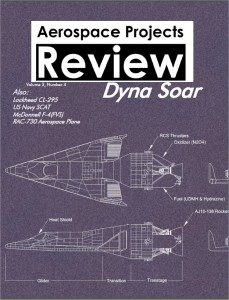
CoverVol3Num4

For example,  one of his recent issues focused on the  X-20 Dyna-Soar projects that almost got a reusable spaceplane to orbit in the 1960s. The 128 page issue is packed with detailed blueprints, artists renditions, and text discussion 93 pages of which deal with the X-20’s history and design.

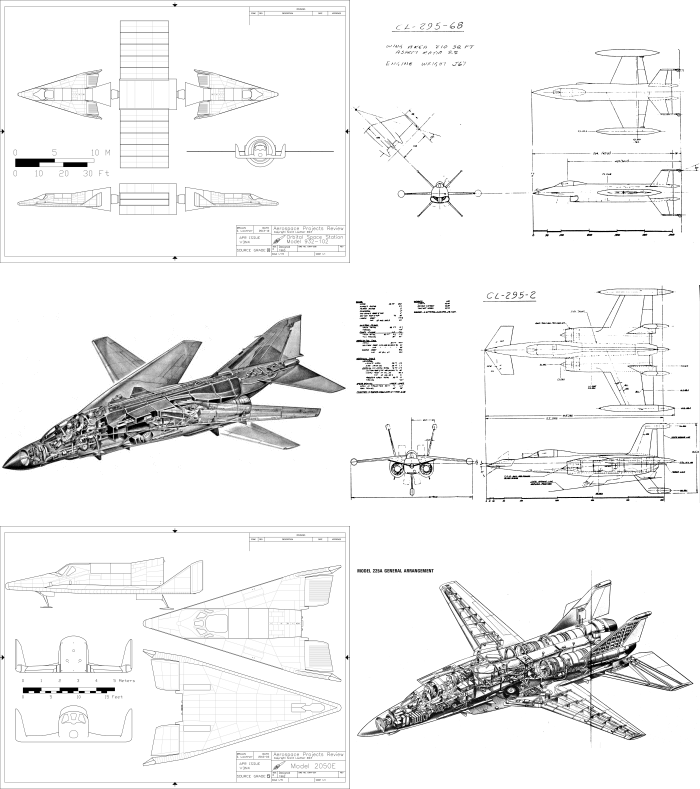
ev3n4ad

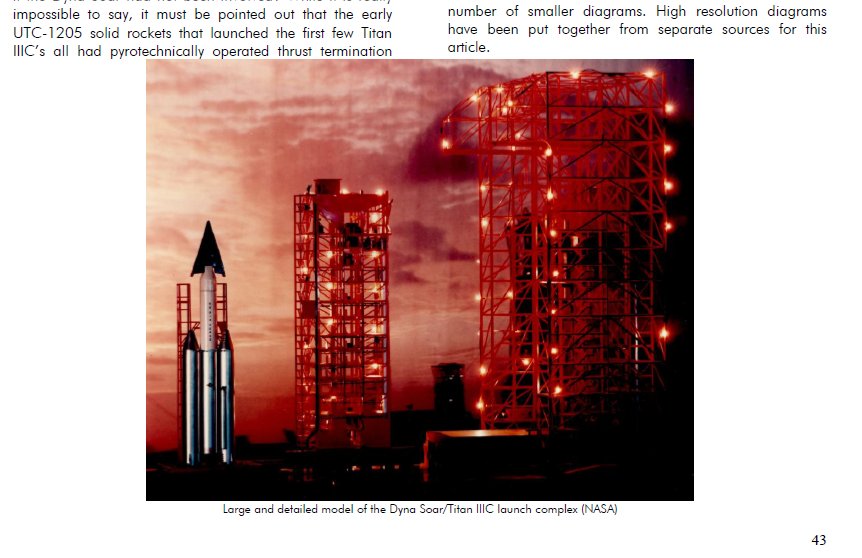
DynaSoarTitanIIIC

The issue also has articles on the Lockheed CL-295,  McDonnell F-4(FVS), US Navy SCAT VTOL and the Republic Aircraft RAC-730 SSTO aerospaceplane. There is also a 49 page addendum with even more resource materials for the article. 

—

Scott talked about his work on The Space Show last year: Scott Lowther, Monday, 12-2-13 0  Thespaceshow’s Blog – Audio (mp3).

I will also note that Scott was involved in the marvelous page-by-page reprinting in the AIAA Horizons magazine of the famous Colliers series on space in 1952-54.  (See posts here, here, and here.)

—

You can support Scott Lowther’s aerospace history research by participating in his Patreon site.

2014 Space Elevator Conference

The 2014 Space Elevator Conference, sponsored by the International Space Elevator Consortium (ISEC), will be held during August 22-24 at the The Museum of Flight in Seattle, Washington. Check out the Program and Registration.

The latest ISEC news is available in the  ISEC Newsletter – July.2014.