The latest Space to Ground video reports on the latest news for the Int. Space Station, including this week’s ammonia leak scare that turned out to be a false alarm:
The latest Space to Ground video reports on the latest news for the Int. Space Station, including this week’s ammonia leak scare that turned out to be a false alarm:
Edward Belbruno has become well known for developing new orbital mechanics techniques that allow spacecraft to move about the solar system more efficiently, i.e with less fuel than a conventional approach. See, for example, From chaos, a new order – The Space Review – Mar. 6.200 6 –
This sensitivity to initial conditions may be a challenge to theoreticians, but it provides an opportunity for those who want to leverage it in spaceflight applications. One of the first to explore the potential of chaotic dynamics in spaceflight is Ed Belbruno, a visiting researcher at Princeton University. Working as an orbit analyst at JPL twenty years ago—new to the field of astrodynamics but with a doctorate in mathematics—he looked to alternatives to the traditional method to sending spacecraft to the Moon and planets. That approach, a Hohmann transfer orbit from the Earth and a “capture maneuver” at the destination, works well, but requires a high change in velocity, or delta-v, to perform the capture maneuver. Barring the availability of alternative deceleration techniques, like aerobreaking, this delta-v requirement translates into substantial propellant, and thus a heavier spacecraft.
…
Belbruno asked if there was a way for a spacecraft to perform a “ballistic capture” maneuver: to arrive at the Moon, for example, on a specific trajectory that would allow it to enter orbit without any delta-v at all. While his JPL colleagues at the time were convinced that it wasn’t possible, Belbruno studied the problem and found there was a way, as he put it, “to slowly creep up” on the Moon, arriving such that all the forces were balanced, allowing the spacecraft to go into orbit rather than escaping from or crashing into the Moon.
Belbruno first proposed taking advantage of “weak stability boundary theory” in 1986 for a proposed small lunar orbiter that could be launched from a Get Away Special canister in the shuttle’s cargo bay. …
Belbruno is also an artist and he says the act of painting helped him develop ideas like using the weak stability boundary technique : Painting Our Way to the Moon – Space.com.
I am both a scientist and an artist. The paintings that I create have given rise to interesting scientific discoveries. The paintings don’t just inspire me to pursue a particular avenue of study — they literally have the key within them to help me figure out how to solve complex scientific problems. The process of how this occurs is somewhat mysterious and has happened to me many times, and recently gave rise to a revolutionary new route to the Moon.
Check out some of his art at The Cosmic Art of Edward Belbruno (Gallery) – space.com.
The latest report on Int. Space Station related activities:
Here’s a video from ESA and the architectural firm Foster & Partners showing how a lunar structure could be built with a robotic rover using a 3D printing
See also this earlier item: ESA: Building a lunar base with 3D printing.
Alan Stern, principle investigator for the New Horizons fly-by of Pluto mission, gives this update as they wait for next July’s encounter with the distant planet:
It’s Pluto Eve!
December 31, 2014: As 2014 ends and 2015 begins, I’m reminded of something senior planetary scientist and New Horizons science team member Rick Binzel said a while back: “It’s Pluto Eve!”
New Horizons has been awake from hibernation since mid-day on Dec. 6, having completed its almost nine-year-long cruise phase from Earth to “Pluto space.” We’re currently in the very earliest stages of Pluto approach.
Since waking New Horizons, we’ve been checking out spacecraft systems and some of the instruments, calibrating gyroscopes, collecting trajectory tracking information, and undertaking many other spacecraft preparations before the Pluto encounter starts on Jan. 15. At the same time, our science, engineering and operations teams have been planning and testing spacecraft command loads (detailed flight plans) for the first parts of encounter operations in early 2015. Needless to say, it’s been a busy time.
When the encounter begins we’ll still be very far from Pluto, about 135 million miles (220 million kilometers). We won’t get close enough to be at our “BTH” — Better than Hubble —imaging point until mid-May, but there is still a lot to do before then.
Throughout January to early-May, we’ll be taking essentially continuous data on the interplanetary environment where the Pluto system orbits. We’ll do that daily using our charged particle sensors (called PEPSSI and SWAP) to measure both solar wind and high-energy particles, and we’ll use the Venetia Burney Student Dust Counter to measure dust-particle concentrations in the inner reaches of the Kuiper Belt.
We’ll also do a great deal of radio tracking of New Horizons using NASA’s Deep Space Network to refine our knowledge of the approach trajectory, and we’ll use our Long-Range Reconnaissance Imager (LORRI) to take hundreds of pictures of Pluto against star fields to better refine the spacecraft’s distance to Pluto. Our navigation teams will use that information to compute burn solutions for midcourse maneuvers we may want to make using New Horizons’ rocket engines in mid-March and mid-May. We should know whether the March burn will be needed by early February and we’ll keep you posted.
Some other data we’ll be planning to take before May include:
The gap in imaging observations in March has been timed to give our ground teams a bit of a break before the sprint to Pluto encounter from April to July.
In all the images we’ll take through April, Pluto will just be a few pixels across at most, so the imagery will look like the Hubble images you may be familiar with. Nonetheless, these datasets will provide important science information because they will be taken from angles that can’t be observed from Earth, and taken more frequently than observations we typically make from the ground. We plan to release results from these approach observations one to several times each month, at a pace that quickens with time.
![Hubble-view-of-Pluto[1]](http://hobbyspace.com/Blog/wp-content/uploads/2015/01/Hubble-view-of-Pluto1.jpg) Pluto as seen by the Hubble Space Telescope.
Pluto as seen by the Hubble Space Telescope.
Back on Earth, from January to April, we’ll inspect all these datasets and determine what they can teach us about Pluto and its environment from afar. We’ll also be planning encounter command loads for both this period and for May and June, during which the pace of Pluto observations will increase dramatically (as will our resolution of Pluto). And our ground team will also further refine our trajectory information and range-to-Pluto measurements, conduct a final set of instrument checkouts, complete final training simulations for encounter, and build and test some of the software we’ll use to analyze the detailed Pluto-system data that begins flowing home in the later stage of approach in early summer.
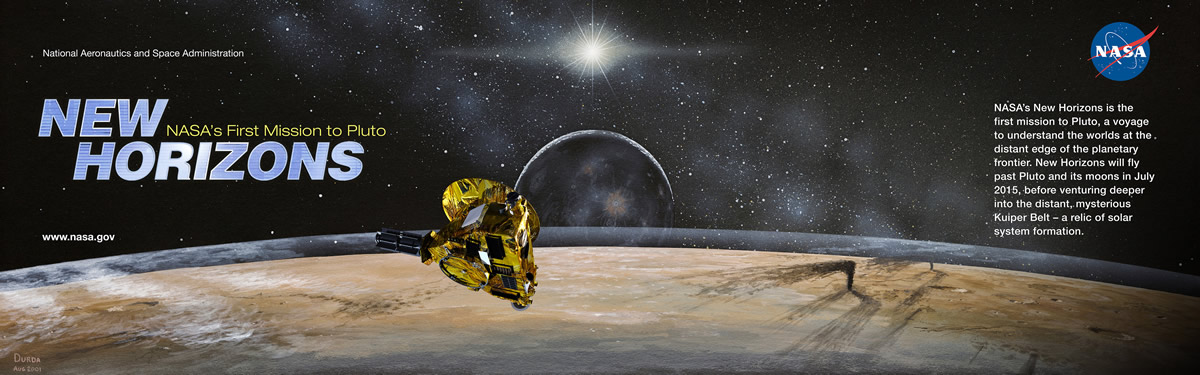 New Horizons: NASA’s First mission to the Pluto system (based
on an artist’s conception of Pluto by planetary scientist Dan Durda).
In early 2015 we also plan to celebrate the 85th anniversary of the discovery of Pluto — made in 1930. More on that soon, too.
We’ve been waiting for 2015 for so long, so I hope you have a safe and joyous New Year’s celebration. And until I write again, I hope you’ll keep exploring—just as we do!
– Alan Stern