Category Archives: Space Systems

Rosetta mission releases lots of images of Comet 67P/C-G

The ESA Rosetta mission released nearly 1300 images today of Comet 67P/C-G as the probe approached the object last summer: Major release of NAVCAM images: 800 to 30 km | Rosetta – ESA’s comet chaser

Today marks a major release from the Rosetta downlink and archive groups of detailed images of Comet 67P/Churyumov-Gerasimenko taken by Rosetta’s Navigation Camera, or NAVCAM. The 1297 images, which can be accessed via the Archive Image Browser, were acquired between 1 August and 23 September. This corresponds to the final approach of Rosetta to the comet, its arrival at a distance of 100 km on 6 August and its transition to a global mapping phase at 30 km (click here for an animation describing the spacecraft’s trajectories at this time). It was during these two months that mapping and characterisation of the comet’s surface began, and Philae’s candidate landing sites were proposed, analysed and finally selected.

Here the images are presented a video clips:


Emily Lakdawalla comments on the images and provides thumbnails for them: More than 1000 Rosetta NavCam images released! – The Planetary Society.

New Horizons starts to see surface features on Pluto

Pluto starting to come into focus as New Horizons gets closer:

NASA’s New Horizons Detects Surface Features,
Possible Polar Cap on Pluto

For the first time, images from NASA’s New Horizons spacecraft are revealing bright and dark regions on the surface of faraway Pluto – the primary target of the New Horizons close flyby in mid-July.

The images were captured in early to mid-April from within 70 million miles (113 million kilometers), using the telescopic Long Range Reconnaissance Imager (LORRI) camera on New Horizons. A technique called image deconvolution sharpens the raw, unprocessed images beamed back to Earth. New Horizons scientists interpreted the data to reveal the dwarf planet has broad surface markings – some bright, some dark – including a bright area at one pole that may be a polar cap.

“As we approach the Pluto system we are starting to see intriguing features such as a bright region near Pluto’s visible pole, starting the great scientific adventure to understand this enigmatic celestial object,” says John Grunsfeld, associate administrator for NASA’s Science Mission Directorate in Washington. “As we get closer, the excitement is building in our quest to unravel the mysteries of Pluto using data from New Horizons.”

First Color Image of RalphView the graphics from the April 29 media telecon.

Also captured in the images is Pluto’s largest moon, Charon, rotating in its 6.4-day long orbit. The exposure times used to create this image set – a tenth of a second – were too short for the camera to detect Pluto’s four much smaller and fainter moons.

Since it was discovered in 1930, Pluto has remained an enigma. It orbits our sun more than 3 billion miles (about 5 billion kilometers) from Earth, and researchers have struggled to discern any details about its surface. These latest New Horizons images allow the mission science team to detect clear differences in brightness across Pluto’s surface as it rotates.

“After traveling more than nine years through space, it’s stunning to see Pluto, literally a dot of light as seen from Earth, becoming a real place right before our eyes,” said Alan Stern, New Horizons principal investigator at Southwest Research Institute in Boulder, Colorado. “These incredible images are the first in which we can begin to see detail on Pluto, and they are already showing us that Pluto has a complex surface.”

The images the spacecraft returns will dramatically improve as New Horizons speeds closer to its July rendezvous with Pluto,

“We can only imagine what surprises will be revealed when New Horizons passes approximately 7,800 miles (12,500 kilometers) above Pluto’s surface this summer,” said Hal Weaver, the mission’s project scientist at the Johns Hopkins University Applied Physics Laboratory (APL) in Laurel, Maryland.

APL designed, built, and operates the New Horizons spacecraft, and manages the mission for NASA’s Science Mission Directorate. SwRI leads the science team, payload operations and encounter science planning. New Horizons is part of the New Frontiers Program managed by NASA’s Marshall Space Flight Center in Huntsville, Alabama.

—-

OpNav3_plutcenv7_lowres[1]


OpNav3_barycen_v7_lowres[1]


These two “movies” show a series of LORRI images of Pluto and Charon taken at 13 different times spanning 6.5 days, from April 12 to April 18, 2015. During that time, the spacecraft’s distance from Pluto decreased from about 69 million miles (111 million kilometers) to 64 million miles (104 million kilometers).

Pluto and Charon rotate around a center-of-mass (also called the “barycenter”) once every 6.4 Earth days, and these LORRI images capture one complete rotation of the system. The direction of the rotation axis is shown in the figure. In one of these movies, the center of Pluto is kept fixed in the frame, while the other movie is fixed on the center of mass (accounting for the “wobble” in the system as Charon orbits Pluto).

The 3x-magnified view of Pluto highlights the changing brightness across the disk of Pluto as it rotates. Because Pluto is tipped on its side (like Uranus), when observing Pluto from the New Horizons spacecraft, one primarily sees one pole of Pluto, which appears to be brighter than the rest of the disk in all the images. Scientists suggest this brightening in Pluto’s polar region might be caused by a “cap” of highly reflective snow on the surface. The “snow” in this case is likely to be frozen molecular nitrogen ice. New Horizons observations in July will determine definitively whether or not this hypothesis is correct.

In addition to the polar cap, these images reveal changing brightness patterns from place to place as Pluto rotates, presumably caused by large-scale dark and bright patches at different longitudes on Pluto’s surface. In all of these images, a mathematical technique called “deconvolution” is used to improve the resolution of the raw LORRI images, restoring nearly the full resolution allowed by the camera’s optics and detector.

Click here for non-annotated versions of the “Pluto-centric”   and  “bary-centric” movies.

(Image credit: NASA/Johns Hopkins University Applied Physics Laboratory/Southwest Research Institute)

 

Grant Imahara partners with Mouser.com for space contests and participation projects

Grant Imahara, a former member of the Mythbusters team, has partnered with the electronics distributor Mouser.com to create space contests and participatory projects. For example, the Space Travel Challenge is a contest to send pictures and messages to the lunar surface via Astrobotic’s MoonMail service: Mouser and Imahara Launch New Space Series to Create a Lunar Legacy and Ultimate Space Face-Off: Mars vs Moon.

For the project, Imahara has a website with videos and articles: The Future of Space Travel | Empowering Innovation With Grant Imahara – Mouser.

For example, Imahara writes about the challenges facing space travelers: Challenges on the Final Frontier – Bench Talk/Mouser Blog

And here is a sampling of his video interviews:

* Bas Lansdorp, CEO of Mars One Project – To Colonize Mars

* Space Exploration – Bobak Ferdowsi talks about the Moon & Mars Exploration

* Space Electronics – John Branthoover, Astrobotic‘s Senior Electrical Engineer

Hubble telescope celebrates 25 years in space

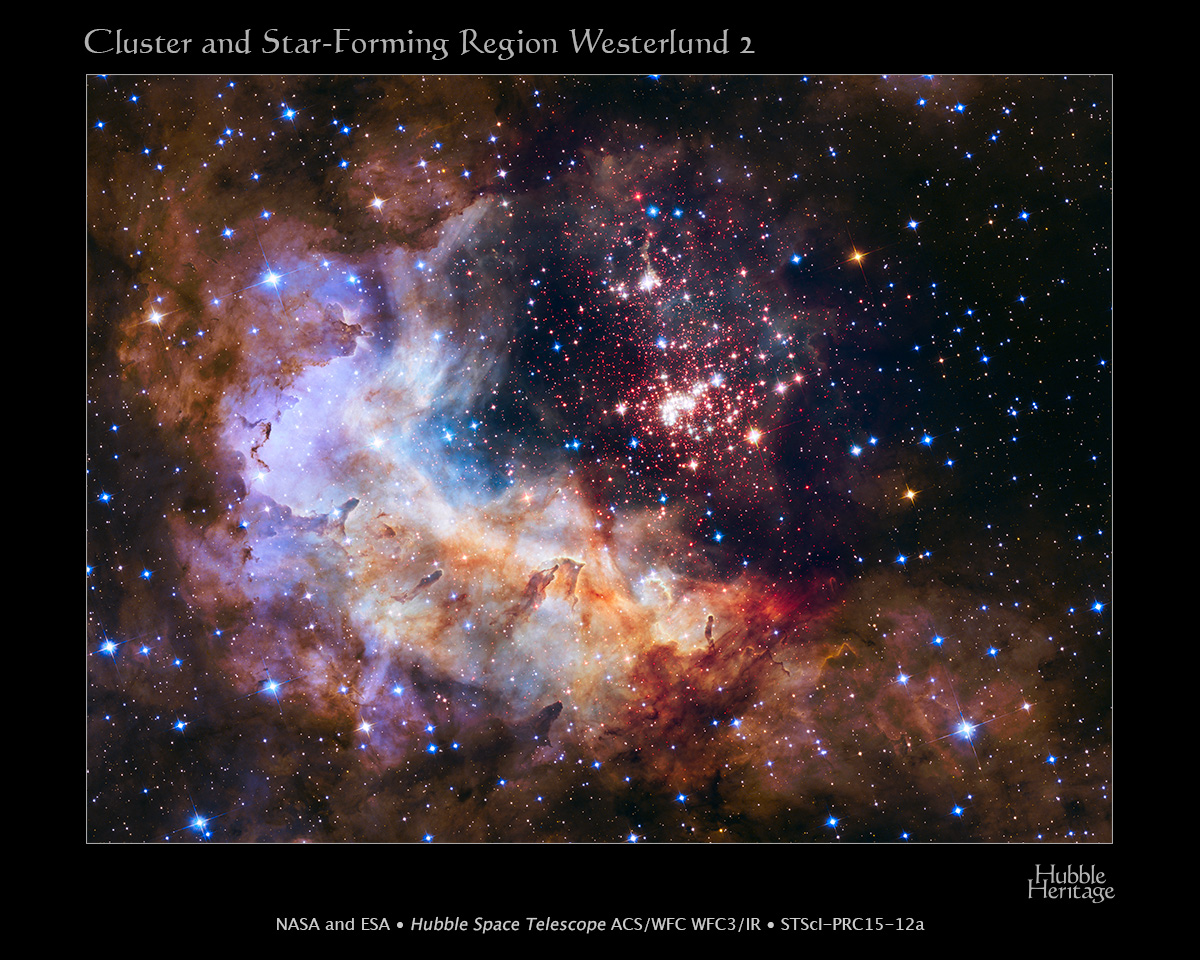
In celebration of the 25th anniversary of the launch of the Hubble Telescope, a beautiful image of the Westerlund 2 star cluster taken by the orbital observatory has been released: Hubble Space Telescope Celebrates 25 Years of Unveiling the Universe – HubbleSite.

0105-4x5color.aiWesterlund 2 star cluster. Zoomable version.

A 3-D visualization of the cluster:

Here’s a statement included with the release:

A new window to the universe opened for humanity on the morning of April 24, 1990, when NASA’s Hubble Space Telescope was lofted into space, riding atop a Promethean flame from the space shuttle Discovery.

“Even the most optimistic person to whom you could have spoken back in 1990 couldn’t have predicted the degree to which Hubble would re-write our astrophysics and planetary science textbooks,” said Charlie Bolden, NASA administrator and pilot of the mission that brought Hubble into orbit. “A quarter century later, Hubble has fundamentally changed human understanding of the universe and our place in it.”

Hubble’s scientific payoff has been immeasurable; it has shown us the universe as we never imagined.

“Hubble has changed the course of science with its discoveries and shown us the depth and beauty of the universe,” said John Grunsfeld, Hubble astronaut and associate administrator of NASA’s Science Mission Directorate at NASA Headquarters, Washington. “With both new observations and treasures hidden in the existing archive of data, Hubble will continue to unravel the mysteries of the cosmos in the years ahead.”

Above the hazy blur of Earth’s atmosphere, Hubble provides a larger-than-life, “super-rainbow” view of the universe: from ultraviolet, visible, and into near-infrared wavelengths of light. Hubble’s fantastic images unveil both beauty and cataclysmic disturbances across an unimaginably deep cosmic tapestry. Combined with the powers of NASA’s Great Observatories, Chandra, Spitzer, and the deorbited Compton Gamma-ray Observatory, Hubble painted a picture of the solar system and beyond that has changed astronomy forever.

Initially tasked to measure the expansion rate of the universe, find very distant galaxies, and investigate black holes, Hubble’s research has now covered nearly every frontier in deep-space astronomy: the expansion and acceleration rate of the universe, the apparent link between galaxy mass and central black hole mass; early galaxy formation shortly after the Big Bang; strange transient events in space; and the chemistry and potential habitability of planets orbiting other stars.

Hubble’s long exposures of the far universe have unveiled an “undiscovered country” of discordant objects, violent explosions, and tumultuous galaxy collisions. They tell the story of the dynamic evolution of the universe from the Big Bang.

Hubble has also provided a fascinating view of our own dynamic solar system, revealing colliding asteroids, changing aurorae and weather on planets and moons, and even enabling the detection of previously unknown moons.

More than being just a tool for astronomers, Hubble is the people’s telescope. It is one of the most influential scientific instruments ever built, reinvigorating and reshaping what the world perceives as outer space. Its images and discoveries have captured the imagination of people around the world, touching everything from pop culture to science fiction, from academia to art. Hubble has also substantially improved science, technology, engineering and mathematics (STEM) education nationwide. Its education materials are used by half a million teachers and six million students annually in all 50 states.

Thanks to five space shuttle servicing missions, totaling 32 astronaut space walks, and the multitude of scientists, engineers, and staff that worked on Hubble, the observatory has long out-lasted its planned end-of-mission in 2005. The observatory’s science capabilities are more powerful than at its launch, with upgraded instruments, computers, and control systems operating at top performance until at least the end of the decade.

With support from ESA (European Space Agency), Hubble has served as a trailblazer for planning humanity’s next big step into the cosmos. The James Webb Space Telescope (JWST), a partnership with ESA and the Canadian Space Agency, is scheduled for launch in 2018 and will see farther back in time than Hubble with its extended infrared capabilities. JWST will reveal fledgling galaxies from the first 200 million years after the Big Bang. It will also peer deeply into the dusty planet-forming disks around young stars that Hubble often sees in silhouette, and push the boundaries of learning about planets orbiting other stars.

Video: ‘Space to Ground’ report on the ISS – Apr.24.15

This week’s episode of NASA”s Space to Ground report on activities on the Int. Space Station: