Category Archives: Space Systems

Latest New Horizons images give hints of highly varied terrain

The latest images of Pluto from the New Horizons probe:

Different Faces of Pluto Emerging in New Images
from New Horizons
 

The surface of Pluto is becoming better resolved as NASA’s New Horizons spacecraft speeds closer to its July flight through the Pluto system.

A series of new images obtained by the spacecraft’s telescopic Long Range Reconnaissance Imager (LORRI) during May 29-June 2 show Pluto is a complex world with very bright and very dark terrain, and areas of intermediate brightness in between. These images afford the best views ever obtained of the Pluto system.

nh-lorri-images-6-1-15[1]

These images, taken by New Horizons’ Long Range Reconnaissance Imager (LORRI), show four different “faces” of Pluto as it rotates about its axis with a period of 6.4 days. All the images have been rotated to align Pluto’s rotational axis with the vertical direction (up-down) on the figure, as depicted schematically in the upper left.From left to right, the images were taken when Pluto’s central longitude was 17, 63, 130, and 243 degrees, respectively. The date of each image, the distance of the New Horizons spacecraft from Pluto, and the number of days until Pluto closest approach are all indicated in the figure. Credits: NASA/Johns Hopkins University Applied Physics Laboratory/Southwest Research Institute

New Horizons scientists used a technique called deconvolution to sharpen the raw, unprocessed pictures that the spacecraft beams back to Earth; the contrast in these latest images has also been stretched to bring out additional details. Deconvolution can occasionally produce artifacts, so the team will be carefully reviewing newer images taken from closer range to determine whether some of the tantalizing details seen in the images released today persist. Pluto’s non-spherical appearance in these images is not real; it results from a combination of the image-processing technique and Pluto’s large variations in surface brightness.

Since April, deconvolved images from New Horizons have allowed the science team to identify a wide variety of broad surface markings across Pluto, including the bright area at one pole that scientists believe is a polar cap.

These images show dramatic variations in Pluto’s surface features as it rotates. When a very large, dark region near Pluto’s equator appears near the limb, it gives Pluto a distinctly, but false, non-spherical appearance. Pluto is known to be almost perfectly spherical from previous data. Credits: NASA/Johns Hopkins University Applied Physics Laboratory/Southwest Research Institute

“Even though the latest images were made from more than 30 million miles away, they show an increasingly complex surface with clear evidence of discrete equatorial bright and dark regions—some that may also have variations in brightness,” says New Horizons Principal Investigator Alan Stern, of the Southwest Research Institute, Boulder, Colorado. “We can also see that every face of Pluto is different and that Pluto’s northern hemisphere displays substantial dark terrains, though both Pluto’s darkest and its brightest known terrain units are just south of, or on, its equator. Why this is so is an emerging puzzle.”

“We’re squeezing as much information as we can out of these images, and seeing details we’ve never seen before,” said New Horizons Project Scientists Hal Weaver, from the Johns Hopkins University Applied Physics Laboratory in Laurel, Maryland. “We’ve seen evidence of light and dark spots in Hubble Space Telescope images and in previous New Horizons pictures, but these new images indicate an increasingly complex and nuanced surface. Now, we want to start to learn more about what these various surface units might be and what’s causing them. By early July we will have spectroscopic data to help pinpoint that.”

New Horizons is approximately 2.9 billion miles (4.7 billion kilometers) from Earth and just 24 million miles (39 million kilometers) from Pluto. The spacecraft and payload are in good health and operating normally.

nh-pluto-06-11-15[1]

These images are displayed at four times the native LORRI image size, and have been processed using a method called deconvolution, which sharpens the original images to enhance features on Pluto. Deconvolution can occasionally introduce “false” details, so the finest details in these pictures will need to be confirmed by images taken from closer range in the next few weeks. All of the images are displayed using the same brightness scale. Credits: NASA/Johns Hopkins University Applied Physics Laboratory/Southwest Research Institute

Dawn at Ceres: Latest photos of the ‘bright spots’ and other areas

The latest photos of Ceres from the Dawn spacecraft:

pia19568_main-1041[1]The brightest spots on dwarf planet Ceres are seen in this image taken
by NASA’s Dawn spacecraft on June 6, 2015.  Full image and caption

Bright Spots Shine in Newest Dawn Ceres Images

New images of dwarf planet Ceres, taken by NASA’s Dawn spacecraft, show the cratered surface of this mysterious world in sharper detail than ever before. These are among the first snapshots from Dawn’s second mapping orbit, which is 2,700 miles (4,400 kilometers) above Ceres.

The region with the brightest spots is in a crater about 55 miles (90 kilometers) across. The spots consist of many individual bright points of differing sizes, with a central cluster. So far, scientists have found no obvious explanation for their observed locations or brightness levels.

pia19569_500x282A large crater in the southern hemisphere of dwarf planet Ceres is
seen
in this image taken by NASA’s Dawn spacecraft on June 6, 2015.
Full image and caption

“The bright spots in this configuration make Ceres unique from anything we’ve seen before in the solar system. The science team is working to understand their source. Reflection from ice is the leading candidate in my mind, but the team continues to consider alternate possibilities, such as salt. With closer views from the new orbit and multiple view angles, we soon will be better able to determine the nature of this enigmatic phenomenon,” said Chris Russell, principal investigator for the Dawn mission based at the University of California, Los Angeles.

Numerous other features on Ceres intrigue scientists as they contrast this world with others, including protoplanet Vesta, which Dawn visited for 14 months in 2011 and 2012. Craters abound on both bodies, but Ceres appears to have had more activity on its surface, with evidence of flows, landslides and collapsed structures.

pia19570_500x282
Craters in the northern hemisphere of dwarf planet Ceres are seen
in this image taken by NASA’s Dawn spacecraft on June 6, 2015.
Full image and caption

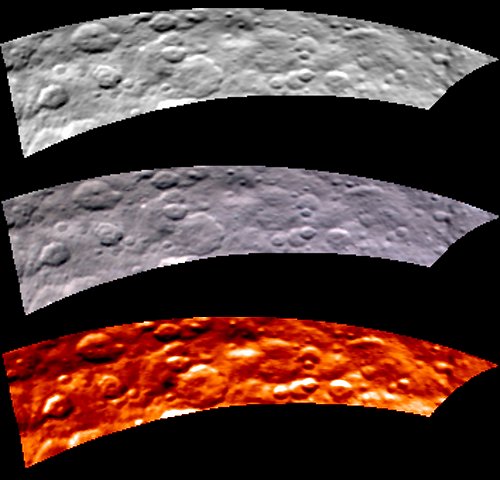
Additionally, new images from Dawn’s visible and infrared mapping spectrometer (VIR) show a portion of Ceres’ cratered northern hemisphere, taken on May 16, including a true-color view and a temperature image. The temperature image is derived from data in the infrared light range. This instrument is also important in determining the nature of the bright spots.

Having arrived in its current orbit on June 3, Dawn will observe the dwarf planet from 2,700 miles (4,400 kilometers) above its surface until June 28. In orbits of about three days each, the spacecraft will conduct intensive observations of Ceres. It will then move toward its next orbit of altitude 900 miles (1,450 kilometers), arriving in early August.

pia19571_500x480Images from Dawn’s visible and infrared mapping spectrometer (VIR)
show a portion of Ceres’ cratered northern hemisphere, taken on
May 16, 2015. Full image and caption

On March 6, 2015, Dawn made history as the first mission to visit a dwarf planet, and the first to orbit two distinct extraterrestrial targets. At its previous target, Vesta, Dawn took tens of thousands of images and made many observations about the body’s composition and other properties.

Dawn’s mission is managed by JPL for NASA’s Science Mission Directorate in Washington. Dawn is a project of the directorate’s Discovery Program, managed by NASA’s Marshall Space Flight Center in Huntsville, Alabama. UCLA is responsible for overall Dawn mission science. Orbital ATK Inc., in Dulles, Virginia, designed and built the spacecraft. The German Aerospace Center, Max Planck Institute for Solar System Research, Italian Space Agency and Italian National Astrophysical Institute are international partners on the mission team. For a complete list of mission participants, visit: dawn.jpl.nasa.gov/mission

More information about Dawn is available at the following sites:

Video: “Space to Ground” – ISS update – June.5.2015

Here’s the latest Space to Ground weekly report on activities related to the Int. Space Station:

The LightSail goes silent once more

After coming back to life and appearing to deploy its solar panels, the Planetary Society‘s LightSail  has gone quiet again, probably due to drained batteries. They are expected to recharge eventually and allow the spacecraft to resume communicating: LightSail Falls Silent; Battery Glitch Suspected – The Planetary Society –

If LightSail is suffering from a chronic undervoltage condition, help could arrive naturally, Spencer said. “The spacecraft orbit is in a geometry where eclipse occurs roughly 2100 seconds each orbit.  This is near the maximum eclipse duration that LightSail-A will experience during the mission. Over the next couple of weeks, the orbit will precess to a full-sun condition, where the entire orbit is sunlit.”

When contact with LightSail is reestablished, the sail deployment sequence will likely be triggered as soon as battery levels are heathy enough to proceed.

For the latest updates:

Update on the Planetary Society’s LightSail

The saga of the Planetary Society’s LightSail spacecraft (see earlier post) continues. The control team decided to deploy only the solar panels today (Wednesday) and, if that went well, unfurl the solar sail on Friday: LightSail Deployment Update: Panels Wednesday, Sails Friday – The Planetary Society.

Data indicates that the deployment of the solar panels occurred, though it has not been confirmed visually with a photo from a spacecraft camera: LightSail Solar Panel Deployment: No Pics, but Data Look Good – The Planetary Society.

They will decide on Thursday whether to proceed with the sail deployment.

The spacecraft is out of range until Thursday, with the next ground station pass expected to begin at 4:45 a.m. EDT. A team meeting is scheduled for 9:00 a.m. to discuss the latest telemetry data. With evidence mounting in favor of a successful panel deployment, and an itch to press forward on the solar sails as soon as possible, further test imaging may be scrapped. Providing battery levels return to normal, and any outstanding issues are resolved, a Friday deployment could still be in the works.

Follow the latest updates at