NASA’s Dawn spacecraft is using its ion propulsion system to descend to its third mapping orbit at Ceres, and all systems are operating well. The spiral maneuvering over the next five weeks will take the spacecraft to an altitude of about 900 miles (less than 1,500 kilometers) above the dwarf planet.
Dawn survey orbit 29, July 17, 2015 (Larger image).
The spacecraft experienced a discrepancy in its expected orientation on June 30, triggering a safe mode. Engineers traced this anomaly to the mechanical gimbal system that swivels ion engine #3 to help control the spacecraft’s orientation during ion-thrusting. Dawn has three ion engines and uses only one at a time.
Dawn’s engineering team switched to ion engine #2, which is mounted on a different gimbal, and conducted tests with it from July 14 to 16. They have confirmed that the spacecraft is ready to continue with the exploration of Ceres.
By the end of the day on July 17, Dawn will have descended to an altitude of about 2,400 miles (3,900 kilometers). After arrival at its next mapping orbit — called the High-Altitude Mapping Orbit, or HAMO — in August, Dawn will begin taking images and other data at unprecedented resolution.
More information on the Dawn mission is online at:
Peering closely at the “heart of Pluto,” in the western half of what mission scientists have informally named Tombaugh Regio (Tombaugh Region), New Horizons’ Ralph instrument revealed evidence of carbon monoxide ice. The contours indicate that the concentration of frozen carbon monoxide increases towards the center of the “bull’s eye.” These data were acquired by the spacecraft on July 14 and transmitted to Earth on July 16. Image Credit: NASA/JHUAPL/SWRI
—-
New Horizon sends the first measurements of Pluto’s atmosphere:
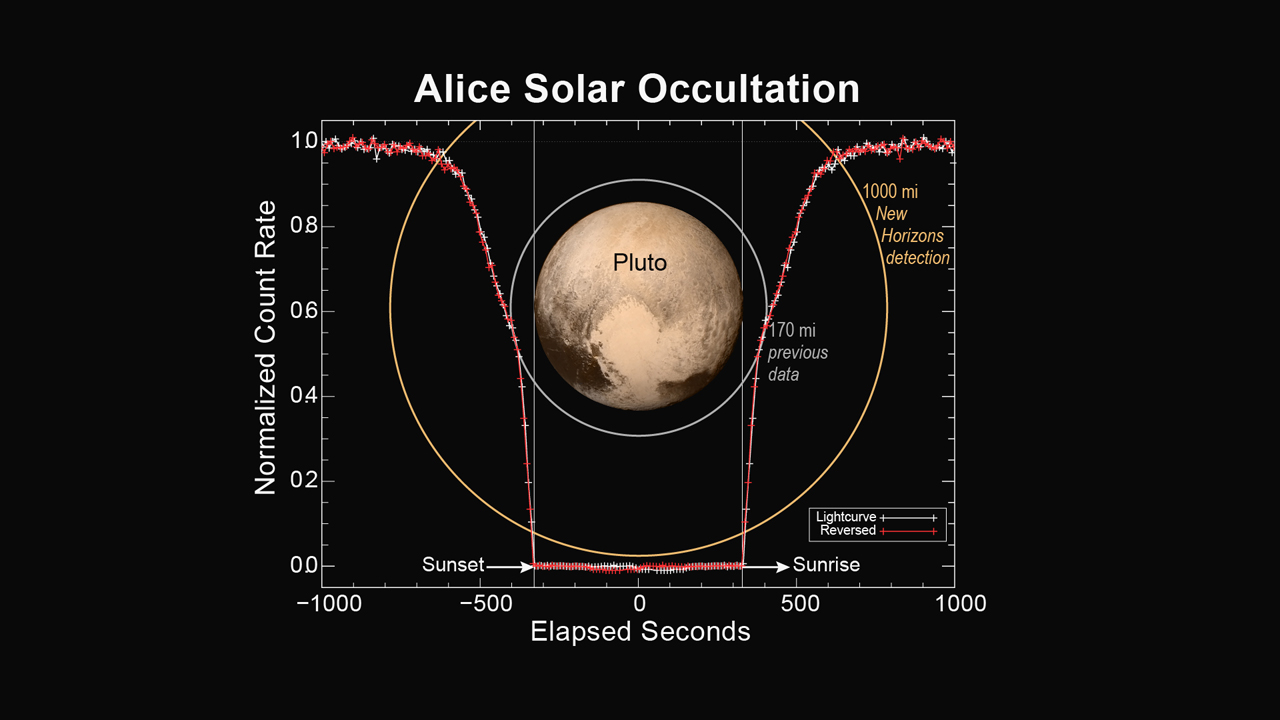
Scientists working with NASA’s New Horizons spacecraft have observed Pluto’s atmosphere as far as 1,000 miles (1,600 kilometers) above the surface of the planet, demonstrating that Pluto’s nitrogen-rich atmosphere is quite extended. This is the first observation of Pluto’s atmosphere at altitudes higher than 170 miles above the planet’s surface (270 kilometers).
The new information was gathered by New Horizon’s Alice imaging spectrograph during a carefully designed alignment of the sun, Pluto, and the spacecraft starting about an hour after the craft’s closest approach to the planet on July 14. During the event known as a solar occultation, New Horizons passed through Pluto’s shadow while the sun backlit Pluto’s atmosphere.
“This is only the beginning for Pluto atmospheric science” says New Horizons scientist Andrew Steffl of the Southwest Research Institute in Boulder, Colorado. “Next month, the full Alice occultation dataset will be sent to Earth for analysis. Even so, the data we have now show that Pluto’s atmosphere rises higher above its surface, in relative terms, than does the Earth’s.”
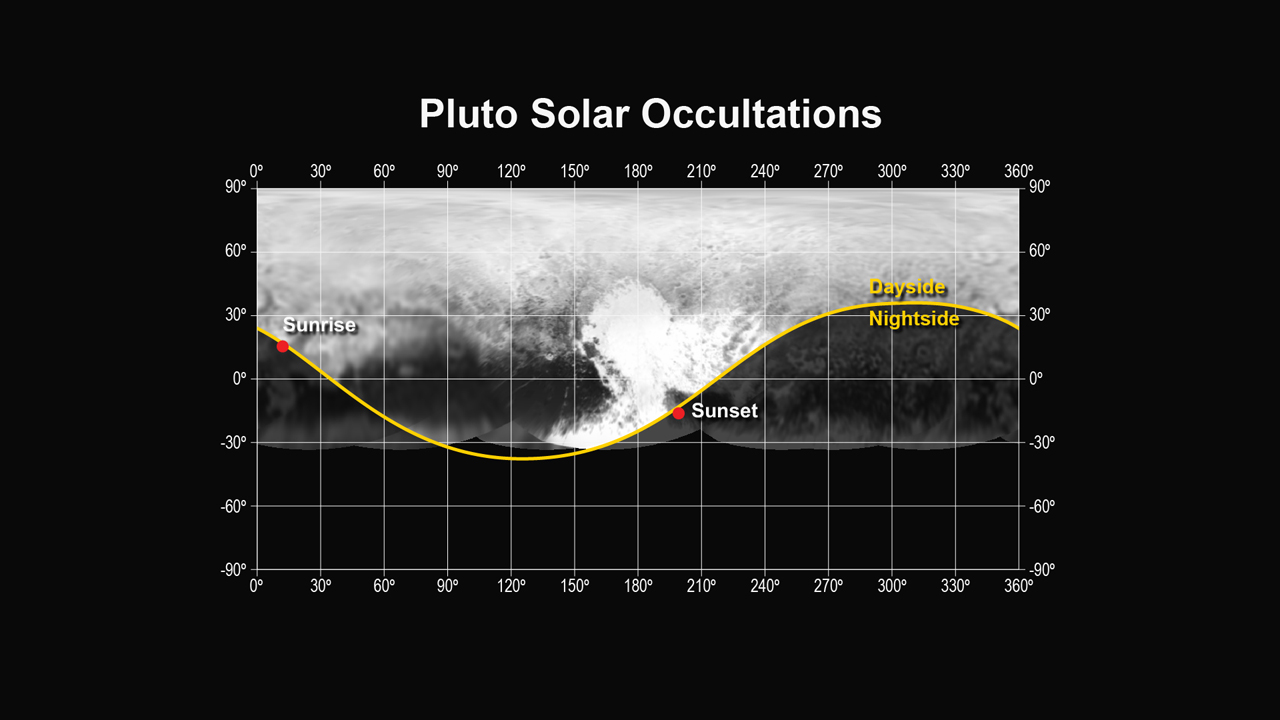
Pluto Solar Occultations – July 17, 2015: This figure shows the locations of the sunset and sunrise solar occultations observed by the Alice instrument on the New Horizons spacecraft. The sunset occultation occurred just south of the “heart” region of Pluto, from a range of 30,120 miles (48,200 km), while the sunrise occurred just north of the “whale tail”, from a range of 35,650 miles (57,000 km). Click for large image.
Alice Solar Occultation – July 17, 2015: This figure shows how the Alice instrument count rate changed over time during the sunset and sunrise observations. The count rate is largest when the line of sight to the sun is outside of the atmosphere at the start and end times. Molecular nitrogen (N2) starts absorbing sunlight in the upper reaches of Pluto’s atmosphere, decreasing as the spacecraft approaches the planet’s shadow. As the occultation progresses, atmospheric methane and hydrocarbons can also absorb the sunlight and further decrease the count rate. When the spacecraft is totally in Pluto’s shadow the count rate goes to zero. As the spacecraft emerges from Pluto’s shadow into sunrise, the process is reversed. By plotting the observed count rate in the reverse time direction, it is seen that the atmospheres on opposite sides of Pluto are nearly identical. Click for larger image.
This animation shows how the count rate observed by New Horizons’ Alice instrument decreases as Pluto’s atmosphere passes in front of the sun. The decreasing count rate is due to the ultraviolet sunlight having to pass through progressively larger amounts of the atmosphere as the spacecraft line of sight gets closer to Pluto. The observed count rates are compared with predictions based on two plausible models of Pluto’s atmosphere: a “turbulent” case, where the expected count rate is relatively large, due to small amounts of sunlight-absorbing hydrocarbons in the lower atmosphere, and a “stagnant” case, where much larger hydrocarbon abundances are predicted. The preliminary count rate data from Alice are matched by neither model, but are closer to the stagnant case. Image credit: NASA/JHUAPL/SwRI
New Horizons has discovered a region of cold, dense ionized gas tens of thousands of miles beyond Pluto — the planet’s atmosphere being stripped away by the solar wind and lost to space. Beginning an hour and half after closest approach, the Solar Wind Around Pluto (SWAP) instrument observed a cavity in the solar wind — the outflow of electrically charged particles from the Sun — between 48,000 miles (77,000 km) and 68,000 miles (109,000 km) downstream of Pluto. SWAP data revealed this cavity to be populated with nitrogen ions forming a “plasma tail” of undetermined structure and length extending behind the planet.
Artist’s concept of the interaction of the solar wind (the supersonic outflow of electrically charged particles from the Sun) with Pluto’s predominantly nitrogen atmosphere. Some of the molecules that form the atmosphere have enough energy to overcome Pluto’s weak gravity and escape into space, where they are ionized by solar ultraviolet radiation.
As the solar wind encounters the obstacle formed by the ions, it is slowed and diverted (depicted in the red region), possibly forming a shock wave upstream of Pluto. The ions are “picked up” by the solar wind and carried in its flow past the dwarf planet to form an ion or plasma tail (blue region). The Solar Wind around Pluto (SWAP) instrument on the New Horizons spacecraft made the first measurements of this region of low-energy atmospheric ions shortly after closest approach on July 14.
Such measurements will enable the SWAP team to determine the rate at which Pluto loses its atmosphere and, in turn, will yield insight into the evolution of the Pluto’s atmosphere and surface. Also illustrated are the orbits of Pluto’s five moons and the trajectory of the spacecraft. Click for larger image.
Similar plasma tails are observed at planets like Venus and Mars. In the case of Pluto’s predominantly nitrogen atmosphere, escaping molecules are ionized by solar ultraviolet light, “picked up” by the solar wind, and carried past Pluto to form the plasma tail discovered by New Horizons. Prior to closest approach, nitrogen ions were detected far upstream of Pluto by the Pluto Energetic Particle Spectrometer Science Investigation (PEPSSI) instrument, providing a foretaste of Pluto’s escaping atmosphere.
Plasma tail formation is but one fundamental aspect of Pluto’s solar wind interaction, the nature of which is determined by several yet poorly constrained factors. Of these, perhaps the most important is the atmospheric loss rate. “This is just a first tantalizing look at Pluto’s plasma environment,” says co-investigator Fran Bagenal, University of Colorado, Boulder, who leads the New Horizons Particles and Plasma team. “We’ll be getting more data in August, which we can combine with the Alice and Rex atmospheric measurements to pin down the rate at which Pluto is losing its atmosphere. Once we know that, we’ll be able to answer outstanding questions about the evolution of Pluto’s atmosphere and surface and determine to what extent Pluto’s solar wind interaction is like that of Mars.”
The New Horizons mission released the following video today:
This simulated flyover of Pluto’s Norgay Montes (Norgay Mountains) and Sputnik Planum (Sputnik Plain) was created from New Horizons closest-approach images. Norgay Montes have been informally named for Tenzing Norgay, one of the first two humans to reach the summit of Mount Everest. Sputnik Planum is informally named for Earth’s first artificial satellite. The images were acquired by the Long Range Reconnaissance Imager (LORRI) on July 14 from a distance of 48,000 miles (77,000 kilometers). Features as small as a half-mile (1 kilometer) across are visible. Credit: NASA/JHUAPL/SWRI
Close-Up of Charon’s ‘Mountain in a Moat – July 16, 2015: This image of an area on Pluto’s largest moon Charon has a captivating feature—a depression with a peak in the middle, shown here in the upper left corner of the inset. The image shows an area approximately 240 miles (390 kilometers) from top to bottom, including few visible craters.
This image gives a preview of what the surface of this large moon will look like in future close-ups from NASA’s New Horizons spacecraft. This image is heavily compressed; sharper versions are anticipated when the full-fidelity data from New Horizons’ Long Range Reconnaissance Imager (LORRI) are returned to Earth.
The rectangle superimposed on the global view of Charon shows the approximate location of this close-up view.
The image was taken at approximately 6:30 a.m. EDT (10:30 UTC) on July 14, 2015, about 1.5 hours before closest approach to Pluto, from a range of 49,000 miles (79,000 kilometers).
In the latest data from NASA’s New Horizons spacecraft, a new close-up image of Pluto reveals a vast, craterless plain that appears to be no more than 100 million years old, and is possibly still being shaped by geologic processes. This frozen region is north of Pluto’s icy mountains, in the center-left of the heart feature, informally named “Tombaugh Regio” (Tombaugh Region) after Clyde Tombaugh, who discovered Pluto in 1930.
In the center left of Pluto’s vast heart-shaped feature – informally named “Tombaugh Regio” – lies a vast, craterless plain that appears to be no more than 100 million years old, and is possibly still being shaped by geologic processes. This frozen region is north of Pluto’s icy mountains and has been informally named Sputnik Planum (Sputnik Plain), after Earth’s first artificial satellite. The surface appears to be divided into irregularly-shaped segments that are ringed by narrow troughs. Features that appear to be groups of mounds and fields of small pits are also visible. This image was acquired by the Long Range Reconnaissance Imager (LORRI) on July 14 from a distance of 48,000 miles (77,000 kilometers). Features as small as one-half mile (1 kilometer) across are visible. The blocky appearance of some features is due to compression of the image. Credits: NASA/JHUAPL/SWRI
“This terrain is not easy to explain,” said Jeff Moore, leader of the New Horizons Geology, Geophysics and Imaging Team (GGI) at NASA’s Ames Research Center in Moffett Field, California. “The discovery of vast, craterless, very young plains on Pluto exceeds all pre-flyby expectations.”
This fascinating icy plains region — resembling frozen mud cracks on Earth — has been informally named “Sputnik Planum” (Sputnik Plain) after the Earth’s first artificial satellite. It has a broken surface of irregularly-shaped segments, roughly 12 miles (20 kilometers) across, bordered by what appear to be shallow troughs. Some of these troughs have darker material within them, while others are traced by clumps of hills that appear to rise above the surrounding terrain. Elsewhere, the surface appears to be etched by fields of small pits that may have formed by a process called sublimation, in which ice turns directly from solid to gas, just as dry ice does on Earth.
Scientists have two working theories as to how these segments were formed. The irregular shapes may be the result of the contraction of surface materials, similar to what happens when mud dries. Alternatively, they may be a product of convection, similar to wax rising in a lava lamp. On Pluto, convection would occur within a surface layer of frozen carbon monoxide, methane and nitrogen, driven by the scant warmth of Pluto’s interior.
Pluto’s icy plains also display dark streaks that are a few miles long. These streaks appear to be aligned in the same direction and may have been produced by winds blowing across the frozen surface.
The Tuesday “heart of the heart” image was taken when New Horizons was 48,000 miles (77,000 kilometers) from Pluto, and shows features as small as one-half mile (1 kilometer) across. Mission scientists will learn more about these mysterious terrains from higher-resolution and stereo images that New Horizons will pull from its digital recorders and send back to Earth during the next year.
The New Horizons Atmospheres team observed Pluto’s atmosphere as far as 1,000 miles (1,600 kilometers) above the surface, demonstrating that Pluto’s nitrogen-rich atmosphere is quite extended. This is the first observation of Pluto’s atmosphere at altitudes higher than 170 miles above the surface (270 kilometers).
The New Horizons Particles and Plasma team has discovered a region of cold, dense ionized gas tens of thousands of miles beyond Pluto — the planet’s atmosphere being stripped away by the solar wind and lost to space.
“This is just a first tantalizing look at Pluto’s plasma environment,” said New Horizons co-investigator Fran Bagenal, University of Colorado, Boulder.
“With the flyby in the rearview mirror, a decade-long journey to Pluto is over –but, the science payoff is only beginning,” said Jim Green, director of Planetary Science at NASA Headquarters in Washington. “Data from New Horizons will continue to fuel discovery for years to come.”
Alan Stern, New Horizons principal investigator from the Southwest Research Institute (SwRI), Boulder, Colorado, added, “We’ve only scratched the surface of our Pluto exploration, but it already seems clear to me that in the initial reconnaissance of the solar system, the best was saved for last.”
New Horizons is part of NASA’s New Frontiers Program, managed by the agency’s Marshall Space Flight Center in Huntsville, Alabama. The Johns Hopkins University Applied Physics Laboratory in Laurel, Maryland, designed, built and operates the New Horizons spacecraft and manages the mission for NASA’s Science Mission Directorate. SwRI leads the mission, science team, payload operations and encounter science planning.
Follow the New Horizons mission on Twitter and use the hashtag #PlutoFlyby to join the conversation. Live updates are also available on the missionFacebook page.
For more information on the New Horizons mission, including fact sheets, schedules, video and new images, visit:
Icy mountains on Pluto and a new, crisp view of its largest moon, Charon, are among the several discoveries announced Wednesday by the NASA’s New Horizons team, just one day after the spacecraft’s first ever Pluto flyby.
The Icy Mountains of Pluto (annotated) – July.15.15: New close-up images of a region near Pluto’s equator reveal a giant surprise: a range of youthful mountains rising as high as 11,000 feet (3,500 meters) above the surface of the icy body.
The mountains likely formed no more than 100 million years ago — mere youngsters relative to the 4.56-billion-year age of the solar system — and may still be in the process of building, says Jeff Moore of New Horizons’ Geology, Geophysics and Imaging Team (GGI). That suggests the close-up region, which covers less than one percent of Pluto’s surface, may still be geologically active today.
“Pluto New Horizons is a true mission of exploration showing us why basic scientific research is so important,” said John Grunsfeld, associate administrator for NASA’s Science Mission Directorate in Washington. “The mission has had nine years to build expectations about what we would see during closest approach to Pluto and Charon. Today, we get the first sampling of the scientific treasure collected during those critical moments, and I can tell you it dramatically surpasses those high expectations.”
“Home run!” said Alan Stern, principal investigator for New Horizons at the Southwest Research Institute (SwRI) in Boulder, Colorado. “New Horizons is returning amazing results already. The data look absolutely gorgeous, and Pluto and Charon are just mind blowing.”
This movie zooms into the base of the heart-shaped feature on Pluto to highlight a new image captured by NASA’s New Horizons. The new image, seen in black and white against a previously released color image of Pluto, shows a mountain range with peaks jutting as high as high as 11,000 feet (3,500 meters) above the surface of the icy body.
A new close-up image of an equatorial region near the base of Pluto’s bright heart-shaped feature shows a mountain range with peaks jutting as high as 11,000 feet (3,500 meters) above the surface of the icy body.
The mountains on Pluto likely formed no more than 100 million years ago — mere youngsters in a 4.56-billion-year-old solar system. This suggests the close-up region, which covers about one percent of Pluto’s surface, may still be geologically active today.
“This is one of the youngest surfaces we’ve ever seen in the solar system,” said Jeff Moore of the New Horizons Geology, Geophysics and Imaging Team (GGI) at NASA’s Ames Research Center in Moffett Field, California.
Unlike the icy moons of giant planets, Pluto cannot be heated by gravitational interactions with a much larger planetary body. Some other process must be generating the mountainous landscape.
“This may cause us to rethink what powers geological activity on many other icy worlds,” says GGI deputy team leader John Spencer, SwRI.
Pluto: The Ice Plot Thickens – July 15, 2015: The latest spectra from New Horizons Ralph instrument reveal an abundance of methane ice, but with striking differences from place to place across the frozen surface of Pluto.
“We just learned that in the north polar cap, methane ice is diluted in a thick, transparent slab of nitrogen ice resulting in strong absorption of infrared light, said New Horizons co-investigator Will Grundy, Lowell Observatory, Flagstaff, Arizona. In one of the visually dark equatorial patches, the methane ice has shallower infrared absorptions indicative of a very different texture. “The spectrum appears as if the ice is less diluted in nitrogen,” Grundy speculated or that it has a different texture in that area.”
The new view of Charon reveals a youthful and varied terrain. Scientists are surprised by the apparent lack of craters. A swath of cliffs and troughs stretching about 600 miles (1,000 kilometers) suggests widespread fracturing of Charon’s crust, likely the result of internal geological processes. The image also shows a canyon estimated to be 4 to 6 miles (7 to 9 kilometers) deep. In Charon’s north polar region, the dark surface markings have a diffuse boundary, suggesting a thin deposit or stain on the surface.
Charon’s Surprising Youthful and Varied Terrain – July.15.15: Remarkable new details of Pluto’s largest moon Charon are revealed in this image from New Horizons’ Long Range Reconnaissance Imager (LORRI), taken late on July 13, 2015 from a distance of 289,000 miles (466,000 kilometers).
A swath of cliffs and troughs stretches about 600 miles (1,000 kilometers) from left to right, suggesting widespread fracturing of Charon’s crust, likely a result of internal processes. At upper right, along the moon’s curving edge, is a canyon estimated to be 4 to 6 miles (7 to 9 kilometers) deep.
Mission scientists are surprised by the apparent lack of craters on Charon. South of the moon’s equator, at the bottom of this image, terrain is lit by the slanting rays of the sun, creating shadows that make it easier to distinguish topography. Even here, however, relatively few craters are visible, indicating a relatively young surface that has been reshaped by geologic activity.
New Horizons also observed the smaller members of the Pluto system, which includes four other moons: Nix, Hydra, Styx and Kerberos. A new sneak-peak image of Hydra is the first to reveal its apparent irregular shape and its size, estimated to be about 27 by 20 miles (43 by 33 kilometers).
The observations also indicate Hydra’s surface is probably coated with water ice. Future images will reveal more clues about the formation of this and the other moon billions of years ago. Spectroscopic data from New Horizons’ Ralph instruments reveal an abundance of methane ice, but with striking differences among regions across the frozen surface of Pluto.
Hydra Emerges from the Shadows – July 15, 2015: Since its discovery in 2005, Pluto’s moon Hydra has been known only as a fuzzy dot of uncertain shape, size, and reflectivity. Imaging obtained during New Horizons’ historic transit of the Pluto-Charon system and transmitted to Earth early this morning has definitively resolved these fundamental properties of Pluto’s outermost moon. Long Range Reconnaissance Imager (LORRI) observations revealed an irregularly shaped body characterized by significant brightness variations over the surface. With a resolution of 2 miles (3 kilometers) per pixel, the LORRI image shows the tiny potato-shaped moon measures 27 miles (43 kilometers) by 20 miles (33 kilometers).
Like that of Charon, Hydra’s surface is probably covered with water ice, the most abundant ice in the universe. Observed within Hydra’s bright regions is a darker circular structure with a diameter of approximately 6 miles (10 kilometers). Hydra’s reflectivity (the percentage of incident light reflected from the surface) is intermediate between that of Pluto and Charon. “New Horizons has finally nailed the basic physical properties of Hydra,” says Hal Weaver, New Horizons Project Scientist and LORRI science operations lead. “We’re going to see Hydra even better in the images yet to come.”
Hydra was approximately 400,000 miles away from New Horizons when the image was acquired.
The Johns Hopkins University Applied Physics Laboratory in Laurel, Maryland designed, built and operates the New Horizons spacecraft and manages the mission for NASA’s Science Mission Directorate. SwRI leads the mission, science team, payload operations and encounter science planning. New Horizons is part of NASA’s New Frontiers Program, managed by the agency’s Marshall Space Flight Center in Huntsville, Alabama.
Follow the New Horizons mission on Twitter and use the hashtag #PlutoFlyby to join the conversation. Live updates also will be available on the mission Facebook page.
For more information on the New Horizons mission, including fact sheets, schedules, video and all the new images, visit:
![PIA19597_hires[1]](http://hobbyspace.com/Blog/wp-content/uploads/2015/07/PIA19597_hires1.jpg) Dawn survey orbit 29, July 17, 2015 (Larger image).
Dawn survey orbit 29, July 17, 2015 (Larger image).![frozen_carbon_monoxide_pluto[1]](http://hobbyspace.com/Blog/wp-content/uploads/2015/07/frozen_carbon_monoxide_pluto1.jpg)
![03_bagenal_02[1]](http://hobbyspace.com/Blog/wp-content/uploads/2015/07/03_bagenal_021.jpg)
![CHARON%20GRAPHIC%207-16[1]](http://hobbyspace.com/Blog/wp-content/uploads/2015/07/CHARON-GRAPHIC-7-161.jpg)
![pluto_heart_of_the_heart_03[1]](http://hobbyspace.com/Blog/wp-content/uploads/2015/07/pluto_heart_of_the_heart_031.jpg)
![nh-pluto-surface-scale[1]](http://hobbyspace.com/Blog/wp-content/uploads/2015/07/nh-pluto-surface-scale1.jpg)
![nh-pluto-ice[1]](http://hobbyspace.com/Blog/wp-content/uploads/2015/07/nh-pluto-ice1.png)
![nh-charon[1]](http://hobbyspace.com/Blog/wp-content/uploads/2015/07/nh-charon1.jpg)
![nh-hydra_1_0[1]](http://hobbyspace.com/Blog/wp-content/uploads/2015/07/nh-hydra_1_01.jpg)