Category Archives: Space Systems

New Horizons: Images show atmospheric haze around Pluto and ices flowing on the surface

Several new images from the New Horizons fly-by were released today during the press conference. Some of the images are shown below and many more are available in this New Horizons gallery.

New Horizons Team Finds Haze,
Flowing Ice on Pluto

Flowing ice and a surprising extended haze are among the newest discoveries from NASA’s New Horizons mission, which reveal distant Pluto to be an icy world of wonders.

nh-pluto-haze-full[1]

Speeding away from Pluto just seven hours after its July 14 closest approach, the New Horizons spacecraft looked back and captured this spectacular image of Pluto’s atmosphere, backlit by the sun. The image reveals layers of haze that are several times higher than scientists predicted. Image Credit: NASA/JHUAPL/SWRI

“We knew that a mission to Pluto would bring some surprises, and now — 10 days after closest approach — we can say that our expectation has been more than surpassed,” said John Grunsfeld, NASA’s associate administrator for the Science Mission Directorate. “With flowing ices, exotic surface chemistry, mountain ranges, and vast haze, Pluto is showing a diversity of planetary geology that is truly thrilling.”

Just seven hours after closest approach, New Horizons aimed its Long Range Reconnaissance Imager (LORRI) back at Pluto, capturing sunlight streaming through the atmosphere and revealing hazes as high as 80 miles (130 kilometers) above Pluto’s surface. A preliminary analysis of the image shows two distinct layers of haze — one about 50 miles (80 kilometers) above the surface and the other at an altitude of about 30 miles (50 kilometers).

01_Stern_02a_Pluto_Nat_Color[1]

Four images from New Horizons’ Long Range Reconnaissance Imager (LORRI) were combined with color data from the Ralph instrument to create this global view of Pluto. (The lower right edge of Pluto in this view currently lacks high-resolution color coverage.) The images, taken when the spacecraft was 280,000 miles (450,000 kilometers) away, show features as small as 1.4 miles (2.2 kilometers), twice the resolution of the single-image view taken on July 13.

“My jaw was on the ground when I saw this first image of an alien atmosphere in the Kuiper Belt,” said Alan Stern, principal investigator for New Horizons at the Southwest Research Institute (SwRI) in Boulder, Colorado. “It reminds us that exploration brings us more than just incredible discoveries — it brings incredible beauty.”

Studying Pluto’s atmosphere provides clues as to what’s happening below.

“The hazes detected in this image are a key element in creating the complex hydrocarbon compounds that give Pluto’s surface its reddish hue,” said Michael Summers, New Horizons co-investigator at George Mason University in Fairfax, Virginia.

Models suggest the hazes form when ultraviolet sunlight breaks up methane gas particles — a simple hydrocarbon in Pluto’s atmosphere. The breakdown of methane triggers the buildup of more complex hydrocarbon gases, such as ethylene and acetylene, which also were discovered in Pluto’s atmosphere by New Horizons. As these hydrocarbons fall to the lower, colder parts of the atmosphere, they condense into ice particles that create the hazes. Ultraviolent sunlight chemically converts hazes into tholins, the dark hydrocarbons that color Pluto’s surface.

Scientists previously had calculated temperatures would be too warm for hazes to form at altitudes higher than 20 miles (30 kilometers) above Pluto’s surface.

“We’re going to need some new ideas to figure out what’s going on,” said Summers.

The New Horizons mission also found in LORRI images evidence of exotic ices flowing across Pluto’s surface and revealing signs of recent geologic activity, something scientists hoped to find but didn’t expect.

04_McKinnon_02c[1]

Annotated image of the northwestern region of Pluto’s Sputnik Planum, swirl-shaped patterns of light and dark suggest that a surface layer of exotic ices has flowed around obstacles and into depressions, much like glaciers on Earth.

The new images show fascinating details within the Texas-sized plain, informally named Sputnik Planum, which lies within the western half of Pluto’s heart-shaped feature, known as Tombaugh Regio. There, a sheet of ice clearly appears to have flowed — and may still be flowing — in a manner similar to glaciers on Earth.

“We’ve only seen surfaces like this on active worlds like Earth and Mars,” said mission co-investigator John Spencer of SwRI. “I’m really smiling.”

Additionally, new compositional data from New Horizons’ Ralph instrument indicate the center of Sputnik Planum is rich in nitrogen, carbon monoxide, and methane ices.

01_Stern_01[1]

Pluto and Charon are shown in a composite of natural-color images from New Horizons. Images from the Long Range Reconnaissance Imager (LORRI) were combined with color data from the Ralph instrument to produce these views, which portray Pluto and Charon as an observer riding on the spacecraft would see them. The images were acquired on July 13 and 14, 2015

“At Pluto’s temperatures of minus-390 degrees Fahrenheit, these ices can flow like a glacier,” said Bill McKinnon, deputy leader of the New Horizons Geology, Geophysics and Imaging team at Washington University in St. Louis. “In the southernmost region of the heart, adjacent to the dark equatorial region, it appears that ancient, heavily-cratered terrain has been invaded by much newer icy deposits.”

View a simulated flyover using New Horizons’ close-approach images of Sputnik Planum and Pluto’s newly-discovered mountain range, informally named Hillary Montes, in the video here: go.nasa.gov/1MMEdTb

The New Horizons mission will continue to send data stored in its onboard recorders back to Earth through late 2016. The spacecraft currently is 7.6 million miles (12.2 million kilometers) beyond Pluto, healthy and flying deeper into the Kuiper Belt.

The Johns Hopkins University Applied Physics Laboratory in Laurel, Maryland, designed, built, and operates the New Horizons spacecraft, and manages the mission for NASA’s Science Mission Directorate. SwRI, based in San Antonio, leads the science team, payload operations and encounter science planning. New Horizons is part of the New Frontiers Program managed by NASA’s Marshall Space Flight Center in Huntsville, Alabama.

For more information on the New Horizons mission, including fact sheets, schedules, video and images, visit: www.nasa.gov/newhorizons
New Horizons update today on latest images and data from the Pluto fly-by [Update]

The New Horizons team will hold a briefing today at 2:00 pm EDT: Complex World: New Horizons Pluto Science Update Set for July 24 – NASA.

The panel will include:

  • Jim Green, director of Planetary Science at NASA Headquarters
  • Alan Stern, New Horizons principal investigator at Southwest Research Institute (SwRI) in Boulder, Colorado
  • Michael Summers, New Horizons co-investigator at George Mason University in Fairfax, Virginia
  • William McKinnon, New Horizons co-investigator at Washington University in St. Louis
  • Cathy Olkin, New Horizons deputy project scientist at SwRI


[ Update: Here is a video of the briefing:

]

Video: ‘Space to Ground’ ISS report – July.24.15

Here’s the latest Space to Ground report from NASA on activities related to the Int. Space Station:

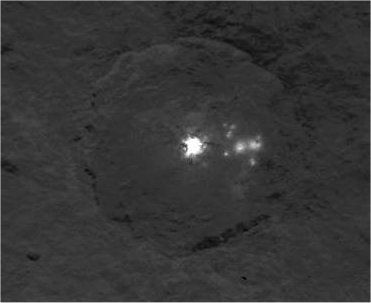
Some of Ceres’s bright spots covered with haze

While waiting for the Dawn spacecraft to spiral down to a closer look at the surface of Ceres, the situation with the bright spots has gotten more rather than less murky:

pia19579_main-1041_crop

From the Nature article:

Haze on Ceres would be the first ever observed directly in the asteroid belt. In 2014, researchers using the European Space Agency’s Herschel Space Observatory reported seeing water vapour spraying off Ceres, which suggested that it was geologically active1. At least one-quarter of Ceres’s mass is water, a much greater proportion than seen in most asteroids.

Bright spots pepper Ceres’s surface, but the haze has so far been seen in only one location — a crater named Occator, which has a large bright area at its centre and several smaller spots nearby. Mission scientists have been trying to work out whether the bright spots are made of ice, evaporated salts or other minerals, or something else entirely.

Some team members had been leaning towards the salt explanation, but the discovery of haze suggests the presence of sublimating ice. “At noontime, if you look at a glancing angle, you can see what seems to be haze,” Russell says. “It comes back in a regular pattern.” The haze covers about half of the crater and stops at the rim.

New Horizons: Second mountain range in Pluto’s Heart + Images of Nix and Hydra

More images from New Horizons of Pluto and its Moons were released today:

NASA’s New Horizons Finds Second Mountain Range in Pluto’s ‘Heart’

nh-pluto-mountain-range[1]
Click for larger image

A newly discovered mountain range lies near the southwestern margin of Pluto’s Tombaugh Regio (Tombaugh Region), situated between bright, icy plains and dark, heavily-cratered terrain. This image was acquired by New Horizons’ Long Range Reconnaissance Imager (LORRI) on July 14, 2015 from a distance of 48,000 miles (77,000 kilometers) and sent back to Earth on July 20. Features as small as a half-mile (1 kilometer) across are visible. Image Credit: NASA/JHUAPL/SWRI

Pluto’s icy mountains have company. NASA’s New Horizons mission has discovered a new, apparently less lofty mountain range on the lower-left edge of Pluto’s best known feature, the bright, heart-shaped region named Tombaugh Regio (Tombaugh Region).

These newly-discovered frozen peaks are estimated to be one-half mile to one mile (1-1.5 kilometers) high, about the same height as the United States’ Appalachian Mountains. The Norgay Montes (Norgay Mountains) discovered by New Horizons on July 15 more closely approximate the height of the taller Rocky Mountains.

The new range is just west of the region within Pluto’s heart called Sputnik Planum (Sputnik Plain). The peaks lie some 68 miles (110 kilometers) northwest of Norgay Montes.

This newest image further illustrates the remarkably well-defined topography along the western edge of Tombaugh Regio.

“There is a pronounced difference in texture between the younger, frozen plains to the east and the dark, heavily-cratered terrain to the west,” said Jeff Moore, leader of the New Horizons Geology, Geophysics and Imaging Team (GGI) at NASA’s Ames Research Center in Moffett Field, California. “There’s a complex interaction going on between the bright and the dark materials that we’re still trying to understand.”

While Sputnik Planum is believed to be relatively young in geological terms – perhaps less than 100 million years old – the darker region probably dates back billions of years. Moore notes that the bright, sediment-like material appears to be filling in old craters (for example, the bright circular feature to the lower left of center).

This image was acquired by the Long Range Reconnaissance Imager (LORRI) on July 14 from a distance of 48,000 miles (77,000 kilometers) and sent back to Earth on July 20. Features as small as a half-mile (1 kilometer) across are visible. The names of features on Pluto have all been given on an informal basis by the New Horizons team.

—-

New Horizons ‘Captures’ Two of Pluto’s Smaller Moons

While Pluto’s largest moon, Charon, has grabbed most of the lunar spotlight, two of Pluto’s smaller and lesser-known satellites are starting to come into focus via new images from NASA’s New Horizons spacecraft.

nh-nix-hydra-7-21[1]Click for larger image

‘Capturing’ Nix and Hydra – July 21, 2015: Pluto’s moon Nix (left), shown here in enhanced color as imaged by the New Horizons Ralph instrument, has a reddish spot that has attracted the interest of mission scientists. The data were obtained on the morning of July 14, 2015, and received on the ground on July 18. At the time the observations were taken New Horizons was about 102,000 miles (165,000 km) from Nix. The image shows features as small as approximately 2 miles (3 kilometers) across on Nix, which is estimated to be 26 miles (42 kilometers) long and 22 miles (36 kilometers) wide.

Pluto’s small, irregularly shaped moon Hydra (right) is revealed in this black and white image taken from New Horizons’ LORRI instrument on July 14, 2015 from a distance of about 143,000 miles (231,000 kilometers). Features as small as 0.7 miles (1.2 kilometers) are visible on Hydra, which measures 34 miles (55 kilometers) in length.

Nix and Hydra – the second and third moons to be discovered – are approximately the same size, but their similarity ends there.

New Horizons’ first color image of Nix, in which colors have been enhanced, reveals an intriguing region on the jelly bean-shaped satellite, which is estimated to be 26 miles (42 kilometers) long and 22 miles (36 kilometers) wide.

Although the overall surface color of Nix is neutral grey in the image, the newfound region has a distinct red tint. Hints of a bull’s-eye pattern lead scientists to speculate that the reddish region is a crater.

“Additional compositional data has already been taken of Nix, but is not yet downlinked. It will tell us why this region is redder than its surroundings,” said mission scientist Carly Howett, of the Southwest Research Institute, Boulder, Colorado. She added, “This observation is so tantalizing, I’m finding it hard to be patient for more Nix data to be downlinked.”

Meanwhile, the sharpest image yet received from New Horizons of Pluto’s satellite Hydra shows that its irregular shape resembles the state of Michigan. The new image was made by the Long Range Reconnaissance Imager (LORRI) on July 14, 2015 from a distance of 143,000 miles (231,000 kilometers), and shows features as small as 0.7 miles (1.2 kilometers) across. There appear to be at least two large craters, one of which is mostly in shadow. The upper portion looks darker than the rest of Hydra, suggesting a possible difference in surface composition. From this image, mission scientists have estimated that Hydra is 34 miles (55 kilometers) long and 25 miles (40 kilometers) wide.

“Before last week, Hydra was just a faint point of light, so it’s a surreal experience to see it become an actual place, as we see its shape and spot recognizable features on its surface for the first time,” said mission science collaborator Ted Stryk, of Roane State Community College in Tennessee.

Images of Pluto’s most recently discovered moons, Styx and Kerberos, are expected to be transmitted to Earth no later than mid-October.

Nix and Hydra were both discovered in 2005 using Hubble Space Telescope data by a research team led by New Horizons project scientist Hal Weaver, Johns Hopkins University Applied Physics Laboratory, Laurel, Maryland. New Horizons’ findings on the surface characteristics and other properties of Nix and Hydra will help scientists understand the origins and subsequent history of Pluto and its moons.