Here’s a brief video about the Moons of Mars (via Universe Today) :
The Russell Space Team at Russell Elementary School in Smyrna, GA is an award winning program in which 4th & 5th graders carry out elaborate Space Shuttle mission simulations. They use their shuttle Intrepid Simulator and a Mission Control. They have been carrying out the day long simulations since the 1990s.
Their Russell Space Team YouTube channel shows reports from their missions, including a 27 hour sim from this month.
Chris Laster is the force behind the Russell Space Team and he was on the Space Show this week to describe the program and how it came about: Chris Laster, Tuesday, 5-13-14 – Thespaceshow’s Blog
A couple of Russell Space Team videos:
An announcement from the European Rover Challenge:
Mars rovers will invade Poland
The registration period for the European Rover Challenge 2014 is over – 24 teams, from all over the world, have applied to step up to the Challenge. The main event will be held September 5th to 7th, at the Regional Science-Technology Centre in Podzamcze near Chęciny.
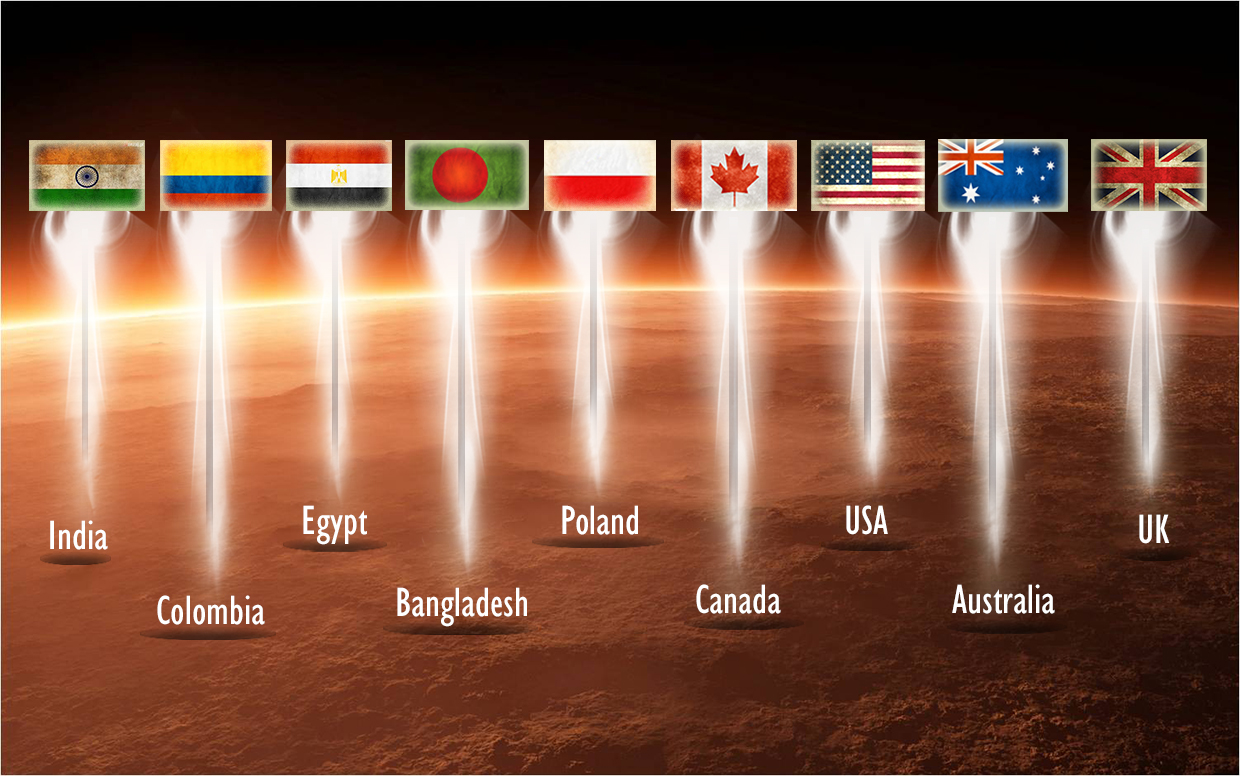
Egypt, India, Bangladesh, Australia, Colombia, Canada, the US and the UK will all have their representatives at the ERC. Poland will field teams from a number of Universities of Technology – Wroclaw, Kielce, Warsaw, Czestochowa, Lodz, Poznan, Lublin – as well as the West Pomeranian University of Technology in Szczecin, th AGH University of Science and Technology and the University of Technology and Life Sciences in Bydgoszcz.
‘When we came out with the idea of organizing the ERC, we were aware events like this were in high demand, bet we weren’t expecting that many teams to register.’ – says Łukasz Wilczyński, a representative of Mars Society Polska, the ERC 2014 organizer. ‘We are very happy that the roster is really international and has a strong Polish presence – a living proof of the high potential of Polish students and engineers.’
The ERC is a contest for teams of higher education students and recent graduates. Advised by the faculty, the teams must design and build analogues of Mars rovers, which will be presented to the Jury and take on four tasks simulating Mars exploration. Performance during the four field tasks and the jury presentation is scored and the rover with the highest total score is declared the Challenge winner.
As part of the ERC 2014 event schedule, the Da Vinci Science Centre in Podzamcze near Chęciny will also host the conference “Humans in Space”, to be attended by international experts from the space industry, medicine and other sciences, as well as various entrepreneurs. A two day long, open air science popularization festival is also planned on the Challenge grounds – on September 6th and 7th the challenge audience will have a chance to take part in numerous scientific workshops and presentations organized at the nearly Science Picnic
Detailed information about ERC 2014, including a full list of registered teams, is available on the official event website: www.roverchallenge.eu
The event is organized by Mars Society Polska, in cooperation with Planet PR, the Marshal Office of the Świętokrzyskie Voivodeship, and the Regional Science-Technology Centre in Podzamcze near Chęciny. The Polish National Centre for Research and Development, the Polish Agency for Enterprise Development, Com Creation, Axis Communications, the Austrian Space Forum and ABM Space Education are event Partners. The Polish Ministry of Economy and the European Commission Representation in Poland have taken honorary patronage over the event.
Here’s a follow-up to the recent news from Citizens in Space about their newly developed experiment payload rack for the XCOR Lynx:
New Space Research Platform Will Be Unveiled at MakerCon
Redwood City, CA (May 8, 2013) – A new research platform that promises to dramatically reduce the cost of access to space for small scientific and education payloads will be publicly unveiled at MakerCon, which takes place at the Oracle Conference Center in Redwood City next week.
The Lynx Cub Payload Carrier, developed by the United States Rocket Academy, Texas A&M University, and the Space Engineering Research Center (a Texas state agency) will fly on the XCOR Lynx spacecraft. A fully reusable, piloted, suborbital spacecraft, Lynx is designed to fly four times a day. The Lynx Cub Payload Carrier will fit behind the pilot’s seat and carry up to 15 small experiments on each flight.
The Lynx Cub Carrier will be unveiled by United States Rocket Academy founder Edward Wright during a presentation on “Citizen Science and Citizen Space Exploration.” The presentation takes place on Tuesday, May 13 at 2:55-3:15 PM, in Room 102/103 of the Oracle Conference Center.
“The Lynx spacecraft is now under construction at the Mojave Air and Space Port in Mojave, California,” Wright said. “XCOR Aerospace expects to begin flight tests later this year.
“The Cub Carrier can be installed and removed quickly for frequent, low-cost flight opportunities. The Lynx Cub Carrier is an ideal platform for small materials-processing, fluid-physics, life-science, and engineering experiments. University teaching and research, K-12 education, citizen science, government and industrial R&D will all benefit from the convenient simple interfaces, rapid integration, and affordability of Lynx Cub experiments. We are pleased to have the opportunity to introduce this exciting platform to the audience at MakerCon.”
MakerCon is a premiere event organized by Maker Media, publisher of Make magazine and producer of Maker Faire.
MakerCon brings together the leaders at the forefront of the maker movement. The conference provides new insights into local and global manufacturing, design, marketing and distribution, and diverse funding options to help makers bring their products to market.
MakerCon is presented by Intel and hosted by Oracle Corporation. More information, including a complete list of speakers, is available at www.makercon.com. Registration is available at www.makercon.com/attend.
Additional information about Citizens in Space can be found at www.citizensinspace.org.
Les Johnson, Greg Matloff, and C Bangs have a new book out:
New Nonfiction ‘Harvesting Space for a Greener Earth’ Looks to
Space Exploration, Technologies to Solve Earthly Challenges
In the nonfiction work Harvesting Space for a Greener Earth
But solutions to these very real challenges exist, the book’s authors contend, thanks to new technologies and scientific discoveries made possible by space exploration — and still more to come as humanity extends its reach ever further into the solar system.
Newly published by Springer, “Harvesting Space” is exhaustively researched and written by Greg Matloff, a physicist and retired associate professor at the New York City College of Technology and former NASA Faculty Fellow and consultant C Bangs, an ecological artist and former NASA Faculty Fellow; and Les Johnson, co-author of the science fiction novels Back to the Moon


“Gloom and doom sells,” writes award-winning science fiction author Jack McDevitt in his foreword to the volume — but the “Harvesting Space” authors remain distinctly sanguine in their approach to their unsettling subject matter, objectively addressing global challenges from overpopulation and dwindling resources to the threat of an extinction-level event caused by a rogue comet or meteor.
The book pairs themes of environmentalism and exploration, championing good stewardship of the Earth and calling for greater investment in missions of discovery into the solar system. The writers illustrate potential solutions in clear, unambiguous language, demonstrating how technologies and capabilities derived from space exploration can slow, and even reverse, centuries of resource mismanagement across the globe.
“We should feel far from hopeless,” the authors assert. Their recommendation? Time to seek out the untapped resources all around us: “We merely have to move a few hundred kilometers straight up into space to access … a literal universe of energy, raw materials and real estate.”
Find “Harvesting Space for a Greener Earth” on Facebook .
Kindle and paperback editions are available on Amazon.com